What's Inside the AI System Prompts Repo: 105 Files, Measured
I measured all 105 files in the AI system prompts repo: 32 tools, 2.24 MB. What the size spread shows, why tool schemas matter, and where to be careful.
There’s a GitHub repository that collects the system prompts of commercial AI tools — Cursor, Claude Code, Devin, v0, Windsurf, Perplexity and a couple dozen more. It’s called system-prompts-and-models-of-ai-tools, it belongs to a user named x1xhlol, and on 23 July 2026 it had 142,220 stars.
That’s a lot of attention for a folder of text files. What almost nobody tells you is what’s actually in there.
Quick distinction before we go further: this is not about the prompts you type. A system prompt is the standing instruction the vendor loads before your message ever arrives — the part you don’t see and can’t edit.
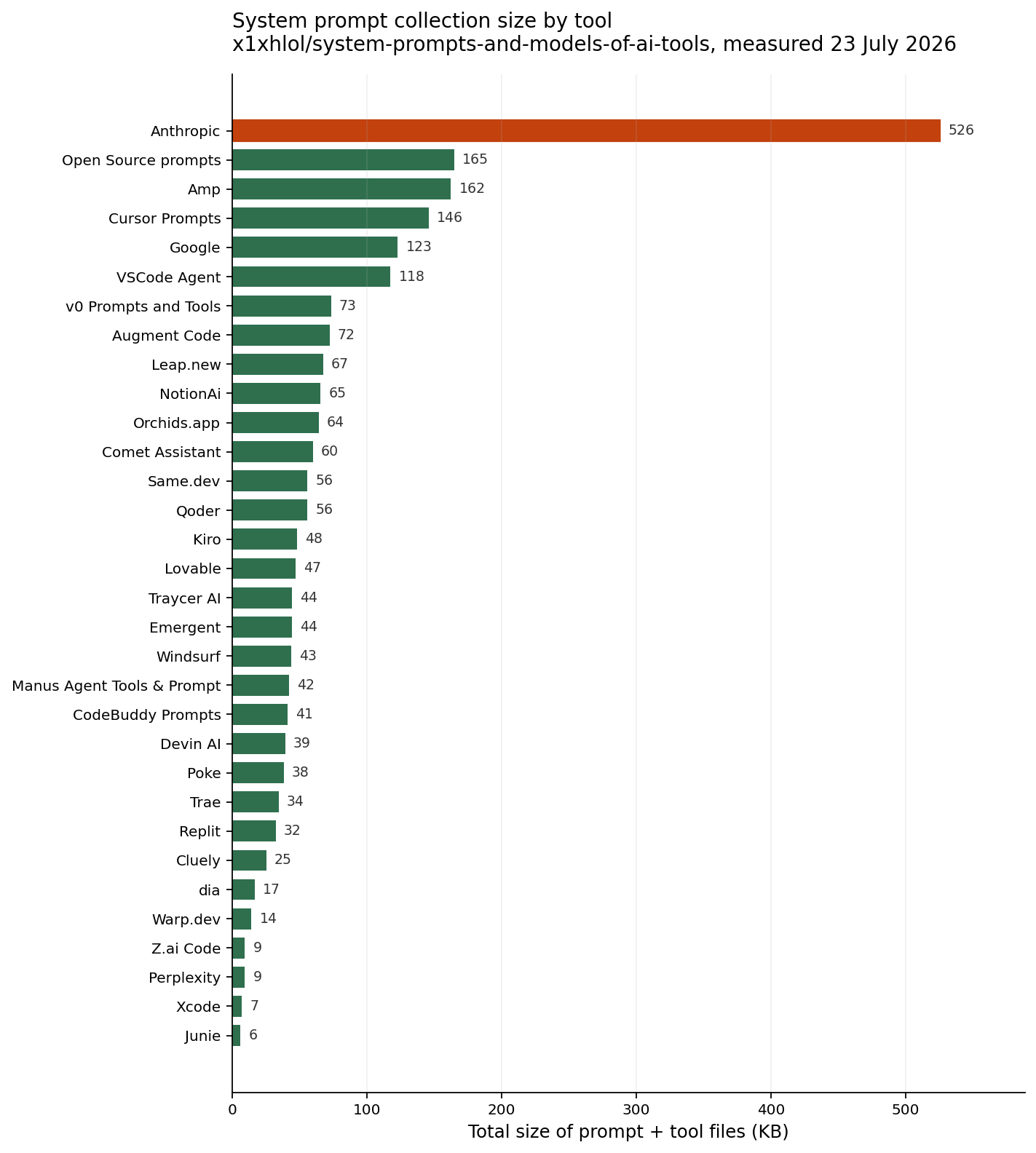
So I measured it. Every folder, every file, through the GitHub Contents API: 32 tool folders, 105 files, 2,350,917 bytes — about 2.24 MB of instructions. Here’s what that pile looks like, what it’s good for, and where I’d be careful.
All figures below were captured on 23 July 2026. Star counts and file listings move; check them yourself before quoting me.
What’s in there
The repo has one folder per tool. Each holds the system prompt, and often a separate file of tool definitions — the JSON schemas the model uses for function calling.
| Tool folder | Files | Total KB | Largest file KB |
|---|---|---|---|
| Anthropic | 10 | 525.5 | 117.2 |
| Open Source prompts | 7 | 165.0 | 46.0 |
| Amp | 4 | 162.4 | 64.7 |
| Cursor Prompts | 7 | 145.8 | 37.9 |
| 3 | 122.9 | 61.1 | |
| VSCode Agent | 9 | 117.5 | 25.0 |
| v0 Prompts and Tools | 2 | 73.4 | 45.1 |
| Augment Code | 4 | 72.3 | 28.3 |
| Leap.new | 2 | 67.4 | 51.2 |
| NotionAi | 2 | 65.4 | 34.1 |
| Orchids.app | 2 | 64.1 | 57.4 |
| Comet Assistant | 2 | 60.0 | 52.6 |
| Same.dev | 2 | 55.9 | 34.1 |
| Qoder | 3 | 55.8 | 25.6 |
| Kiro | 3 | 47.8 | 31.2 |
| Lovable | 2 | 47.1 | 27.3 |
| Traycer AI | 4 | 44.3 | 18.2 |
| Emergent | 2 | 44.2 | 36.5 |
| Windsurf | 2 | 43.5 | 32.1 |
| Manus Agent Tools & Prompt | 4 | 42.1 | 18.1 |
| CodeBuddy Prompts | 2 | 41.2 | 39.7 |
| Devin AI | 2 | 39.3 | 33.9 |
| Poke | 7 | 38.2 | 11.9 |
| Trae | 3 | 34.4 | 18.1 |
| Replit | 2 | 32.3 | 24.4 |
| Cluely | 2 | 25.2 | 20.8 |
| dia | 1 | 16.8 | 16.8 |
| Warp.dev | 1 | 14.3 | 14.3 |
| Z.ai Code | 1 | 9.4 | 9.4 |
| Perplexity | 1 | 9.4 | 9.4 |
| Xcode | 6 | 7.0 | 3.9 |
| Junie | 1 | 6.0 | 6.0 |
The repo has been running since March 2025 and has 513 commits, the most recent on 12 July 2026. It’s maintained, not abandoned.
The spread is the story
Look at the top and bottom of that table. Anthropic’s folder is 525 KB. Junie’s is 6 KB. That’s an 87× difference between two products that both put a model behind a chat box.
The single largest file is Claude Fable 5.txt at 117 KB. For scale, that’s longer than most novellas, and it’s the standing instruction set the model carries before a user types anything.
Then there’s Perplexity at 9.4 KB and Xcode at 7 KB across six files.
I’d resist the obvious reading here. A bigger prompt is not a better product, and it’s definitely not a smarter model. What the spread actually shows is how much of the product lives in the prompt versus somewhere else. Perplexity does most of its work in retrieval and ranking — code the prompt never sees. Anthropic ships a general assistant that has to handle everything from tax questions to grief, and every one of those edge cases is a paragraph someone had to write.
If you’re building on top of a model and your system prompt is 800 words, that isn’t necessarily a problem. But it does tell you where your product is: mostly in the plumbing, not in the instructions.
The finding I didn’t expect
Windsurf ships two files. The prompt, Prompt Wave 11.txt, is 11.4 KB. The tool definitions, Tools Wave 11.txt, are 32.1 KB — roughly three times bigger.
That made me check every folder that separates the two. Fifteen of them do, and the split is not what I assumed:
| Tool | Prompt prose KB | Tool schema KB | Schema share |
|---|---|---|---|
| Traycer AI | 9.8 | 34.5 | 78% |
| Replit | 7.9 | 24.4 | 76% |
| Windsurf | 11.4 | 32.1 | 74% |
| Augment Code | 25.3 | 47.0 | 65% |
| Lovable | 19.8 | 27.3 | 58% |
| NotionAi | 31.3 | 34.1 | 52% |
| Manus | 24.0 | 18.1 | 43% |
| Same.dev | 34.1 | 21.8 | 39% |
| v0 | 45.1 | 28.3 | 39% |
| Leap.new | 51.2 | 16.2 | 24% |
| Trae | 26.4 | 8.1 | 23% |
| Anthropic | 421.7 | 103.8 | 20% |
| Emergent | 36.5 | 7.7 | 17% |
| Cursor | 122.8 | 23.0 | 16% |
| Comet Assistant | 52.6 | 7.4 | 12% |
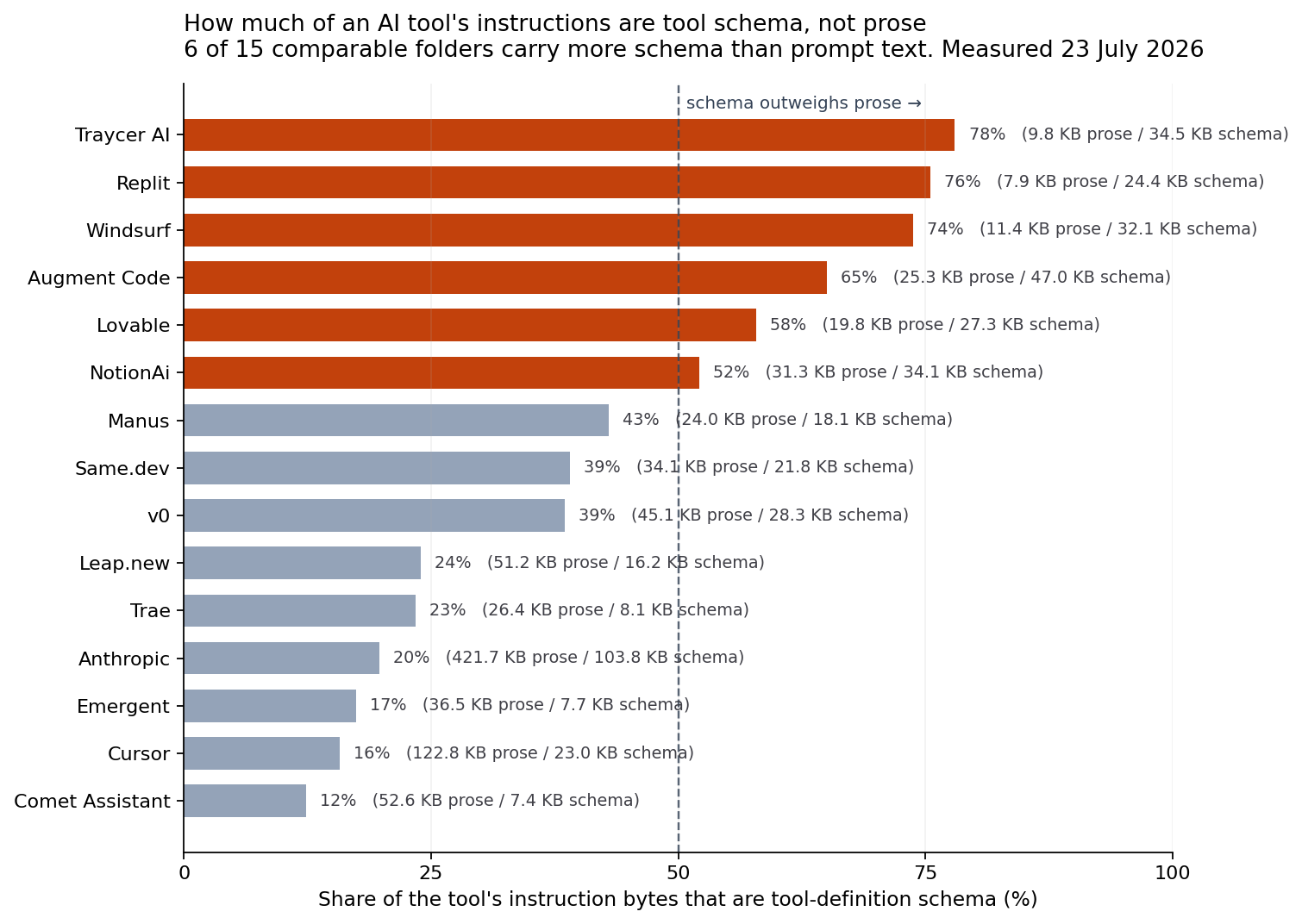
Six of the fifteen carry more schema than prose. Replit’s prompt is 7.9 KB against 24.4 KB of tool definitions. Traycer’s is 9.8 against 34.5.
I’d assumed this was universal after seeing Windsurf. It isn’t — Cursor and Anthropic sit at the other end, with prose four to five times the schema. But even at the low end, the tool definitions are a sixth of everything the model is told, and in the median case they’re around 40%.
That’s the part people leave out when they talk about prompt engineering. Your tool definitions are instructions too, and on an agent product they can be most of them. Vague descriptions and sloppy argument names cost you more than an unpolished persona paragraph ever will.
There’s a rough pattern in the ordering, too. The tools that lean on schema — Replit, Windsurf, Traycer, Augment — are the ones that mostly do things to a codebase. The ones that lean on prose — Anthropic, Cursor, Comet — spend their words on judgment: when to ask, when to refuse, how to handle a user who’s wrong. Different products, different centre of gravity.
You can watch them change
The Cursor folder holds seven files: Agent Prompt v1.0.txt, v1.2, 2.0, plus versions dated 2025-08-07 and 2025-09-03, a CLI variant and a chat prompt.
That’s a changelog. Diff v1.0 against 2.0 and you can see which instructions got added after something went wrong — the rules about not deleting code the user didn’t ask about, the escalating insistence on reading a file before editing it. Every one of those lines is scar tissue from a bug report.
For anyone writing their own prompts, this is worth more than the current version alone. You get to see which problems were bad enough to be worth a permanent instruction.
Now the part that should slow you down
The README does not say where any of this came from. Not one sentence on method, on which prompts were extracted from running products, which were pulled from published docs, which were contributed by third parties. For a repository whose entire value proposition is authenticity, that’s a strange gap.
It matters practically, not just philosophically. You have no way to tell a current prompt from one that was accurate eight months ago, or a real extraction from something a model hallucinated when asked to repeat its instructions. Models will happily produce a confident, plausible, wrong “system prompt” on request.
Two more things I noticed reading the repo page:
The repo is licensed GPL-3.0. As I read it, that licence can’t do much work here — you can’t license text you didn’t write, and the whole point is that this text was written by Anthropic, Cursor, Vercel and the rest. The licence file is 35 KB of GPL boilerplate sitting on top of other companies’ property. I’m not a lawyer and this isn’t legal advice, but I wouldn’t treat that licence as permission to republish any of it.
And the README’s security notice — a warning to AI startups that exposed prompts become a target — links to a paid service that helps companies prevent prompt extraction, alongside crypto donation addresses and paid sponsor slots. A project that publishes extracted prompts while advertising anti-extraction consulting is at minimum an awkward position. I’ll leave it at describing what the README says.
There are official sources, and you should use them first
For some of these questions you don’t need a leak at all.
Anthropic publishes Claude’s system prompts in its own documentation, covering claude.ai and the iOS and Android apps, with dated entries per model. Anthropic states explicitly that these don’t apply to the Claude API. That’s a first-party source with a known provenance and a maintained history — strictly better than a copy of unknown age.
OpenAI publishes its Model Spec, the document describing how its models are meant to behave, dedicated to the public domain under CC0. Different artefact from a system prompt, but if your question is “what is this company trying to make the model do,” the Spec answers it with the company’s signature on it.
Start there. Use the repo for the tools that don’t publish anything — which, to be fair, is most of them.
If you’re going to read it, read these three
- Windsurf, both files together. The prompt-versus-tools ratio is the single most transferable lesson in the collection.
- Cursor, all seven files in date order. The evolution teaches more than any current version.
- Anthropic’s
Claude Code 2.0.txt(56 KB), if you build coding agents. It’s the most detailed treatment of a problem you probably also have.
Skip the temptation to copy any of it into your own product. Beyond the copyright question, these prompts are tuned to a specific model, a specific tool set and a specific user base. Lifted out of that context they’re just long.
What this is and isn’t
This is a snapshot of a moving target, taken on 23 July 2026 by listing the repository through the GitHub API and measuring file sizes. I did not verify that any individual prompt is genuine — nobody outside those companies can, and the repo doesn’t help you try.
What I can say is that the shape of the collection is informative on its own. The size spread, the tools-over-prose ratio, the version history: you get all of it from the file listing, without republishing a single line of anyone’s prompt. That felt like the right way to write about a pile of other people’s text.