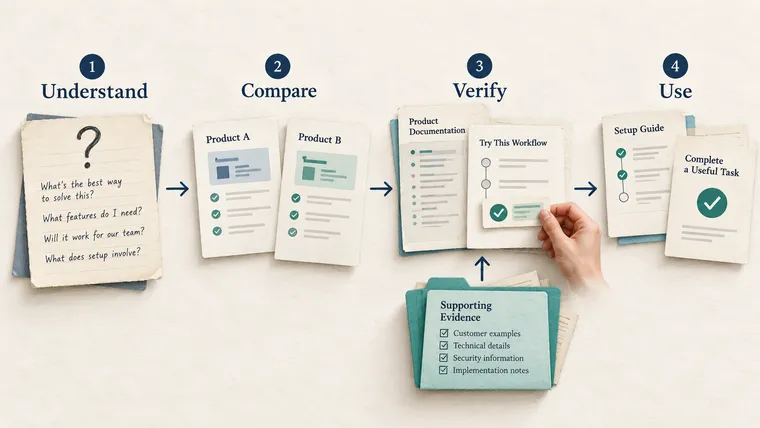
B2B SaaS SEO helps business buyers find the information they need to choose and use software. Each page should help them do something specific: understand a problem, compare approaches, verify a capability, evaluate a risk, or implement the product.
B2B means business-to-business. SaaS means software as a service, typically software you access online through a subscription. AI can speed up research and drafting, but the product claims still need real evidence.
🎯 Plan pages around buying tasks. A visitor should leave with an answer and a useful next step, not just a longer reading list.
1. Match buying questions to the right page
Generic articles around popular terms rarely create a useful route from a problem to a product decision. Choose the page format that fits the question.
| Buyer task | Useful page | What the page must provide |
|---|---|---|
| Understand the problem | Problem education | Symptoms, consequences, and the cost of leaving the issue unresolved |
| See whether it fits the team | Use-case page | A real workflow for a defined team |
| Check a capability | Feature page | What the product actually does, including relevant limits |
| Connect it to existing tools | Integration page | Setup requirements and limitations |
| Compare alternatives | Comparison page | Fair criteria and first-hand testing |
| Get value after signup | Documentation | Steps the user can follow to complete a task |
Give each distinct intent one preferred page. Link education to evaluation, evaluation to proof, and proof to an appropriate product action.
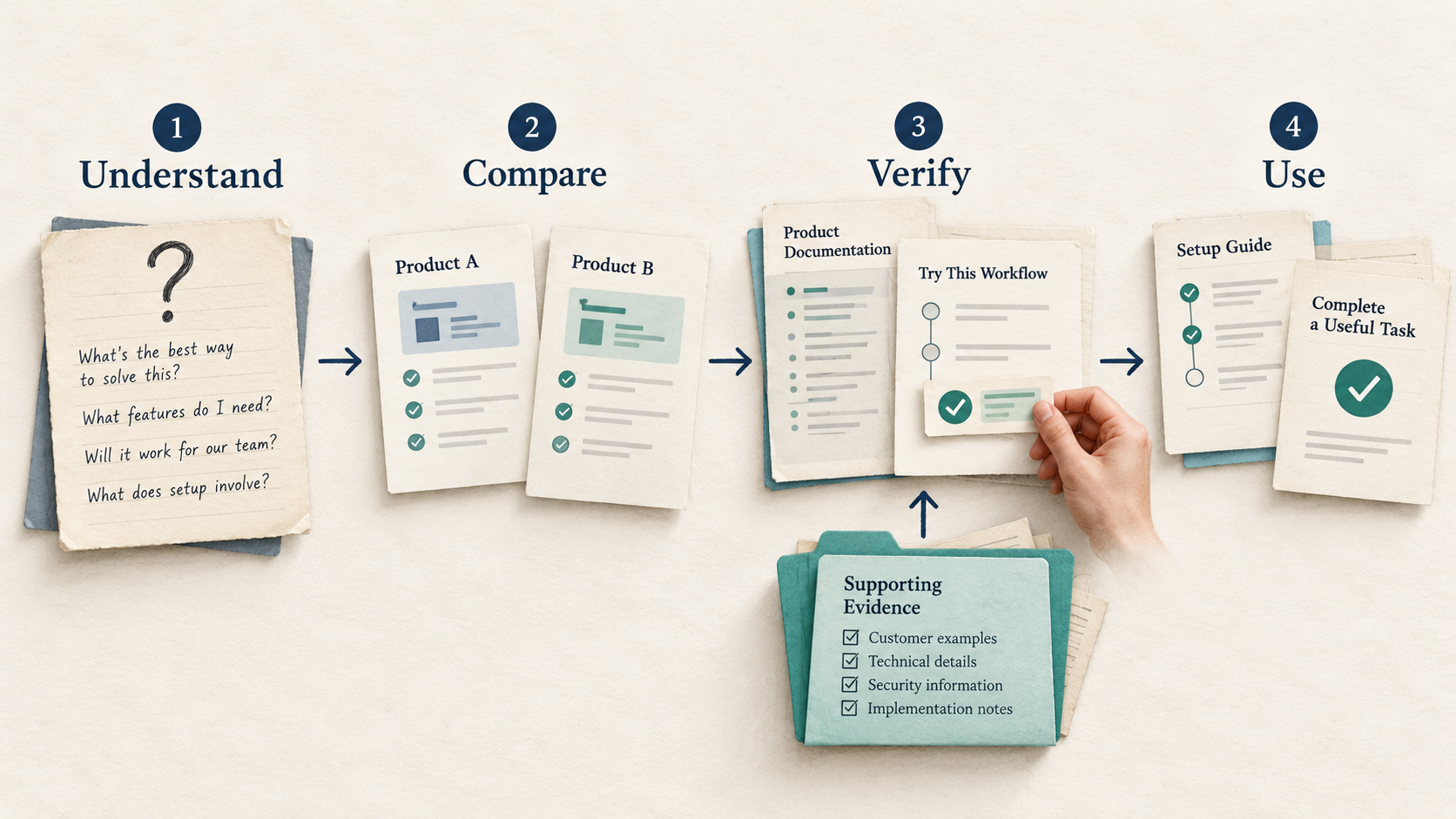
Publish the answers buyers need before they contact sales
In its 2025 Buyer Experience Report, 6sense reports that buyers first contacted sellers about 61% of the way through their buying journey, compared with 69% in 2024. It also reports that 95% chose a vendor already on their initial shortlist. Read the 6sense report.
This is vendor-published survey research across B2B purchases, not a SaaS-only experiment or proof that SEO caused a sale. The practical inference is narrower: make requirements, limitations, and evaluation evidence easy to find before a demo request. A buyer should not have to book a call to learn whether a basic requirement is supported.
2. Give AI sources rather than asking it to invent proof
AI can organize interviews, compare the search-result evidence you supply, find gaps in documentation, and prepare structured briefs.
It cannot independently verify your product, customer results, security posture, integration support, or a competitor’s capabilities from a writing prompt. Those claims need product documentation, actual testing, or an authorized source.
For example, “works with Tool X” may mean a native integration, a manual export, or an API connection the customer must build. Those are different promises. An integration page should say which one exists.
Scale the evidence before scaling the page count
Google says AI can help with research and structure, but generating many pages without useful added value may violate its scaled-content policy. Google’s guidance on generative AI content, checked October 2026.
For a SaaS team, a useful gate is: Does this page answer a distinct buying question with evidence we can support? Changing the industry name in an otherwise identical page does not establish that evidence.
3. Keep a claim ledger
A claim ledger is a simple record of what you are saying and why you can say it. For each important claim, record its source, owner, last verification date, and what must not be implied.
Consider a hypothetical claim: “Export records as CSV.” The evidence should show which plan supports it, which fields export, and whether any limit applies. It should not quietly become “syncs automatically with every spreadsheet.”
This record lets a writer simplify the wording without turning an assumption into a product promise.
4. Link pages in the order a buyer needs them
Create a hub around the main problem. Connect it to relevant use cases, implementation guides, product proof, and comparisons.
Use the primary keyword naturally in the page title, opening answer, and relevant headings. In links, describe what the reader gets next: a setup guide, evaluation checklist, or worked example. Repeating the same keyword in every anchor makes the route harder to follow.
Google’s link best practices, checked October 2026, recommend concise, descriptive anchors and links that can be crawled.
Give the skeptical reader a next step too
A visitor who has not accepted the product claim may need proof before a trial. Put the relevant documentation or test beside the claim, then offer the action.
This is an editorial inference from the need for clear evidence and useful links, not a claim that one link pattern guarantees conversions. For a comparison page, the next step might be checking a test method; for an implementation page, it might be following the setup guide.
5. Measure whether the right people move forward
Track non-brand impressions, qualified visits, product actions, assisted conversions, and sales feedback. Non-brand impressions come from searches that do not include your brand. An assisted conversion credits an earlier touchpoint in a longer path to a desired action.
Rankings alone cannot tell you whether visitors are suitable buyers. Agree with sales or the product team on what “qualified” means before comparing results.
- Impressions but few clicks: inspect the search task, title, and snippet for a mismatch.
- Visits but no useful action: look for missing proof, unclear requirements, or an unsuitable next step.
Keep the measurement dates and relevant page changes together. A page can help a buyer without being the final visit before signup.
Before producing content, follow the keyword research process and use prompts for SEO optimization as controlled templates. The free generator can assemble those constraints without storing your inputs.