How to Do Keyword Research: A Step-by-Step Guide for 2026
Learn how to do keyword research step by step: find seed keywords, use the right tools, read search intent, judge difficulty, and map keywords to pages.
Keyword research is the process of finding the actual words and questions people type into search engines, then deciding which of them are worth creating pages for. Do it well and every article you write has a built-in audience. Skip it, and you end up publishing content that no one is searching for.
This guide walks through how to do keyword research from zero, the way an in-house SEO would actually run it: start with a short list of topics, expand them into hundreds of real queries, figure out what each searcher actually wants, weigh how hard each keyword is to rank for, and finish with a prioritized list mapped to specific pages. No prior SEO experience required.
If you just want the toolbox, jump to our roundup of keyword research tools. If you want the full picture of how all the pieces fit together, start at the keyword research hub. Otherwise, follow the six steps below in order.
What keyword research actually does
Before the steps, it helps to be clear on the goal. Keyword research is not about collecting the biggest possible list of words. It is about answering three questions for your specific site:
- What are people searching for in your topic area?
- Which of those searches can you realistically rank for given your site’s authority today?
- Which ones are worth your time because they bring the right visitors, not just any visitors?
A good keyword list is the bridge between “topics I could write about” and “pages that will actually get traffic.” Everything below is in service of building that list.
The four metrics that matter
You will see dozens of numbers in keyword tools. For day-to-day research, four of them carry most of the weight.
Search volume is the estimated number of searches a keyword gets per month. It tells you the size of the opportunity, but it is an estimate and it lumps a whole country together, so treat it as a rough order of magnitude, not a promise.
Keyword difficulty (KD) is a tool’s score, usually 0–100, for how hard it is to rank on page one. It is mostly based on how strong the sites already ranking are. Higher means more established competitors.
Search intent is the why behind the query: is the person trying to learn something, compare options, or buy? This is the single most important factor, and we give it its own step below.
Business value is how close the keyword is to something you offer. A high-volume keyword that never leads to a sign-up or sale can be worth less than a low-volume one that attracts exactly the right reader.
The mistake beginners make is chasing volume alone. A keyword with 20,000 searches but a SERP full of major brands and pure tool pages is often a worse bet than a 1,500-search question that matches your content and that you can actually win.
Step 1: Build a list of seed keywords
Seed keywords are the broad, obvious terms that describe your topics. You are not trying to be clever here, just comprehensive. These seeds become the input for everything else.
Pull seeds from a few places:
- Your own knowledge of the business. List the products, services, problems, and categories you cover. If you sell project-management software, seeds might include “project management,” “task tracking,” “team collaboration,” and “gantt chart.”
- The words your customers use. Sales calls, support tickets, and reviews are gold, because real people rarely use the same jargon you do internally.
- Competitors. Look at the navigation and blog categories of two or three sites that rank well in your space. Their section headings are essentially a list of validated seed topics.
- Google’s own suggestions. Start typing a seed into Google and watch the autocomplete. Scroll to the bottom of the results for “People also search for” and the “Related searches” block.
Aim for a starting list of 5–15 seeds. That is plenty; each one will expand into dozens of keywords in the next step.
Step 2: Expand seeds into real keywords
Now you turn each seed into the specific phrases people actually search. This is where keyword tools earn their keep, because guessing only gets you so far.
Drop your seeds into a keyword tool and look at three kinds of expansions:
- Variations and modifiers: “keyword research” becomes “keyword research for beginners,” “free keyword research,” “keyword research for YouTube.”
- Questions: “how to do keyword research,” “what is keyword research,” “why is keyword research important.” Question keywords are often easier to rank for and map cleanly to blog posts.
- Long-tail keywords: longer, more specific phrases with lower volume but clearer intent, like “how to do keyword research for a new website.” Each one is less competitive, and together they add up to serious traffic.
You do not need a paid tool to start. Free options — Google Keyword Planner, Google autocomplete, “People also ask,” and answer-style sites — will get a new site a long way. When you are ready to compare them, we break down the options in our guide to keyword research tools.
By the end of this step you should have a messy spreadsheet of a few hundred keywords. Messy is fine. The next three steps clean it up.
Step 3: Read the search intent behind each keyword
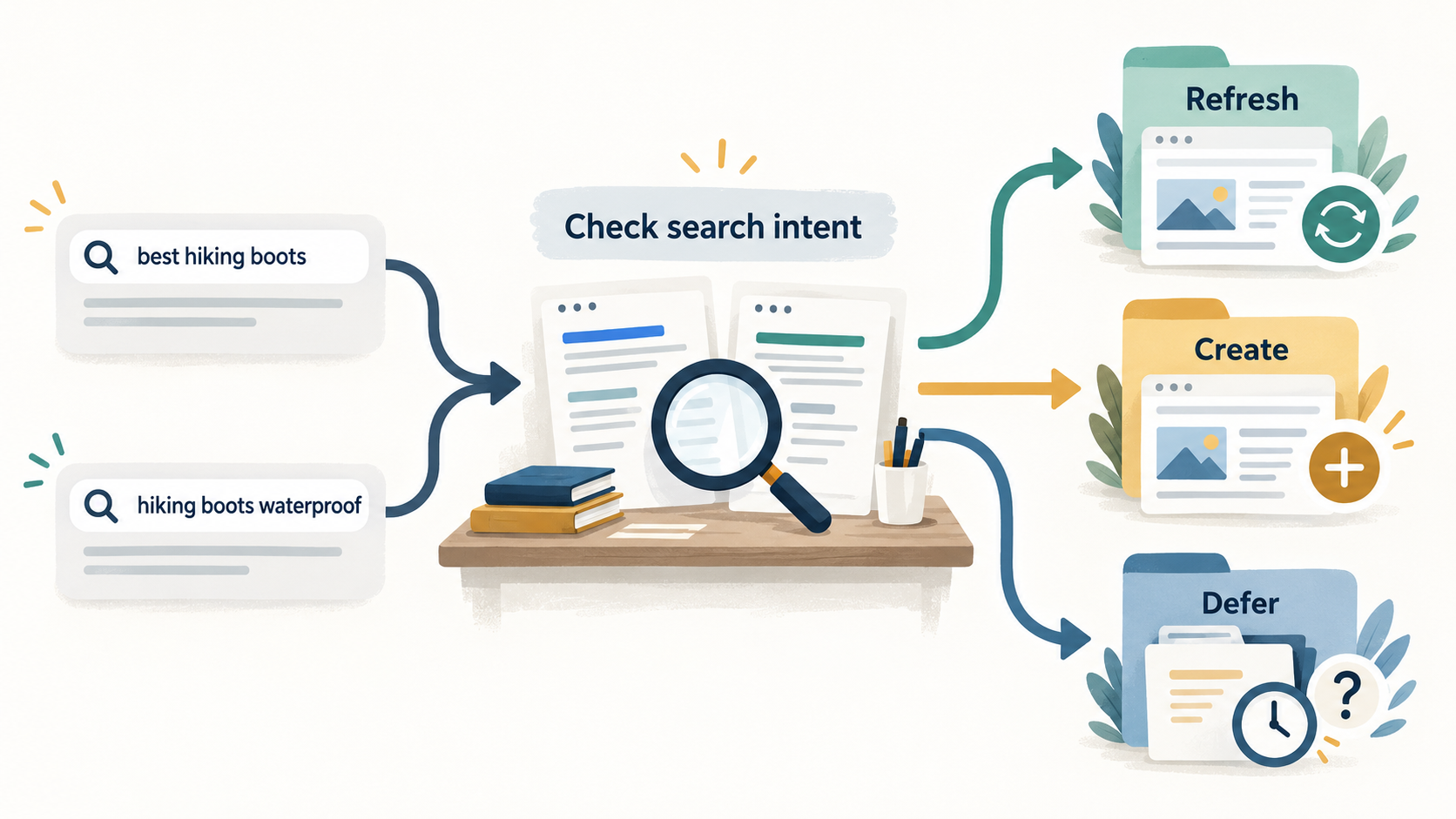
This is the step most beginners skip, and it is the one that separates pages that rank from pages that do not. Google rewards results that match what the searcher is trying to do, so you have to classify intent before you decide what kind of page to build.
Most keywords fall into one of four intents:
- Informational — the person wants to learn. “how to do keyword research,” “what is search intent.” These call for guides, tutorials, and explainers.
- Commercial — the person is comparing options before deciding. “best keyword research tools,” “ahrefs vs semrush.” These call for comparisons, roundups, and reviews.
- Transactional — the person is ready to act. “keyword research tool free trial,” “buy seo software.” These call for product, pricing, or sign-up pages.
- Navigational — the person wants a specific brand or page. “semrush login.” Usually not worth targeting unless it is your brand.
The reliable way to confirm intent is to search the keyword yourself and look at what already ranks. If the first page is all step-by-step guides, Google has decided this is an informational query — publishing a product page there will not work, no matter how good it is. If the results are all tool pages, a written tutorial will struggle. Match the format that is already winning.
This is also where you protect yourself from overlap. “how to do keyword research” and “keyword research tools” look similar but have different intent — one wants a tutorial, the other wants a list of tools. They deserve separate pages, each matching its own intent, so they do not compete with each other in search.
Step 4: Weigh difficulty against your site
A keyword is only a good target if you can realistically rank for it. That depends on two things: the keyword’s difficulty and your own site’s authority.
For each promising keyword, glance at the difficulty score, then sanity-check it by looking at the actual first page of results. Ask:
- Are these huge, established brands, or are there smaller sites and forum threads mixed in? Seeing Reddit, Quora, or niche blogs on page one is a strong signal that a newer site can compete.
- Do the ranking pages genuinely answer the query, or is there a gap you could fill with something clearer, more current, or more complete?
- How many of the results are pure tool or product pages? If the SERP is dominated by interactive tools and you only have an article to offer, that keyword will be hard to crack with content alone.
If your site is new, deliberately favor lower-difficulty, longer-tail keywords. Winning ten “easy” keywords that each bring a trickle of the right visitors builds the authority you will later need to go after the big head terms.
Step 5: Group keywords into clusters
You now have a filtered list of keywords worth targeting. The final structural move is to group them, because many keywords are really the same topic phrased different ways and should live on one page, not several.
Cluster by meaning and intent. “how to do keyword research,” “keyword research step by step,” and “keyword research process” are one cluster — one thorough guide can rank for all three. But “keyword research template” is a different intent (the person wants a downloadable file), so it earns its own page.
A simple way to organize the result is the hub-and-spoke model:
- A pillar (hub) page covers the broad topic and links out to everything below it.
- Spoke pages each target one specific sub-topic and link back up to the pillar.
For the keyword research topic, that looks like a hub page on keyword research linking to spokes like this how-to guide, the keyword research template, the keyword research checklist, and the keyword research tools roundup. This internal-linking structure tells search engines the pages belong together and spreads ranking strength across the cluster.
Step 6: Prioritize and map keywords to pages
Not everything gets written at once. Score each cluster so you know what to build first. A quick, practical way is to rate each one on three axes:
- Opportunity — search volume and how many related keywords it covers.
- Winnability — how realistic ranking is, based on difficulty and your authority.
- Value — how close it is to a sign-up, lead, or sale.
The clusters that score well on all three are your first articles. The ones with high volume but a tool-dominated SERP and no matching asset go later — they need a different page type, not just another blog post.
Capture the decision in a simple table: one row per planned page, with its primary keyword, intent, target URL, and priority. That table is your keyword map, and it turns research into a publishing plan. If you want a ready-made structure to fill in, grab our keyword research template.
Common keyword research mistakes to avoid
- Chasing volume and ignoring intent. A high-volume keyword you can’t satisfy with the right page type is a trap.
- Targeting the same keyword with multiple pages. This splits your ranking strength. One intent, one page.
- Ignoring long-tail keywords. They are easier to win and convert better because they are specific.
- Treating the list as final. Search behavior shifts. Revisit your research every few months and after every algorithm update.
- Never checking the actual SERP. Tool scores are estimates; the results page is the real exam. Always look.
Frequently asked questions
How long does keyword research take? For a single topic cluster, a focused session of one to two hours is enough to go from seeds to a prioritized list. A full site’s research is an ongoing process, not a one-time project.
Can I do keyword research for free? Yes. Google autocomplete, “People also ask,” “Related searches,” and Google Keyword Planner cover the basics. Paid tools mainly save time and give more precise difficulty and volume data.
What is a good search volume to target? There is no universal number. For a newer site, keywords in the low hundreds to low thousands with clear intent and modest difficulty are usually the sweet spot. Volume only matters if you can actually rank.
How is keyword research different from keyword mapping? Keyword research finds and qualifies the keywords. Keyword mapping assigns each finished keyword (or cluster) to a specific page so two pages never compete for the same term. Mapping is Step 6 above.
Your next step
You now have the full process: gather seeds, expand them, read intent, judge difficulty, cluster, and prioritize. The fastest way to make it stick is to run it once on a single topic.
To keep your work organized as you go, start from our keyword research template, then use the keyword research checklist to confirm you haven’t missed a step before you move into writing.