How to Build Topic Clusters and Prevent Keyword Cannibalization
One page = one intent = one main keyword. Learn the pillar-cluster architecture that keeps your content organized, internally linked, and free from self-competition.
A blog without cluster architecture is a pile of articles. Readers find one post, read it, and leave because nothing else seems connected. Google sees a collection of isolated pages instead of a topical authority. Worse, when two of your articles target similar keywords, they compete against each other in search results—splitting your backlinks, confusing Google’s indexing, and ensuring neither ranks well.
This problem is called keyword cannibalization. It is one of the most common and most fixable issues we see in content audits. The solution is topic cluster architecture: a deliberate structure where every page has a single job, a clear position in a knowledge hierarchy, and explicit links to related pages above, beside, and below it.
This article explains how to design that architecture, how to audit for cannibalization, and how to fix it when it already exists.
What Is a Topic Cluster (and Why Google Rewards It)
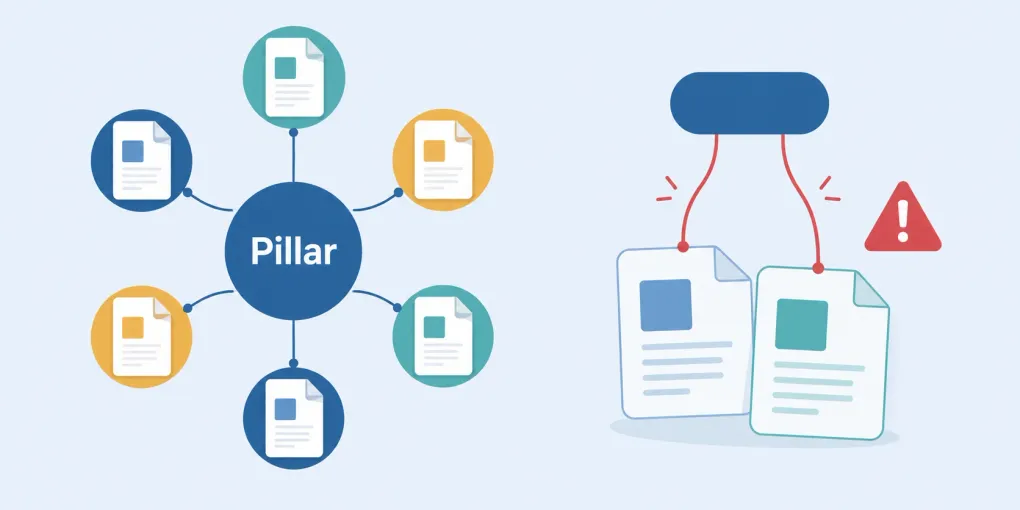
A topic cluster is a content structure with two layers:
- Pillar page: A broad, authoritative page that covers a core topic in depth. It is usually 2,500–4,000 words and targets a high-volume head term. Its job is to signal topical authority.
- Cluster pages: Narrower articles that explore subtopics, specific use cases, comparisons, or technical questions related to the pillar. Each targets a long-tail keyword and links back to the pillar. The pillar links out to each cluster page.
The model works because it mimics how humans organize knowledge. A textbook has a chapter on “Electric Motors” (pillar) and sections within it on DC motors, AC motors, stepper motors, and servo motors (clusters). Google understands this hierarchy through internal links, anchor text, and the semantic relationship between the content of linked pages.
When you build clusters, you accomplish three things simultaneously:
- Topical authority: Google sees that you cover a subject comprehensively, not superficially.
- Internal link equity: Link juice flows from the pillar to clusters and back, strengthening the whole group.
- User retention: A reader who lands on a cluster page about “stepper motors for 3D printers” can navigate upward to the pillar on motor types, or sideways to a cluster on servo motors for CNC machines.
Pillar vs. Cluster: Roles and Expectations
| Attribute | Pillar Page | Cluster Page |
|---|---|---|
| Target keyword | Broad head term (high volume, high KD) | Long-tail variant (lower volume, lower KD) |
| Word count | 2,500–4,000+ | 1,200–2,500 |
| Content scope | Comprehensive overview | Deep dive into one angle |
| Internal links | Links out to 5–15 cluster pages | Links up to pillar, sideways to 2–5 related clusters |
| Conversion goal | Establish authority, capture email | Drive to product page or specific action |
| Update frequency | Quarterly refresh | As needed, or when data changes |
A common mistake is making the pillar too narrow. If your pillar is “Best Espresso Machines for Home Use,” you have limited cluster options. If your pillar is “How to Choose, Use, and Maintain Espresso Equipment,” your clusters can cover grinder selection, milk frothing technique, descaling schedules, bean storage, and machine comparisons.
The Iron Rule: One Page = One Intent = One Main Keyword
Before any article enters production, write this sentence: “The single intent of this page is to [verb] [target audience] [outcome].”
Examples:
- “The single intent of this page is to teach small restaurant owners how to calculate the daily ice volume they need.”
- “The single intent of this page is to compare QuickBooks Online and Xero for freelance designers who bill in multiple currencies.”
- “The single intent of this page is to explain what cold brew coffee is and how it differs from iced coffee.”
If you cannot state the intent in one sentence, the page is unfocused. If two pages share the same sentence, they will cannibalize each other.
Intent Drift: The Silent Killer
Intent drift happens when a writer, halfway through an article, starts answering questions that belong to a different page. A selection guide on “how to choose a CRM” drifts into a comparison of two specific CRMs. That comparison content belongs in a separate cluster page. In the selection guide, the correct treatment is one sentence—“For a detailed comparison of the two most popular options, see our [HubSpot vs. Salesforce guide]“—with an internal link.
Action: Add an “intent checkpoint” to your editing process. After every H2 section, ask: “Does this section still serve the single intent stated at the top?” If not, cut it or move it to the correct article.
Mapping the Cluster Before You Write
https://yepsoso.com/images/topic-clusters-prevent-cannibalization-cluster-mapping.webp

Do not write first and cluster later. The cluster map is a content calendar decision tool. Build it in a spreadsheet, a whiteboard tool like Miro, or a project management platform.
The Three-Link Rule
https://yepsoso.com/images/topic-clusters-prevent-cannibalization-three-link-rule.webp
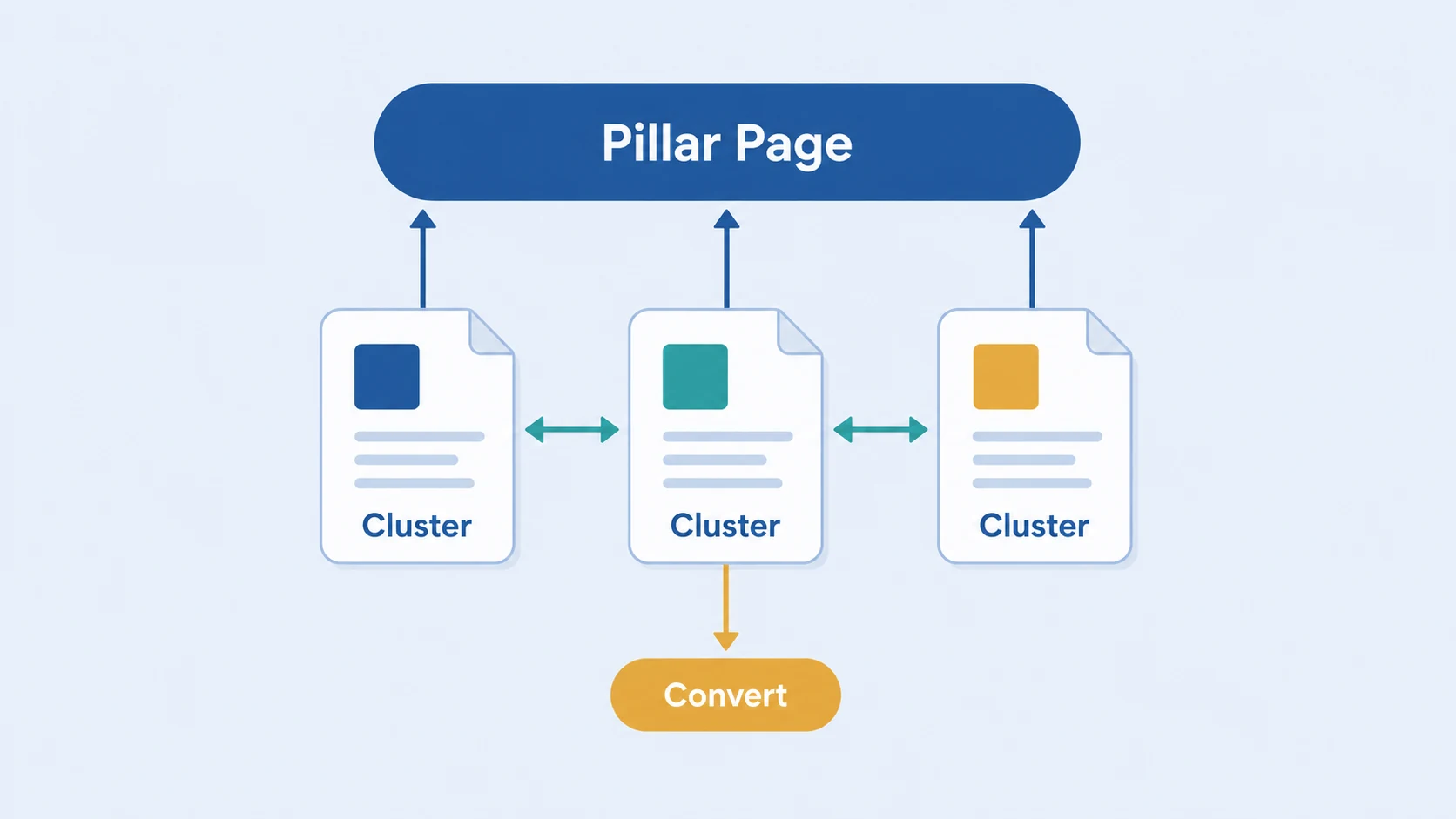
Every cluster page needs three types of internal links:
- Upward link: One link to the pillar page, usually in the first 200 words or in a “Related Overview” box. Anchor text should be descriptive: “our complete guide to espresso equipment” rather than “click here.”
- Sideways links: 2–5 links to related cluster pages at the same depth. These keep readers in your ecosystem. A page on “burr grinder types” should link to “how to clean a burr grinder” and “best grinders under $200.”
- Downward or conversion links: At least one link to a product page, service page, or lead capture form. This is the conversion exit.
A Real Cluster Example: Project Management Software
Pillar: “The Complete Guide to Project Management Software for Small Teams” (targets “project management software”)
Cluster pages:
- “What Is Project Management Software? Definitions, Types, and Core Features” (A: awareness)
- “How to Choose Project Management Software: 6 Criteria for Small Teams” (B: selection)
- “Asana vs. Monday.com vs. ClickUp: Which Fits Your Workflow?” (C: comparison)
- “Best Project Management Software for Marketing Agencies” (D: application)
- “What Is Gantt Chart Dependency Mapping? A Beginner’s Guide” (E: technical)
- “How to Build a Custom Project Dashboard in Notion” (F: design/engineering)
Each cluster page links up to the pillar. The comparison page links sideways to the selection guide and the application page. The awareness page links sideways to the selection guide. Every page links to a “Start a Free Trial” or “See Plans and Pricing” conversion page. For a B2B manufacturing version of this exercise, see our B2B topic cluster example.
Cannibalization Audit: How to Find and Fix Competing Pages
Keyword cannibalization occurs when two or more pages on your site target the same keyword or serve the same intent. Google cannot decide which to rank, so it ranks neither well.
Detection Method 1: Site Search
In Google, search: site:yourdomain.com "target keyword". If multiple URLs appear, you have potential cannibalization. Check whether the pages serve different intents. If they do, the issue is usually fixable with clearer H1s and distinct angle statements. If they serve the same intent, you have a real problem.
Detection Method 2: GSC Query-to-Page Mapping
In Google Search Console, go to Performance → Queries. Click a specific query. Then click the “Pages” tab above the graph. If multiple URLs show impressions for the same query, they are competing. Look at the click-through rate. Often one page gets 90% of clicks and the other gets almost none. The weaker page should be merged, redirected, or re-angled.
Detection Method 3: Rank Tracking Tools
In Ahrefs or Semrush, set up rank tracking for your target keywords. If two of your URLs appear in the top 100 for the same keyword, note their positions. If one is on page 2 and the other is on page 5, the page 2 URL is winning the internal competition. Decide whether the page 5 URL has a different enough angle to justify existence.
The Fix: Merge, Redirect, or Differentiate
https://yepsoso.com/images/topic-clusters-prevent-cannibalization-fix-decision.webp
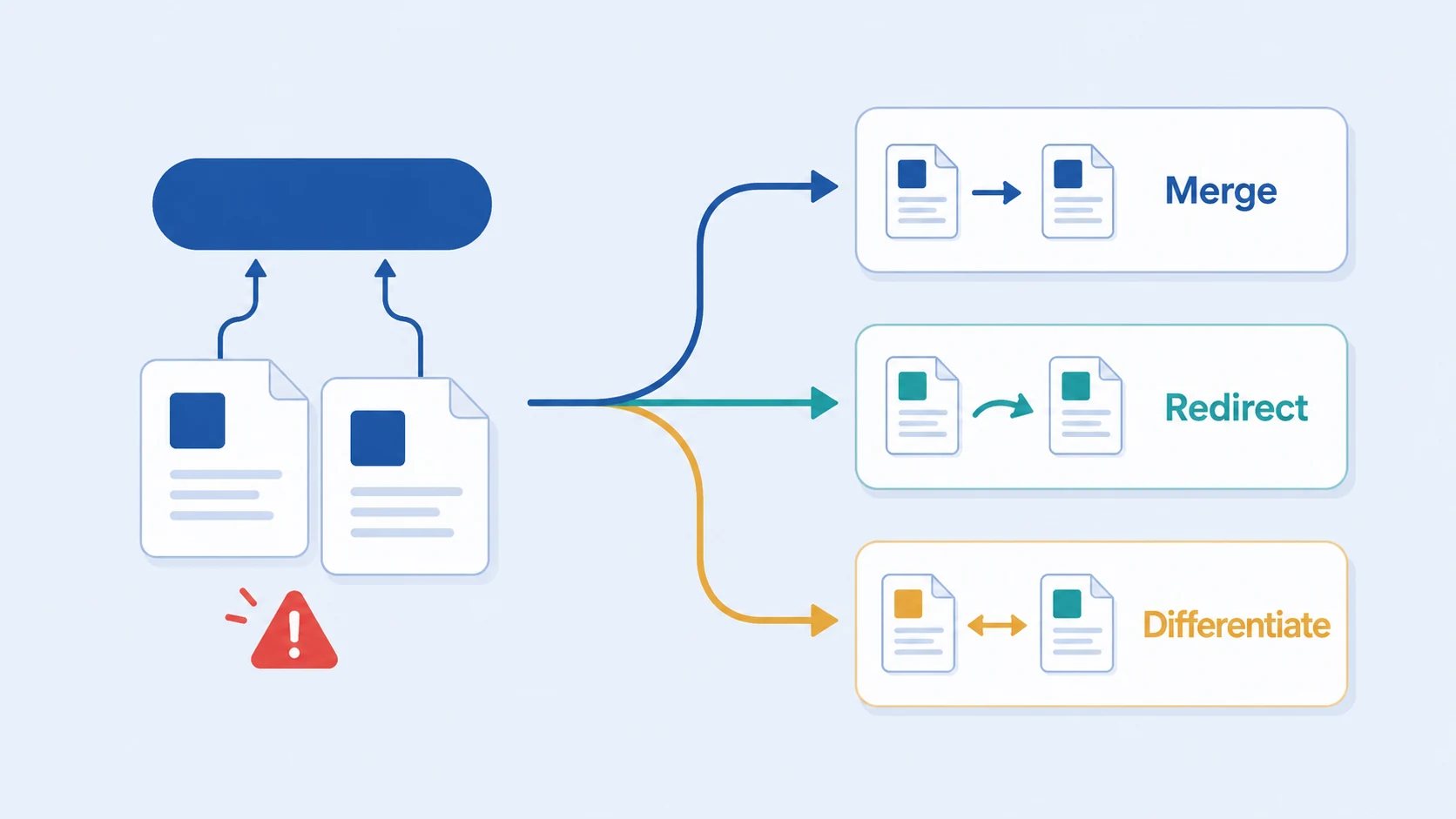
| Situation | Action |
|---|---|
| Two pages serve identical intent | Merge the weaker page into the stronger one. Redirect the weaker URL to the stronger one. Preserve any unique content or data from the weaker page by adding it to the stronger one. |
| Two pages serve related but distinct intents | Clarify the H1, title tag, and first 200 words of each to emphasize the distinct angle. Add stronger internal links from the pillar to each, signaling their separate roles. |
| One page is outdated but has backlinks | Update and republish the outdated page. Do not create a new URL. Backlinks follow the URL; moving content to a new page loses that equity. |
| A category page and a blog post compete | Decide which Google prefers (usually the one ranking higher). Strengthen that page and canonicalize or noindex the weaker one if it does not serve a unique user need. |
Cannibalization Prevention: The Content Calendar Gate
https://yepsoso.com/images/topic-clusters-prevent-cannibalization-calendar-gate.webp

The cheapest fix is prevention. Before any new article is approved, run this three-question gate:
- Does any existing page target this main keyword? Search your own site and your GSC query report.
- Does any existing page serve this exact intent? Read the H1 and first paragraph. If the intent is identical, do not write a new page. Update the old one.
- If the keyword overlaps but the intent differs, is the difference clear enough for a user to understand? If you cannot explain the difference in one sentence to a colleague, a reader will not understand it either.
Action: Add these three questions to your content brief template. No brief gets approved without answering them.
FAQ
Q: How many cluster pages should one pillar have?
There is no fixed number, but 5–15 is the practical range. Fewer than 5 and the pillar looks thin. More than 15 and the cluster becomes unwieldy to maintain. If you have 30 potential cluster topics, consider splitting into two pillars (e.g., “Espresso Equipment for Home” and “Espresso Equipment for Cafes”).
Q: Can a page be a cluster for one pillar and a pillar for its own sub-cluster?
Yes. This is called a sub-pillar or tier-2 pillar. A page on “How to Choose a Coffee Grinder” can be a cluster under the “Espresso Equipment” pillar, while also serving as a pillar for clusters on “Burr vs. Blade Grinders,” “Grinder Settings for Espresso,” and “Best Grinders Under $300.” Just ensure the internal link structure makes the hierarchy clear.
Q: What if I already have 200 blog posts and no cluster structure?
Run a content audit. Group existing posts by topic. Identify the 5–10 topics where you have the most coverage. Designate the best, most comprehensive post in each group as the pillar. Update it to link to all related cluster posts. Then update each cluster post to link back to the pillar. This is labor-intensive but high-ROI. We have seen domain-wide organic traffic increases of 30–50% from this exercise alone.
Q: Should I use the same anchor text every time I link to the pillar?
No. Vary the anchor text naturally. “Our complete guide to espresso equipment,” “learn more about choosing espresso gear,” “the main espresso equipment overview,” and “read our pillar guide” all work. Exact-match anchor text every time looks manipulative to Google and robotic to readers.
Q: How do I handle seasonal or trending topics in clusters?
Seasonal content (e.g., “Best Coffee Gifts for Holiday 2026”) can be a temporary cluster page under a gift-giving pillar. Publish it, link it into the cluster, and decide after the season whether to update, merge, or redirect it. Do not let temporary content become permanent cannibalization risks.
What Comes Next
Cluster architecture gives your content a skeleton. The next step is giving each article a differentiated reason to exist. Read our guide on how to write a content brief with a differentiated angle so every cluster page has a unique value proposition that separates it from the ten other results on page one.
If you have not yet built your keyword list, start with our complete keyword research system to generate the raw material for your clusters. And once your clusters are mapped, make sure each page has a keyword-to-page map with a conversion target that matches its intent—or the traffic you earn will leave without becoming business value.
Last updated: June 2026