Game Theory Games: The Classic Models That Explain Strategic Thinking
Explore classic game theory games like Prisoner's Dilemma, Chicken, and Battle of the Sexes. Learn how these models explain real-world strategy.
What Are Game Theory Games?
When you hear “game theory,” you might think of board games or video games. But in economics and strategy, a “game” is any situation where two or more people (or companies, or countries) make decisions that affect each other’s outcomes. Game theory games are simplified models that capture the essence of these strategic interactions.
Think of them as mental models: once you learn the structure of these games, you start seeing them everywhere—in negotiations, pricing wars, social dilemmas, and even personal relationships.
Why Learn Classic Game Theory Games?
The payoff is pattern recognition. Once you know the shape of a handful of games, you start noticing them in ordinary situations: two colleagues deciding whether to share credit, two shops deciding whether to undercut each other, two teams deciding whether to commit to a shared platform.
You don’t need a maths degree for this. Each classic game is defined by one thing only — how each side ranks the four possible outcomes. Change that ranking and you change the game, and with it the advice that actually works.
The 5 Major Types of Games in Game Theory
Before diving into specific games, it helps to understand how game theorists categorize them. According to UBS, the five major types are:
| Dimension | What it means | Quick example |
|---|---|---|
| Zero-sum vs. non-zero-sum | One side’s gain is exactly the other’s loss, or both can gain and lose together | Poker vs. a trade deal |
| Symmetric vs. asymmetric | Everyone has the same options and payoffs, or players hold different roles and resources | Two identical shops vs. landlord and tenant |
| Simultaneous vs. sequential | Players move at the same time, or take turns and can see earlier moves | Sealed bids vs. chess |
| Cooperative vs. non-cooperative | Binding agreements are possible, or they are not | A signed contract vs. an informal promise |
| Perfect vs. imperfect information | Everyone can see the full history of moves, or some information stays hidden | Chess vs. poker |
These five dimensions are a sorting tool, not a list of games. They tell you what kind of situation you are in; the named games below tell you what to do about it.
The Classic Games You Should Know
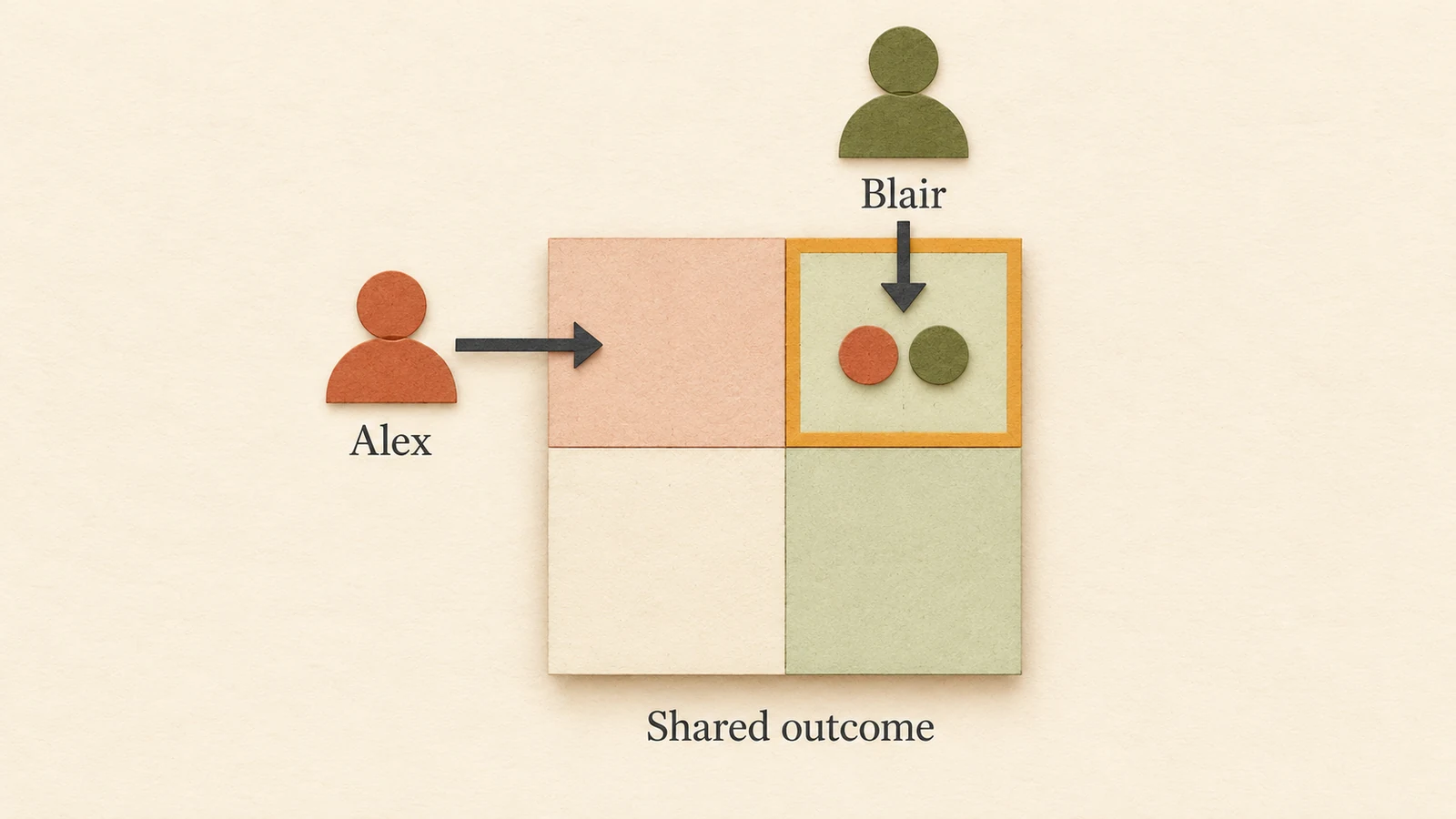
All four of the best-known games use the same 2x2 shape: two players, two choices each, four outcomes. What separates them is purely the ranking of those outcomes — which is why one diagram can hold all of them at once.

Read the diagram this way: the outlined cells are the stable outcomes (Nash equilibria), where neither side can improve by changing course alone. The Prisoner’s Dilemma has exactly one, and it is the bad one. The Stag Hunt has two, one good and one merely safe. Chicken and Battle of the Sexes have two, and both require the players to end up doing different things or the same thing respectively. That structural difference is the whole story.
1. The Prisoner’s Dilemma
This is the most famous game in game theory. Two suspects are arrested and held separately. Each can either confess (defect) or stay silent (cooperate). The payoffs are arranged so that:
- If both stay silent, they each get a light sentence.
- If one confesses and the other stays silent, the confessor goes free and the silent one gets a heavy sentence.
- If both confess, they both get a moderate sentence.
Rational self-interest leads both to confess, even though mutual silence would be better for both. This is the classic tension between individual rationality and collective benefit.
The Prisoner’s Dilemma appears in arms races, price wars, and environmental agreements. It is also the base game for most laboratory research on trust.
One condition defines it: betrayal has to beat cooperation even when the other side cooperates. If that single condition fails, you are in a different game — and as you’ll see below, misdiagnosing this is the most common mistake people make with game theory.
How to play it best
Be honest about the bad news first: in a genuine one-shot Prisoner’s Dilemma there is no clever move. Defection is the dominant strategy, which means it beats cooperation against every possible choice the other side can make. Any advice that tells you to cooperate anyway is asking you to accept a worse outcome and hope for a favour.
So the best play is not a move inside the game. It is to stop playing that game:
- Make it repeated. Cooperation becomes rational the moment both sides expect to meet again and care about future rounds. Turn a one-off transaction into an ongoing relationship — longer contracts, staged deliveries, recurring orders.
- Make the promise binding. Contracts, escrow, penalties, deposits, third-party enforcement. Talking about cooperating does nothing here: a promise in a Prisoner’s Dilemma isn’t self-enforcing, because you still gain by breaking it after making it. This is exactly why pre-play communication helps in coordination games but not in this one.
- Make defection visible. Reputation systems, public scorecards, references, industry gossip. Visibility converts a one-shot into a repeated game even when you only deal with each person once.
- If none of the above is available, protect yourself. No hostages, no advances, no irreversible investment. Shrink the exposure until being betrayed is survivable.
And if you’re already inside a repeated version: open with cooperation, respond to a betrayal once and proportionally, and forgive as soon as they return. That is tit-for-tat, and it is the right default in a small circle where reputations follow you — with the caveat in the tournament section below.
2. The Game of Chicken
Two drivers race toward each other. The first to swerve loses (the “chicken”), but if neither swerves, both crash. This game models brinkmanship—like nuclear standoffs or competitive pricing that could lead to a price war.
The best outcome is to be the one who doesn’t swerve while the other does. But if both refuse to swerve, disaster follows. Chicken is a game about credibility and commitment.
How to play it best
Chicken has no dominant strategy and no good symmetric answer. Its mixed-strategy equilibrium — bluff sometimes, fold sometimes — is technically stable and practically terrible, because “sometimes” includes a real probability that both sides go straight and crash. Randomising is not a solution; it’s a rate of accidents you’ve agreed to accept.
The winning play is to remove your own option to swerve, before the other side removes theirs. Thomas Schelling built The Strategy of Conflict (1960) around this inversion: “the power to constrain an adversary may depend on the power to bind oneself… to burn bridges behind one may suffice to undo an opponent.” A commitment only works if it is:
- Visible — the other side has to see it, or it does nothing.
- Irreversible — a promise you can quietly retract is not a commitment.
- First — commitment is a first-mover advantage. Two locked-in sides is the crash.
In practice that means published price-matching guarantees, publicly announced red lines, delegating the decision to someone with no authority to concede, or spending money in a way that only pays off if you don’t back down.
Two things follow that most write-ups miss. First, if the other side has already committed credibly and you haven’t, swerving is your best move — recognising a lost Chicken early is a skill, not a defeat. Second, if you are the committed one, your remaining job is to build the other side a face-saving exit. A cornered opponent with no dignified way out is the most likely cause of the outcome you both wanted to avoid.
3. The Battle of the Sexes
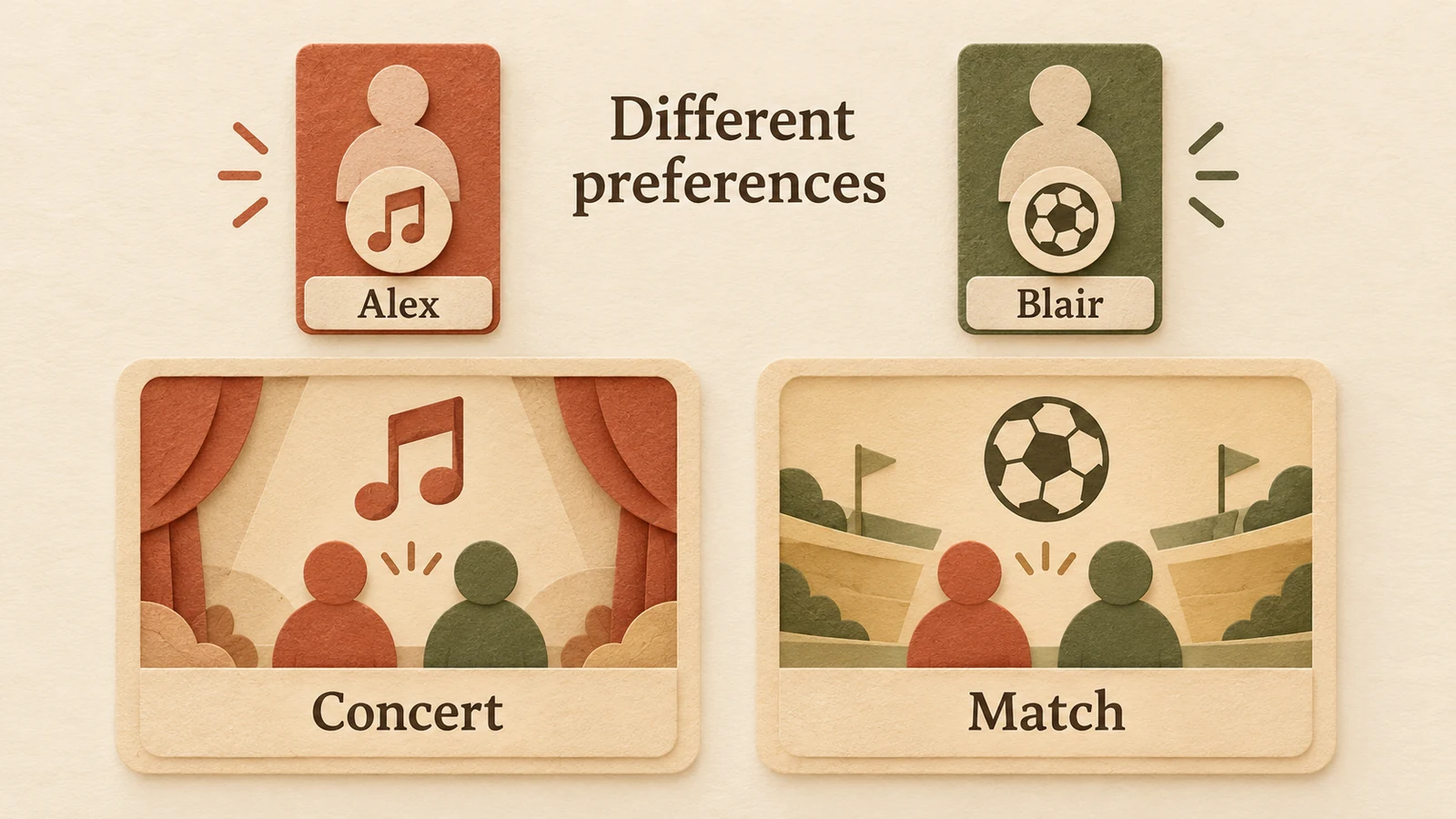
A couple wants to go out but prefers different activities: he wants the fight, she wants the opera. Both would rather be together than apart, but each prefers their own choice. This is a coordination game with a conflict of interest.
It models situations where parties need to coordinate but have different preferences—like choosing a technical standard or negotiating a meeting time.
How to play it best
This game has three equilibria: both go to the fight, both go to the opera, and a mixed one where each randomises. The mixed equilibrium is the trap. With the textbook payoffs, both sides randomising “fairly” leaves them in the same place only 12 times out of 25 — they miss each other more than half the time, and both end up worse off than under either coordinated outcome. Splitting the difference by independently hedging is the one strategy guaranteed to fail.
Better plays, in order of reliability:
- Find the focal point. Schelling’s insight was that people coordinate on whatever is obvious, salient or traditional — the default option, the incumbent standard, last year’s venue. If an obvious answer exists, take it and stop negotiating.
- Agree a rule, not an outcome. Alternation (“my choice this time, yours next time”) converts a fight over one decision into a stable convention over many. This is the single most useful move in recurring coordination disputes.
- Appoint one speaker. Experiments on communication in this game found that one-way messages help coordination, while simultaneous two-way messages don’t reliably reduce coordination failure — both sides just announce their favourite (Cooper, DeJong, Forsythe & Ross, RAND Journal of Economics 1989 and Quarterly Journal of Economics 1992). Let one party propose and the other respond.
- Commit first, but only mildly. Booking the tickets works. It also costs you goodwill you’ll need next round, so use it sparingly.
The thing to protect is the coordination itself. Both sides being together at the “wrong” event beats both sides being right and alone.
4. The Stag Hunt (or Deer Hunt)
Two hunters can either cooperate to catch a stag (a big reward) or each hunt a hare on their own (a smaller but guaranteed reward). If one hunter defects while the other tries for the stag, the defector gets a hare and the other gets nothing. This game highlights the tension between safety and mutual benefit.
Unlike the Prisoner’s Dilemma, the Stag Hunt has two stable outcomes: both hunt stag, and both hunt hare. Hunting stag is what game theorists call payoff dominant (it pays more if it works); hunting hare is risk dominant (it pays regardless of what the other person does). That distinction comes from Harsanyi and Selten’s 1988 work on equilibrium selection, and it explains why good outcomes are so hard to reach even when everyone wants them.
Lab evidence is blunt about which one wins. Battalio, Samuelson and Van Huyck (Econometrica, 2001) ran three Stag Hunt variants that shared exactly the same best-response structure, changing only how costly a failed stag hunt was. Behaviour diverged sharply: as the penalty for reaching for the stag alone grew, players drifted toward the safe hare equilibrium and stayed there. The maths said cooperation was available; the risk profile decided the outcome.
The practical lesson: if you want a team, a partnership, or a standards coalition to reach for the stag, arguing that the stag is worth more will not do it. You have to lower the cost of being the only one who shows up.
How to play it best
Unlike the Prisoner’s Dilemma, this one is genuinely solvable — and unlike Chicken, the fix isn’t confrontation. Everyone already wants the good outcome. What’s missing is assurance.
- Talk first — here it actually works. Robert Aumann conjectured in 1990 that cheap talk couldn’t help in a Stag Hunt, since anyone would say “let’s hunt the stag” regardless. Gary Charness tested it (Games and Economic Behavior, 2000) and found the opposite: one-way pre-play messages did move players toward the efficient outcome — but only when the message came before the action, not after. The same pattern shows up in the broader coordination-game experiments. A stated intention isn’t binding, yet in a game where both sides want the same thing, it is informative. That is precisely why the same conversation is worthless in a Prisoner’s Dilemma and valuable here.
- Shrink the first step. Break the commitment into increments small enough that going first alone is survivable. Pilot projects, trial periods, partial deployments.
- Insure the first mover. Explicitly cover whoever moves first if the other side doesn’t follow — a refund, a fallback, a guarantee. Since the hare equilibrium is chosen out of risk, not greed, removing the risk removes the reason.
- Make participation observable. People commit far more readily when they can see the others committing at the same time. Simultaneous signing, public pledges, shared dashboards.
- Keep the group small if you can. Every extra participant is another way for the stag hunt to fail.
Notice what’s absent from that list: penalties. Punishing people for not cooperating is the Prisoner’s Dilemma remedy, and in a Stag Hunt it adds risk to the very move you’re trying to encourage.
5. The Lock Out Game
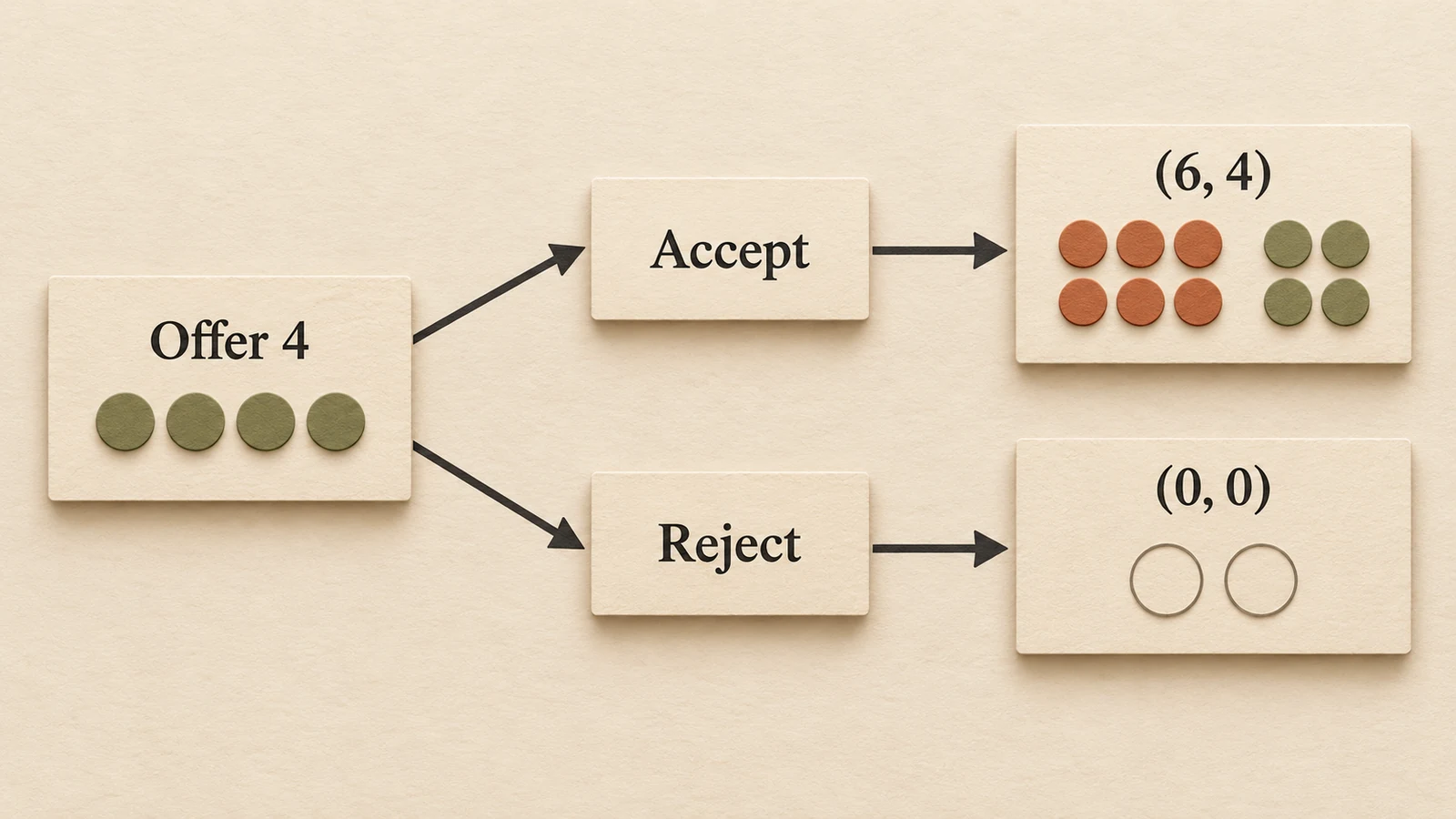
This is a less common but instructive game. Imagine two players who must divide a resource. One proposes a split, and the other can accept or reject. If rejected, both get nothing (or a worse outcome). This is essentially the ultimatum game, which tests fairness and retaliation.
It shows that people will pay real money to punish unfairness. The numbers are consistent: reviewing 37 studies, Oosterbeek and colleagues (2004) found proposers typically offer around 40% of the pot, and offers below roughly 30% are frequently turned down (summary of the experimental literature). Pure self-interest predicts an offer of almost nothing and acceptance of almost anything. That prediction fails in essentially every version of the experiment ever run.
How to play it best
The theoretical solution and the practical solution genuinely differ here, which is what makes the game worth studying.
If you’re proposing: the maths says offer the smallest possible amount, and the evidence says don’t. Since offers under roughly 30% get rejected often enough to wipe out the gain, the expected-value maximising offer sits close to what looks fair — around 40% in most settings. Squeezing the last few percent buys you a meaningful chance of receiving nothing at all.
If you’re responding: once an offer is in front of you, accepting anything above zero is your best move, and the other side knows it. Your leverage has to be built earlier:
- Pre-commit publicly. A threshold announced before the offer arrives (“I don’t take anything under half”) is the only thing that changes the proposer’s calculation. Announced after, it’s just complaining.
- Improve your walk-away option. Rejection only hurts the proposer if you have somewhere else to go. An alternative offer, a second supplier, a competing employer — that’s real bargaining power, and unlike indignation it works at any stake level.
- Watch the stakes. Because rejection rates fall as the amounts grow, the threat of a fairness-driven refusal is strongest on small and mid-sized sums and weakest exactly when the money matters most. On a large deal, rely on your outside option, not on the other side’s fear of offending you.
If you can restructure the game: do that instead. Simultaneous sealed offers, alternating proposals, or a neutral splitting rule remove the take-it-or-leave-it asymmetry that causes the problem in the first place.
Best Play in Each Game, Side by Side
If you remember nothing else from this article, remember this table. The single most common error in applying game theory is using the right technique on the wrong game.
| Game | The core problem | Best play | What does not work |
|---|---|---|---|
| Prisoner’s Dilemma | Betrayal pays even against a cooperator | Change the game: repeat it, bind it with contracts, make defection visible; reciprocate in repeated play | Promises and appeals to goodwill — nothing self-enforcing about them |
| Chicken | Both want the other to yield; mutual firmness is catastrophic | Commit visibly and irreversibly, and do it first; leave the other side a face-saving exit | Randomised bluffing, and staying firm after they’ve credibly committed |
| Battle of the Sexes | Both want to coordinate but prefer different outcomes | Use the obvious focal point, or agree an alternation rule; let one side propose | Independently hedging — the mixed strategy leaves you apart most of the time |
| Stag Hunt | Everyone wants the good outcome; nobody wants to move first | Cut the downside of going first: small steps, visible participation, insure the first mover, talk beforehand | Penalties and enforcement — they add risk to the move you want |
| Ultimatum / Lock Out | One side sets the terms, the other can only accept or destroy | Proposer: offer near fair. Responder: pre-commit before the offer and build a real outside option | Objecting after the offer lands, and relying on fairness pressure at high stakes |
Interactive Games and Simulations
One of the best ways to understand game theory is to play it. Several online tools let you experiment with these games:
- The Evolution of Trust (ncase.me/trust) — Nicky Case’s interactive guide, published in July 2017 and built to be played in about half an hour. It is based directly on Robert Axelrod’s 1984 book The Evolution of Cooperation, and volunteers have translated it into more than thirty languages, so it is usually available in your first language.
- Game Theory .net — a long-running teaching archive with simulations for the Prisoner’s Dilemma, mixed strategies and more. Worth one caveat: many of its interactive pieces were built as Java applets, and browsers dropped Java plugin support years ago, so some links will simply not run today. Treat it as a reading resource first.
- The Economics Network — a set of interactive games you can play against the computer, aimed at undergraduate teaching.
- PerThirtySix — a Prisoner’s Dilemma simulator where you can adjust the payoffs and watch the outcome change.
These tools make the abstractions physical. You feel why a strategy like tit-for-tat works long before you could prove it.
How to Use Game Theory Games in Real Life
Recognize the Game You’re In
Start by identifying which classic game matches your situation. Three questions get you most of the way there.

Most “Prisoner’s Dilemmas” Are Not Prisoner’s Dilemmas
Here is where almost everyone goes wrong. “Prisoner’s Dilemma” has become the default label for any situation where cooperation breaks down — and the label is usually incorrect.
In a genuine Prisoner’s Dilemma, betrayal is your best move no matter what the other side does. In most real situations people describe that way, betrayal is only attractive because you’re afraid the other side will betray first. Remove the fear and cooperation becomes your preferred choice. That is a Stag Hunt, not a dilemma. Abram Demski made this argument directly in the widely cited essay “Most Prisoner’s Dilemmas are Stag Hunts”.
The same complaint shows up in legal scholarship. A University of Chicago law and economics paper, “Beyond the Prisoner’s Dilemma: Coordination, Game Theory and the Law” (2008), argues there is “a strong temptation to describe a situation as a Prisoners’ Dilemma because it renders the problem amenable to an uncontroversial legal solution” — the diagnosis gets chosen because the cure is convenient.
Why this matters to you, practically: the two games need opposite interventions.
| If it’s really a… | The problem is… | So the fix is… |
|---|---|---|
| Prisoner’s Dilemma | Betrayal genuinely pays | Change the payoffs — contracts, penalties, enforcement |
| Stag Hunt | Nobody wants to move first | Change the risk — go first visibly, split the commitment into small steps, signal loudly |
Apply contract-and-penalty thinking to a Stag Hunt and you add friction to a relationship that only needed someone to move first. Apply trust-building to a real Prisoner’s Dilemma and you get exploited. Before you reach for a solution, check which condition actually holds.
Then ask the broader question too: is this zero-sum, or is there a joint outcome that beats anything either side can get alone?
Change the Payoffs
If you’re stuck in a bad equilibrium, try to change the payoffs. For example, in a Prisoner’s Dilemma, you can create penalties for defection or rewards for cooperation. Contracts, reputation systems, and social norms do exactly that.
Communicate and Build Trust
In repeated games, cooperation can emerge if players expect to meet again. The Evolution of Trust shows that trust grows when interactions are repeated and when players use reciprocal strategies.
Think About Commitment
In Chicken, the player who can credibly commit to not swerving wins. That’s why companies announce price-matching policies or countries build missile defenses—they’re signaling commitment.
Common Mistakes When Learning Game Theory
Mistake 1: Assuming Everyone Is Rational
Game theory often assumes rational players, but real people are moved by emotion, fairness and habit. The ultimatum game is the standard demonstration: people reject unfair offers even though rejecting costs them money.
The more useful finding is that this “irrational” fairness instinct is not one fixed human setting. Two lines of evidence pull in the same direction:
- It varies by culture. Henrich and colleagues ran ultimatum, dictator and public-goods games in fifteen small-scale societies (Behavioral and Brain Sciences, 2005) and found far more variation between groups than decades of university-student experiments had suggested. Among the Machiguenga of the Peruvian Amazon (Henrich, American Economic Review, 2000), offers were low and low offers were mostly accepted — rejection simply wasn’t the norm there.
- It shrinks as the money grows. Andersen, Ertaç, Gneezy, Hoffman and List, in “Stakes Matter in Ultimatum Games” (American Economic Review, 2011), tested proportionally identical offers at much larger stakes than earlier work. The same percentage split was rejected less often as stakes rose, and at high enough stakes rejection rates approached zero.
Put those together and a cleaner rule appears: fairness enforcement behaves like a purchase. People will buy the satisfaction of punishing you when it’s cheap and when their local norms say unfairness deserves punishment. Raise the price high enough, or move to a group with different norms, and the punishment stops arriving.
So the practical version of “don’t assume everyone is rational” is not expect chaos. It is: expect fairness pushback on small and mid-sized stakes, expect much less of it on very large ones, and never assume your own culture’s threshold is universal.
Mistake 2: Confusing Zero-Sum with Non-Zero-Sum
Not every interaction is a competition. Many business deals and relationships are non-zero-sum, where both sides can win. Treating them as zero-sum leads to unnecessary conflict.
Mistake 3: Ignoring Repeated Interactions
One-shot games are different from repeated games. In a one-shot Prisoner’s Dilemma, defection is rational. But in repeated games, cooperation can be stable. Don’t apply one-shot logic to ongoing relationships.
Mistake 4: Overlooking the Role of Information
Whether moves are simultaneous or sequential, and whether you have perfect information, changes the strategy. In sequential games, you can signal and respond. In simultaneous games, you must anticipate.
Real-World Applications
Game theory games aren’t just academic curiosities. They’re used in:
- Economics: pricing strategies, auction design, and oligopoly behaviour.
- Biology: evolutionary game theory explains animal behaviour and the emergence of cooperation.
- Politics: arms races, international negotiations, and voting systems.
- Business: competitive strategy, negotiation, and supply chain coordination.
For example, the Prisoner’s Dilemma models why companies in a duopoly might collude (cooperate) or undercut each other (defect). The Stag Hunt models why firms might hesitate to invest in joint ventures without trust.
Interactive Learning: The Evolution of Trust
One of the most engaging ways to learn game theory is through Nicky Case’s “The Evolution of Trust.” This interactive mini-game walks you through the Prisoner’s Dilemma and shows how different strategies perform over many rounds. You can play as a character and see how trust builds or erodes.
It is a good starting point because it explains everything visually. The game gives the classic strategies friendlier names — its Copycat is tit-for-tat, Always Cheat is always defect, Grudger never forgives a single betrayal, and Detective probes you before deciding how to behave.
The strategies themselves are simple enough to write on a napkin. What matters is how differently they react to the same opponent.

Notice the two rows that look identical here: tit-for-tat and Grudger behave the same way against an opponent who never returns to cooperating. The difference only appears if the opponent apologises. Tit-for-tat forgives immediately; Grudger never does. Six rounds is not enough to separate them — which is a useful warning about judging strategies, or people, from short samples.
Why Tit-for-Tat Isn’t the Final Answer
Almost every popular account of game theory ends with the same moral: Axelrod ran a tournament, the simple reciprocal strategy won, therefore be nice, be forgiving, be provokable. The tournament is real. The moral is shakier than it sounds, and the numbers are the reason.
Axelrod’s first tournament (1980) had fourteen submitted programs plus a random player. The second had sixty-two entries plus random, and every entrant had already seen the results of the first. He then ran an “ecological” version over 1,000 generations, where successful strategies reproduced. Tit-for-tat won all three. It also happened to be the shortest program submitted.
But fourteen to sixty-two hand-picked strategies is a small, self-selected pool, with fixed game lengths and no noise. Two later re-analyses put the finding in a different light:
- A 2015 re-analysis in PLOS ONE (“Is Tit-for-Tat the Answer? On the Conclusions Drawn from Axelrod’s Tournaments”) went back to the original tournament data and showed that tit-for-tat’s success depends on the tournament design, the success criterion used, and the specific payoff numbers chosen. Change any of the three and the ranking moves.
- A study published in PLOS Computational Biology and summarised by the Max Planck Institute for Evolutionary Biology tested 195 strategies against each other. Tit-for-tat is no longer the standout. What predicts success in a large, diverse pool is adaptability and reading the opponent, not rigid simplicity — while the mathematically clever “zero-determinant” strategies that dominate one-on-one matchups fare poorly in tournaments.
The cross-source picture is the interesting part. Both the 1980 result and the modern ones are correct; they answer different questions. Axelrod’s tournaments tell you what survives in a small, stable, well-behaved group of players. The large-pool studies tell you what survives when the population is big, noisy and varied. So the advice is conditional: reciprocate simply in a small stable circle where reputations carry, and stay adaptive in a crowded environment full of strangers you’ll never meet again.
That also explains the awkward gap between the pop-culture version of game theory and the research literature — the pop version quietly assumes a small-group world.
FAQ
What are the different games in game theory?
There are many named games, but the most famous are the Prisoner’s Dilemma, Chicken, Battle of the Sexes, Stag Hunt, and the Ultimatum Game. Each models a different kind of strategic conflict.
What are some fun game theory games to play?
You can play interactive versions online. The Evolution of Trust is a popular choice. Game Theory .net and The Economics Network also offer browser-based games.
Is there an online game theory class available?
Yes. The best-known option is the Coursera course simply called “Game Theory,” taught by faculty from Stanford and the University of British Columbia, which covers how to represent games, find equilibria, and reason about strategies. It can be audited for free. For a gentler start, play The Evolution of Trust first — half an hour there makes the course much easier to follow.
What is the 3 6 9 game?
This is not a standard game theory game. It might refer to a classroom activity or a puzzle, but it’s not one of the classic models. If you’re looking for specific games, stick to the well-known ones.
Who is famous for game theory?
John Nash is the most famous, known for the Nash equilibrium. Other notable figures include John von Neumann, Oskar Morgenstern, and Thomas Schelling.
Conclusion
Game theory games are useful because they strip a messy situation down to the one thing that decides the outcome: how each side ranks the possible endings.
Three things are worth carrying away from this article:
- Learn the Prisoner’s Dilemma and the Stag Hunt properly, and check which one you’re in before choosing a fix. Contracts solve one; going first solves the other.
- Treat “be nice, be forgiving, be provokable” as advice for small stable groups, not a universal law. In large, noisy environments, adaptability beats a fixed rule.
- Expect fairness pushback, but expect it to weaken as the stakes rise and to differ across cultures.
Play The Evolution of Trust for half an hour. Then, next time a negotiation or a stalled collaboration is in front of you, ask the only question that matters: which game is this, and what is actually stopping the good outcome?