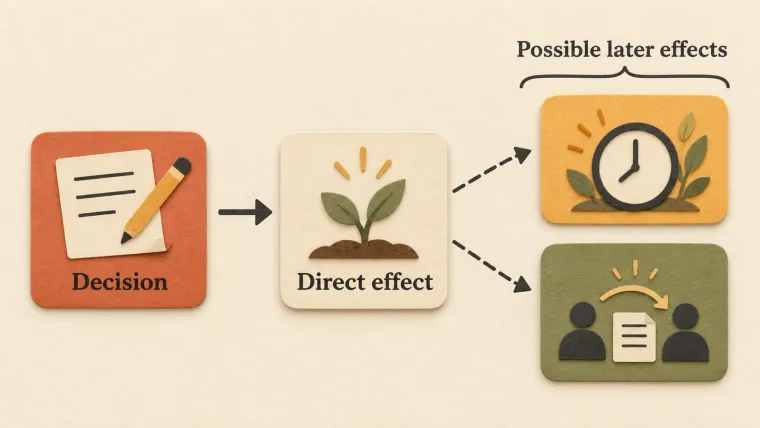
Ten private day-care centers in Haifa had a familiar problem: parents arriving after the 4 p.m. closing, leaving a teacher to wait with their children. In a study by economists Uri Gneezy and Aldo Rustichini, six of the centers introduced a small fine for lateness. Late pickups rose. When the fine was removed, they stayed high.
Second-order thinking means asking what happens after the first effect of a decision: how people, incentives, and information respond to the change, and what those responses cause in turn. The first-order effect of a fine is a cost for being late. The second-order effect depends on what the fine tells parents.
The fine that made parents later
Gneezy and Rustichini’s paper, “A Fine is a Price”, published in the Journal of Legal Studies in 2000, followed the centers for 20 weeks. For the first four, researchers simply counted late parents. At the start of week five, six randomly selected centers posted a note: from next Sunday, a fine of NIS 10 per child would be charged every time a child was collected after 16:10. The other four centers changed nothing.
The number of late-coming parents rose steadily for a few weeks, then settled at a level clearly higher than before. The fine was dropped at the start of week 17, with no explanation. Over the last four weeks, lateness stayed at the same high level. The control centers showed no noticeable change at any point.
| Order | What happened | Why, according to the authors |
|---|---|---|
| Decision | NIS 10 fine for pickups after 16:10 | Managers expected a penalty to deter lateness |
| First order | Lateness now cost money | The intended effect |
| Second order | Parents came late more often | The fine revealed that the worst consequence was a small, known charge, and it turned a favor into a service with a price |
| Third order | Lateness stayed high after the fine ended | Parents had learned the center was “mild,” and the old norm did not come back |
The authors’ explanation rests on information. Before the fine, the contract said nothing about lateness. Parents faced an unspecified risk, perhaps something serious, and kept delays rare. The fine replaced that uncertainty with a small known cost. Parents “slowly test the reaction of the day-care centers to higher levels of delays,” and when nothing happened beyond the fine, they kept going. A teacher’s unpaid goodwill had become something parents could buy for NIS 10.
First-order vs. second-order thinking
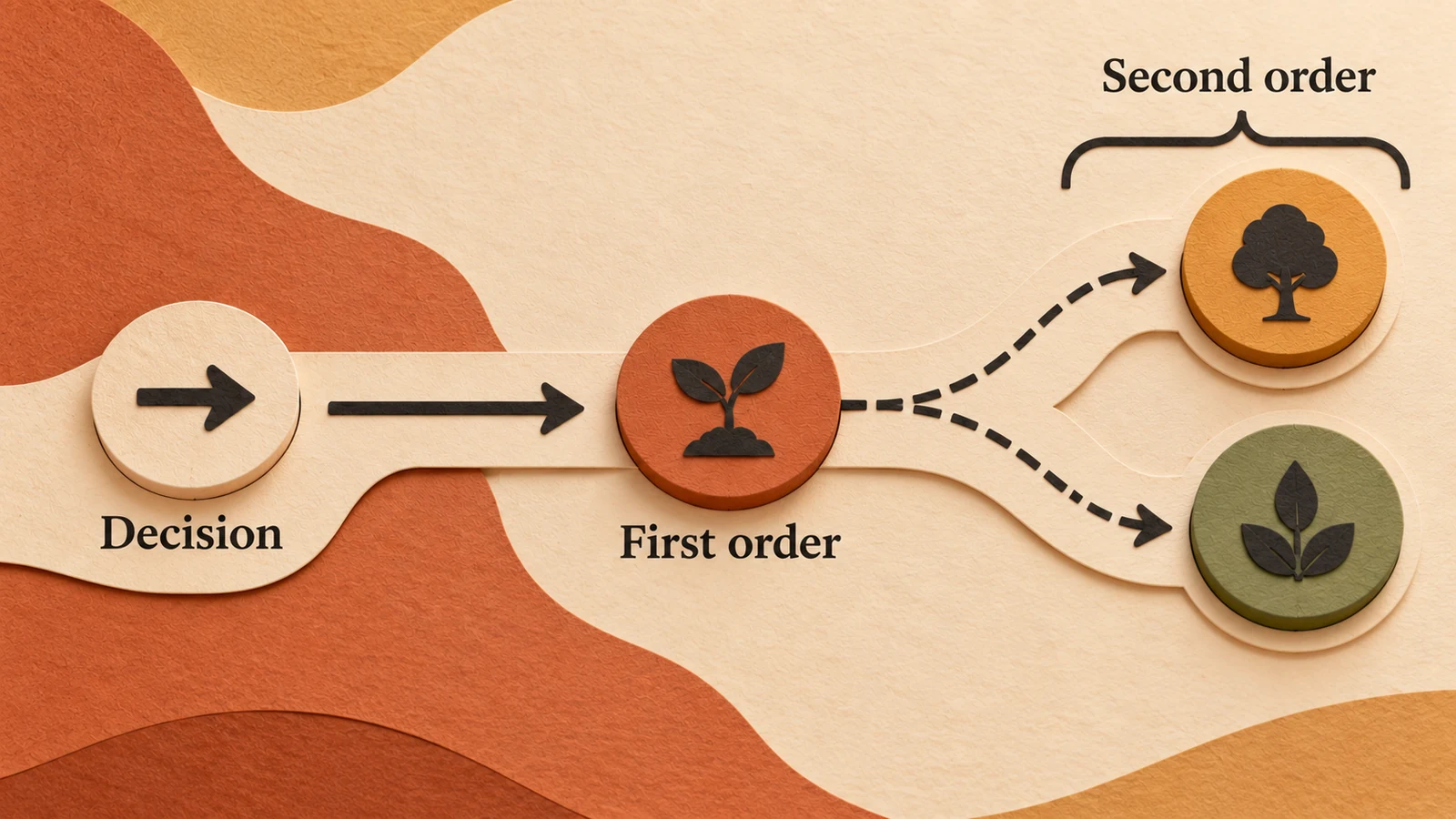
| Question | First-order thinking | Second-order thinking |
|---|---|---|
| What am I examining? | The direct effect of the action | What that direct effect could cause |
| Day-care example | Lateness now costs NIS 10 | Parents reinterpret what lateness means |
| What needs checking? | Whether the direct change occurs | The mechanism linking it to the next effect |
| What could be missed? | Costs outside the immediate result | How people respond, and what the change signals |
Order and timing answer different questions. The day-care effect showed up within weeks, but it was second order because it ran through the parents’ reading of the fine. A distant date does not make an effect second order. A chain of cause does.
The second effect usually hides in people’s response
Most decisions are judged on their direct effect because that is what the plan was built to produce. The surprises tend to come through three channels:
- Information. What does the change tell people about the rules, the risks, or you? The fine told parents the worst case was cheap.
- Incentives. What is now rewarded? Paying for dead cobras produced cobra farms, the story behind the cobra effect. Targets that become rewards drift from what they measured, as Goodhart’s law describes.
- Feedback. Does the effect circle back to the starting condition? Then it is a feedback loop, and it can keep growing after the decision.
The same channels show up in everyday decisions. These are hypothetical branches to test, not predictions:
| Decision | First-order effect | Possible second-order effect | Signal to watch |
|---|---|---|---|
| Replace the daily status meeting with a written update | Fewer meeting minutes | More focus time, or blockers stay hidden if nobody reads the update | Dependencies first noticed after their handoff was due |
| Run frequent discounts | Lower price, more sales this week | Customers learn to wait for the next sale | Full-price sales between promotions |
| Let a teammate approve routine requests | Shorter wait for approvals | Faster flow, or inconsistent approvals and rework if boundaries are vague | Requests escalated or reversed |
When a branch involves someone else’s behavior, check the process before judging their intent. Hanlon’s razor is a useful prompt there.
How to use second-order thinking
- State the decision precisely. “Charge NIS 10 for pickups after 16:10” can be examined. “Fix lateness” cannot. Keep an alternative on the page, including doing nothing.
- List the direct effects. Write what changes because of the action itself, separate from what you hope will improve.
- Trace a few branches. For each important direct effect, ask what it could change for people, incentives, workload, or information. Draw at least one unfavorable branch when one is plausible.
- Name the mechanism and the assumption. “Parents will avoid the fee” assumes the fee is the only consequence they care about. Mark each link as observed, inferred, or unknown.
- Choose an observable signal. Pick an event or count tied to the branch, and decide who records it and when.
- Run the smallest check that answers the question. The Haifa design, a few centers with a control group, is the model. For a hard-to-reverse choice, get more evidence or expert input before acting.
Write down what would make you keep, adjust, or end the change. When evidence challenges your preferred branch, the closed mindset guide helps give the objection a fair hearing.
A decision worksheet you can copy
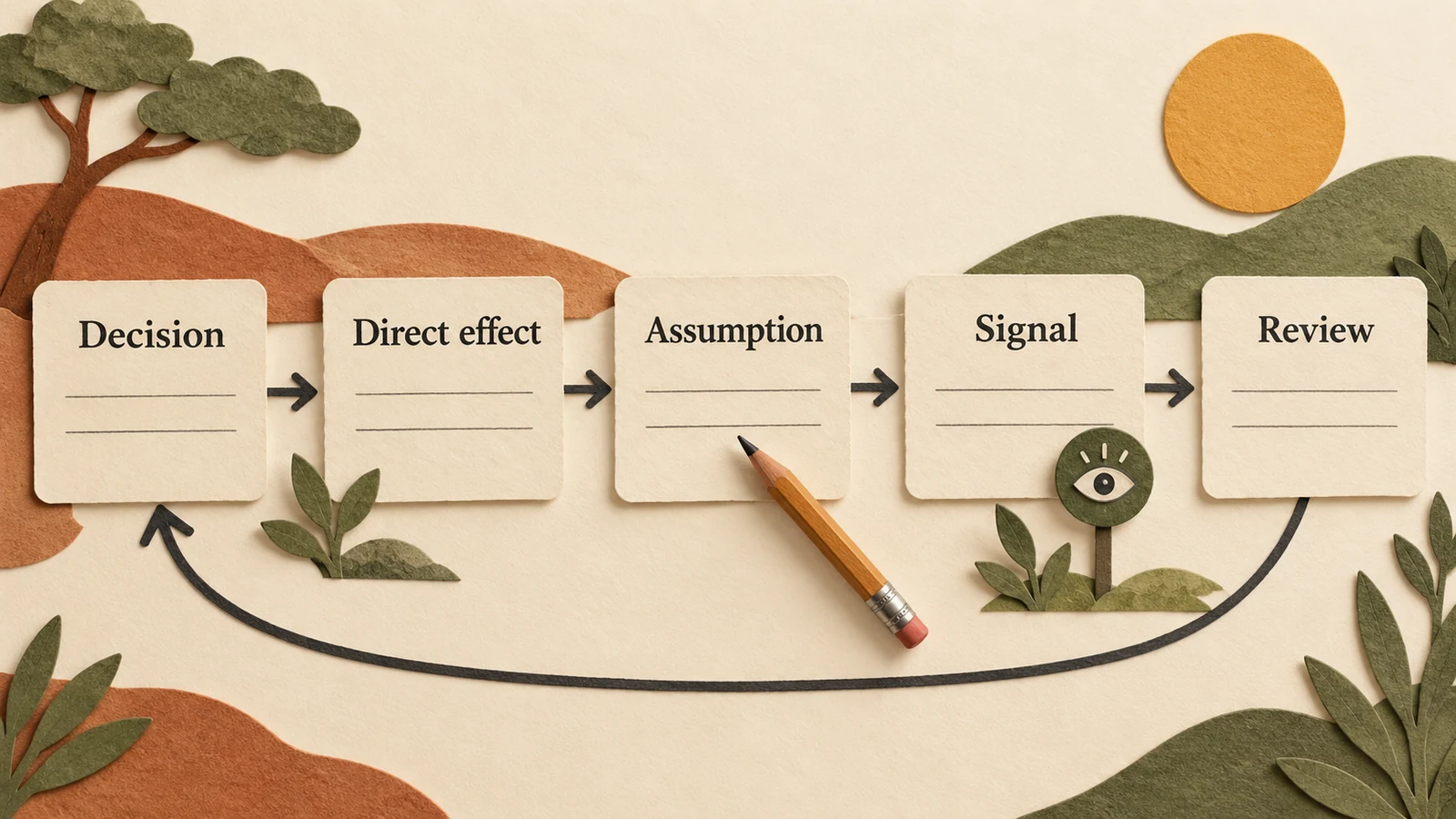
| Field | Your note |
|---|---|
| Decision and scope | What exactly will change, and for whom? |
| Alternative | What else could we do, including nothing? |
| Direct effect | What changes because of the action itself? |
| Possible next effect | What could that direct change cause? |
| Mechanism | Why might the connection hold? |
| Key assumption | What must be true, but is not yet established? |
| Observable signal | What event or evidence would show which branch is happening? |
| Review | When, or after what event, will we reconsider? Who checks? |
Filled in for the day-care fine, the key assumption would read: “Parents treat the fine as a punishment, not a fee.” The signal would be the weekly count of late pickups, compared with centers that did not add a fine. That comparison is what let the researchers see the problem clearly.
Where second-level thinking fits
Investor Howard Marks uses a related term, second-level thinking, with an extra question: how does your view compare with what other people expect, and with the price? In his 2015 memo, It’s Not Easy, he discusses the range of possible outcomes, the probability of being right, the consensus view, and how expectations relate to price.
That usage overlaps with looking past the obvious first impression, and it adds requirements a consequence chain does not capture. Holding a different view, or holding it longer, does not make it correct.
When second-order thinking backfires
A story turns into a forecast. A neat chain of “and then” feels like analysis. Mark each uncertain link and name the evidence it lacks.
One study becomes a law. Gneezy and Rustichini wrote, “We do not claim that the effect is similar every time a fine is introduced.” They noted that a large enough fee, proportional to the delay, would eventually reduce lateness. The lesson is to test how a penalty will be read before assuming fines always work, or always fail.
The branches never stop. Each extra branch should affect the decision or point to something worth checking. For a small, reversible choice, stop once you have found the consequence that could change your mind, its key assumption, and a check.
Frequently asked questions
What is the difference between first and second order thinking?
First-order thinking looks at the direct effect of an action. Second-order thinking looks at what follows from that effect, including how people respond. Timing is a separate question.
What are examples of second order thinking?
Asking whether a fine will be read as a price, whether frequent discounts will teach customers to wait, or whether removing a meeting will hide blockers. Each outcome stays conditional until you check it.
What is 2nd and 3rd order thinking?
A second-order effect follows through the first. A third-order effect follows through the second. In Haifa, the fine cost money (first), parents came later (second), and the new habit outlived the fine (third).
Your 5-minute “and then what?”
Decision (one sentence, with scope):
Direct effect:
What does this change tell people?
What does it now reward?
And then what? (one favorable branch, one unfavorable)
Key assumption behind the branch I'm betting on:
Signal I'll watch, and when I'll check it:
Pick one decision you expect to make this week and spend five minutes on it in Slow Down before you announce it.