
Hanlon’s razor is a rule of thumb for interpreting other people’s mistakes: consider an adequate nonmalicious explanation before deciding someone intended harm. Its familiar wording is “Never attribute to malice that which is adequately explained by stupidity.” Treat it as a prompt to check your explanation, not a guarantee that people mean well. A missed message may result from a wrong address, an overloaded inbox, or deliberate exclusion; the first observation does not tell you which. Separate what happened from what you inferred, look for evidence that distinguishes the explanations, and address the consequences while you investigate. Clear boundaries do not require certainty about someone’s motive.
What is Hanlon’s razor?
The maxim asks you to pause when a bad result immediately becomes a story about bad intent. An explanation involving confusion, missing information, or a process failure may fit the facts without a plan to hurt you.
“Adequately explained” does real work. It is not enough to imagine any innocent story. The story should fit what you observed and survive reasonable checks. If it requires ignoring inconvenient evidence, it is not an adequate explanation.
The traditional word “stupidity” is blunt and often unhelpful in an actual conversation. You can apply the principle more precisely by asking whether the person misunderstood the task, lacked access, overlooked a detail, or worked within a faulty system. Those are different causes with different remedies.
Hanlon’s razor is an adage, not a statistical law. It supplies no measured percentage of malicious behavior and cannot establish what a particular person intended. Its value is in helping you consider another explanation before escalating a conflict.
Why a bad result can feel personal
The APA’s definition of fundamental attribution error describes a tendency to emphasize someone’s personal characteristics while giving too little weight to the surrounding situation. That is a useful concept here, although it does not prove that any particular mistake was innocent.
A short reply can look dismissive when you read it without knowing the sender was answering between appointments. A late delivery can look disrespectful when you cannot see a broken handover. In each case, you observe the result but only part of the conditions that produced it.
You can also make the opposite mistake: build such a generous story that you stop noticing evidence of a repeated problem. The task is to improve the explanation, not to choose the most comforting one.
The daily critical-thinking exercises offer a practical way to separate an observation from an interpretation and record what would change your mind.
Examples: the invitation that never arrived

A missing invitation establishes a communication failure; it does not by itself establish exclusion as the motive.
This is a fictional workplace example. Your team held a meeting about a project you contribute to. You did not receive the invitation, and someone later mentions decisions made there.
Your first thought is: “They are trying to keep me out.” That is one explanation. Other possibilities include an outdated mailing list, a mistaken assumption about your role, or an invitation sent to an address you no longer use.
| Layer | What you can write |
|---|---|
| Observation | I did not receive the invitation; the meeting covered my project |
| Initial interpretation | Someone deliberately excluded me |
| Alternative explanation | The organizer used an old recipient list |
| Distinguishing check | Ask which list was used and whether my current address appears on it |
| Immediate repair | Request the notes and correct the recipient list |
| Revision trigger | The same exclusion occurs after my role and address are explicitly confirmed |
The check is better than an accusation because the explanations predict different evidence. An old list containing other obsolete addresses supports a process error. A current list that selectively omits you requires further explanation. Neither finding tells you everything about the organizer’s intentions.
You can keep the conversation concrete: “I missed the invitation, and this affects my work. Can we check the recipient list and add my current address?” That sentence names the harm and asks for a remedy without treating an inference as established fact.
How to use Hanlon’s razor
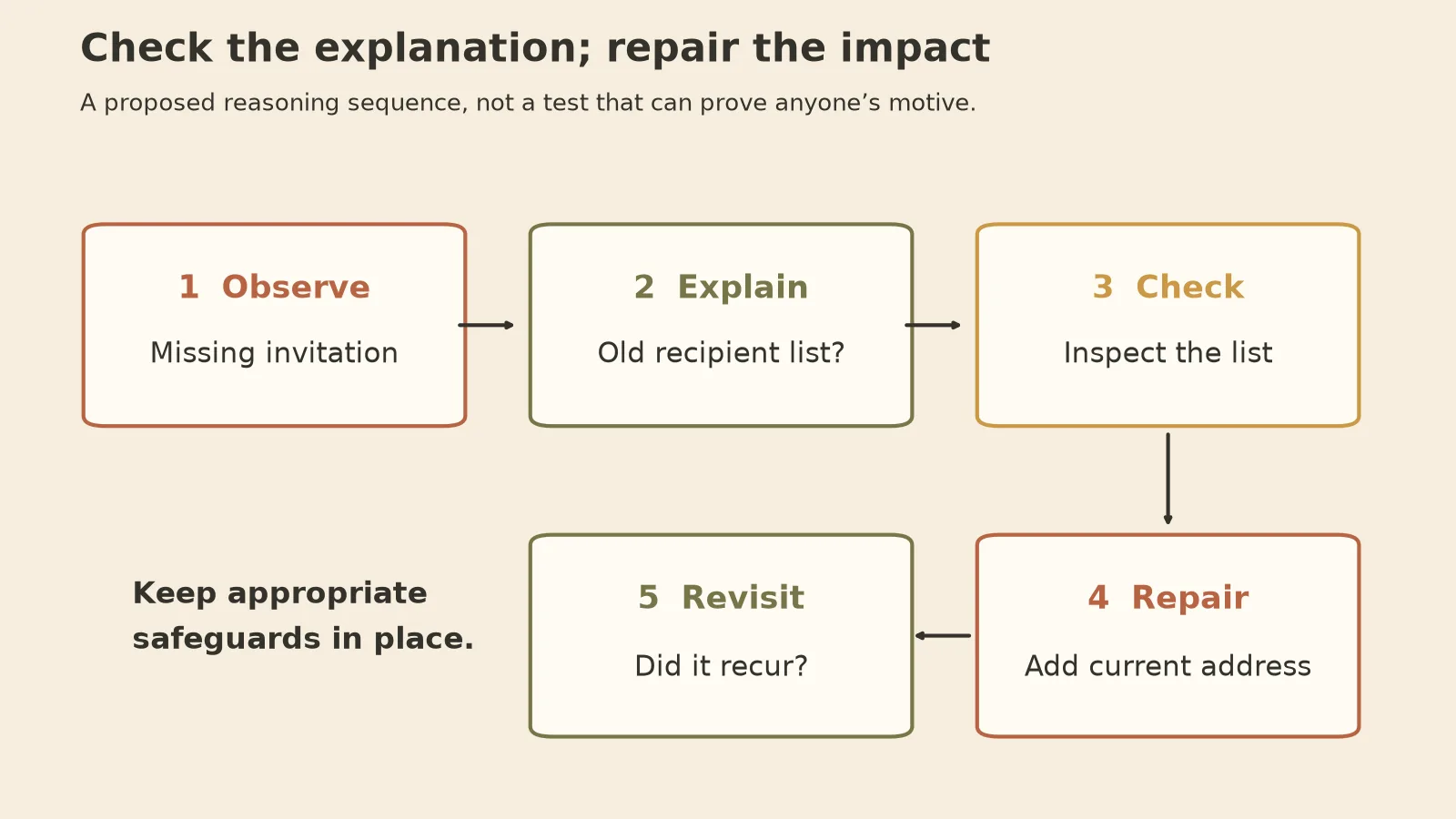
A useful alternative explanation predicts something you can check.
- Record the event without an intent claim. “The file was changed after approval” is an observation. “They wanted to sabotage me” is an interpretation.
- Name a plausible nonmalicious cause. Consider a misunderstood instruction, incorrect permissions, missing information, or a process failure.
- Ask what would distinguish it from your first explanation. Check the version history, recipient list, instructions, or sequence of events where appropriate.
- Repair the consequence. Recover the approved file, resend the message, or clarify responsibility. You do not have to wait for a complete account of motive.
- State what would change your judgment. Record what you expect after the correction, then compare the next observation with that expectation.
Keep the test proportionate. A curt message may warrant a clarifying question. A consequential failure may need a written record and a reliable review process. The maxim does not replace the practical safeguards appropriate to the situation.
It can also help to examine the system. If a process rewards rushing and never checks handovers, mistakes may reflect those incentives. Follow the incentives explains why a behavior’s surrounding rewards can matter even without coordinated bad intent.
Limits: when the default needs to change
An innocent explanation can coexist with a serious problem. Someone may repeatedly miss a deadline without wanting to hurt you; your work can still suffer. The response must account for the impact as well as the explanation.
| What you observe | What it supports | A proportionate response |
|---|---|---|
| One unexplained mistake | Motive remains uncertain | Clarify, check a plausible cause, and repair |
| A documented process problem | A system explanation is plausible | Correct the process and verify the result |
| Repetition after a clear correction | The original explanation is less adequate | Document the pattern, tighten review, and escalate as appropriate |
| Direct evidence of deliberate interference | The benign account may no longer fit | Respond to the evidence and protect the affected work or people |
This table is a proposed reasoning aid, not a diagnostic or legal test. Repetition alone does not prove intent. It can, however, make continued reliance on the same benign explanation unreasonable.
Where you face immediate danger or serious harm, prioritize protection and relevant help. You are not obliged to expose yourself to another incident just to test a philosophical maxim. For ordinary work conflicts, a useful boundary might be requiring approval before changes or moving a critical handover into a documented channel.
Accountability concerns what someone must repair or change. Motive concerns why they acted. Keeping those questions separate lets you address a failure without pretending to know more than the evidence shows.
Hanlon’s razor and Occam’s razor

Considering an error explanation does not require removing safeguards.
Occam’s razor concerns explanatory simplicity: avoid multiplying assumptions without a reason. The Stanford Encyclopedia’s discussion of simplicity explains that these principles involve important qualifications; the simplest-looking story is not automatically true.
Hanlon’s razor addresses a more specific temptation: explaining a bad result by attributing hostile intent when an adequate error explanation exists. It does not mean that an innocent explanation always uses fewer assumptions. A detailed excuse can be more complicated than a straightforward account of deliberate conduct.
Apply either principle alongside evidence. If new information makes your preferred story less credible, update it. A mental model should help you ask a better question rather than prevent an uncomfortable answer.
Is Hanlon’s razor wrong?
It is wrong when treated as an absolute: “People are never malicious, so ignore the evidence.” It is useful when treated as a check on an early inference: “I have observed a harmful result; have I tested an adequate alternative explanation?”
The same distinction applies to forgiving a mistake. Understanding why it occurred can inform your response, but it does not require unlimited trust, removal of consequences, or repeated tolerance of the same failure.
If the situation offers several possible remedies, the decision-making frameworks guide can help you compare their costs, reversibility, and responsibilities. Choose an action that addresses the actual problem while keeping uncertain claims about intent appropriately uncertain.
A short note to use after a conflict
Write five lines before sending a heated reply:
- What happened: .
- What I inferred: .
- Another explanation that fits the facts: .
- A check and a repair I can request: .
- Evidence that would make me revise my view: .
If you cannot name a reasonable check, acknowledge the uncertainty. You can still state the effect on you and ask for a specific change. If the check contradicts your initial interpretation, say so. Revising the explanation is the point of the exercise.
Frequently asked questions
What is the full quote of Hanlon’s razor?
The familiar wording is: “Never attribute to malice that which is adequately explained by stupidity.” It is a maxim for considering explanations, not a guarantee about anyone’s intentions.
What is Hanlon’s razor and Occam’s razor?
Hanlon’s razor prompts you to consider an adequate error explanation before attributing malice. Occam’s razor favors explanatory parsimony. Neither overrides evidence or establishes that a comforting explanation must be true.