Robert Moses never won an election. He ran for governor of New York once, in 1934, and lost. Yet for over 40 years he held up to 12 public titles at once and decided where New York’s bridges, parkways, and beaches went. Mayors and governors came and went. Removing him took a new state agency and a bank that chose not to sue.
Power dynamics describe how people’s abilities to influence an outcome interact in a group. Formal authority is one source. Expertise, money, information, access, and the ability to block or carry out a decision are others. The person who signs last is often not the person who shaped the options.
Moses’ power sat in tolls and fine print
Moses rose under Governor Al Smith in the 1920s and became known as “the best bill drafter in Albany,” according to his Wikipedia biography. Writing the bill meant he could set the terms of the jobs he later held.
His strongest post was chairman of the Triborough Bridge and Tunnel Authority (TBTA), from 1934 to 1968. As the New York Daily News put it, the authority “controlled millions of dollars in toll money,” most of which Moses “could spend as he pleased on projects he liked.” Mayor John Lindsay tried in 1966 to legislate Moses and the TBTA out of business. He failed.
Moses also misread his own position. In 1962, when Governor Nelson Rockefeller wanted his state parks chairmanship, Moses threatened to resign all of his state posts. That move had always worked on lesser politicians. This time the governor let him go. Moses still kept the TBTA, and with it, in the Daily News’ words, “the power of the purse.”
The end came through the fine print. The legislature voted to fold the TBTA into the new Metropolitan Transportation Authority. Because the bond contracts were written into state law, bondholders could have sued. The largest holder, and agent for the rest, was Chase Manhattan Bank, then headed by David Rockefeller, the governor’s brother. No suit was filed. On March 1, 1968, the TBTA became part of the MTA, and Moses got a consultancy with “the trappings of power, but no real power itself.”
| What looked like the power | Where Moses’ influence came from |
|---|---|
| Elected office | He never held one and lost his only race |
| A mayor’s or governor’s signature | Bill language he often drafted |
| The city budget | Toll revenue the TBTA controlled |
| The power to fire him | Bond contracts written into state law |
Titles explain less than the five bases
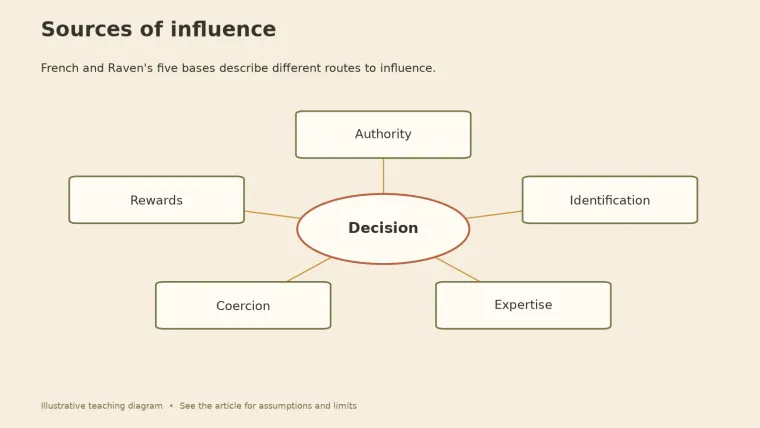
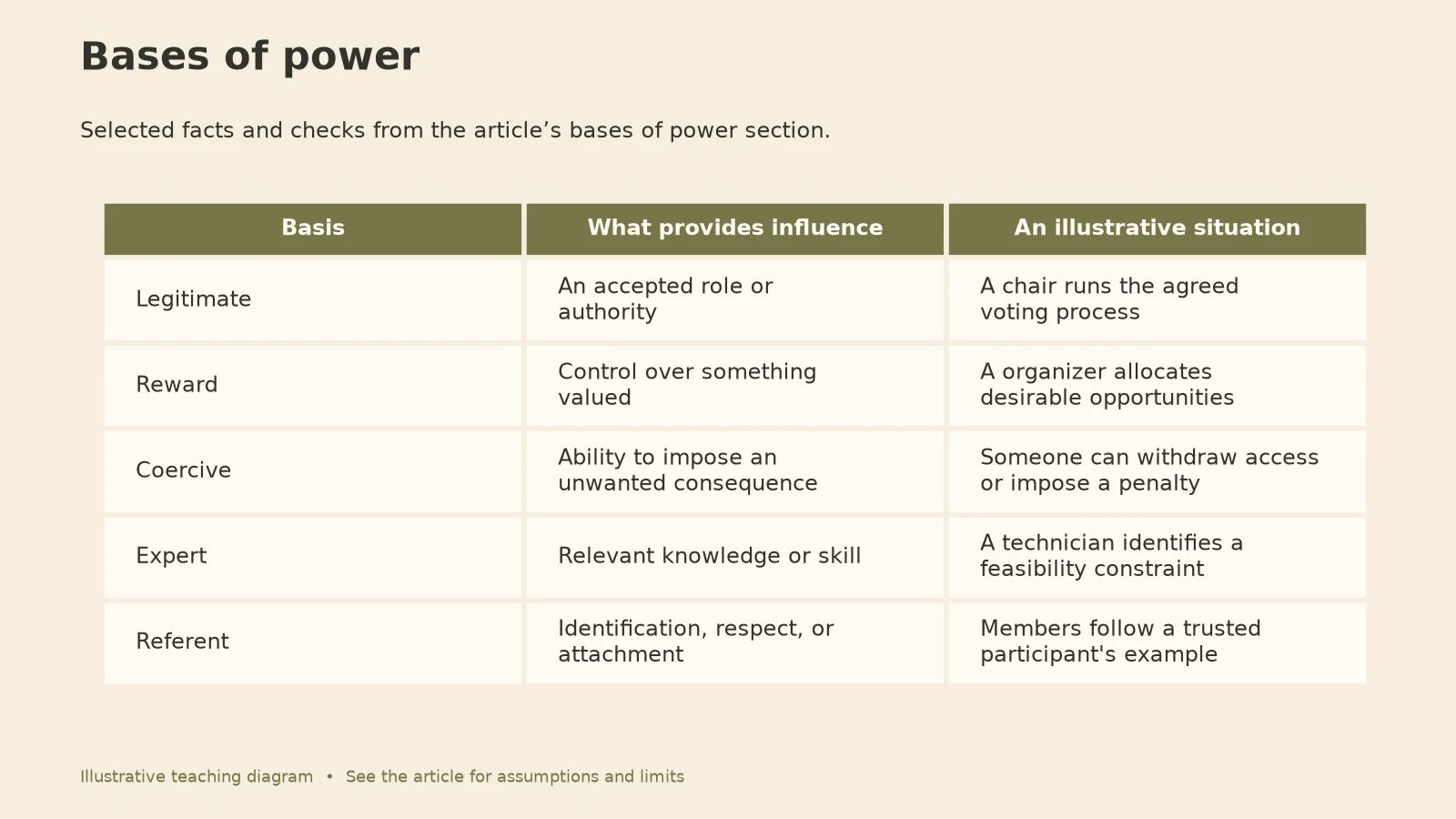
French and Raven’s original social-power framework distinguishes legitimate, reward, coercive, expert, and referent power. These describe different reasons one person’s influence can affect another.
| Basis | What provides influence | An illustrative situation |
|---|---|---|
| Legitimate | An accepted role or authority | A chair runs the agreed voting process |
| Reward | Control over something valued | An organizer allocates desirable opportunities |
| Coercive | Ability to impose an unwanted consequence | Someone can withdraw access or impose a penalty |
| Expert | Relevant knowledge or skill | A technician identifies a feasibility constraint |
| Referent | Identification, respect, or attachment | Members follow a trusted participant’s example |
Moses drew on several at once. His titles gave him legitimate power. Toll money let him reward allies with projects. His legal and engineering skill was expert power. The categories overlap, and the table does not rank them or imply that every use of authority is improper.
Trace one decision before you judge a group
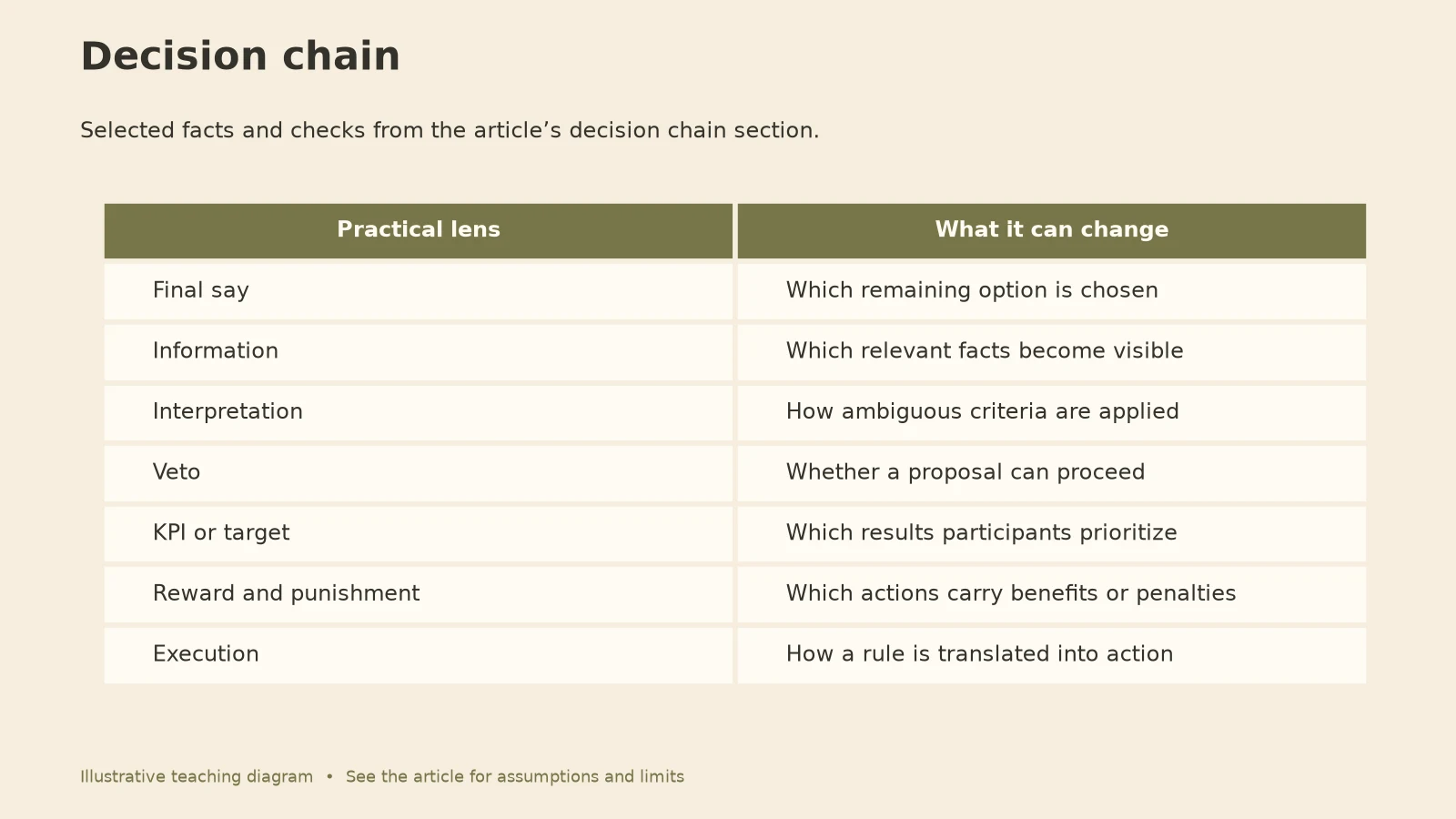
Start with one decision rather than a general claim that a place is “political.” The thirteen lenses below are an original diagnostic map of where influence can appear along a process. They are not a validated scientific typology.
| Practical lens | What it can change |
|---|---|
| Final say | Which remaining option is chosen |
| Information | Which relevant facts become visible |
| Interpretation | How ambiguous criteria are applied |
| Veto | Whether a proposal can proceed |
| KPI or target | Which results participants prioritize |
| Reward and punishment | Which actions carry benefits or penalties |
| Execution | How a rule is translated into action |
| Resources | Whether money, time, or capacity is available |
| Agenda | What is discussed and when |
| Access | Who can raise an issue with the relevant person |
| Relationships | Whose support helps a proposal travel |
| Appointment | Who occupies a role with decision rights |
| Exception | Who can depart from the normal process |
Run Moses through it. Drafting bills gave him the agenda and interpretation. Tolls gave him resources. His own staff handled execution. The bond contracts worked like a veto over any attempt to restructure him. A mayor had final say on paper, but over options Moses had already shaped.
The same lenses apply to a team choosing new software. If a proposal never reaches the shortlist, the person who signs cannot choose it. The information-asymmetry guide explains why controlling relevant facts can affect a choice without any change in the formal hierarchy. A target can also steer people, as Goodhart’s law shows.
Map power with evidence
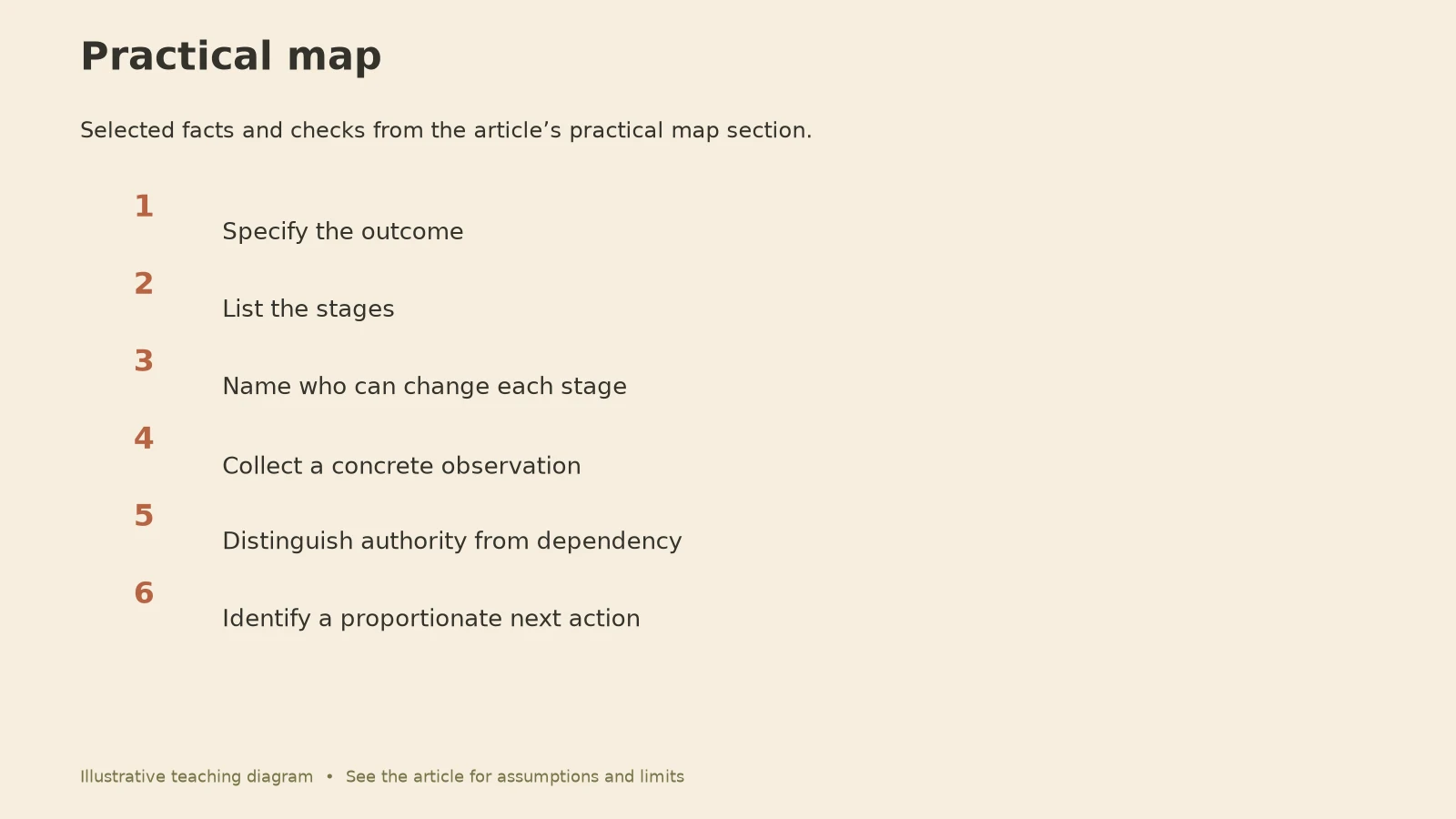
Use this original mapping procedure when a decision feels hard to read:
- Specify the outcome. “Choose the team’s new software” is more useful than “understand the department.”
- List the stages. Include proposal, filtering, interpretation, approval, funding, and execution where relevant.
- Name who can change each stage. Record the action they can take, beyond their title.
- Collect a concrete observation. A written approval rule is stronger evidence than an assumption that somebody has influence.
- Distinguish authority from dependency. An expert can affect feasibility without owning the final choice.
- Identify a proportionate next action. Request missing information, clarify a decision right, or make the criteria visible.
A compact record might read: “Finance checks affordability; a tool above the approved budget cannot proceed; this is in the published purchasing rule.” That is easier to assess than “finance controls everything.” For day-to-day roles, see the workplace power-dynamics guide.
When power mapping backfires
- You read motives into delays. A slow answer could reflect a queue, missing evidence, or competing work. Hanlon’s razor is a good reminder, with safeguards kept in place.
- You overrate your own position. Moses assumed his resignation threat would work in 1962 because it always had. Maps go stale when the other side’s position changes.
- You treat the map as a manipulation plan. Clear criteria, accessible information, and explicit responsibilities often fix more than finding a stronger ally.
Questions
Is power dynamics always about hierarchy?
No. Formal rank is one source. Expertise, dependency, relationships, resources, and access matter in groups without a clear hierarchy.
Does an imbalance mean someone is abusing power?
No. Unequal responsibilities and expertise are common. Misuse needs evidence about conduct, rules, and effects, beyond the imbalance itself.
How do I avoid reading motives into everything?
Describe observable actions and decision rights first. “The proposal requires this approval” is a checkable claim. “The approver wants to undermine us” needs much stronger evidence.
Your 5-minute power map
One decision I care about:
Stages it passes through:
Who can change each stage (action, not title):
One piece of written evidence for each:
Where I depend on someone without authority over me:
A benign explanation I haven't ruled out:
My one proportionate next step:
Pick one stalled decision this week, then use Slow Down to map it before you react.