The Veil of Ignorance: What It Is and Why It Matters for Fairness

Learn what the veil of ignorance is, who introduced it, how it works, its criticisms, and real-world applications for fair decision-making.

The veil of ignorance is a thought experiment that asks you to design society’s rules without knowing who you’ll be in that society. Source This simple tool forces you to consider everyone’s interests, not just your own. Behind the veil, you don’t know your wealth, gender, race, or abilities, so you can’t rig the game in your favor. That is why it matters for fairness.

🎯 The veil of ignorance is a mental model for impartial decision-making. If a rule seems fair only because you know you’ll be on the winning side, it probably fails the test.

What Is the Veil of Ignorance?

Definition

The veil of ignorance is a thought experiment introduced by philosopher John Rawls in his 1971 book, A Theory of Justice. Source It is a tool for evaluating the fairness of societal structures and institutions. Source The core idea is that if you don’t know your own social status, talents, or personal circumstances, you’ll choose principles that don’t unfairly favor any particular group. Source Rawls argued that such principles would prioritize equal rights, social cooperation, and the well-being of all members of society, including the least advantaged. Investopedia

The veil is not a real object; it is a mental device to block out self-interest. When you cannot see your own position in society, you cannot tailor rules to benefit people like you. This forces you to think from the perspective of every possible person who might be affected by those rules.

The Purpose of the Veil

The purpose of the veil is to ensure fairness and impartiality when designing rules and institutions. Source By imagining yourself behind a veil where you lack knowledge of your social status or talents, you are more likely to create a society that treats everyone fairly. Source The approach helps ensure that policies and systems serve the interests of all, not just the powerful. Investopedia

Imagine you are designing a tax system behind the veil. You don’t know if you’ll be born rich or poor, healthy or disabled. So you would likely support a progressive tax that funds education and healthcare, because you might end up needing those services. This hypothetical example shows how the veil nudges you toward rules that protect the worst-off. (Hypothetical)

💡 To use the veil in your own life, ask: “If I didn’t know my position in this group, what rule would I want?”

Who Introduced the Veil of Ignorance?

John Rawls and A Theory of Justice

The veil of ignorance was popularized by the American philosopher John Rawls through his 1971 book, A Theory of Justice. Source Rawls built on earlier social contract theorists like Locke, Hobbes, and Rousseau, but he added the veil as a device for impartiality. Source He proposed that the fairest principles of governance are chosen from an “original position” where decision-makers are behind a veil that hides their future social status, abilities, and personal circumstances. Everyday Concepts

Rawls’s innovation was to combine two older ideas: the social contract, which says legitimate government comes from agreement, and the idea of impartiality. By adding the veil, he made the agreement fair because no one could negotiate for personal advantage. The concept became a key idea in moral and political philosophy, influencing discussions on fairness, equality, and social justice. Investopedia

He wanted a theory that protected each person’s basic rights even if the majority benefits. The veil is the engine of that protection: because you don’t know if you’ll be a minority, you won’t agree to rules that sacrifice minorities for the majority.

How Does the Veil of Ignorance Work?

The Original Position

Rawls asks you to imagine a group of rational people choosing the basic principles for a society from behind the veil. Source In this “original position,” they have no knowledge of their personal characteristics, natural abilities, socioeconomic status, or conception of the good life. Source Because they don’t know who they’ll be in that society, they must think about everyone’s interests equally. Source This setup is a thought experiment, not a description of how actual people decide. Claremont Review of Books

The original position is not a real meeting; it’s a model. It strips away all the concrete facts that normally bias our judgments. The people in the original position know general truths about society, like economics and human psychology, but they don’t know their own place in that society. That ignorance is what makes the choice fair.

The Fairness Principle

The people behind the veil are risk-averse: they care more about avoiding a terrible outcome than about maximizing a great one. Source So they choose principles that protect the worst-off position. Source Rawls called this the “difference principle”: inequalities are allowed only if they benefit the least advantaged. Source Before that, they choose equal basic liberties for all and fair equality of opportunity. Claremont Review of Books
This risk-aversion is crucial. If you were a gambler who loved huge payoffs, you might accept a society with massive inequality because you might end up rich. But Rawls assumes most people are not willing to gamble with their basic life prospects when they don’t know the odds. So the rational choice is to guarantee a decent floor for everyone.

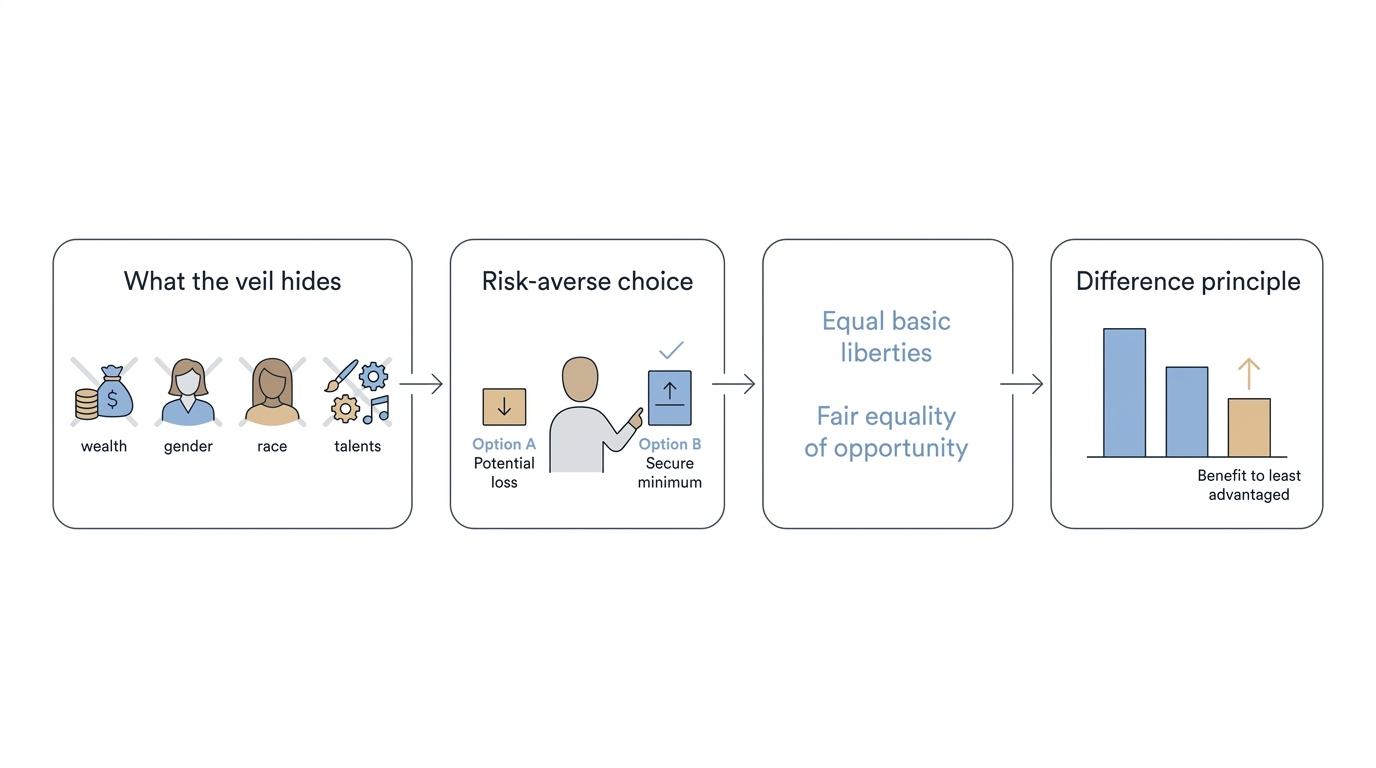
The veil hides wealth, gender, race, and talents, which pushes people toward a risk-averse choice, equal basic liberties, fair equality of opportunity, and the difference principle

The Fairness Principle and Veil’s Impact

What Is the Fairness Principle?

The fairness principle is the rule that a decision is just if you would accept it without knowing your own place in the outcome. Source It turns fairness into a test of impartiality. You can apply this test to any policy, from a workplace rule to a national law. The veil of ignorance is the mental tool that forces you to apply the fairness principle.

Impact on Fairness

The veil pushes decisions toward equal rights, social cooperation, and care for the least advantaged. Source When you can’t tailor rules to your own advantage, you naturally favor rules that don’t leave anyone drastically worse off. Source This is why the veil is often used to critique policies that benefit the rich or powerful at the expense of the vulnerable. Investopedia

For example, when a company sets its pay scales, a leader behind the veil would ask: “If I didn’t know whether I’d be the CEO or the janitor, what salary structure would I want?” That question tends to produce a more equal distribution than the leader might otherwise choose. (Hypothetical)

Comparison with Tragedy of the Commons

In the tragedy of the commons, individuals acting in their own self-interest deplete a shared resource, like a pasture open to all herders. Source If those herders were behind the veil, they would likely divide the common land evenly and limit the number of cattle each could graze to prevent depletion. Source The veil can make the long-term shared interest outweigh short-term self-interest.

This comparison shows the veil’s power to solve collective action problems. Without the veil, each herder thinks, “If I don’t graze more, someone else will.” But behind the veil, no one knows which herder they’ll be, so the rational choice is to agree on limits that benefit everyone.

Criticisms of the Veil of Ignorance

Common Critiques

Critics raise three main objections. First, the veil offers limited guidance for concrete policy: it stays at the level of abstract principles and doesn’t tell you how to design specific institutions. Source Second, it focuses on individual rights and liberties and may overlook group rights and collective interests. Source Third, some argue it oversimplifies human nature or assumes cultural universals that not everyone shares. Investopedia

Each critique deserves a response. On the lack of concrete guidance, some defenders respond that Rawls never claimed the original position was a policy manual; it sets the rules for evaluating policies, not the policies themselves. On group rights, defenders note that Rawls’s principles include fair equality of opportunity, which can address systemic group disadvantages, though critics argue it may not be enough. On cultural relativism, according to a review in Claremont Review of Books, Rawls later argued that his theory could work within an “overlapping consensus” of different worldviews, so it does not require everyone to share the same comprehensive doctrine. Claremont Review of Books

⚠️ The veil of ignorance is not a policy manual. Use it as a directional test, not a detailed blueprint.

Despite these criticisms, the veil of ignorance remains influential in moral and political philosophy, providing valuable insights into how we can strive for a more just society. Investopedia

Real-World Applications and Examples

Ways to Apply the Veil

You can use the veil in three practical ways: evaluating proposed policies, designing organizational rules, and checking personal ethical decisions. For example, a manager deciding on a new remote work policy might imagine not knowing whether she will be a junior employee or a senior executive. That perspective encourages rules that are fair across all levels. Similarly, a city council considering a zoning change could ask whether it would support the change if it didn’t know where its members would live. (Hypothetical)

The Leadership Version

An adapted version of the veil can be a powerful tool for business leaders. Source If you’re a CEO, ask yourself what rules you would want if you didn’t know your role in the company. This forces you to think beyond the interests of top management and consider the experience of every employee, from intern to executive. The author of that article argues this exercise should be mandatory for every business leader. Corporate Rebels

For instance, a founder designing a stock option plan behind the veil would not know if they’ll be the founder or an early employee. So they might avoid a plan that heavily favors founders and leaves little for the first hires. This hypothetical shows how the veil can correct power imbalances in real organizations. (Hypothetical)

Where the Veil Is Already Built Into Real Institutions

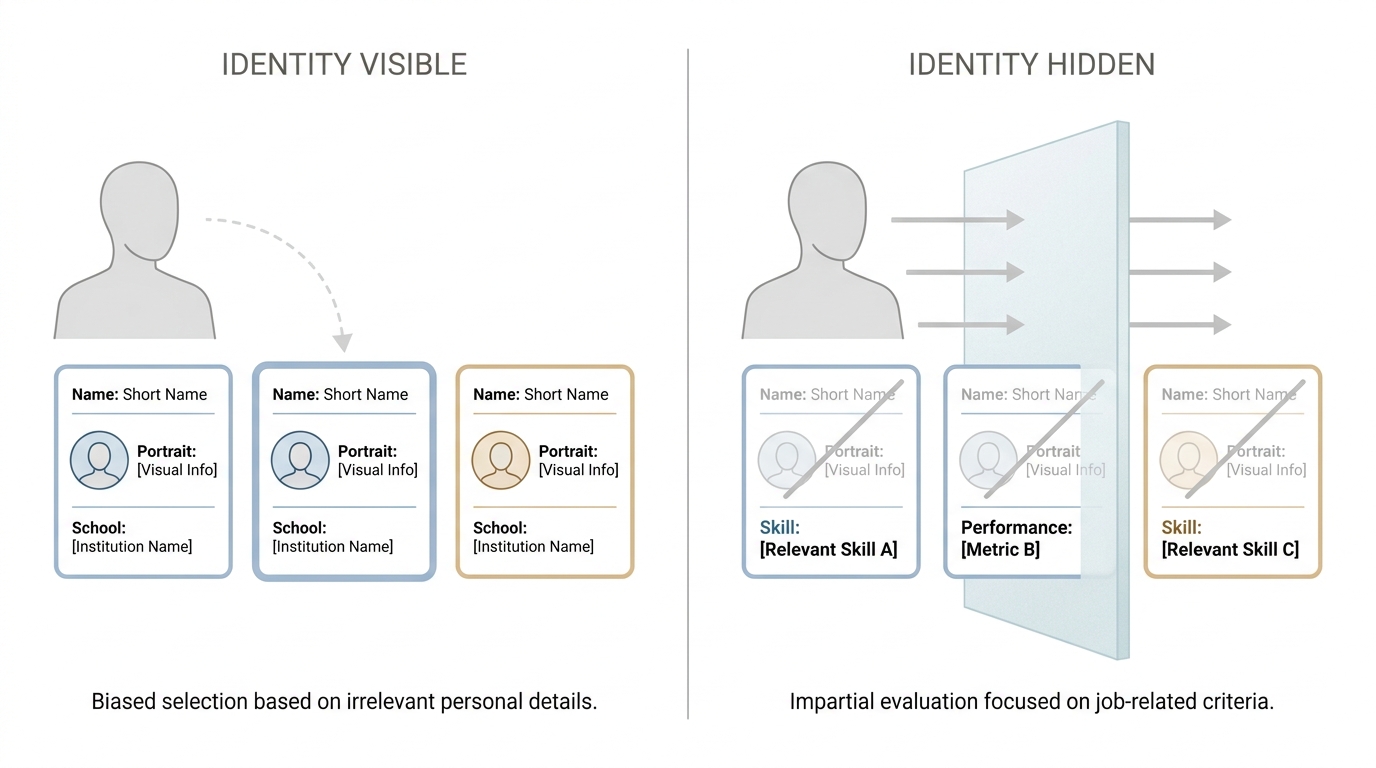
Some organizations do not merely imagine the veil — they engineer it into their procedures by hiding identifying information from the decision-maker.

  • Blind orchestra auditions. When symphony orchestras adopted auditions with a screen concealing the candidate’s identity from the jury, the probability that women were advanced and hired rose substantially. Source The authors concluded that the blind procedure “fostered impartiality in hiring” and increased the proportion of women in orchestras. Goldin & Rouse, American Economic Review
  • Double-blind peer review. The researchers themselves noted that blind audition procedures “bear some resemblance to ‘double blind’ refereeing in academic journals,” where the reviewer cannot see who wrote the paper. Source
  • Blind résumé screening. Stripping names, schools, and photos from applications is the same move applied to hiring: remove the information that lets bias operate. Source

The pattern is consistent: wherever you can physically remove identifying information from a decision, you can approximate the veil instead of only imagining it.

Two panels comparing an evaluator who can see candidates' names, photos, and schools with an evaluator separated by a screen who sees only skill and performance information

Public Policy: Insurance, Taxes, and Scarce Medical Resources

  • Organ allocation. Bioethicists have argued that rational planners behind the veil, “ignorant as to whether or not they will ever need a transplant or retransplant,” would increase their own expected benefit by distributing scarce organs to those most likely to gain long-term survival. Source US organ-allocation policy separately commits to not allocating on morally irrelevant criteria such as sex, ethnicity, socioeconomic status, or geography. OPTN ethical principles
  • Social insurance. Private insurers compete by segmenting people into homogeneous risk pools, which is exactly the knowledge the veil removes. Mandatory social insurance with subsidies for high-risk members is the policy form of “choose the system before you know your own risk.” Source
  • Wealth distribution. Norton and Ariely gave a nationally representative US sample an explicit Rawlsian veil: pick a country to live in, knowing you will be randomly assigned to one of its five wealth quintiles. Around 92% chose a Sweden-like distribution over the actual US one — a result that held across gender, income, and 2004 vote. Norton & Ariely, Perspectives on Psychological Science
  • Taxation and redistribution. Because Rawls’s framework judges societies by how well they provide for their poorest members, it is regularly invoked to defend stronger safety nets — though the framework itself stays agnostic about the specific institutions that deliver them. Source

Governing AI From Behind the Veil

The veil has become a working tool in AI governance, not just an analogy.

In five incentive-compatible studies with 2,508 participants (two preregistered), people chose principles to govern an AI assistant either knowing or not knowing their own relative position in the group. Those behind the veil more frequently chose — and endorsed on reflection — principles that prioritize the worst-off, and the effect was driven by increased consideration of fairness rather than by political orientation or risk attitudes. The authors conclude the veil “may be a suitable process for selecting principles to govern real-world applications of AI.” Weidinger et al., PNAS 2023

In machine learning, the veil also maps onto technique: excluding arbitrary distinctions is analogous to removing biased features or inputs from a model, and fairness-aware methods try to operationalize the Rawlsian ideal in domains like criminal justice risk scoring. Source One line of work proposes evaluating a model’s fairness by asking what a decision-maker would accept if they did not know which subject they would turn out to be. Source

A Quick Field Guide: Veil Questions by Decision

Decision you faceThe veil question to askWhat usually changes
Setting pay bands or equityIf I were randomly assigned to any role here, would I accept this structure?Compresses top-to-bottom spread
Hiring and promotionCan I remove names, schools, and photos from this stage?Fewer identity-driven judgments
Layoff or budget cutsWould I endorse this rule not knowing which team I’m on?Rules over ad hoc exceptions
Remote-work or on-call policyWould I accept this as a junior and as an executive?Protects the weakest position
Rationing scarce resourcesWould I accept this if I might be any patient in the queue?Explicit, transparent criteria
Deploying an AI systemWould I accept this system if I were the person it scores worst?Guardrails for the worst-off

What Science Says

The veil began as philosophy, but it now has a real experimental track record — which is a change from how it is often described.

  • It shifts choices toward the greater good. Across 7 experiments with 6,261 participants (4 preregistered), participants who first asked themselves what they would want if they did not know who among those affected they would be subsequently made more utilitarian choices — on a classic philosophical dilemma, a medical dilemma, a real donation decision between a more versus less effective charity, and a policy decision about autonomous vehicles. Source The effects depended on the impartial thinking the veil induces and could not be explained by anchoring, probabilistic reasoning, or generic perspective-taking. Huang, Greene & Bazerman, PNAS 2019
  • It works under real crisis pressure. Applied to the COVID-19 ventilator dilemma, two preregistered studies (N = 414; replication N = 1,276) found that veil-of-ignorance reasoning shifted preferences toward saving younger patients, and the effect on older participants was dramatic enough to reverse their opposition to favoring the young. Source
  • It isolates self-serving bias. In an experimental study of climate-change negotiations, a veil-of-ignorance procedure separated self-serving bias from genuine cultural differences in fairness perceptions, showing that self-serving bias itself contributes to negotiation deadlock. Source

The honest caveat still holds at the level of concrete allocation: critics argue that choice behind a veil often fails to give clear guidance on specific resource-allocation questions, and that its outputs do not automatically carry moral authority. Source Treat the evidence as showing that the veil reliably changes how people reason — more impartially, more protective of the worst-off — not that it hands you a finished policy.

💡 Next time you face a tough decision, pause and ask: “Would I still support this if I were randomly assigned to any affected position?”

Tags:
  • #philosophy
  • #fairness
  • #justice
  • #thought experiment
  • #ethics
  • #decision making