Ethos, pathos, and logos are three ways to persuade someone. They come from Aristotle, the ancient Greek philosopher. You use them every day, often without thinking. This guide explains each one with clear examples. You’ll also learn how to mix them for your own writing and speeches.
🎯 Short answer: Ethos is about your credibility. Pathos is about emotion. Logos is about logic. Most strong arguments use all three.
What Are Ethos, Pathos, and Logos?
Aristotle called them the “modes for persuasion.” Source They are tools for convincing others to agree with you. You see them in ads, speeches, essays, and everyday conversations.
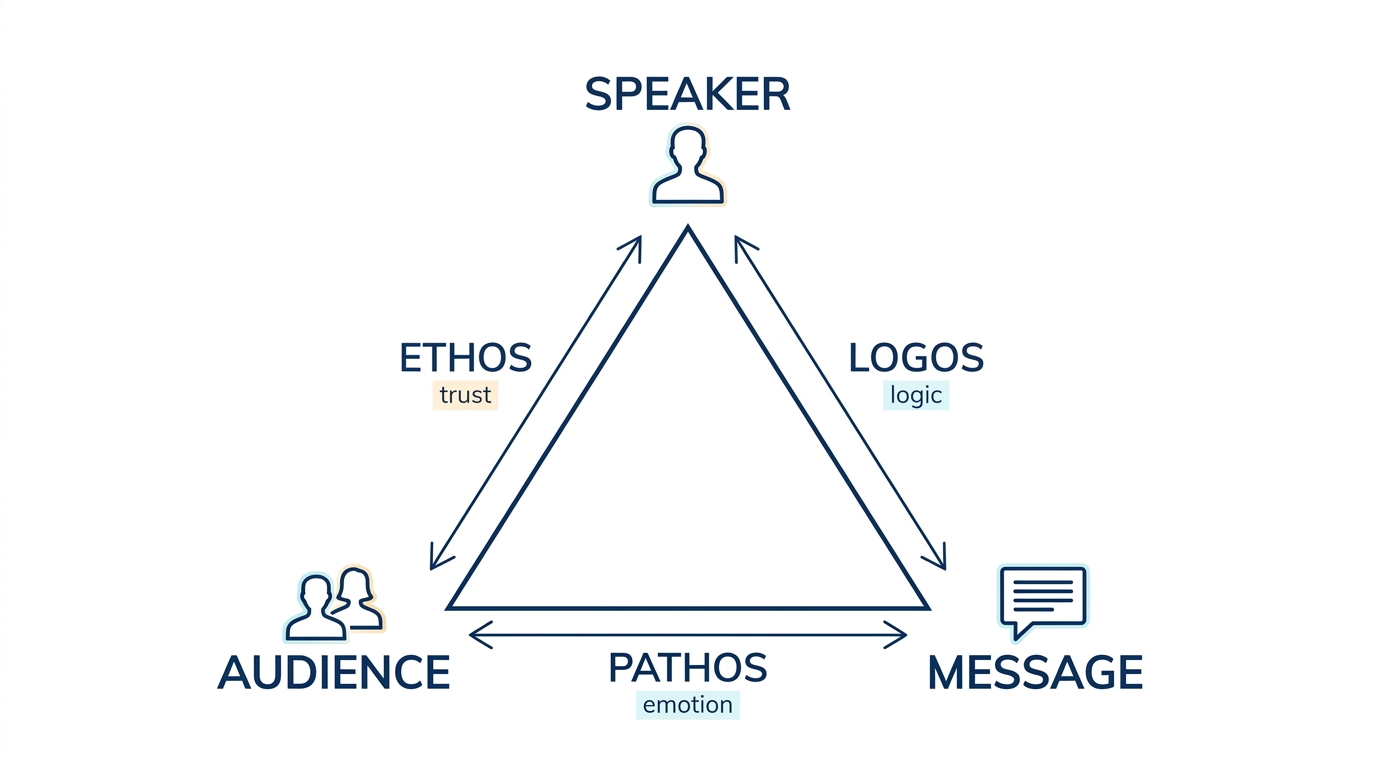
The Rhetorical Triangle: Speaker, Audience, Message
Think of a triangle. One corner is the speaker (you). One corner is the audience. The third corner is the message. Source Ethos connects the speaker to the audience. Pathos connects the audience to the message. Logos connects the message to the speaker. All three work together.
To put these appeals into a discussion without losing the question at issue, read how to win an argument.
Ethos: Appeal to Credibility
Ethos is about trust. Source Your audience asks: “Why should I listen to you?” You build ethos by showing you know your topic. You can mention your experience, your credentials, or your character. For example, a doctor giving health advice has ethos. A celebrity endorsing a product also uses ethos, even if they are not an expert.
Pathos: Appeal to Emotion
Pathos targets feelings. Source You want your audience to feel something: joy, fear, anger, pity, hope. Stories and vivid language create pathos. A charity ad showing a hungry child uses pathos. A politician talking about a struggling family uses pathos. It works because emotions drive decisions.
Logos: Appeal to Logic
Logos uses reason. Source You present facts, statistics, and clear arguments. Your audience asks: “Does this make sense?” A scientist presenting data uses logos. A lawyer laying out evidence uses logos. Logos appeals to the rational mind.
💡 Remember: Ethos = trust, Pathos = emotion, Logos = logic. If you forget, think: “credibility, feelings, facts.”
Now that you know the basics, let’s look at real examples.
Real-Life Examples of Ethos, Pathos, and Logos
You can find these appeals everywhere. Here are examples from famous speeches, literature, and daily life. The focus is on how each appeal works, not on reproducing exact wording.
Ethos Examples in Speeches and Literature
Martin Luther King Jr.’s “I Have a Dream” speech uses ethos. He speaks as a leader in the civil rights movement, and his moral authority makes people listen. His credibility comes from his position and his character. Source
Everyday Examples You Can Use
You don’t need a famous speech to see these appeals.
- Ethos: Your friend who has worked as a mechanic for many years tells you a car is a good deal. You trust their judgment because of their experience.
- Pathos: A coworker warns that missing a deadline will upset the team and create stress. They make you feel the pressure.
- Logos: A parent points to studies showing helmets reduce head injuries and tells you to wear one. They use evidence and reason.
💡 Try this: Next time you watch a commercial, pause and ask: Is this using credibility, emotion, or logic? You’ll start seeing the appeals everywhere.
Now let’s focus on advertising, where these appeals are most obvious.
Ethos, Pathos, and Logos in Advertising and Commercials
Advertisers use these appeals constantly. Source Here’s how to spot them.
Ethos in Advertising: Credibility and Authority
Ethos ads use experts or celebrities. Source Source A toothpaste ad might show a dentist recommending the brand. A sports drink ad might feature a famous athlete. The implied message is that a credible person makes the product seem good.
Pathos in Advertising: Emotion and Bandwagon
Pathos ads make you feel something. Source A car commercial might show a happy family on a road trip. A charity ad might show a suffering animal. The goal is to create an emotional connection.
“Bandwagon advertising” is a type of pathos. It says, “Everyone is using this product, so you should too.” It plays on your fear of missing out.
Why Emotional Appeals Look Weaker Outside the Lab
Almost every guide leans on the same study. In 2007, Small, Loewenstein, and Slovic (Organizational Behavior and Human Decision Processes) found that people gave more to help one named child than to relieve a famine described with statistics. That single result is why “tell one person’s story” became standard advice.
The follow-up evidence is messier:
- A meta-analytic review by Lee and Feeley (Social Influence, 2016) found the effect is dependable only under narrow conditions: a single identified victim, often a photographed child in poverty who carries little blame for the situation, plus a request for money.
- A field experiment mailed real appeals to 25,797 past donors of a working charity (Applied Economics, 2015). The letter built around one identifiable victim did not raise donations significantly compared with the statistical version.
- A 2023 replication in Collabra: Psychology found no support for the effect in hypothetical donation tasks.
The lab and the mailbox disagree, and both readings are worth keeping. In a quiet room with one story in front of you, emotion moves money. In a mailbox full of competing appeals, it mostly does not.
Research on “narrative transportation” — how far a story pulls you in — points the same way from the other side. A meta-analysis of 132 effect sizes (van Laer and colleagues, Journal of Consumer Research, 2014) and a later digital-era meta-analysis of 138 effect sizes (Journal of Business Research, 2019) both found stories work better when they reach one person at a time and when they feel user-made rather than produced.
So pathos is not weak. It is fragile. It needs undivided attention, and it needs ethos and logos standing next to it whenever attention is split.
Logos in Advertising: Data and Logic
Logos ads use facts and figures. Source A phone ad might say the battery lasts a long time. A cleaning product ad might say it kills most germs. These claims appeal to your rational side.
How to Spot the Appeals in Any Ad
Use this simple framework next time you see an ad:
- Look for the source. Is a celebrity or expert speaking? That’s ethos. Source
- Check your feelings. Does the ad make you sad, happy, or scared? That’s pathos. Source
- Find the facts. Are there statistics or logical reasons? That’s logos. Source
Most ads use a mix. A car ad might show a happy family (pathos), mention safety ratings (logos), and feature a trusted spokesperson (ethos).
⚠️ Be careful: Ads often use pathos to bypass your logic. If an ad makes you feel strongly, pause and ask: What are the facts? Don’t let emotion alone drive your purchase.
Now that you can spot the appeals, let’s learn how to choose the right mix for your own message.
How to Choose the Right Mix of Appeals
Knowing the definitions is one thing. Knowing how to mix them is another. Here’s a practical framework.
Consider Your Audience and Stakes
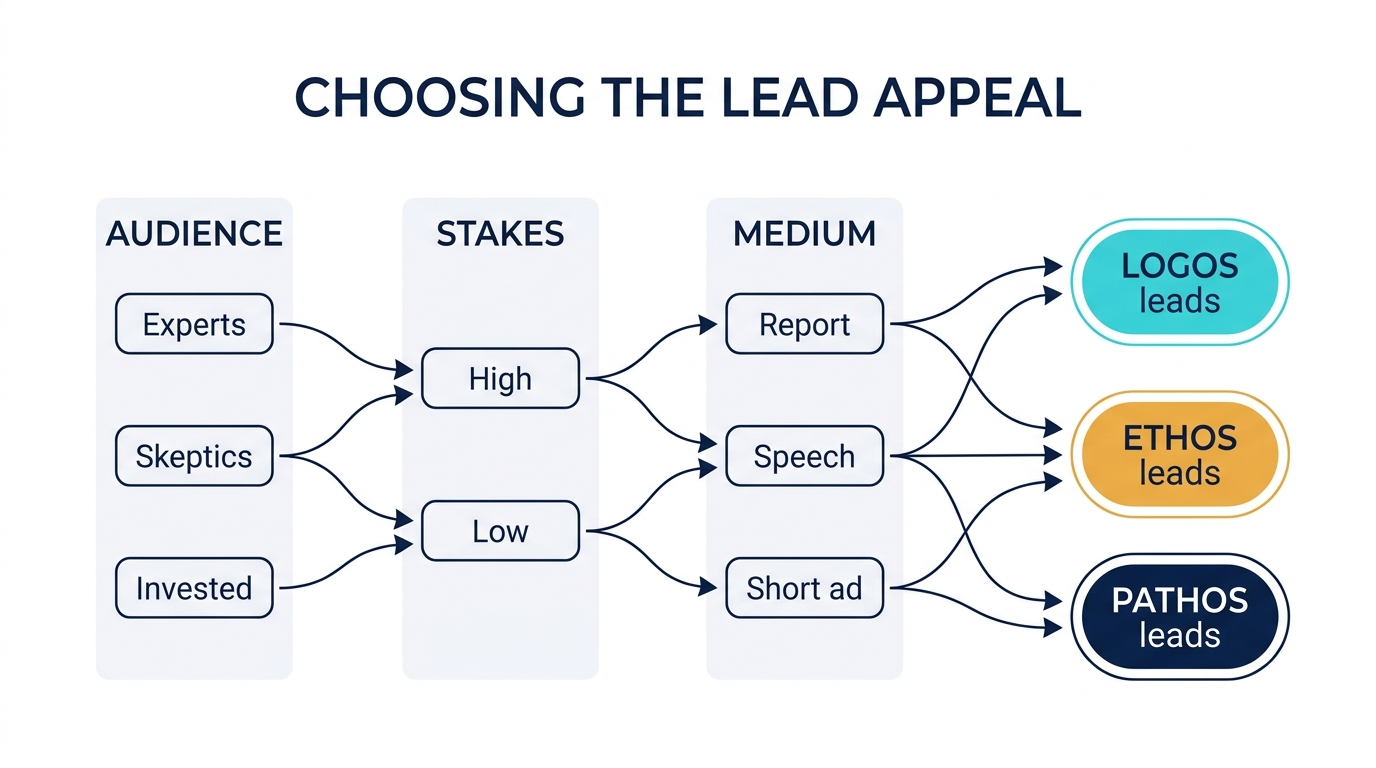
Start with your audience. Are they experts, skeptics, or emotionally invested?
- Experts expect logos. Lead with data and clear reasoning.
- Skeptics need ethos first. They must trust you before they listen.
- Emotionally invested audiences respond to pathos. Connect with their feelings.
Next, consider the stakes. High-stakes decisions (medical, financial, legal) require strong logos. But pathos still matters because people make emotional choices even about serious matters. Low-stakes decisions (choosing a coffee brand) often rely more on pathos and ethos.
Then, match the appeal to the medium. In a written report, logos dominates because readers can study evidence. In a speech, pathos and ethos carry more weight because you have tone and body language. In a short ad, pathos grabs attention, but you need ethos to build trust and logos to justify the purchase.
The Same Argument, Three Ways: A Side-by-Side Comparison
Seeing the appeals side by side makes their differences clear. Here’s one goal—persuading a friend to visit the new public library—built three ways.
Ethos version: “I’m a librarian who has spent years helping people find great books. Trust me, this library is worth your time.”
The appeal rests on your credibility. Your friend believes you because of who you are.
Pathos version: “Remember how much you loved that cozy bookstore we visited last year? Imagine having a place like that just down the street, with quiet corners and endless stories. Don’t you want that feeling again?”
This taps into nostalgia and desire. It works by making your friend feel something.
Logos version: “You’ve been saying you want to read more but can’t justify buying new books. The library lends them for free, and it’s open most evenings. You could borrow a few books this week without spending a cent.”
This appeals to reason with a clear cause-and-effect chain.
Now see how they combine. A powerful pitch might open with ethos, then use pathos, and finish with logos:
“As a librarian who knows your taste in mysteries (ethos), I remember how you lit up talking about that detective novel last month (pathos). The library just got the new sequel, and you can pick it up tomorrow for free (logos).”
This layered approach works because each appeal reinforces the others.
Layering Appeals for Maximum Impact
A common pattern is: open with ethos to establish credibility, use pathos to create an emotional hook, and then deliver logos to provide the logical reasons.
For example, a climate scientist (ethos) opens a talk with a story of a flooded town (pathos), then presents temperature graphs (logos). This structure works because each appeal reinforces the others.
Avoid leaning too hard on one appeal. All logos can feel cold. All pathos can feel manipulative. All ethos can feel arrogant. The goal is a balanced mix.
Persuasion Has a Time Lag: The Sleeper Effect
Most advice assumes your audience decides while you are still talking. Often they decide weeks later — and the mix that wins then is not the mix that wins in the room.
Pratkanis, Greenwald, Leippe, and Baumgardner (Journal of Personality and Social Psychology, 1988) ran 17 experiments and found a real, if modest, “sleeper effect”: a strong argument attached to a source people had dismissed became more persuasive over time, because the argument stayed in memory after the source faded. Later work by Albarracín and colleagues (Journal of Experimental Social Psychology, 2017) found the mirror image: when attention sits on the source instead of the argument, a weak message from a credible source gains persuasion after a delay.
What to do with that:
- Decision today? Ethos and pathos carry the most weight. People act on who you are and how they feel.
- Decision later? Put your effort into logos. A memo that circulates for a month is remembered as an argument long after readers forget whose name was on it.
- Credibility is your best asset? Repeat it inside the argument — in the headline, the caption, the footer — because the source is the first part people lose.
💡 Quick checklist before you write:
- Who is my audience? Experts, skeptics, or emotionally invested?
- What are the stakes? High or low?
- What is the medium? Written, spoken, or visual?
- Which appeal should lead based on the above?
- How can I layer the other two appeals to support the lead?
This framework turns abstract theory into a concrete plan. Next time you write a persuasive email, prepare a presentation, or craft an ad, run through these questions.
Where These Appeals Show Up in Real Life
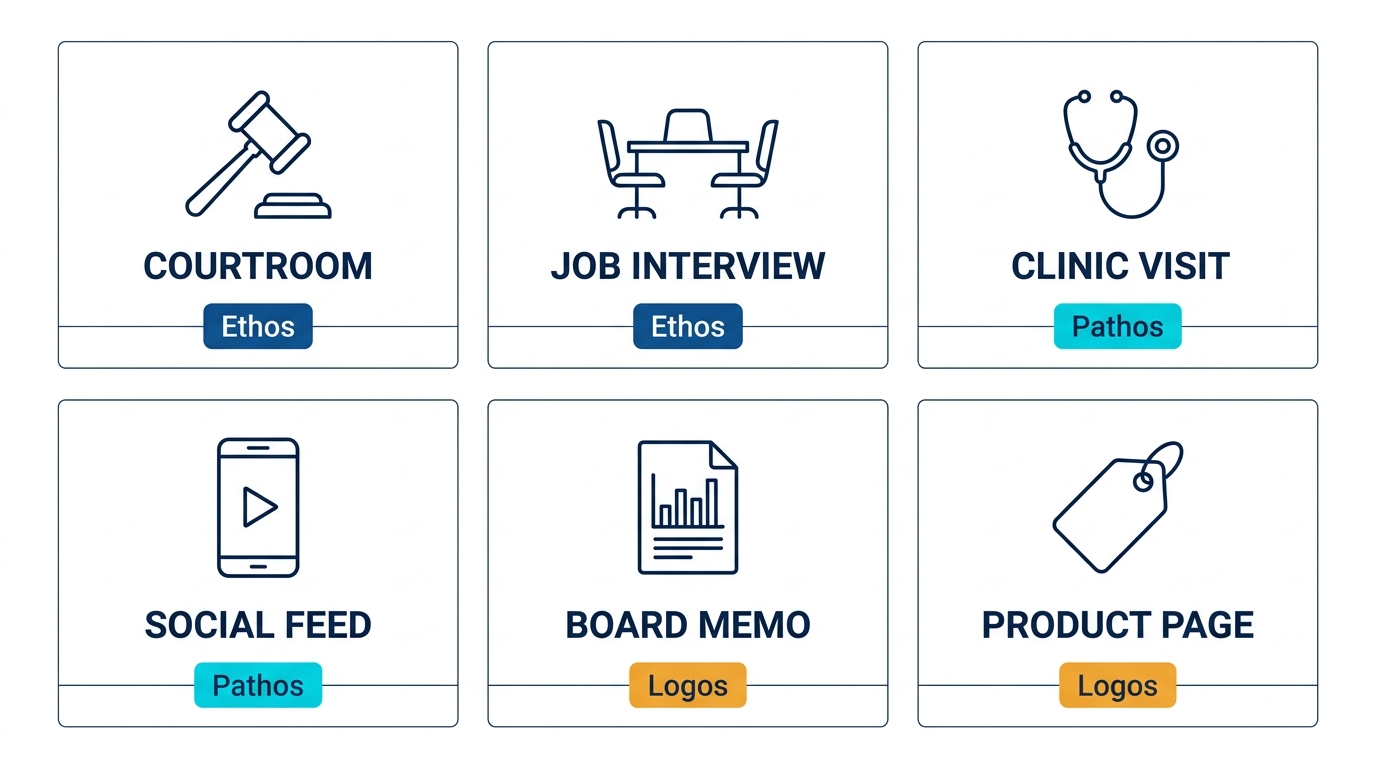
Ads and essays are the usual examples, but these three appeals settle much smaller and more frequent things: whether you get the job, whether the room backs your plan, whether a patient actually takes the pills.
Job Interviews and Résumés: Ethos You Can Check
An interview is an ethos test scored with logos. “I’m a strong communicator” is a claim about character. “I rewrote our onboarding guide, and setup questions in support dropped for two quarters straight” is the same claim with evidence attached. Pathos has a place — genuine interest in the work, a short story about why you care — but it only lands once the first two are in place.
Meetings and Internal Pitches: Nearness Beats Fame
Trust is not evenly distributed across roles. In the 2025 Edelman Trust Barometer (28-market average), scientists were trusted by 77% of people and teachers by 75%, while “my CEO” scored 67% — against just 53% for CEOs in general and 52% for journalists.
The same job gains roughly 14 points simply by being yours. In an internal pitch, that means the person who did the work usually has more ethos than the outside authority they are quoting. Start with what you saw yourself, then hand over the numbers.
The Courtroom: How Certain the Expert Sounds
Jurors weigh delivery, not just evidence. Cramer, Brodsky, and DeCoster (Journal of the American Academy of Psychiatry and the Law, 2009) manipulated an expert witness’s confidence and found it shifted mock jurors’ credibility ratings — and those ratings went on to predict sentencing decisions. Heavy jargon, defensiveness under cross-examination, and overstated certainty all push credibility down.
The Clinic: Pathos Is Not Decoration
A meta-analysis of 106 correlational studies and 21 experimental interventions (Haskard-Zolnierek and DiMatteo, Medical Care, 2009) found that patients whose physician communicates poorly carry a 19% higher risk of not following treatment. After doctors received communication training, the odds of patients sticking to treatment were 1.62 times higher.
Same prescription, same logic, different result — because warmth and clarity decide whether the logic ever gets used.
Social Feeds: Borrowed Credibility Is Losing Value
Ethos used to be transferable: hire a famous face, borrow their trust. The numbers no longer support that.
- BBB National Programs’ Influencer Trust Index (2025) reports that 87% of surveyed U.S. consumers trust the advertising they see at least somewhat (5.5% completely, 83.2% somewhat), but only 74% say the same about influencer advertising — and 26% say they simply don’t trust influencers.
- In the UK, the Credos tracker published by the Advertising Association put trust in advertising at 39% in 2024, up from 36% the year before and 30% in 2022.
Those two figures are not comparable, and that is the point: one counts “somewhat” as trust and the other does not, which is how a single trust statistic gets misused. Read together, they still agree on something useful — the endorsement no longer carries the trust by itself. A creator’s ethos now has to be re-earned post by post, which is why receipts (long-term use, disclosed partnerships, visible testing) outperform fame.
AI-Written Content: Disclosure Is Part of Your Ethos
Audiences now factor “who or what wrote this” into every appeal. In a survey of nearly 10,000 consumers across seven markets, Meltwater and YouGov found 86% say AI-generated content should be disclosed, while 32% would trust a brand less if content is AI-generated and 15% would trust it more. KPMG’s 2025 global study on trust in AI reported that 72% of Americans are unsure whether online content can be trusted, because it may be AI-generated.
For writers, that shifts the burden onto logos: a claim with a checkable source now persuades more than the same claim phrased well.
🎯 Pattern across all six settings: the appeal that leads is set by the situation, not by preference. Ethos wins where you can be verified, logos wins where your argument outlives the room, and pathos wins where you have someone’s full attention.
Using Ethos, Pathos, and Logos in Your Own Writing and Speeches
Now let’s apply these appeals to your own work.
Ethos in Your Writing: Building Credibility
To build ethos in an essay or blog post:
- Cite reliable sources. Source
- Show you understand the topic.
- Be honest about limitations.
- Use a professional tone.
For example, if you write about climate change, link to scientific studies. Mention your background if relevant. Avoid exaggeration.
Pathos in Your Writing: Connecting Emotionally
To add pathos:
- Tell a story. Source
- Use vivid language.
- Appeal to shared values.
- Show empathy.
For example, if you write about poverty, describe a specific family’s struggle. Make the reader feel the hardship.
Logos in Your Writing: Structuring Logical Arguments
To strengthen logos:
- Present clear evidence. Source
- Use statistics and facts. Source
- Explain cause and effect.
- Address counterarguments.
For example, if you argue for a new policy, provide data on its expected impact. Show the logical steps from problem to solution.
A Checklist for Your Next Persuasive Piece
Before you publish or present, ask:
- Have I established my credibility? (Ethos)
- Have I connected emotionally with my audience? (Pathos)
- Have I provided logical reasons and evidence? (Logos)
- Is the mix appropriate for my audience and medium?
🎯 Remember: You don’t need equal amounts of each appeal. A scientific report will be mostly logos. A fundraising letter will be mostly pathos. The key is to use each appeal intentionally.
Now let’s answer some common questions.
Frequently Asked Questions
What is an example of ethos, pathos, and logos?
Imagine a public service announcement about smoking: the ethos is a doctor speaking, the pathos is a story of a smoker suffering from lung cancer, and the logos is the logical argument that smoking leads to health problems. Together, they make a powerful argument.
How do I identify ethos, pathos, and logos in a text?
Look for three things: Does the author establish credibility? (ethos) Does the text make you feel something? (pathos) Does it use facts and logic? (logos) Source Most persuasive texts use all three, but one usually dominates.
Can you use all three appeals in one sentence?
Yes, but it’s rare. More often, you use them across a paragraph or a whole piece. For example: “As a nutritionist (ethos), I’ve seen families struggle with obesity (pathos), and studies show that a balanced diet reduces health risks (logos).”
Why are ethos, pathos, and logos important?
They help you persuade effectively. Understanding them also helps you analyze arguments critically. Source You can see when someone is manipulating your emotions or hiding weak logic.
Where do ethos, pathos, and logos show up at work?
Mostly in three places: hiring (ethos, checked against evidence), internal pitches (logos in the document, ethos in the room), and feedback conversations (pathos, handled carefully). The 2025 Edelman Trust Barometer found people trust “my CEO” (67%) far more than CEOs in general (53%) — a useful reminder that the credibility you have inside your own team beats any outside authority you can quote.
What is the difference between ethos and pathos?
Ethos is about the speaker’s credibility. Pathos is about the audience’s emotions. Source Ethos answers “Why should I trust you?” Pathos answers “Why should I care?”