Information Asymmetry: Where the Profit Actually Hides
Information asymmetry decides who sets the price. How lemon markets form, why costly signals work, and a four-step audit you can run on any deal.
🎯 Information is never evenly distributed, and a lot of money is made in that gap. Three questions are usually enough to read any deal: What does each side know? Who can verify the truth more cheaply? Who can pay a price a fake could never afford?
Sellers know more about the product than buyers. Owners know more about cash flow than staff, and staff know more about the daily work than owners. Platforms know more about the traffic algorithm than merchants. Doctors know more than patients. Insiders know more than retail investors.
This situation — one side holding information the other cannot see — is called information asymmetry. It is not a moral failing. It is the default state of almost every transaction, and it sits at the foundation of modern microeconomics, business model design, and game theory.
1. There Are Two Kinds, and They Happen at Different Moments
1.1 Hidden type, before the deal: adverse selection
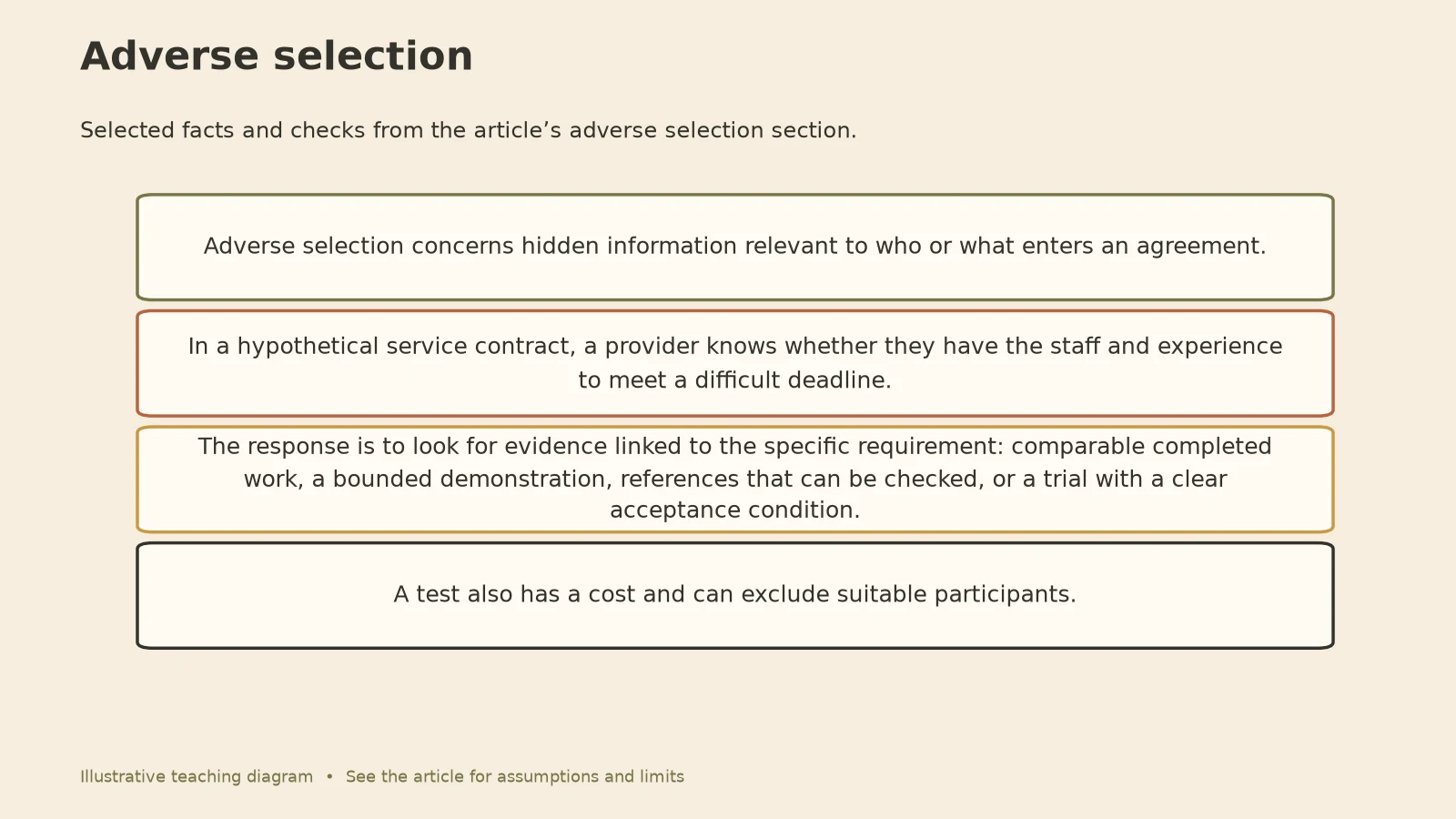
Before the deal closes, the other side already knows something about what they are. The hidden damage in a used car, a candidate’s real ability, a pre-existing condition the applicant knows about — all of it belongs here. Economists call it adverse selection.
1.2 Hidden action, after the deal: moral hazard
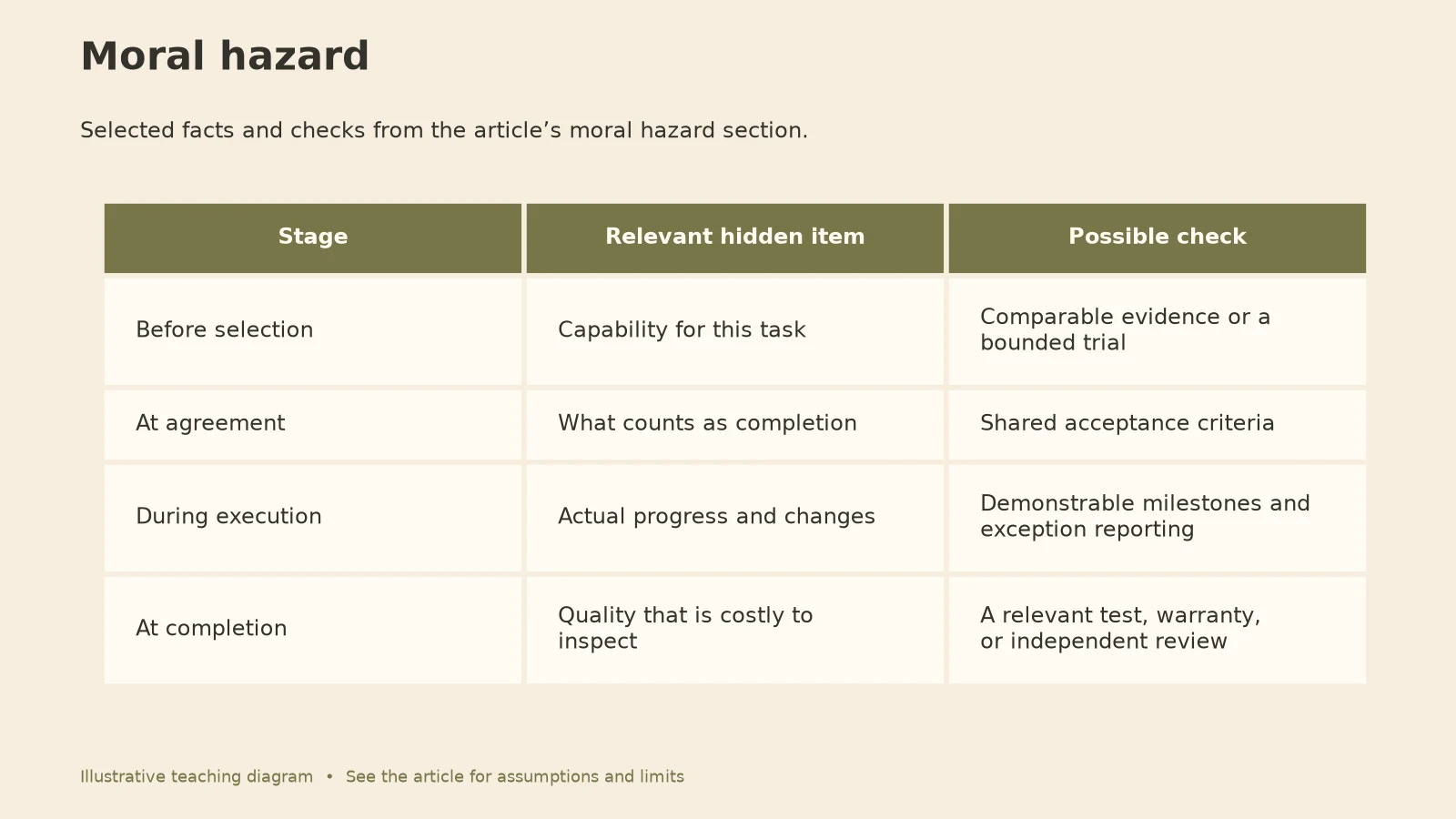
Once the contract is signed and the money is paid, the other side starts doing things you cannot see. The renter overloads the truck, the funded team spends the budget elsewhere, the fully insured driver gets careless. That is moral hazard.
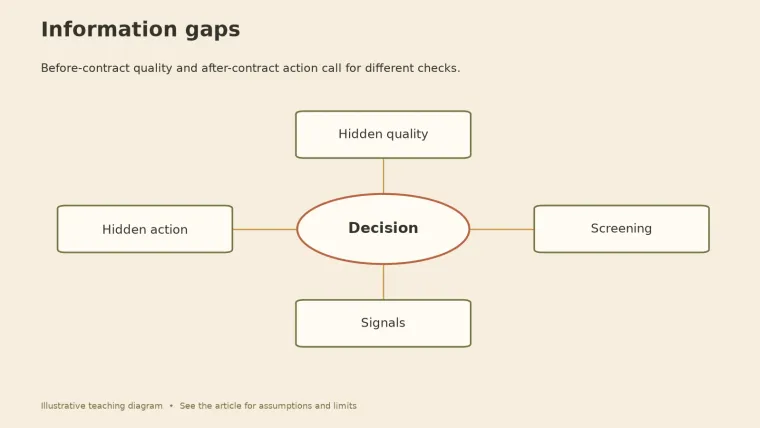
One line to separate them: before the deal, they hide who they are; after the deal, they hide what they are doing.
1.3 When buyers cannot tell good from bad, the good leaves first
George Akerlof made the classic argument with the used car market, better known as the market for lemons (in American slang, a lemon is a defective car).
The logic is simple. Buyers cannot judge whether a car is actually sound, so they will only pay for an average car. Sellers of good cars decide the price is not worth it and leave. The remaining stock is worse on average, so buyers cut their offer again, and the next tier of good cars exits. After a few rounds, only bad cars are left — and the market can collapse entirely.
💡 This is the real mechanism behind “bad money drives out good”: the bad option is not more competitive; the good option simply cannot be identified, has to sell at the average price, and therefore leaves first. Hiring markets, content platforms, and cross-border supply chains all run the same play today.

2. Three Nobel Laureates, One Complete Loop
The 2001 Nobel Prize in Economic Sciences went to Akerlof, Spence, and Stiglitz for their analysis of markets with asymmetric information. Their work forms a single loop: the breakdown, the escape, the counterweight.
| Idea | Core question | Who acts |
|---|---|---|
| Akerlof: adverse selection | How asymmetry breaks a market | Nobody acts; the market rots on its own |
| Spence: signaling | How the informed side proves itself | The informed side moves first |
| Stiglitz: screening | How the uninformed side fights back | The uninformed side sets the filter |

2.1 Spence: signaling, where the informed side pays a price
Michael Spence’s move was this: if buyers cannot see the difference, let the seller do something a fake could not afford to copy. That action is a signal.
What makes a signal work is not that it sounds credible. It is the cost structure: imitating the signal must cost a low-quality player more than the deception could ever earn. In the literature this is the single-crossing or Spence-Mirrlees condition — for the same signal, the high type pays a lower marginal cost.
A degree from a selective school works as a signal not only because of the knowledge behind it, but because passing years of filtering is punishing for someone who cannot keep up. An expensive flagship store, a no-questions-asked return policy, and a performance bond all work the same way.
2.2 Stiglitz: screening, where the uninformed side builds a gate
Joseph Stiglitz attacked the problem from the other end. The side at the information disadvantage designs a contract menu, and the other side reveals its true type through the choice it makes. This is self-selection.
Insurers offer “high deductible, low premium” alongside “zero deductible, high premium,” and healthy and high-risk customers sort themselves. Tiered SaaS subscriptions, stepped platform commissions, and earn-out clauses in investment agreements all follow the same idea: I will not investigate you. I will let you choose, and the choice is the answer.
3. How Wealth Grows Out of an Information Gap
A large share of economic rent in business is really information rent — not a reward for doing more work, but for knowing one thing your counterpart does not.
| Setting | Advantaged side | Disadvantaged side | Where the money comes from |
|---|---|---|---|
| Capital markets | Insiders, quant funds | Retail investors | Early information and order-flow data enable low-risk arbitrage |
| Platform economies | The platform | Merchants and consumers | Exclusive control of the ranking black box and conversion data, monetized through paid placement |
| Employment | Frontline staff | Management | Execution detail is invisible, which buys slack or hard-to-replace status |
| Professional services | Doctors, lawyers, consultants | Clients | Credence goods: even after paying, the client struggles to judge whether the work was necessary |
Which leaves two strategies. Either build an information barrier and collect the rent, or become the connector that reduces asymmetry for everyone else — rating agencies, search engines, auditors, and price comparison tools all live in the second camp.
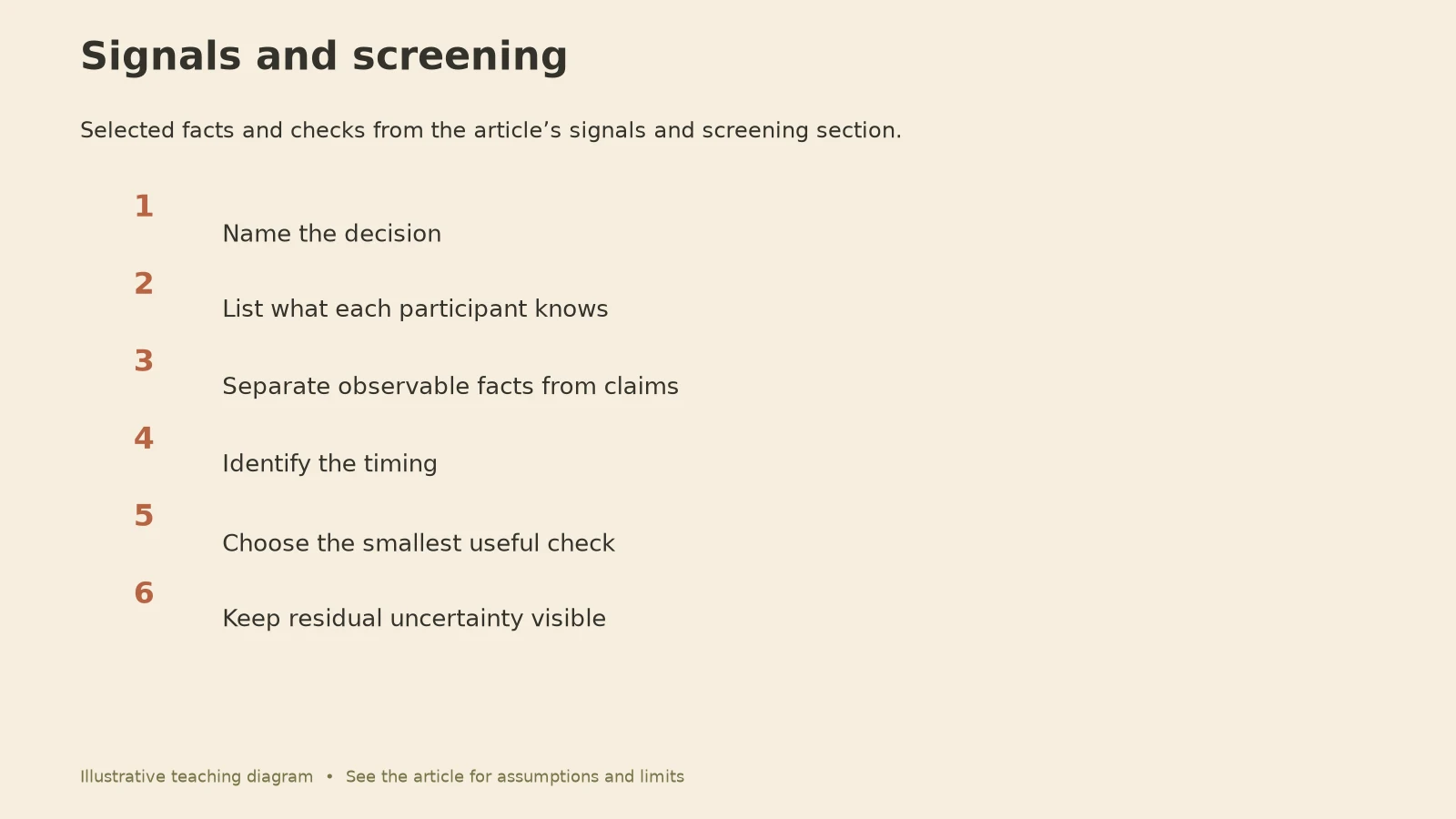
4. The Four-Step Information Audit
“What does each side know, and who can verify it more cheaply?” is already a strong question. Applied to a specific deal, it breaks into four steps. Each one comes with a story, which is easier to remember than a definition.

4.1 Step one: map the private information
Start by separating a hidden type from a hidden action.
Story: Old Li’s used truck
Old Li wants to sell his five-year-old truck to Zhang.
Li knows exactly what he is selling: the engine has been rebuilt twice, and the gearbox sticks once it heats up. Zhang sees a glossy paint job. That is a hidden type.
Now suppose Zhang changes his mind and says, “Let me rent it for a year first.” Suddenly Li is the nervous one. The truck is in Zhang’s hands, hauling overloaded cement and hitting speed bumps at full speed, and Li cannot see any of it. That is a hidden action.
Same truck. Change the deal structure and the disadvantaged side changes with it. So step one is not “who is the worse actor,” but: in this deal, am I blind to their cards or to their conduct?
4.2 Step two: price the cost of verification
Suspecting a bluff is easy. Proving it is expensive. If verification requires specialist knowledge, real money, or a lot of time, you usually end up eating the loss.
Story: the only repair shop for miles
You break down on a road trip in the middle of nowhere, engine light on. The only shop within thirty miles takes one look under the hood: “Throttle body is gone, and it took the ECU with it. Three thousand to fix.”
You do not know engines, and towing the car to a dealership costs a full day plus a four-figure bill. Verification costs more than the dispute is worth, so the pricing power is entirely his.
Whoever verifies more cheaply talks louder at the table. It also explains a lot of pricing that looks unfair: the other side is not stronger, you just cannot afford to check.
4.3 Step three: find the signal that cannot be faked
“Trust me, I am reliable” costs nothing to say. That is cheap talk. Someone who is actually reliable does something that would bankrupt an imitator.
Story: the banquet hall and the street cart
Both owners swear their ingredients are the freshest.
The street vendor’s promise is worthless — one push and the cart is gone. Breaking the promise costs him almost nothing.
The restaurant downtown spent twenty million on its fit-out. What it is really saying is: “If I poison a customer with spoiled food and get shut down, that twenty million evaporates. Only someone planning to be here for years would put up that much.”
⚠️ The most common mistake is treating a claim as a signal. “Most professional,” “handmade,” “100% original” — anyone can say these, so they carry no information at all. There is only one test: if they are lying to me, what do they lose? A promise with nothing behind it should be scored as zero information.
4.4 Step four: design a mechanism and let them sort themselves
If you cannot see through them and cannot afford to investigate, change the game: write rules that push the wrong candidates out on their own.
Story: two contractors bidding
Both contractors insist their work is excellent and they never run late. Instead of arguing, you hand them two options.
Option A: 100k total, 80% paid up front, no penalty for delays.
Option B: 120k total, 30% up front, payments released per inspected milestone, 1k deducted for each day late, balance on final sign-off.
Anyone planning to coast will find reasons to refuse B. Anyone genuinely fast and skilled fights for B, because it pays 20k more. You never have to play detective; the rules make them reveal themselves.
Milestone payments, performance bonds, escrow, earn-out clauses — they all do the same job: move the cost of verification onto the party best able to bear it.
✅ Before the next negotiation or investment, ask four questions in order:
Is the other side hiding a type or an action?
What would it cost me, in money and time, to verify it myself?
Does breaking their promise cost them more than cheating would earn?
Can payment timing, tiered pricing, or escrow move the risk somewhere better?
5. A Fable: The Honey Market of Hive Valley
5.1 The story
Every midsummer, Hive Valley holds its honey market. Bees from the east cliff and the west cliff both come to sell. The buyers are mole caravans who pay by the jar but never open one — the jars are sealed with wax, the caravans are in a hurry, and the only things to go on are the sales pitch and the pattern on the jar.
The east cliff bees gather moonlight orchid from the clifftops. The honey is clear as dew, and a single jar means flying thirty miles of rock face over seven days. The west cliff bees gather wild chrysanthemum from the valley floor. That honey is cloudy and heavy, and a jar takes half a day. Both jars carry the same golden spiral — the valley’s traditional mark of quality.
At first the moles paid ten pine nuts a jar. The east cliff bees thought it was fair; the west cliff bees thought it was a windfall. Then the caravans got home and found six of every ten jars were chrysanthemum honey. The next year they would only pay five pine nuts, priced on the average.
The east cliff bees were furious: five pine nuts did not even cover the energy of crossing the cliffs. So they switched to chrysanthemum honey too — same jar, far lower cost. By the third year the market was almost entirely chrysanthemum honey, the moles stopped trying to tell the difference, and the price fell to three pine nuts. The east cliff bees left the market, and the valley was left with nothing but heavy, cloudy honey.
One old east cliff bee refused to accept it and flew to the wise owl. The owl said: “You need buyers to believe you really crossed the cliffs. Saying so is useless, because the west cliff bees will say it too.”
The old bee thought about it all night. The next morning he raised a tall spruce pole in the market with a single moonlight orchid at the top, and announced: “Buy one jar from me and I will carry you to the top of this pole so you can see the flower fields on the cliffs with your own eyes. Only I can lift you — my wings have trained for thirty years. The west cliff bees have short wings; they cannot lift a single pine nut.”
A young mole paid ten pine nuts. The old bee carried him up, wings shaking, and from the top the mole saw the silver glimmer of orchids on the distant cliff face. He told everyone. From then on the old bee carved a “seen it myself” mark for each buyer, and his honey went back to ten pine nuts, then higher.
The west cliff bees raised their own pole, but their wings trembled under half a pine nut and they fell three times. The buyers laughed: “You cannot lift half a pine nut. How would you reach flowers on a cliff?”
The old bee’s business was not easy. Every jar cost him a full exhausting climb, and he could only sell three a day. A younger bee asked, “Why not simplify — keep the pole and skip the carrying?” The old bee shook his head: “Without the real effort, the west cliff bees could put on the same show, and the pole would mean nothing.”
Years later the market settled into two tiers, high-pole honey and low-ground honey, each at its own price. And the moles remembered one lesson: when you cannot tell where the honey came from, the good honey disappears; the only way to bring it back is to make sellers pay a price a fake seller cannot afford.
5.2 What the story maps to
| Element | Concept |
|---|---|
| East cliff and west cliff bees | High-quality and low-quality sellers |
| Moles never opening the jars | Buyers cannot verify quality before purchase |
| The golden spiral | A cheap signal: anyone can copy it, so it carries no information |
| Ten, then five, then three pine nuts | Lemon market dynamics driven by average pricing |
| Raising the pole and carrying the buyer | A costly signal |
| West cliff bees unable to lift half a nut | Imitation is prohibitively expensive for the low type, so they give up |
| The “seen it myself” mark | The verifiable outcome of the signal, not the signal itself |
| ”Keep the pole, skip the carrying” | Lower the cost of a signal and it stops separating anyone |

The last row deserves its own paragraph. The moment a signal can be copied cheaply, it degrades into the golden spiral. So an effective signal has to satisfy two conditions: the high type nets more by sending it than by staying silent, and the low type nets less by imitating it than by not bothering. The old bee’s wings took thirty years; the west cliff bees were born with short ones and cannot fake that in a season. The cost gap pushes the two groups into different actions, buyers can infer type from the action, and the market reaches what economists call a separating equilibrium.
Education works as a signal in labor markets, and dividends work as a signal in corporate finance, for exactly the same reason.
6. Running the Framework on Two Real Situations
6.1 I do a lot of work and my manager has no idea
This is a textbook principal-agent problem, with a layer of black-box execution on top.
6.1.1 What private information do you hold
Operations work is full of invisible labor: filtering keywords, fixing broken links, monitoring competitors, tuning assets. You know your own load; your manager sees only the final numbers — inquiries, traffic curves. He also cannot distinguish “four hours rebuilding ten core pages” from “four hours of coasting plus two clicks.” When the process is invisible, the default assumption usually skews toward low effort.
6.1.2 Why he will not learn how hard the work is
Because his verification cost is too high. His attention is on cash flow, supply chain, and business development. Learning tag rules, plugin code, or bid algorithms costs him far more than it returns. So he falls back on the cheapest possible evaluation: surface output, or a gut call — “how long can it take to publish a few posts and change a few words?“
6.1.3 Which signals cannot be faked
Saying “exhausting day” in a group chat is cheap talk, and it can even read as “too slow to be any good.” Replace it with deliverables that are hard to fabricate:
- Structured data: translate “it took ages” into “audited 320 broken links, cleared 1,200 dead keywords, rebuilt metadata on 15 pages.”
- A benchmark: give a reference point, such as “a site this size normally needs three weeks for this kind of recovery; scripting got it to four days.”
6.1.4 Turning the black box into a dashboard
Do not wait for your manager to develop an interest in your work. Make the workload surface itself:
- Scope it up front. When a deceptively simple request arrives, do not just reply “on it.” Reply: “Breaking this into A, B, C. A needs an API test, B needs a data cleanup. Roughly six hours, delivered Wednesday afternoon.” That single message lowers his cognitive cost.
- Make the process visible. Turn underwater work into cards that move across a board, so blockers and volume are always in view.
- Report return, not effort. Skip “this was hard.” Say “because we did these three things, we avoided this risk and gained this efficiency.”
A manager not knowing the details is a normal consequence of division of labor. Converting invisible labor into visible assets is your job, not his.
6.2 My product really is better, and my article really was not written by AI
The marginal cost of AI-generated content is near zero, so the web is now stuffed with tidy, evenly hedged, interchangeable posts. That is a new lemon market.
6.2.1 What each side knows
You know you did primary research, ran the tests, wrote in years of hard-won mistakes, and spent two full days. The reader does not. Worse, he has been burned by rewritten filler so many times that he has developed a defensive bias: one glance at a neatly formatted long post and he assumes boilerplate.
6.2.2 Why the reader will not bother checking
Reading time is scarce, and he cannot judge substance in three seconds. Meanwhile AI produces subheadings, bold text, and structure just as well. Verifying whether the reasoning is original, line by line, is expensive. Since checking is exhausting, he applies one rule to everything — assume average quality and scroll past.
6.2.3 What AI cannot fabricate
“Written entirely by a human” at the end of the post is cheap talk; the content farms write it too. Real signals look like this:
- First-hand process with fingerprints on it: your own dashboard screenshots, real error logs, timestamped messages. A general model can invent principles; it cannot invent the specific parameter and outlier you hit yesterday.
- Judgment specific enough to sting: an AI optimizes for the most probable answer on the internet, so its opinions come out broad and safe. Taking a non-consensus position and backing it with an obscure but decisive detail is very hard to imitate.
- Reputation as collateral: a real name, a traceable track record, a long-lived personal brand. Fabricate once and the goodwill is permanently impaired.
6.2.4 Designing the mechanism
Do not make readers reach the last paragraph before they discover the post is good. Move the proof to the front:
- Put unfakeable evidence in the first screen — an exclusive test screenshot, or a counterintuitive conclusion.
- Write less “in principle you should note that,” and more “last Tuesday, tuning parameter X threw error Y.” A concrete first-person scene is itself a signal.
- Attach something instantly verifiable: your own template, a post-mortem sheet, a snippet of working code.
7. Three Things Worth Keeping
- Information asymmetry is the default state of a deal. Start by identifying whether the hidden thing is a type or an action.
- Pricing power follows verification cost. Whatever you cannot afford to check, you will buy at their price.
- A promise is worth what backs it, not how it is worded. Only a cost a fake could not pay counts as evidence.
So the next time you analyze a deal, do not stop at who knows what. Take one more step: who can send a signal, cheaply, that the competition cannot imitate? That is usually where the profit is hiding.