The Red Queen Effect: Why Running Faster Just to Stay Still Is the New Normal
The Red Queen Effect means staying in the same place is falling behind. Learn how it works in biology, markets, and organizations—and how to thrive within the cycle rather than fight it.
1. The Red Queen Effect: Why Running Faster Just to Stay Still Is the New Normal
In August 2000, Jerry Mayfield, a forty-one-year-old Louisiana policeman diagnosed with chronic myelogenous leukemia (CML), began treatment with Gleevec. Source His cancer responded briskly at first — the fraction of leukemic cells in his bone marrow dropped over six months, his blood count normalized, his symptoms improved. He felt rejuvenated, “like a new man on a wonderful drug.” But the response was short-lived. By winter 2003, Mayfield’s CML had stopped responding. Source His oncologist increased the dose, then increased it again. By October of that year, there was no response at all. Leukemia cells had fully recolonized his bone marrow, blood, and spleen. Mayfield’s cancer had become resistant to the drug designed to kill it. When CML cells kicked Gleevec away, only a different molecular variant would drive them down — and when they outgrew that drug, yet another would be needed. The vigilance could never be dropped, even for a moment.
This is the Red Queen Effect in its most stark form.
🎯 The core claim: The Red Queen Effect means that staying in the same place is falling behind. Surviving another day means coevolving with the systems you interact with.
In Lewis Carroll’s Through the Looking-Glass, the Red Queen tells Alice that the world keeps shifting so quickly under her feet that she has to keep running just to keep her position. This is our predicament with cancer: we are forced to keep running merely to keep still. What Carroll intended as fantasy has become one of the most precise descriptions of how competitive systems actually behave — not just in biology, but in markets, in organizations, and in careers.
Understanding this effect is not optional for anyone navigating competitive landscapes today. It is the frame through which all subsequent strategy must be viewed.
1)The Alice in Wonderland origin story
The Red Queen character appears in Lewis Carroll’s sequel to Alice’s Adventures in Wonderland, where Alice finds herself running faster and faster but staying in the same place. The scene is whimsical, but the underlying observation is sharp: in a world where the environment is constantly shifting, effort alone does not produce progress. Your absolute motion does not translate into relative advancement because the ground under you is moving at the same speed.
Evolutionary biologist Leigh Van Valen formalized this observation in his foundational evolutionary biology paper as the Red Queen Hypothesis, which states that species must constantly adapt not to gain advantage but simply to survive — coevolution with other species and environments creates an arms race with no ultimate winner. The name comes from Van Valen’s observation that in an arms race, it takes all the running you can do just to stay in the same place.
2)From evolutionary biology to business strategy
The Red Queen Effect migrated from biology to business because executives and researchers kept encountering the same counterintuitive dynamic: putting in more effort produced the same results as before. Markets that seemed stable would suddenly shift. Competitors who had been trailing would match capabilities overnight. Organizations that invested heavily in capability-building would find themselves no better positioned than before the investment.
Stanford Graduate School of Business research on organizational learning describes this as a “self-exciting dynamic”: organizations learn in response to competition. The learning then intensifies the competition generated by each organization against its rivals, motivating rivals to learn, thereby becoming stronger competitors. In turn, this response increases the competitive pressure faced by each organization, again triggering a learning response. The treadmill accelerates because everyone is on it. This dynamic was documented in Illinois retail banks from 1990–1993, where Red Queen evolution helped some organizations grow quickly and created strong competitive barriers to entry — but also made them more susceptible to “competency traps” that slowed their growth rates.
3)What this guide will cover
This article does three things that most Red Queen Effect content does not. First, it shows you the exact mechanism — why effort without coordination produces no relative progress. Second, it fills the gap that most business articles skip: the mathematical and academic research that makes this a durable theory, not just a catchy metaphor. Third, it gives you a framework for responding that goes beyond “work harder” — because working harder is exactly what feeds the Red Queen dynamic, not what escapes it.
💡 How the Red Queen Effect works (in one sentence): In a coevolving system, your absolute effort does not translate into relative progress because the environment is changing in response to — or in competition with — your efforts.
2. What Is the Red Queen Effect? Definition and Core Concept
The Red Queen Effect means that staying in the same place is falling behind. Surviving another day means coevolving with the systems you interact with.
The Red Queen Effect is not simply “competition is hard.” The precise mechanism is more specific and more instructive: in a coevolving system, your absolute effort does not translate into relative progress because the environment is changing in response to — or in competition with — your efforts. You are running, but the finish line is moving at the same pace.
Think of it this way. Imagine you are walking up a down-moving escalator. You can walk faster, but the escalator is moving down at the same speed. Your absolute velocity increases, but your relative position on the escalator stays the same. The escalator is the competitive environment. Your walking is your effort. The Red Queen Effect is what happens when the escalator speeds up every time you walk faster.
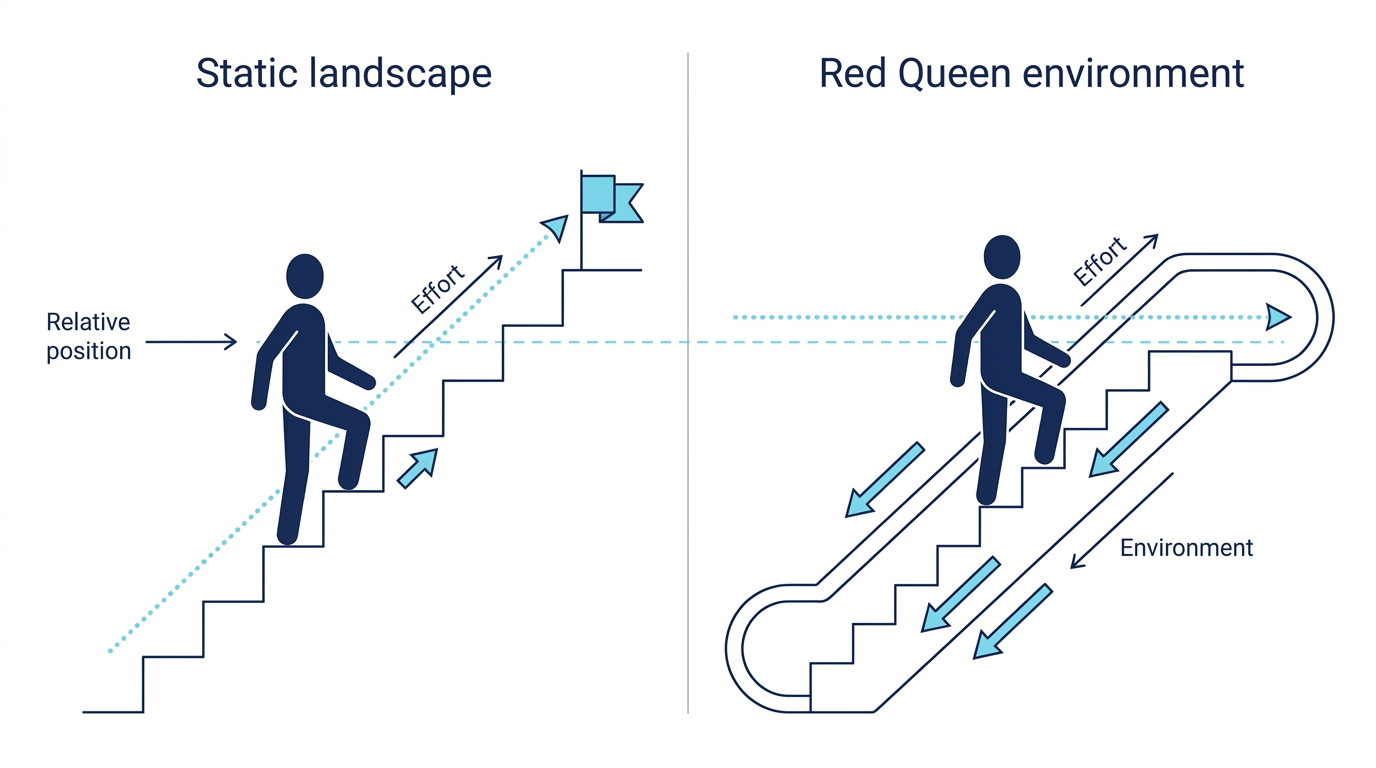
This is fundamentally different from a static competitive landscape. In a static landscape, enough effort eventually produces a lead you can defend. In a Red Queen environment, effort is consumed entirely by the need to maintain position. The Stanford research on Illinois retail banks found that this self-exciting dynamic helped organizations grow quickly and created barriers to entry — but also made them more susceptible to “competency traps” that ultimately slowed their growth rates.
⚠️ The counterintuitive trap: The logical response to intense competition — work harder, move faster — actually feeds the Red Queen dynamic rather than escaping it.
1)Red Queen Effect vs. Red Queen Hypothesis: What’s the Difference?
Most articles use these terms interchangeably. They are not the same thing, and the distinction changes how you apply the concept.
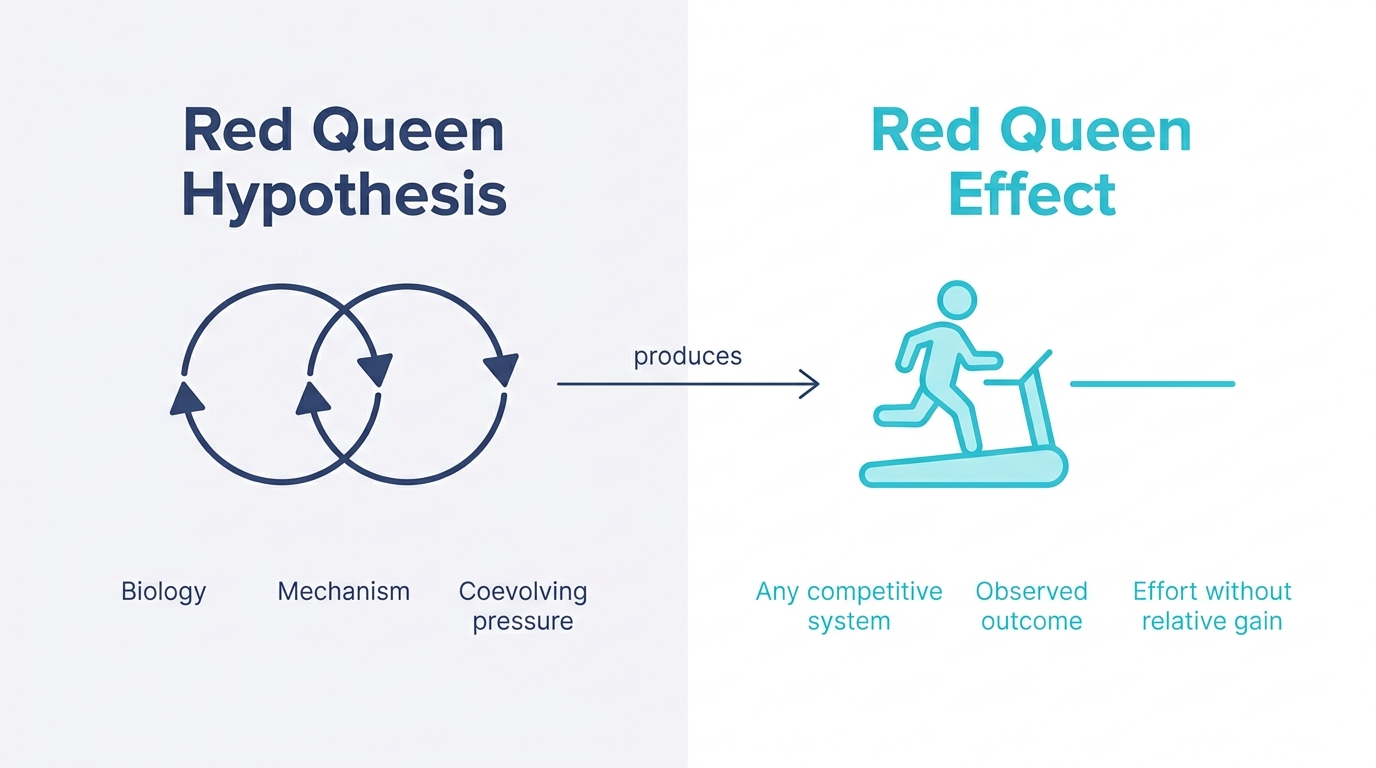
The Red Queen Hypothesis is an evolutionary biology theory. It was formalized by Leigh Van Valen to explain why species must constantly adapt just to maintain their niche. The idea: in order for a species to maintain its relative fitness, it must constantly undergo adaptive evolution because the organisms with which it is coevolving are themselves undergoing adaptive evolution. This often results in an evolutionary arms race.
The Red Queen Effect is the observable outcome of this dynamic in any competitive system — biological, market-based, organizational, or individual. It is the phenomenon: effort that maintains position without producing relative progress. The Red Queen Hypothesis is the mechanism that produces the effect.
Why does this distinction matter? Because understanding the mechanism lets you choose strategies that actually interrupt the cycle. Without understanding the mechanism, you default to “run faster” — which is exactly what the Red Queen wants you to do.
2)Why the Distinction Matters for Business Thinking
In business, the Red Queen Effect shows up as competitive pressure that intensifies no matter how much you invest. A growth strategy that works in a static competitive landscape — build a better product, capture market share, lock in customers — fails in a Red Queen environment not because it’s wrong, but because the response time of competitors compresses the advantage window.
The moment you achieve relative progress, the system adapts. Your better product triggers better competing products. Your captured market share attracts entrants who now have your playbook to reverse-engineer. Your locked-in customers find a challenger who figured out how to unlock them.
The goal is not to win. The goal is to stay in the game, and winning and staying in the game require the same activity.
3. Red Queen Effect Examples: From Host-Parasite Arms Races to Market Competition
1)Biological Roots: Host-Parasite Coevolution and the Arms Race Model
The Red Queen Effect was not invented as a business metaphor. It was discovered in biology first, and the biological examples are the most precisely documented.
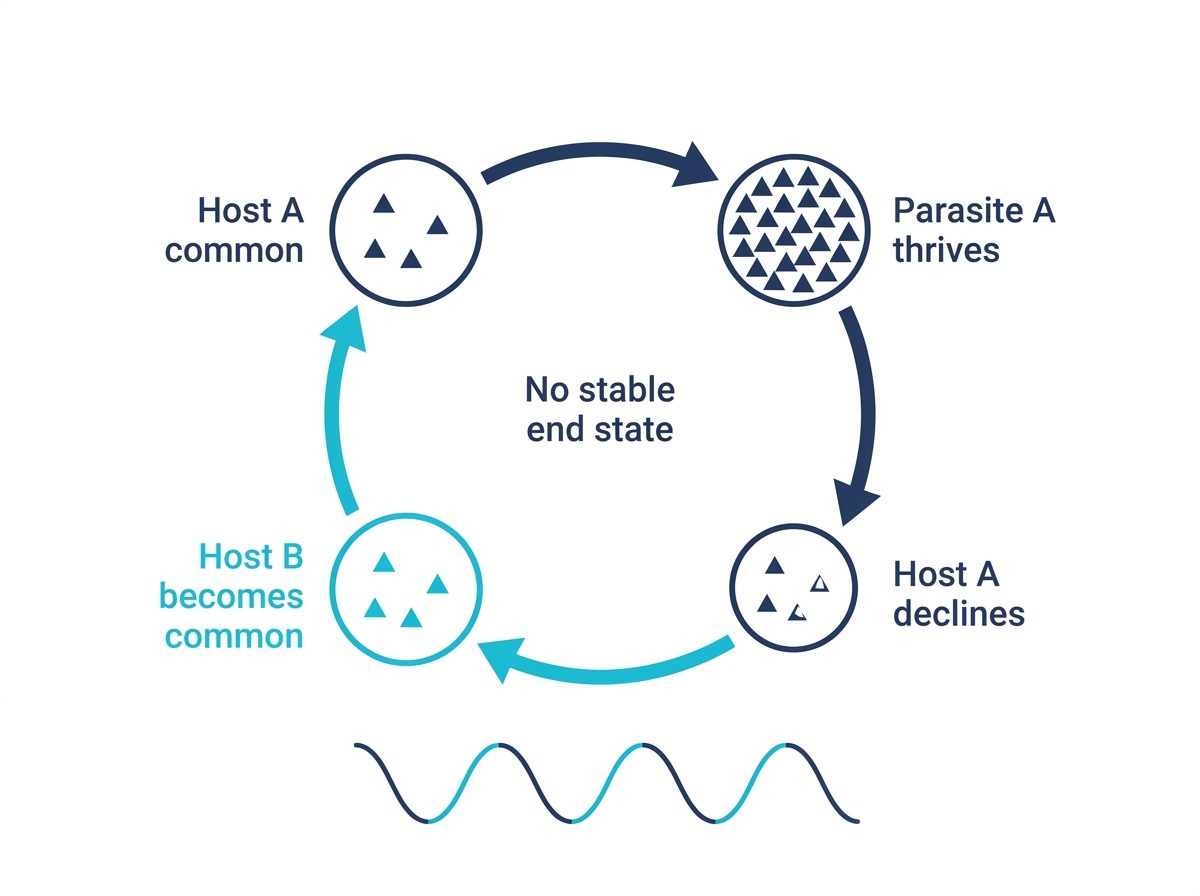
In host-parasite systems, dominant host types are expected to be eventually replaced by other hosts due to the elevated potency of their specific parasites. This leads to changes in the abundance of both hosts and parasites exhibiting cycles of alternating dominance called Red Queen dynamics. Source Numerical simulations of systems with more than ten host and specialist parasite types show that the parameter region where Red Queen cycles arise contracts as the number of interacting types increases, but never disappears entirely. With relatively large host carrying capacity and intermediate rates of parasite mortality, you get never-ending cycles of dominant types. Source
What this means in plain language: in ecosystems with many host and parasite species, the most common host type becomes vulnerable to the parasites that specialize in it. When that host type declines, a different host becomes common, and parasites that specialize in that host become dominant. The dominance is temporary, the cycle never ends.
This is not a metaphor. It is a mathematical consequence of coevolution in competitive systems. And it applies far beyond biology.
2)Corporate Competition: Why Every Competitor Is Also Running to Stay Still
The same dynamic appears in corporate competition. When one company develops a new capability, it triggers rival companies to develop similar or better capabilities. The competitive advantage is temporary because the information diffuses, the talent spreads, and the customer expectations ratchet up.
This is why companies in the same market often see their relative positions stabilize despite radically different effort levels. The Stanford research on Illinois retail banks found that Red Queen evolution led some organizations to grow quickly, placed strong competitive barriers to entry — and yet also made those same organizations more susceptible to competency traps that slowed their growth rates. The same dynamic that drove growth created the conditions for stagnation.
A concrete example: in the early 2010s, many companies rushed to build social media capabilities. Those that moved fastest gained an initial advantage. But within two to three years, competitors had caught up. The companies that had moved fastest were not significantly better positioned than those that had moved more slowly. The advantage had been consumed by the need to maintain position.
3)Is the Red Queen Effect Seen in Humans? Evidence from Social and Cognitive Domains
The Red Queen Effect is not limited to biology and markets. It appears in any domain where humans compete for status, knowledge, or resources within a shifting system.
Consider academic research. The Red Queen Effect in mathematics manifests as an relentless pressure to evolve your research approach, methodology, and focus areas, not necessarily to get ahead, but to avoid falling behind as the field advances around you. Source The very definition of progress is constantly shifting. What counted as a significant contribution five years ago may be routine today.
In careers, the Red Queen Effect shows up as skill inflation. The competencies required for a given role five years ago are now baseline expectations. Learning a new skill provides a temporary advantage that is eliminated as the skill becomes common. The knowledge worker who stops learning does not stay at the same level — they fall behind.
💡 The pattern to recognize: Red Queen dynamics appear whenever first, the system is competitive; second, information or capability can diffuse; and third, the “goalposts” for success are moving. If all three conditions are present, you are in a Red Queen environment.
4. The Red Queen Effect in Academic Research: Mathematical Models and Theoretical Foundations
1)Mathematical Research and Red Queen Dynamics
Most business articles treat the Red Queen Effect as a metaphor. This is a mistake. The concept has formal mathematical grounding that explains why the effect is robust and when it appears.
In host-parasite models, Red Queen dynamics are the predicted behavior when three conditions hold: first, there is genetic specificity — each parasite is specialized to particular host types; second, there is frequency dependence — the fitness of each type depends on how common it is; and third, there is coevolution — both hosts and parasites are evolving simultaneously.
The mathematical framework typically uses variants of the Lotka-Volterra system adapted for frequency-dependent selection. In these models, the fitness of each host type depends on its frequency in the population and the corresponding parasite pressures. As one host type becomes common, its specialized parasites thrive, reducing that host’s fitness and allowing a previously rare host type to expand. The system exhibits oscillatory dynamics — Red Queen cycles — rather than convergence to a stable equilibrium where one type dominates permanently.
Numerical simulations of systems with more than ten host and specialist parasite types show that cycles of alternating dominance arise under specific parameter conditions. The parameter region where Red Queen cycles appear shrinks as the number of interacting types increases, but never disappears entirely. With relatively large host carrying capacity and intermediate rates of parasite mortality, you get never-ending cycles of dominant types.
This is not a metaphor for business. It is a mathematical statement about systems with the right structure. And business markets — with their competing firms, shifting customer preferences, and diffusion of capabilities — have precisely that structure.
2)Coevolution Equilibrium: When Adaptation Cancels Out
A key insight from the mathematical models: Red Queen dynamics are not a failure of adaptation. They are the equilibrium. The system does not converge on a stable state where one type dominates permanently. The system reaches a dynamic equilibrium where the relative frequencies of types cycle indefinitely.
This means that in a Red Queen environment, the goal of “find the stable position and defend it” is structurally impossible. There is no stable peak. There is only the cycle. Research on Illinois retail banks (1990–1993) found that Red Queen evolution created strong competitive barriers to entry and made organizations more susceptible to competency traps that slowed growth — both outcomes from the same mechanism. The organizations that grew fastest were the ones that learned to operate within the cycle, not the ones that invested most heavily in static defenses.
For organizations, this has a direct implication: the strategic question is not “how do we build a defensible advantage?” The strategic question is “how do we thrive within the cycle rather than fighting it?“
3)Why Academic Rigor Matters for Practitioners
You might wonder why this matters if you are not an academic. The answer is practical: understanding the formal structure of Red Queen dynamics tells you which interventions work and which ones don’t.
For example: adding more resources to a single competitive dimension is exactly the wrong response in a Red Queen environment. The Stanford research found that Red Queen evolution made organizations more susceptible to competency traps — investing heavily in a single capability that was currently successful — which ultimately slowed growth. The trap is to mistake the current peak of the Red Queen cycle for a stable position.
🎯 The academic finding translated: Research on Illinois retail banks (1990–1993) found that Red Queen evolution created strong competitive barriers to entry and made organizations more susceptible to competency traps that slowed growth. Both outcomes come from the same mechanism. The organizations that grew fastest were the ones that learned to operate within the cycle, not the ones that invested most heavily in static defenses.
Understanding that the Red Queen Effect is a formal dynamical system — not just a vivid metaphor — changes what you look for. You start looking for the structural features that create the cycle (frequency dependence, coevolution, diffusion of information) rather than treating competitive pressure as a generic fact of life. And once you see those structural features, you can intervene in them.
5. How Organizations Respond to the Red Queen Effect: Strategies and Frameworks
The common response to Red Queen pressure is to run faster on the same treadmill: more features, more marketing spend, more headcount. This is exactly what the Red Queen wants. The better response is structural: change what you are optimizing for, so that the Red Queen cycle works for you rather than against you.
1)Why One Area of Excellence Is Not Enough
In a Red Queen environment, any single competitive advantage is temporary. Competitors will eventually match it. The companies that thrive are not those with one great product or one great team — they are those that can generate a stream of advantages faster than the environment can neutralize them.
This is why single-threaded strategies are vulnerable. If your entire competitive position depends on one capability, one product, or one market, the Red Queen cycle will eventually erode it. You need multiple streams of advantage generation that compound and reinforce each other.
💡 Portfolio logic, not single-play logic: In a Red Queen environment, the question is not “which single advantage should we build?” The question is “how do we build a system that generates advantages faster than the environment can neutralize them?“
2)Building Anti-Fragile Structures That Benefit from Constant Motion
The concept of anti-fragility, developed by risk analyst Nassim Taleb, describes systems that improve under stress rather than breaking down. The Red Queen Effect is precisely the kind of stress that breaks fragile systems and strengthens anti-fragile ones.
Anti-fragile organizational structures share three features:
- They treat adaptation as a core capability, not an occasional project. Organizations that revisit their strategy annually — or less often — are structurally fragile. Those that build continuous adaptation into their operating rhythm are anti-fragile.
- They create optionality. Anti-fragile organizations maintain multiple bets rather than doubling down on a single strategy. When one bet fails, they have others. When the environment shifts, they can reallocate.
- They benefit from volatility. Red Queen environments are volatile by definition. Anti-fragile organizations have designed their structures so that rapid change is an opportunity rather than a threat.
3)The Talent Trap: How the Red Queen Effect Makes Hiring Harder for Growth-Stage Startups
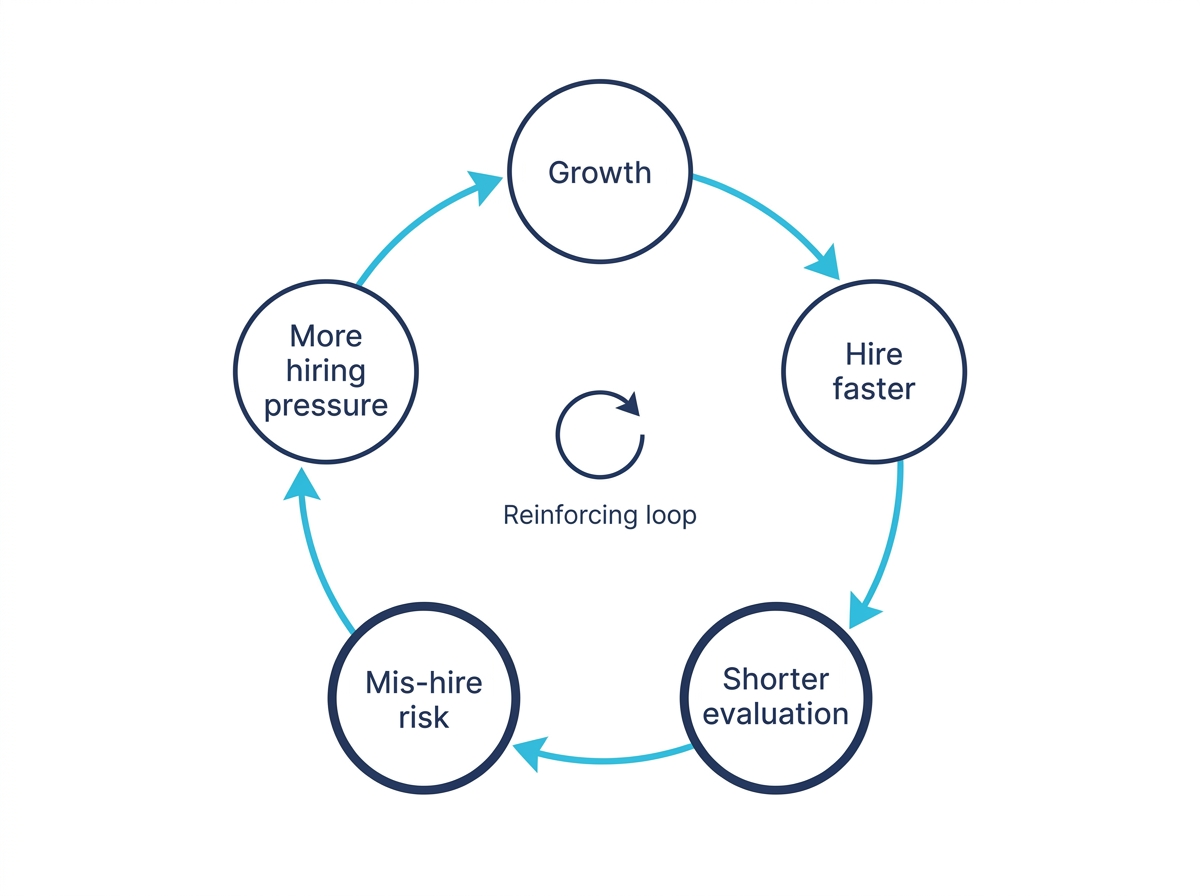
The Red Queen Effect in hiring is particularly vicious for growth-stage startups. You need senior engineering talent to build competitive products, but competing for that talent means facing established companies with more resources, brand recognition, and hiring infrastructure. Source When a startup begins to succeed, it needs to hire rapidly to sustain growth. But rapid hiring in a competitive talent market means competing on compensation, location, and prestige with companies that have been hiring for longer and have established reputations. The startup runs faster — posting more job listings, moving through interviews more quickly, offering higher salaries — but the talent market is moving just as fast. The position does not improve.
Worse, the act of rapid hiring creates new Red Queen dynamics within the organization. New hires raise the average competency bar, which raises expectations, which makes the next hire harder to justify, which creates pressure to hire faster, which compresses the evaluation process, which increases the risk of mis-hires. The treadmill accelerates.
Growth-stage organizations need to hire faster precisely when they are worst equipped to hire well. The resources to build a rigorous hiring process come after the growth that demands rapid hiring. The Red Queen is in full effect.
The response is not to slow growth (which means falling behind the market) but to change the hiring strategy. Options include:
- Building talent pipelines before they are urgently needed, rather than reacting to open positions.
- Investing in employer brand so that the company attracts candidates without competing solely on compensation.
- Designing roles for growth so that each hire increases the capacity to make the next hire, rather than consuming the capacity of the current team.
- Using structured interviews and evaluation frameworks to reduce mis-hire risk even when speed is critical.
🎯 The hiring Red Queen trap: Growth-stage startups often respond to hiring pressure by moving faster — shorter interviews, looser criteria, higher compensation. This feeds the Red Queen dynamic rather than escaping it. The organizations that escape are the ones that invest in hiring infrastructure before the urgent pressure arrives.
4)What You Can Actually Do About It
The Red Queen Effect is not a problem you can solve. It is a condition you must manage. The organizations that navigate it successfully share a common orientation: they treat the Red Queen dynamic as a design constraint, not a challenge to be overcome.
Design for the cycle, not for escape. There is no exit from the Red Queen. Trying to escape it is the most common and most expensive mistake. Design your strategy, your organization, and your metrics to thrive within the cycle.
Optimize for learning rate, not current position. In a static environment, your current position is the most important variable. In a Red Queen environment, your learning rate is. The organization that learns fastest — not the one that starts in the best position — ends up ahead.
Build systems that compound. Individual advantages are temporary. Systems of compounding advantage — where each success makes the next success more likely — are not. The Red Queen cannot erode a compounding system as easily as it erodes a static one.
Monitor the cycle, not just your position. If you are only watching your own metrics, you are watching the wrong thing. In a Red Queen environment, your relative position depends on what your competitors are doing. Monitor the cycle, not just the outcome.