The Anthropic S-1 filing is the company’s public IPO prospectus, filed with the SEC on October 26, 2026 (Anthropic S-1, 2026). It reports $16.3 billion of revenue and an $80.7 billion net loss for the first half of 2026. About $72 billion of that loss is a non-cash accounting charge. The harder question is whether usage-based revenue can keep up with compute contracts that run into the 2030s.

Reading a prospectus starts with separating headline numbers from the notes that explain them.
What the Anthropic S-1 filing shows at a glance
Anthropic plans to list on the Nasdaq Global Select Market under the ticker “ANT” (Anthropic S-1, 2026). The price range and share count are still blank. The company is a Delaware public benefit corporation.
The growth is steep. Revenue went from $386 million in 2024 to $4.6 billion in 2025 (Anthropic S-1, 2026). First-half 2026 revenue reached $16.3 billion, up about 1,300% year over year.
| Metric | H1 2025 | H1 2026 |
|---|---|---|
| Revenue | $1.2B | $16.3B |
| Operating income (loss) | –$2.1B | –$0.7B |
| Net loss | –$13.0B | –$80.7B |
| Operating cash flow | –$1.5B | +$3.9B |
| Implied gross margin | About 12% | About 85% |
Source: Anthropic S-1, 2026; gross margin as calculated by CNBC, 2026.
Anthropic held $112.4 billion in cash and $19.3 billion in short-term investments on June 30, 2026 (Anthropic S-1, 2026). That is $131.7 billion in total. It had raised $141.1 billion since its founding.
🎯 The core business now brings in cash. The main risk sits in long compute contracts that future revenue has to pay for.
Seven numbers people misread
1. The 5–7% of revenue from rule-breaking accounts
Anthropic estimates that 5% to 7% of its revenue came from customers it later restricted or terminated for usage-policy violations. The period is the nine months ended September 30, 2026 (Anthropic S-1, 2026).
The filing explains the lag. Detection and enforcement take time, and banned users can re-register under new accounts. It also calls the figure an estimate that may change as detection improves.
One detail matters for investors. The company says its run-rate revenue includes customers that have not yet been cut off (Anthropic S-1, 2026).
2. The $29.7 billion stock compensation figure
As of June 30, 2026, Anthropic reported $26.6 billion of unrecognized stock-based compensation tied to RSUs (Anthropic S-1, 2026). It reported about $3.1 billion more for other equity awards. Together that is roughly $29.7 billion.
Viral posts divide this by about 5,300 employees and get $5.6 million each. That math skips two facts. The expense is recognized over several years, and the S-1 does not show an even split per person.
The cost is paid in shares, so existing owners feel it as dilution. Actual stock compensation expense in the first half of 2026 was $2.2 billion (Anthropic S-1, 2026).
3. The $4.66 billion tender offer in April 2026
In April 2026, a syndicate of stockholders bought shares from existing holders through a tender offer (Anthropic S-1, 2026). The total price was about $4.66 billion for 179.9 million shares.
Anthropic facilitated the deal, and the cash went to the sellers. Because shares sold at fair value, the company booked no stock compensation expense for it.
4. The 50.1% founder vote
The seven co-founders hold a single Class F share through a Founder LLC (Anthropic S-1, 2026). That share carries a fixed 50.1% of the voting power. The members decide how to vote it by majority.
A separate Long-Term Benefit Trust holds Class T stock. It elects and removes four Class T directors, a majority of the board. Anthropic will be a “controlled company” under Nasdaq rules.
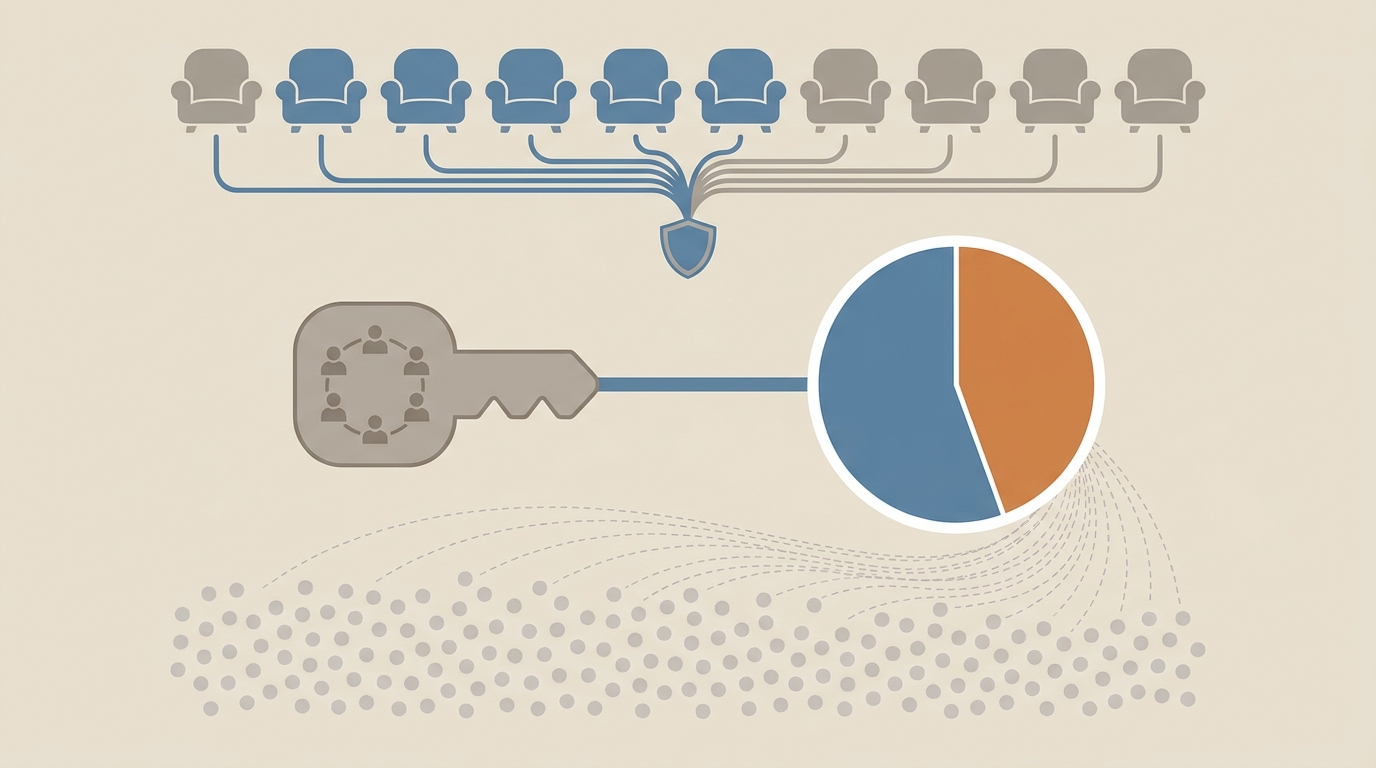
Voting control and board control sit in two different places, and neither belongs to public shareholders.
For public buyers, this means economic exposure with little say over direction. That gap between insiders and new owners stays in place after listing.
5. “90% of code written by Claude” and $6.6 million per employee
Over 90% of contributions to Anthropic’s codebase in September 2026 were written by Claude (Anthropic S-1, 2026). Average daily code volume per engineer in Q3 2026 was over 45 times the 2024 average.
Headcount rose from about 940 at the end of 2024 to about 5,300 by September 30, 2026. Trailing revenue per employee climbed from $1.4 million to over $6.6 million in a year (Anthropic S-1, 2026).
These metrics count volume. More code can also mean more code to review and maintain. Once a company advertises a metric, it may start optimizing for it, which is Goodhart’s law in action.
6. A profitable quarter next to an $80.7 billion loss
Both are true. Anthropic posted $974 million of operating income in Q2 2026, an 8% margin (Anthropic S-1, 2026). The first quarter showed a $1.7 billion operating loss.
Most of the $80.7 billion first-half net loss came from fair-value changes on convertible notes, derivatives, and SAFEs. Those totaled about $72.4 billion (Anthropic S-1, 2026). As the valuation rose, the instruments owed to investors became more expensive on paper.
Operating cash flow was positive at $3.9 billion. Adjusted net income, which strips out these charges, was $2.7 billion (Anthropic S-1, 2026).
💡 Ask which question each number answers. Operating income shows whether the core business covers its costs. Net income shows what accounting rules record. Cash flow shows whether money actually arrived.
7. The size of the compute commitments
The filing lists about $417 billion in future minimum payments for compute (Anthropic S-1, 2026). These deals start in 2026 or 2027 and last up to 20 years. Extra TPU capacity for 2028–2031 could add $125–150 billion more.
Some posts cite totals above $800 billion. The public filing still leaves its aggregate commitment figure blank. Treat any single headline total with care until an amended filing fills it in.
Why compute contracts are the biggest risk
The S-1 names the mismatch itself. Revenue is mostly consumption-based and often not locked into long contracts (Anthropic S-1, 2026). Compute commitments, by contrast, extend over many years.
Consumption-based revenue made up 80% of first-half 2026 revenue. That revenue can grow fast, and it can also shrink fast.
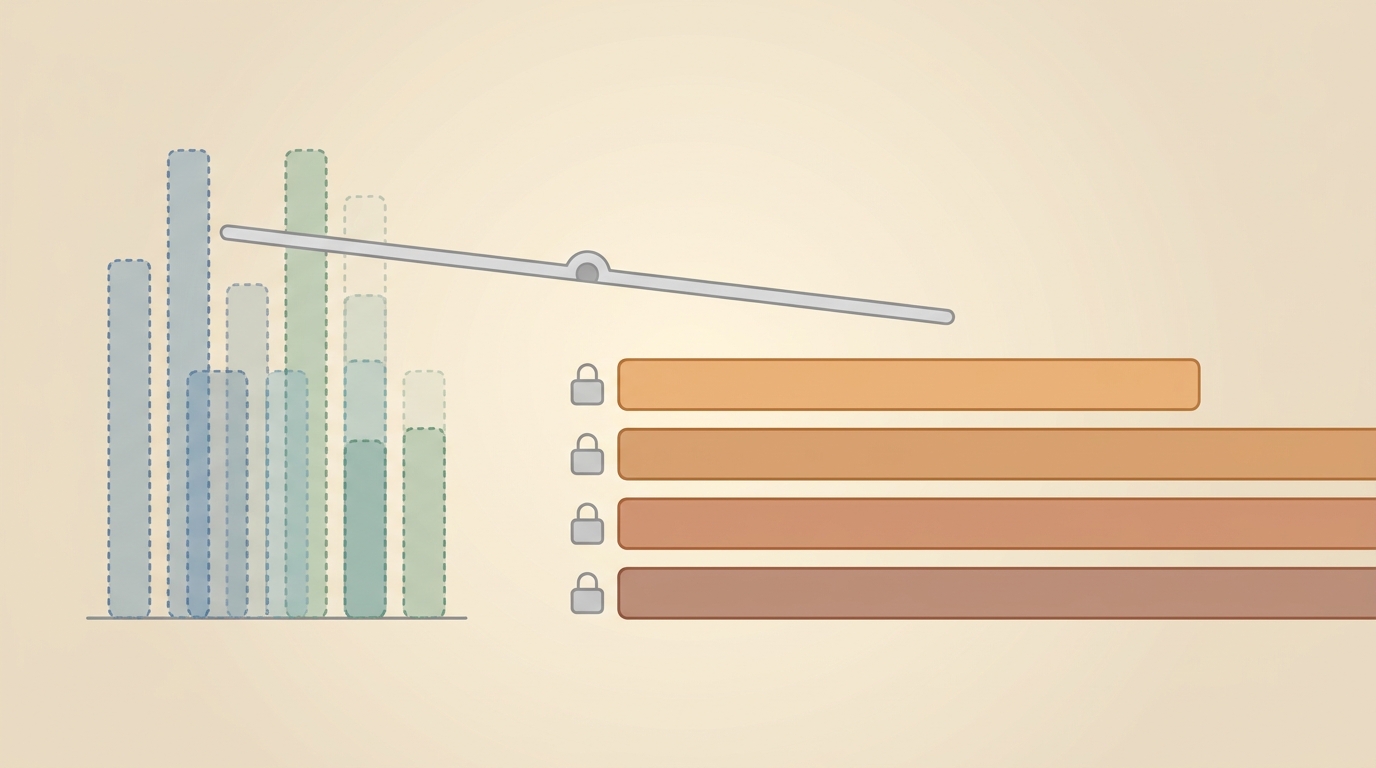
Flexible, usage-based income on one side; fixed, multi-year obligations on the other.
| Partner | Commitment | Period | Exit terms |
|---|---|---|---|
| At least ~$114.5B | Apr 2026 – Jul 2033 | Non-cancelable; true-up if spend falls short | |
| Amazon | At least $110.0B | May 2026 – Apr 2036 | Non-cancelable; true-up if spend falls short |
| Microsoft | At least $44.9B | Nov 2026 – May 2033 | Non-cancelable, except undelivered tranches |
| Broadcom | ~$125.2B in rent | Five-year equipment lease | Non-cancelable during the lease term |
| SpaceXAI | Up to $120.5B | Into 2029 | 90 days’ notice after early 2027 |
| Nscale | Up to ~$44.6B | Into 2033 | Fees accrue as capacity arrives |
Source: Anthropic S-1, 2026; SpaceXAI total from CNBC, 2026.
For example, imagine a gym that signs a 10-year lease but sells only monthly passes. A busy year looks great. A quiet year still has to cover the full rent.
There is a positive trend. Compute and infrastructure costs fell from 72% of revenue in Q1 2026 to 48% in Q2 (Anthropic S-1, 2026).
⚠️ A $131.7 billion cash pile sounds decisive. Yet the four largest named contracts add up to about $395 billion, payable over many years.
How cloud partners act as investor, supplier, and sales channel
Cloud marketplaces drive a growing share of sales. Revenue through them rose from 11% in 2023 to 47% in 2025, then 48% in H1 2026 (Anthropic S-1, 2026).
The same companies also fund Anthropic:
- Amazon: $6.2 billion of convertible notes outstanding on June 30, 2026 (Anthropic S-1, 2026). Up to $15 billion more may follow in $5 billion tranches (CNBC, 2026).
- Google: up to $20 billion still available under a 2026 note agreement. It also holds an option to buy up to $10 billion of stock at the IPO price (Anthropic S-1, 2026).
- AMD: a commitment to buy up to $5 billion of stock if conditions are met (Anthropic S-1, 2026).
Money moves in a loop. A partner invests, Anthropic spends on that partner’s cloud, and the partner resells Claude. To read deals like this, follow the incentives of each party.
Sales and marketing costs hit $3.17 billion in the first half of 2026. Of that, $2.7 billion was fees to channel partners (CNBC, 2026). That pattern suggests partner sales are booked at the full customer price. Check the revenue-recognition note before comparing margins with rivals.
What the filing says about safety and legal risk
- Test environment leak: a misconfigured third-party cybersecurity evaluation left a model connected to the open internet (Anthropic S-1, 2026).
- Training pause: Anthropic delayed pre-training a new frontier model for over a month to better protect model weights.
- FTC inquiry: the FTC issued a civil investigative demand in October 2026 covering privacy, data protection, and product safety.
- Pentagon dispute: a California court ruled largely for Anthropic on August 27, 2026. The D.C. Circuit upheld the supply-chain-risk label 2–1 on September 25, 2026.
- Copyright: the $1.5 billion Bartz settlement was approved in July 2026. Other suits remain pending.
What the S-1 doesn’t tell you yet
The price range, share count, and listing date are blank (Anthropic S-1, 2026). So is run-rate revenue as of October 31, 2026.
For context, Anthropic raised $65 billion at a $965 billion valuation in May 2026 (CNBC, 2026). MIT professor Sinan Aral told CNBC a $1.5–2 trillion valuation would mean 22–30 times revenue.
Numbers to watch in the next filing
✅ - Compute cost as a share of revenue: 72% in Q1 2026, 48% in Q2.
Net revenue retention: about 900% as of September 30, 2026, excluding Pro and Max plans.
Revenue from accounts later cut off: 5–7% over nine months.
Operating margin: 8% in Q2 2026.
Cloud marketplace share of revenue: 48% in H1 2026.
Customer concentration: no single customer above 10% of nine-month revenue.
All figures in this checklist: Anthropic S-1, 2026.
When this reading doesn’t apply
- You need a price view. This guide explains the disclosures. It does not value the stock.
- An amended S-1 is out. Later versions will add the price range and may revise figures.
- You want audited Q3 numbers. The financial statements run through June 30, 2026. September figures are operating metrics.
Anthropic S-1 filing FAQ
1. When is the Anthropic IPO date?
No date is set yet. Anthropic filed confidentially in June and made its S-1 public on October 26, 2026 (CNBC, 2026). Companies usually add a price range in an amended filing, then price shortly before trading starts. Watch EDGAR for an S-1/A with the range filled in. That is the clearest sign a listing is close.
2. What is Anthropic’s stock ticker?
Anthropic plans to list its Class A common stock on the Nasdaq Global Select Market as “ANT” (Anthropic S-1, 2026). The listing is not final until the SEC declares the registration effective and the offering prices. Until then, there are no public “ANT” shares to buy.
3. Can you buy Anthropic shares before the IPO?
Most individuals cannot. Pre-IPO shares change hands privately, often between existing holders and approved buyers, as in the April 2026 tender offer (Anthropic S-1, 2026). Some large partners hold rights at the IPO price, such as Google’s option to buy up to $10 billion. Retail investors usually get access once trading begins.
4. Did Anthropic make money in 2026?
It depends on the measure. Operating income was positive in Q2 2026, at $974 million (Anthropic S-1, 2026). Operating cash flow was $3.9 billion for the first half. Net income was a loss of $80.7 billion, mostly from non-cash fair-value charges on investor instruments.
5. Where can I read the Anthropic S-1 filing PDF?
The full prospectus sits on the SEC’s EDGAR system as a web page (Anthropic S-1, 2026). Your browser’s print function can save it as a PDF. Start with “Risk Factors,” “Management’s Discussion and Analysis,” and the commitments note. Those three sections hold most of the numbers in this article.
Read the filing with a checklist
Open the S-1 on EDGAR and search for “commitments,” “Net Revenue Retention,” and “usage policy.” Compare each figure with the checklist above. If an AI assistant summarizes the filing for you, check every number against the source. This guide on using AI without losing critical thinking shows how.
This article is for general information and isn’t professional advice.