By 2016, Wells Fargo was famous for cross-selling. Its customers held about six of the bank’s products, roughly double the average at other large banks, and the internal goal was eight per household: “Eight is great” (Nova SBE case study).
On September 8, 2016, regulators revealed what had been feeding the number. Employees had opened roughly 1.5 million deposit accounts and applied for about 565,000 credit cards that customers may never have authorized (CFPB, 2016).
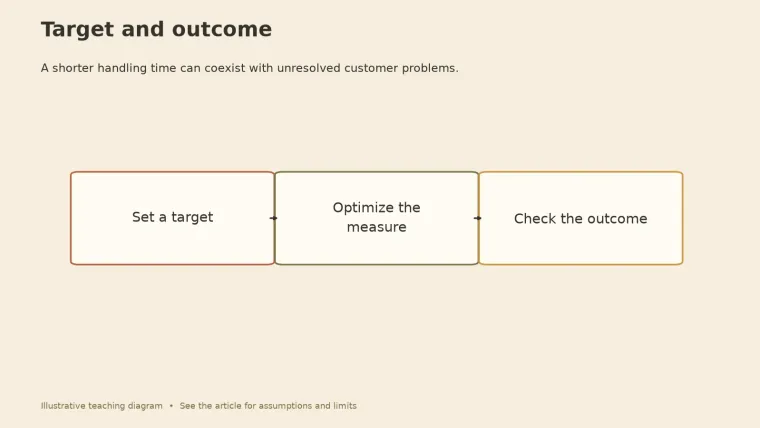
Goodhart’s law says that when a measure becomes a target, it stops being a good measure. Once people are rewarded for moving a number, they find ways to move it that leave the underlying goal behind. The number keeps improving while the thing it was meant to track gets worse.
Wells Fargo paid $185 million in penalties, and about 5,300 employees were fired over several years for these practices. The metric had looked healthy the entire time.
The cross-sell number rose while customer value fell
Products per household was a reasonable signal at first. Customers who use several of a bank’s products tend to be more engaged. Then the bank attached sales goals and incentive pay to it, and the signal broke.
| What the cross-sell number showed | What was actually happening | |
|---|---|---|
| Products per household | Climbing toward eight | Many accounts unwanted, or unknown to the customer |
| Branch performance | Teams hitting sales goals | Employees moving customers’ money to fund new accounts |
| Customer relationship | Deeper and more profitable | Some customers charged overdraft and insufficient-funds fees |
The regulator’s description is blunt. The practice “gave the employees credit for opening the new accounts, allowing them to earn additional compensation and to meet the bank’s sales goals.”
The idea is older than the scandal. In 1975 the economist Charles Goodhart, writing about British monetary policy, observed that “any observed statistical regularity will tend to collapse once pressure is placed upon it for control purposes” (Goodhart’s law). The shorter version most people quote came later, from the anthropologist Marilyn Strathern.
Fraud is the dramatic version. Most Goodhart failures are quieter.
Gaming is only one way a target breaks a measure
People can damage a measure while working honestly. Here are the common routes:
- Faking the number. Accounts opened without consent. This is the Wells Fargo route.
- Narrowing the work. A teacher rewarded for completed activities picks tasks that are easy to finish over tasks that reveal understanding.
- Reclassifying. Incidents get logged under a different category, so the count drops while the incidents continue.
- Shifting costs elsewhere. A team hits its budget by pushing spending into next quarter or onto another department.
Ask who gains from each way of moving the number. Following the incentives usually reveals which route people will take.
Goodhart’s law and the cobra effect answer different questions
The two ideas overlap, and they often appear in the same story.
| Question | Goodhart’s law | Cobra effect |
|---|---|---|
| Main concern | A targeted measure stops telling the truth | An incentive makes the original problem worse |
| In the Wells Fargo case | Products per household stopped reflecting real relationships | Sales pressure created new harm: unwanted accounts and fees |
| What needs checking | How the proxy relates to the goal under pressure | The chain from incentive to behavior to harm |
Not every broken proxy creates a cobra effect. A number can drift away from the goal while the goal stays where it was. The cobra effect guide covers incentives that backfire. A well-known field study, A Fine Is a Price, shows how a new penalty at Israeli daycare centers changed behavior in a direction nobody intended.
So how do you set a target without breaking the measure?
Six questions to ask before you attach a reward to a number
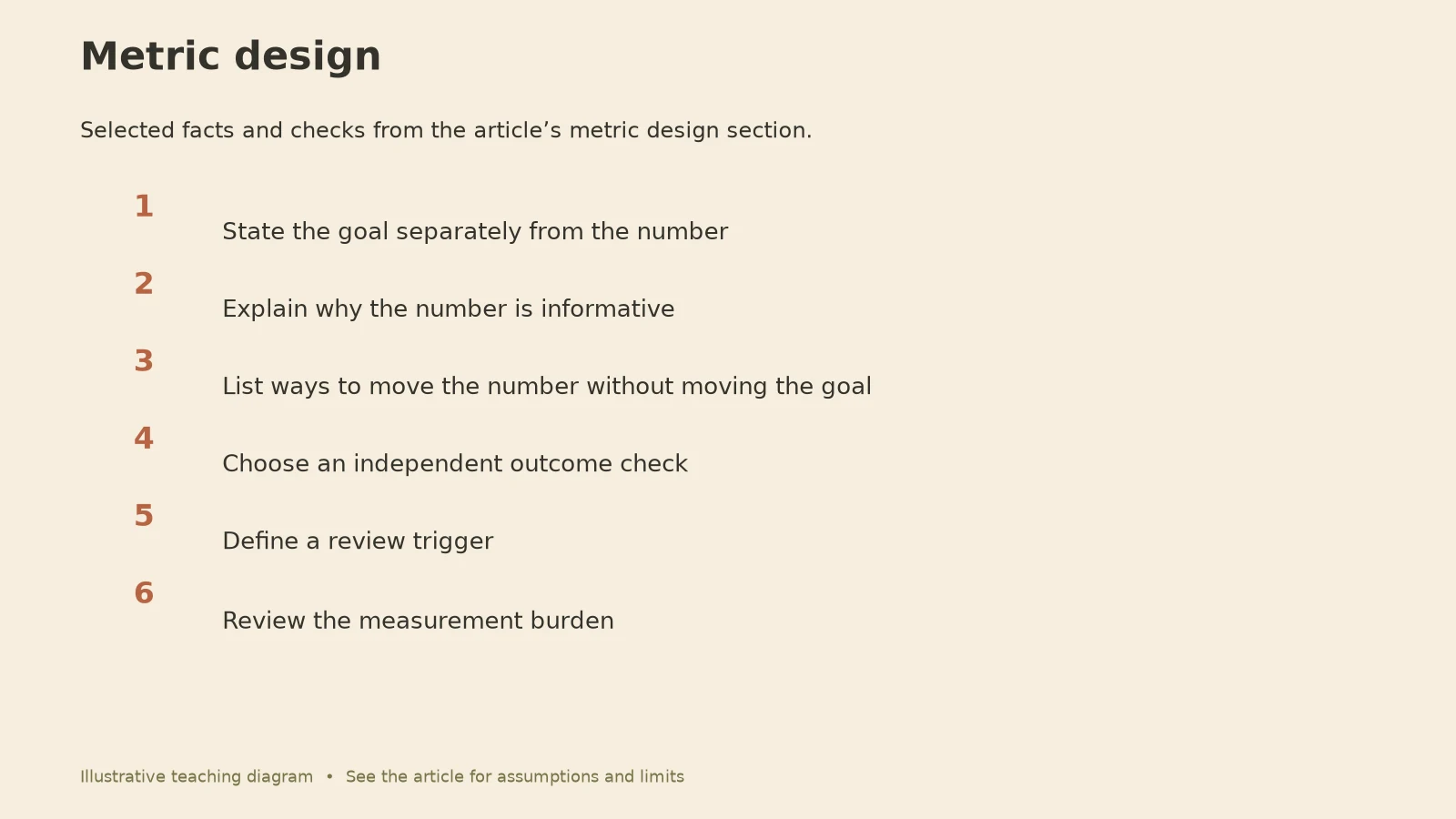
- State the goal separately from the number. Wells Fargo’s goal was presumably customers who benefit from more products. Products per household was only a stand-in.
- Explain why the number is informative. Write down the assumed link: engaged customers use more products.
- List ways to move the number without moving the goal. Unrequested accounts, products customers never use, and accounts opened and closed quickly.
- Choose an independent outcome check. Accounts the customer actually funded and used, complaints, and customers who stay.
- Define a review trigger. For example, a jump in unfunded new accounts launches an investigation before bonuses are paid.
- Review the measurement burden. Each extra metric costs time to collect, and people can learn to game it too.
Question 3 does the most work. If you cannot think of a way to game your own metric, ask the people who will be measured by it. They usually know within a minute. Second-order thinking helps trace what they will do next.
When Goodhart’s law is taken too far
- Dropping targets entirely. Teams still need numbers to coordinate. The law warns against treating a proxy as the whole of success, especially under heavy pressure.
- Treating every improvement as suspicious. A metric can rise because the work really improved. Compare it with an independent outcome before assuming manipulation.
- Adding metrics until nothing is gameable. Five proxies can still miss the goal together, and each one adds reporting work.
Questions people ask about Goodhart’s law
Who said “when a measure becomes a target, it ceases to be a good measure”?
The popular wording is usually credited to anthropologist Marilyn Strathern, summarizing Charles Goodhart’s 1975 point about monetary statistics.
Should I stop setting targets?
No. Targets help people coordinate. Pair each one with an outcome check that the target itself does not reward.
How can you tell real improvement from gaming?
Look for a second signal that should move with the first. At Wells Fargo, product counts rose while many new accounts sat unfunded. When the two diverge, investigate.
Test your next target for five minutes
Before you set a target for a team, or for yourself, fill in this card:
The goal behind this number: ___
Fastest way to hit the number without the goal: ___
Who would be tempted to do that, and why: ___
A second signal that would catch it: ___
Personal metrics break the same way. If you track a habit with the Sweat habit tool, write the real goal next to the streak, so a two-minute version that keeps the chain alive does not quietly replace the habit you wanted.