A hobby takes place in the life you have today. The evening spent listening, reading, or making something can matter before it produces income, a new skill, or something to show anyone.
That is easy to forget when every interest arrives with a suggested upgrade. Read a book, then track the books. Enjoy a game, then consider streaming. Start drawing, then work out whether the drawings could become a product. Before long, the activity has another job.
Learning how to enjoy hobbies without being productive starts with taking the enjoyment seriously. An evening can be worth having even when it leaves very little to show anyone afterward.
An evening spent with something you enjoy.
What did you like before you started measuring it?
The atmosphere can be part of what you enjoy. A gaming-café membership or a single evening there can look like a poor purchase if the calculation includes only access to a computer. A gaming café is also a place to spend time: the room, the company, the feeling of being there. Those may be what someone is paying for.
The same question applies to quieter interests. Perhaps you like the light in the room where you read. Perhaps you like taking care of something that grows slowly, or hearing an album without having to talk. None of those experiences needs to become an achievement before you can value it.
This makes a difference when choosing a hobby. “What could I become good at?” produces a different list from “What would I like to do on an ordinary Tuesday?” Both questions have uses. The second deserves an answer too.
Try describing the part you actually enjoy. “Gardening” is broad. “Looking at the new leaves while I water the plant” is specific enough to protect. Buying more equipment, joining a challenge, or posting progress may add something you like. They may also take time away from the part that brought you there.
When leisure starts needing an excuse
A familiar bargain goes something like this: I can read the novel because it will improve my writing. I can go for a walk because it will make the afternoon more efficient. The activity receives permission through its contribution to later work.
Sometimes that contribution is real. The trouble is that the permission can be withdrawn whenever a more efficient use of time appears. Rest becomes a competition it is unlikely to win.
In four studies involving 1,310 participants, published in 2021, researchers examined the belief that leisure is wasteful. That belief was linked to lower enjoyment; experimental prompts also reduced enjoyment in the settings studied. The research gives us a reason to notice the explanation we attach to leisure. It does not establish one cause for everyone’s guilt.
You can hear the bargain in a small word: “At least.” At least I learned something. At least it counted as exercise. At least I can post a review.
What remains if you leave that explanation out? You enjoyed the story. You liked moving outside. You wanted to know what the music sounded like all the way through. Those are intelligible reasons to spend some of your own time.
Keep the real limits; question the expanding ones
There are evenings when a responsibility genuinely needs attention. Money, care work, sleep, and health put limits on leisure. Calling everything self-care won’t pay a bill or make an unsafe activity safe.
But “I have an unfinished task” can grow into a rule that rules out almost every hobby. There is usually another email, another useful skill, another part of life that could be improved. Under that rule, free time exists only after an impossible finish line.
Put a real limit into plain language. “I can afford this much this month.” “I need to leave by nine.” “This activity has to fit around treatment and rest.” A limit you can identify is easier to plan around than a general feeling that you haven’t earned any pleasure yet.
A modest container can help: an amount of money you are comfortable spending, a stretch of time that won’t create trouble elsewhere, somewhere to put the materials afterward. The hobby then has room inside your life. You don’t have to make it repay its place through income, public approval, or constant improvement.
There is also no obligation to find the perfect hobby before trying anything. Borrow the book, try the inexpensive version, or attend once before buying an identity’s worth of equipment. The first attempt can tell you whether the experience appeals to you.
You can practice seriously and still keep the hobby yours
Some people love scores, difficult pieces, training plans, and the slow business of getting better. Removing those things would remove much of their pleasure.
The useful question is whether the goal is still doing work you want it to do. A practice plan may give shape to an interest. It may begin to feel like another supervisor. You are allowed to notice the change and adjust the plan.
A missed practice session, for example, can remain a missed session. It needn’t become evidence about your character. A lower target during a busy month can let you continue an interest that an all-or-nothing rule would end.
Commercializing a hobby deserves the same clear look. Selling something may be welcome. It also introduces customers, deadlines, revisions, and work you might never have chosen for pleasure. Keep enough space to discover whether you like that arrangement before asking it to support you.
Advice about needing three hobbies or five hobbies can supply ideas. Treat those numbers as informal suggestions. Your schedule, access, health, and interests will determine the arrangement you can actually enjoy. A single recurring interest can already occupy a meaningful part of a week.
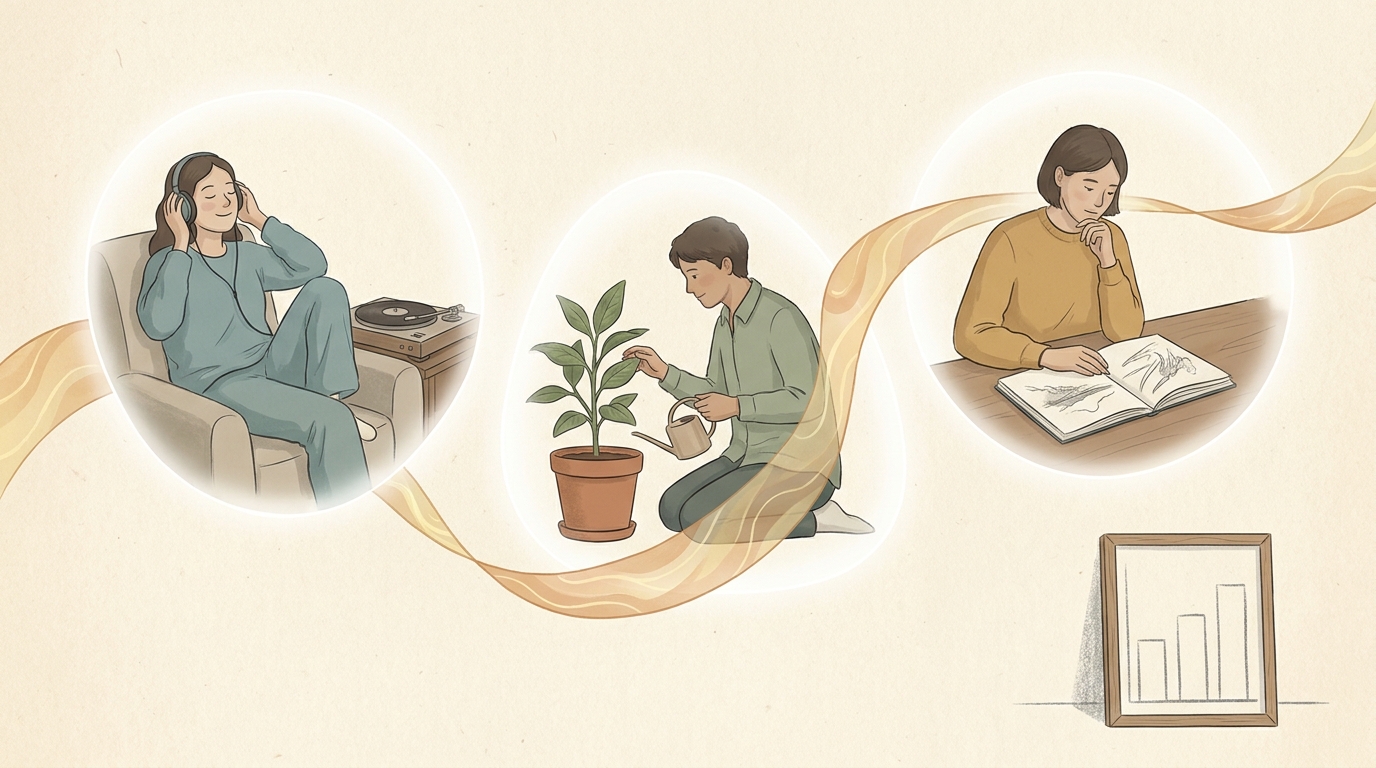
Music, plant care, and drawing can take their time.
Leave some of the experience unrecorded
Tracking can help you remember a good experience or keep a habit going. It can also move your attention toward the record. You finish a chapter and immediately wonder what counts toward the target. You like a place, then begin composing its public explanation.
For something you already enjoy, try leaving the record optional. You can photograph the plant when you want a photograph. You can read a short book without deciding whether its length makes it a respectable entry in the count.
The same applies to recommendations. A book can matter to you even when you don’t have a polished argument for it. “I liked spending time in it” says something different from a review and says enough for some conversations.
I want to keep that distinction in my own writing too. Publishing what I value can be satisfying. Letting platform numbers decide what I am permitted to value would narrow the life the writing came from.
If a record helps, keep it small enough to serve the activity. You could mark the days you did it and add a few words about what you enjoyed. Leave the entry blank when you skip a day; the record need not become another score. The guide to using a habit tracker gives more options. Some activities can stay off it.
What hobbies research can tell us
A 2023 study in Nature Medicine followed 93,263 adults aged 65 and older across 16 countries. Hobby engagement was associated with aspects of better mental well-being. It was a longitudinal study of older adults, so the findings cannot establish that taking up any hobby causes the same benefit for everyone.
The research is useful background. It doesn’t need to become the sales pitch for tonight’s pleasure, and hobbies are no substitute for professional help when that is needed.
The everyday question is smaller. Is there room for something you want to return to, at a cost your life can bear? You can change it when it loses its appeal. You can keep it ordinary. An interest that gives you a good hour has already done something for that hour.
Work shares a life with relationships, rest, movement, and other interests. Giving those parts of life room can help when every free hour is being claimed by more work. Some time can be set aside simply because you want to spend it that way.
For the next ordinary day, choose something you keep postponing that could fit into the time and budget you already have. Try the activity before deciding what it ought to become.
This article is for general information and isn’t professional advice.