
I wanted this habit tracker to keep a small action within reach. It can be surprisingly easy to forget something you care about when it has no clear place in the day.
A record can help you see that place. It can also show you when the plan is too difficult. The useful question after a missed day is what would make the next attempt easier.
Record the action after doing it. After a missed day, choose a small action you can do today.
Make the behavior easier to recognize
“Be healthier” is an intention. “Take a short walk after lunch” is an action you can recognize and record. “Read more” can become “read a page after making tea.” Pick something small enough that you have a reasonable chance of doing it on an ordinary day.
In his book excerpt about habit tracking, James Clear describes how a visible record can provide feedback and make progress easier to notice. He also recommends scaling new habits down. That is useful guidance for beginning; the tracker still cannot make the action happen for you.
Tie the action to a situation you already meet: after lunch, before closing your laptop, or when you put your phone down for the evening. If the situation rarely occurs, choose another one.
Set up one habit
Open YepSoso Habits. Add a name that describes the action, then use the habit’s settings to choose its goal and unit. A count should mean something you can observe, such as one reading session or a few repetitions of a chosen action.
Start with one habit so that the act of recording it stays manageable. You can add others later. The tool supports check-ins, calendar views, progress, settings, and archiving. Those controls are useful when they help you understand the behavior you are building.
In guest mode, records stay in the current browser. Sign in when you want the tool to save to your account and sync across devices. The guest collection and the signed-in collection are separate; export anything you want to keep before changing how you use the tool.
Record what actually happened
After doing the action, mark the check-in or record the count that matches it. Keep the entry honest. A full calendar cannot tell you much if its marks describe what you hoped to do rather than what you did.
English and Chinese interfaces use the same guest storage keys or the same signed-in account records. Your habit names and check-ins stay yours when the language changes. A name you wrote in Chinese can therefore still appear in the English interface.
When you review a week, look at the circumstances as well as the count. Was the action easier on days when you started earlier? Did you forget when the usual cue disappeared? You can use that information to change the next week’s plan.
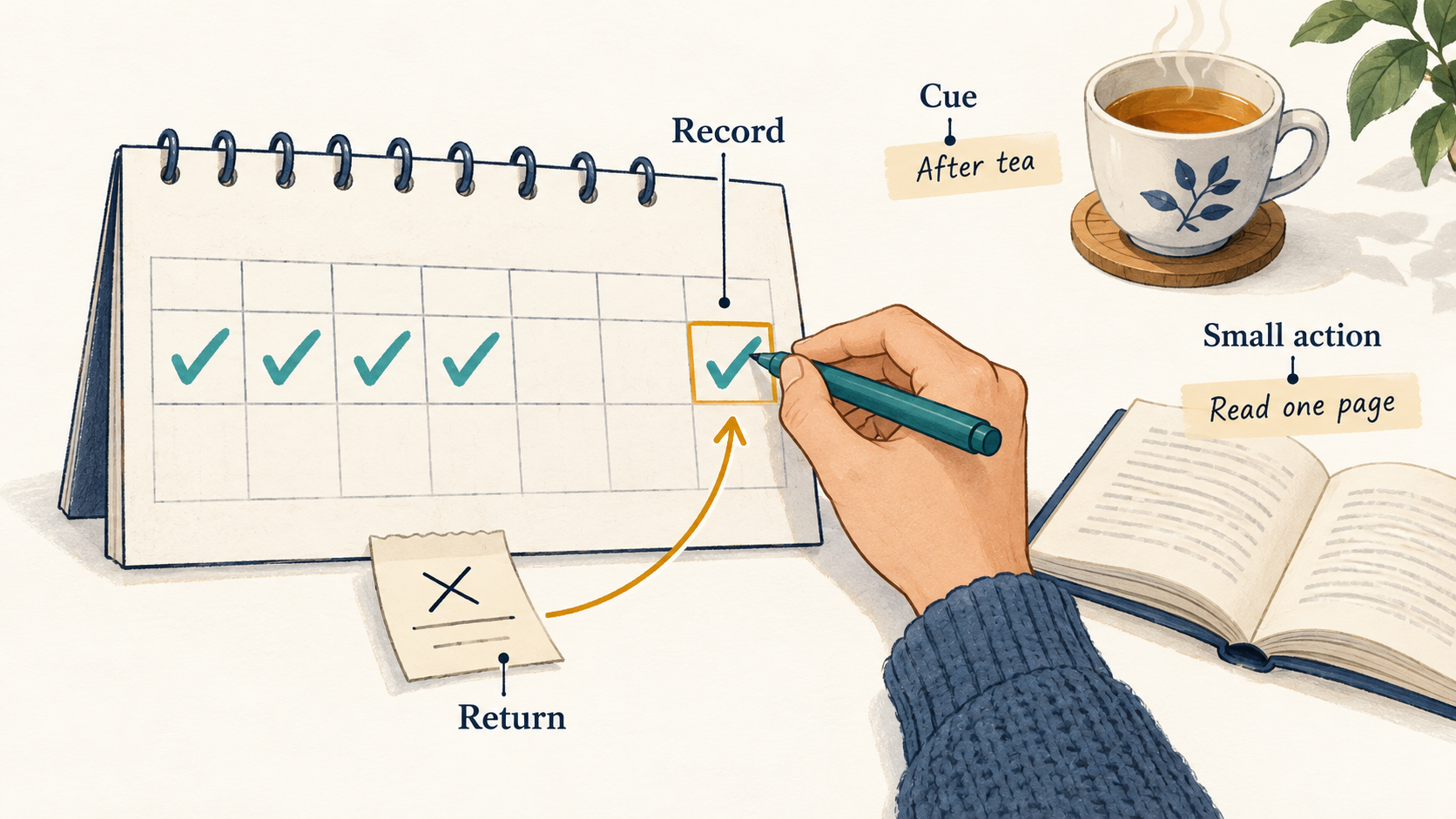
Come back after a gap
Clear’s advice about returning promptly after an interruption is a practical rule, rather than a deadline that proves whether you have succeeded. If several days are already missing, the next manageable action still matters.
Choose a smaller version for the restart. If a reading session feels difficult, begin with one page. If a habit no longer fits your life, edit it or archive it. The record can help you make that decision without pretending the old plan worked.
Avoid choosing a universal number of days when a habit is supposed to become automatic. Different actions and circumstances can develop differently. What you can observe today is whether your next action is clear and possible.
A missed day does not erase the earlier practice
In Lally and colleagues’ habit study, missing one opportunity did not materially disrupt the measured formation process. That finding concerns an occasional omission, not an assurance that long interruptions never matter. Read the original study, published in 2010.
Keep the earlier check-ins. Use today’s cell for what happens today rather than inventing entries to repair a streak.
The “66 days” number is not a deadline
Among the 39 participants whose data fitted the researchers’ curve well, the median modelled time to near-maximum automaticity was 66 days, with estimates from 18 to 254 days. The study observed people for 84 days; longer estimates came from modelling, not watching everyone for 254 days. “Automaticity” simply means that starting the action feels less deliberate. The same study supports patience, not a countdown that guarantees a habit.
Choose a cue you actually encounter
A 2021 randomized study of 192 adults compared nutrition habits tied to a routine with habits tied to a time. Both groups improved, and the researchers found no difference between the two conditions. Keller and colleagues’ trial.
For your tracker, that suggests a practical choice: use “after lunch” if lunch is dependable, or a specific time if that fits your day better. The study tested nutrition behaviors; applying the cue comparison to reading is a practical adaptation, not a tested result for this app.
Read the gaps in one week
Suppose your habit is “read one page after lunch.” A week has a few check-ins and a few gaps. Look for what the gaps have in common. Was there no lunch break, was the book out of reach, or was the material too difficult? Move the cue when your routine changes. Put the book somewhere accessible if finding it keeps getting in the way. Your own records can help you choose an adjustment.
When tracking an amount, keep the unit consistent. Pages one day and minutes the next make the numbers hard to compare. If you reduce the goal, keep the earlier records so you can see the conditions you were working with.
Use records to adjust the plan. A gap may show what needs to change. The action you take when you return deserves a place in the record too.
A good week might include a broken streak and a thoughtful return. That is the purpose I want this tool to serve: make the action visible, learn from the record, and leave the next beginning close enough to reach.