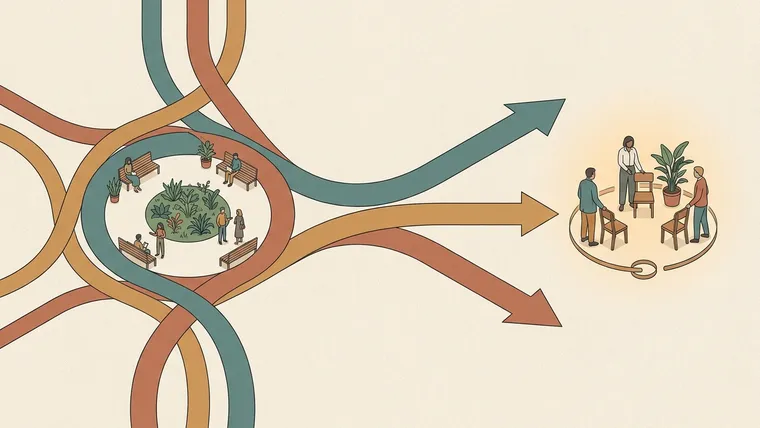
At school, you could see someone tomorrow without arranging anything. There was a classroom to return to, a break between lessons, a route you both happened to take. A conversation could stop halfway through because another chance would probably arrive.
After graduation, that chance needs a place in two calendars. Sometimes it needs travel money, childcare, or enough energy left after work.
One reason it is hard to make friends after college is that the shared setting disappears. Adult life offers more freedom, and people head in different directions. The recurring, ordinary contact that once came with school now needs an arrangement.
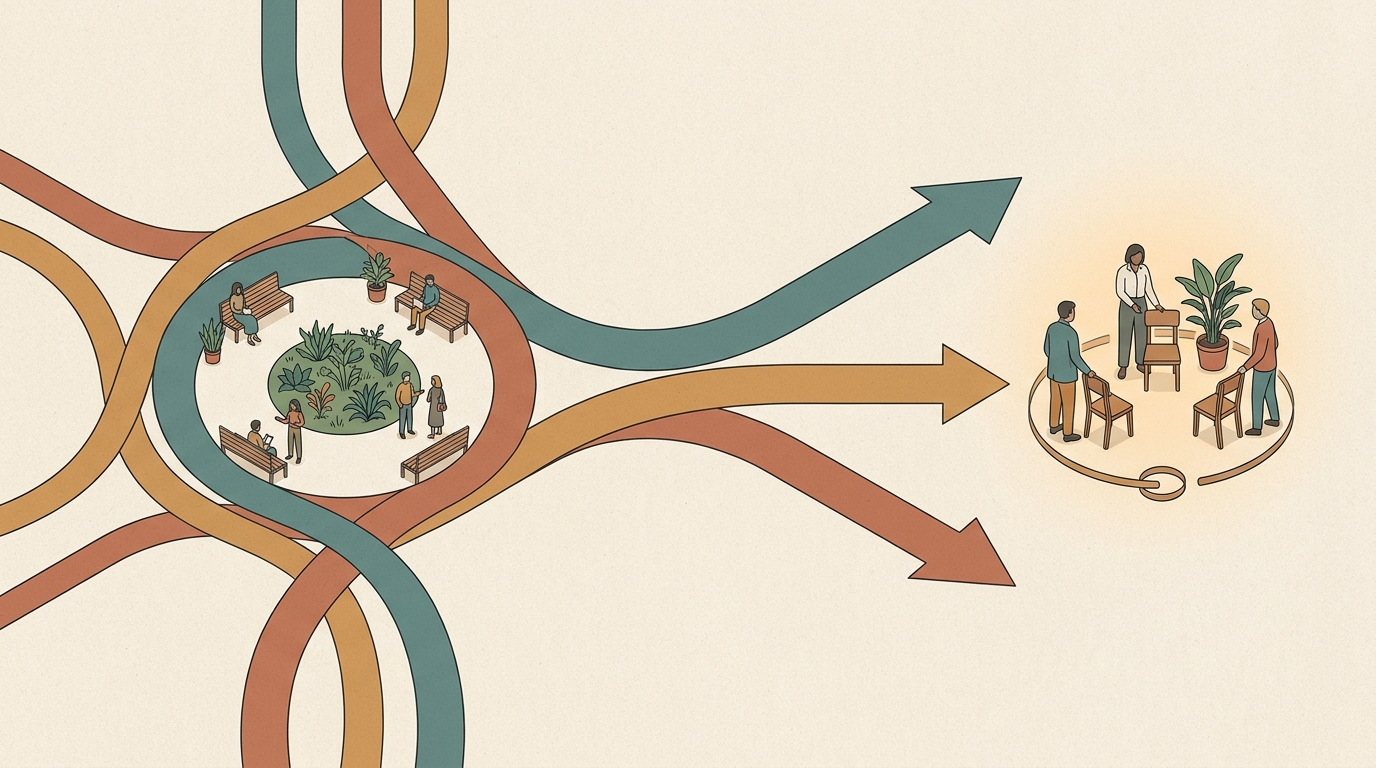
A shared place can give people another chance to meet.
A good conversation can have nowhere to go
You meet someone you like at an event. You talk easily, exchange details, and mean to meet again. Then there is no next occasion. Starting from scratch requires more effort than either of you expected.
It is easy to read this as evidence that the conversation was insincere or that people only care about what they can get. Sometimes a relationship is disappointing. A missing arrangement, though, tells us very little about either person’s character.
Consider how much school arranged without asking. People returned to the same setting. You could learn a little about someone on an uneventful day. There were shared references and activities that gave you something to discuss when neither of you had a brilliant opening line.
Adult friendship often has to build those conditions deliberately. That makes it more dependent on time, money, access, and where life has placed you. Someone working shifts or caring for a relative may have very few recurring openings. Being told to “put yourself out there” does little to solve that.
The useful question is where another ordinary meeting could happen. A recurring class, a walking group, a shared project, or an online group with regular conversation can provide a return point. The setting needs to be one you can afford to revisit and have some genuine reason to enjoy.
Familiarity takes repeated time, but the hours aren’t a quota
Jeffrey Hall’s friendship research, first published online in 2018, included 355 adults who had recently moved and 112 first-year students followed over nine weeks. It examined how time together related to changes in closeness.
The University of Kansas summary reports rough estimates of 40–60 hours for a casual friendship, 80–100 hours for friendship, and more than 200 hours for close friendship. These are estimates from the study, with plenty of variation. Logging enough hours cannot oblige someone to feel close to you.
The finding helps explain why a pleasant introduction may feel so far from the friendship you want. A shared school day used to supply time in the background. An occasional adult meet-up has to carry much more of the work.
That makes repeated, manageable contact worth considering. Choose a setting you can return to often enough for recognition to become ordinary. Stay curious about whether the contact is enjoyable on both sides. Time spent together is an opportunity to find that out.
You may discover that you like a person but have little room for a closer relationship, or that your expectations differ. That is information too. Continuing every acquaintance is a demanding goal that nobody needs to adopt.
Make the next invitation easier to answer
A big, indefinite invitation asks the other person to invent the plan with you. “We should hang out sometime” is friendly, but leaves every practical decision open.
If you already meet through an activity, use the opening it provides: “I’m getting a coffee after this. Want to join me?” You have named a place in time, and declining doesn’t cancel the activity you already share.
Use wording that sounds like you, and offer something small enough to answer. A short walk, sitting together during a break, or joining the next group session may fit better than an entire evening.
Pay attention to what comes back. A person who can’t make it may suggest another time. Someone may enjoy talking in the group and prefer to keep it there. After repeated declines without another opening, give the invitation a rest.
Friendship needs some contribution from both people, although the contributions won’t always be equal in each week. Work, illness, and family life can change what a person can offer. Leave room to learn about those circumstances without treating every delay as a secret message about you.
If finding a question is the awkward part, begin with a detail the person already offered. Asking about that detail gives the conversation some continuity. You do not have to turn every meeting into an exchange of impressive life updates.

The same people, meeting more than once.
An old contact may be an easier place to begin
A new group is one route. An old classmate or former colleague is another. You already have something shared, even if the relationship became quiet.
A series of experiments involving more than 5,900 participants, first published online in 2022, found that people tended to underestimate how much others appreciated being contacted. The American Psychological Association’s summary describes the pattern. It gives some reason to question the assumption that a simple hello would necessarily be an intrusion.
The actual relationship still matters. A boundary, a painful history, or a request for no contact needs to be respected. The average response in a study cannot tell you what a particular person wants.
For an ordinary faded connection, a message can be straightforward: something reminded you of them, you wanted to ask how they were, or you remembered something you used to share. There is no need to pretend you have a practical favor to ask.
Let a reply be a reply. It may become a longer conversation, or it may be a warm exchange that ends there. Asking one message to restore years of closeness puts a lot on both people.
Your adult social world can have several kinds of closeness
A school group can make friendship look like a single, complete package: shared days, shared jokes, invitations, and someone nearby when things go wrong. Adult relationships often distribute those parts across different people.
You may have someone to see through a hobby, someone you talk to at work, and an old friend who knows you well but lives far away. Some contacts will remain light. A long-distance friendship can remain important even with infrequent meetings. These relationships don’t all need to develop in the same direction.
It is worth asking which part feels absent. Is there nobody nearby for a walk? Nobody you can tell a difficult thing to? Are you exhausted by arranging every meeting? Different gaps suggest different next moves. Adding more contacts to a list may leave the most painful gap untouched.
A social setting gives people repeated chances to recognize each other and share an activity. School once supplied that structure; later, hobbies, online groups, and places to eat can supply smaller versions. Building a social life after college includes choosing some settings you can revisit.
The practical arrangement is rarely romantic. Agreeing on a time makes another meeting more likely. You can put the plan on a calendar and later note whether it happened, without counting friends or scoring closeness. A habit tracker is an optional way to keep that simple record. If cost, distance, or exhaustion keeps stopping the plan, change the arrangement before adding reminders.
Let the setting do some of the work
There is a lot of social advice about being more interesting. A shared activity gives people something to do while they gradually learn about each other. The conversation can be ordinary, and a quiet day needn’t ruin anything.
Time with people needs a place alongside work, rest, and other commitments. Making room for different parts of life is useful background. For a friendship you want to continue, the practical question is whether another manageable meeting can actually happen.
Persistent loneliness can be painful even when you are making an effort. If it is affecting your health or making daily life difficult, seek support from someone you trust or an appropriate professional. Having difficulty here does not establish a personal failure.
For the next invitation, I would look for something school used to supply: a reason to meet again that both people can actually manage. Another ordinary meeting gives a promising conversation somewhere to continue.
This article is for general information and isn’t professional advice.