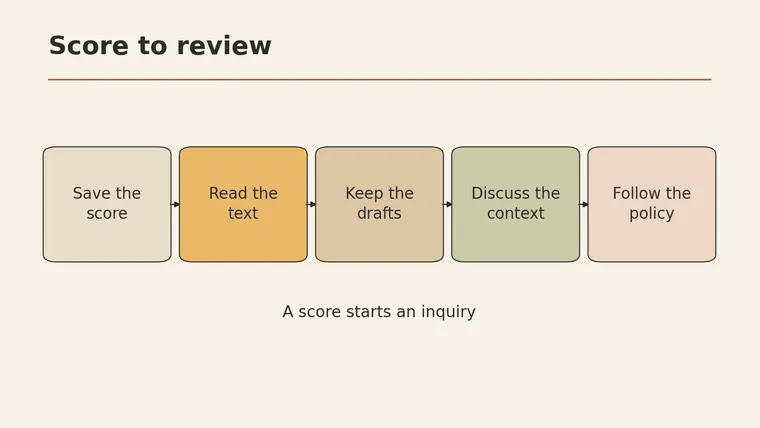
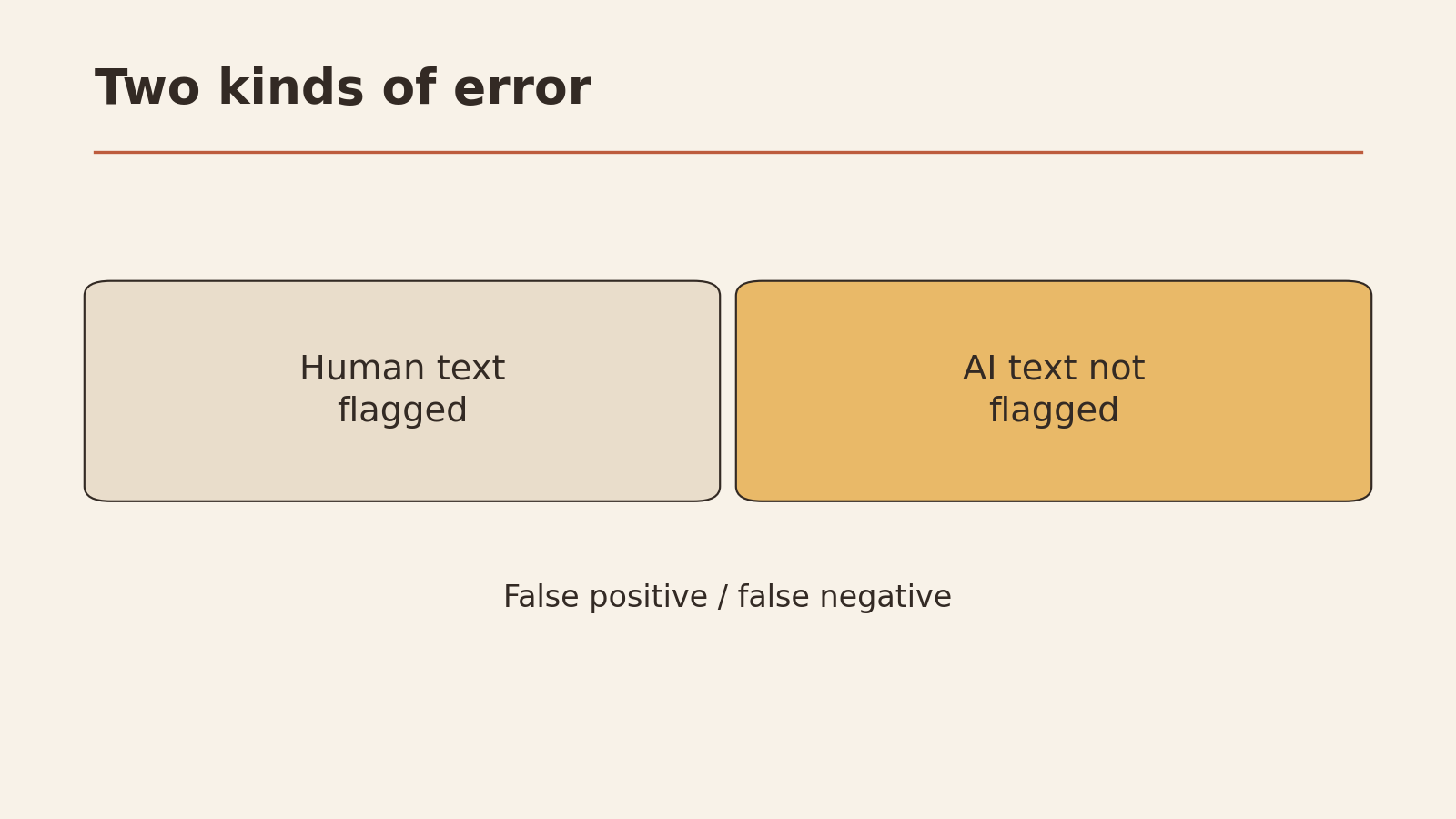
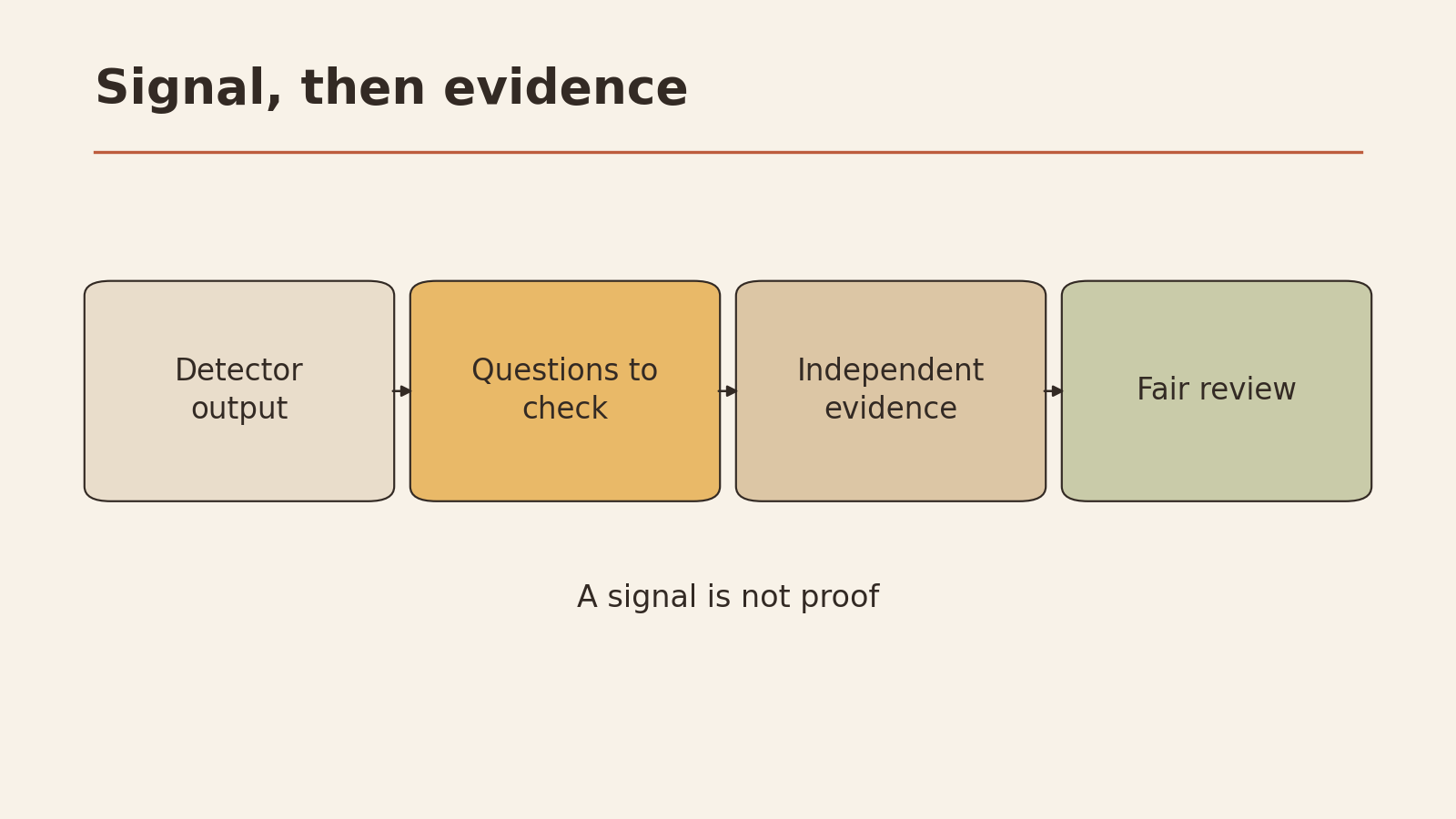
AI detector reliability has clear limits: a score can suggest that a piece of writing deserves a closer look, but on its own it cannot reliably prove that a specific author broke a rule. Detectors make two kinds of error: false positives, where human writing gets flagged, and false negatives, where AI-assisted text passes as human. Because of this, guidance from university libraries and teaching centers says a detector result should not be the only basis for an academic integrity finding (University of San Diego). Treat a score as a prompt for further checking. Then do the slower work: read the text, look at drafts and notes, compare with earlier writing, and talk with the author under your institution’s existing rules.
This guide is for anyone holding a score and wondering what to do next: the student or writer who was flagged, and the teacher, editor, or reviewer who ran the check. It includes a five-step record card, two neutral message templates, and a review checklist you can copy.
What an AI detector score can tell you
A detector looks at a piece of text and returns an estimate, usually a percentage or a label like “likely AI.” That estimate comes from patterns the tool has learned. It does not come from watching anyone write.
So a score can tell you one narrow thing: this tool, with its settings, rated this text a certain way. On its own, it can’t reliably show who wrote the text, which parts were assisted, how much, or whether that assistance broke a rule.
| A detector score is | A detector score is not |
|---|---|
| One tool’s estimate about patterns in a piece of text | A record of how the text was written |
| A reason to look more closely | Proof that a person used AI |
| Something to write down with the date, tool, and text checked | A finding, a grade, or a decision |
| Affected by the tool, its version, and the text given to it | A fixed fact about the writer |
MIT’s teaching and learning technologists put it bluntly: AI detectors are not reliable, and they recommend clear policies, open communication with students, and careful use instead (MIT Sloan Teaching & Learning Technologies). That advice applies whether the score is high or low.
Why you can’t add up or vote across detectors
A common reaction to an uncertain score is to run the text through a second and third tool. If two out of three say “AI,” it feels like a majority verdict. It isn’t, for three reasons:
- Different scales. One tool’s 70% is not the same unit as another tool’s “likely AI.” Adding or averaging them mixes things that were never measured the same way.
- Different thresholds. Each tool decides for itself where “likely” starts. You usually don’t know where that line is, or whether it moved in the latest update.
- Shared blind spots. If several tools react to similar surface patterns, they can be wrong together. Agreement between them may only mean they made the same mistake.
Extra runs can still be worth recording, as long as you write down every result and treat each one as a separate signal. Don’t add them up like votes.
False positives
A false positive is when the detector flags text that a person wrote without AI.
Fictional example. Priya writes a lab report on her own. Lab reports follow a strict format: standard section headings, passive voice, short factual sentences, common phrases like “the results indicate.” Her report comes back with a high AI score. Nothing in her process involved AI. The writing simply looks like a lot of other lab reports.
The costs of a false positive fall mostly on the writer:
- Stress and time spent defending honest work
- A formal process started on weak grounds
- Damaged trust between student and teacher, or writer and editor
- A lesson that careful, conventional writing is risky
This is the main reason guidance says a detector result should not be the sole basis for an integrity decision (University of San Diego).
False negatives
A false negative is the reverse: text produced with AI help gets a low score and passes as human.
Fictional example. Leo submits an essay that includes several AI-generated paragraphs he did not disclose, even though the class rules required disclosure. The detector gives it a low score. The reviewer, seeing the low number, does not look further.
The costs here are different:
- False reassurance for the reviewer
- Unfairness to people who followed the rules
- A habit of trusting the number instead of reading the work
A low score does not certify that a person wrote every word. It means this tool did not flag this text this time.
Both errors in one view
The table below uses made-up cases to show how a score can line up with reality. It is not data from any tool.
| Score says “likely AI” | Score says “likely human” | |
|---|---|---|
| AI was used | Flag matches, but still needs context: was it allowed? | False negative: risk of false reassurance |
| AI was not used | False positive: risk of an unfair accusation | Match, no action needed |
Notice that even the “correct” flag in the top-left box doesn’t answer the real question. Some courses and teams allow certain kinds of AI use. Whether a rule was broken depends on the rules and on what actually happened. The score can’t answer that.
How to use a detector score
If you are a reviewer, the University of Kansas teaching center suggests a careful path: gather more information, compare with the student’s previous writing, and have a conversation before drawing conclusions (KU Center for Teaching Excellence). The record card below turns that into five steps. It was designed for this article, and it sits inside your institution’s procedures and does not replace them.
Five-step record card (template)
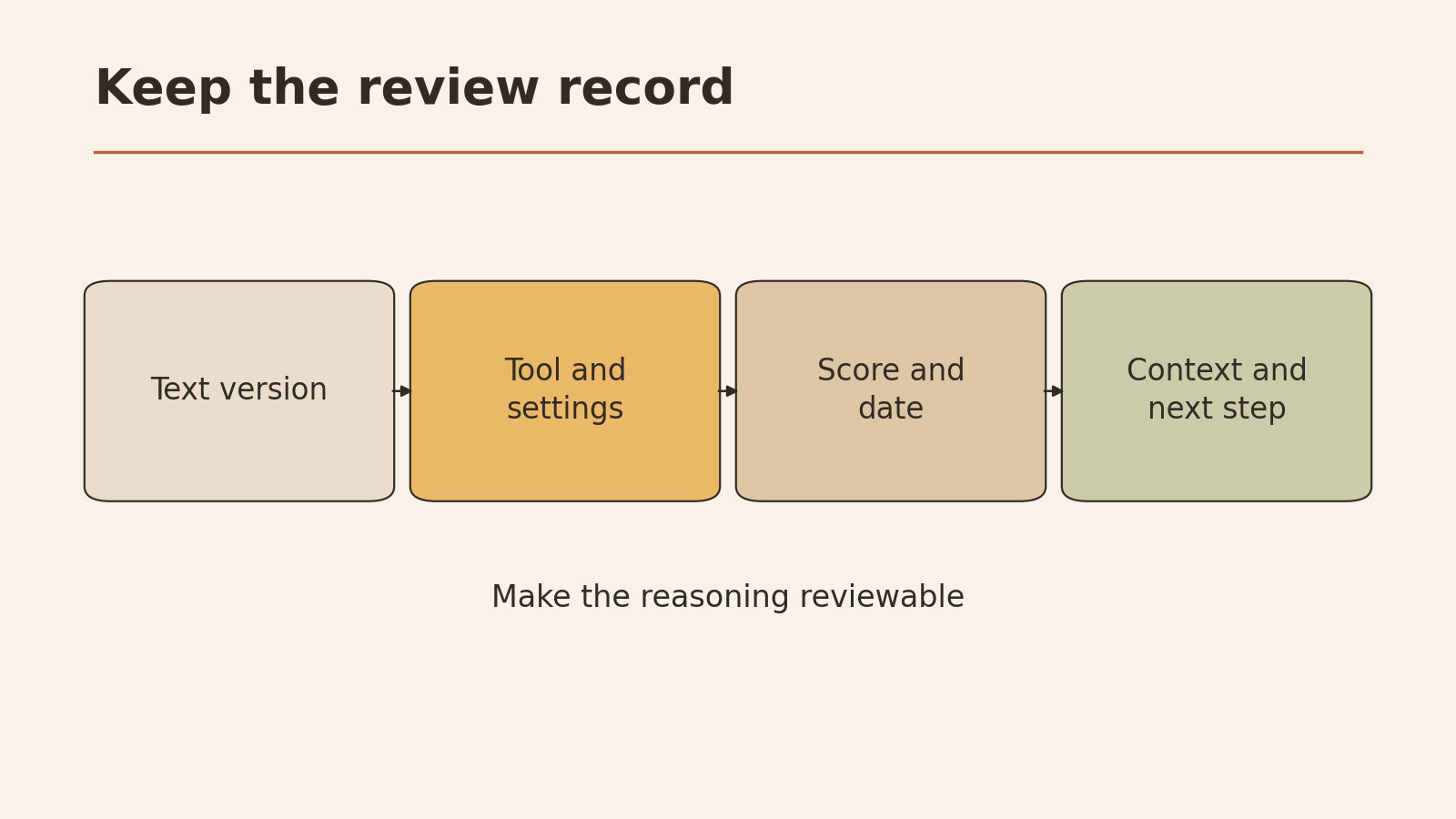
AI DETECTOR SCORE - RECORD CARD

1. KEEP THE SCORE
   Tool name: ____________  Date run: ____________
   Exact text checked (whole piece / section): ____________
   Result as shown (number or label): ____________
   Any other tools run, with results: ____________
   Note: treat each result as a separate signal. Don't add or average them.

2. CHECK THE TEXT
   Specific passages that raised a question: ____________
   Why (in my own words): ____________
   Compared with earlier writing by the same person? Y / N
   What the comparison showed: ____________
   Assignment or brief rules on AI use: ____________

3. SAVE PROCESS MATERIALS
   Drafts available: Y / N    Notes or outline: Y / N
   Source list: Y / N         Version history: Y / N
   Reminder: missing materials are not proof of misconduct.

4. HAVE A CONVERSATION
   Date: ____________  Who was present: ____________
   Author's account of how the work was made: ____________
   Could they explain choices, sources, and structure? ____
   Questions still open: ____________

5. FOLLOW THE RULES
   Applicable policy or procedure: ____________
   Next step under that procedure: ____________
   Decision made by (a named person): ____________
A few points that make the card work in practice:
- Write down your own reasons. “The tool said 80%” is not a reason. “Paragraph three uses terms we never covered and cites a source I can’t find” is.
- Compare like with like. A timed in-class paragraph and a polished take-home essay will read differently for many innocent reasons.
- Keep the conversation open. Ask the author to walk you through how they built the piece. Listen before deciding.
- Let the procedure decide. If your school or organization has an integrity process, the score enters that process as one piece of information. It doesn’t skip any step.
If your writing was flagged
Being flagged is stressful, especially when you wrote the work yourself. These steps help you respond clearly.
- Ask what exactly was flagged. Which tool, which text, what result, and which rule is in question.
- Gather your process materials. Drafts, notes, outlines, research tabs or bookmarks, the sources you used, and any version history your writing app keeps.
- Prepare to explain your process. How you chose the topic, where your ideas came from, why you structured it the way you did. Being able to talk through your own work is useful context.
- Ask how the review will work. Who decides, what the steps are, and whether you can share materials or meet in person.
- Be honest about any AI use. If you used a tool for something like grammar or brainstorming, say so, and point to the rules you followed.
If you don’t have version history, that is not evidence against you. Some people write in tools that don’t keep detailed history, or write in one sitting, or copy drafts between apps. Other materials and your ability to discuss the work can still help show how it was made.
Message template for a student or writer
Adapt this to your situation. It is a neutral starting point and does not count as legal advice.
Subject: Question about the AI detection result on [assignment/piece]

Hi [Name],

Thank you for letting me know about the detection result on
[assignment/piece]. I want to understand it and help with the review.

Could you share which tool was used, which part of the text was
checked, and the result? It would also help to know which policy
applies and what the next steps are.

I have [drafts / notes / outline / source list / version history]
from my writing process, and I am happy to share them and walk you
through how I wrote it. [If relevant: I used (tool) for (purpose),
which I understood to be allowed under (rule).]

Would a short meeting work this week?

Thanks,
[Your name]
Message template for a reviewer
This version opens a conversation without making an accusation.
Subject: Quick conversation about [assignment/piece]

Hi [Name],

I'd like to talk with you about [assignment/piece]. An AI detection
tool returned a result that I want to understand better. A score like
this is not a conclusion, and I haven't made any decision.

Could you bring or send any drafts, notes, outline, or sources you
used? I'd like you to walk me through how you put the work together.
If you used any AI tools, it's fine to tell me what you used them for
so we can look at that against the course/team rules.

Are you free on [day/time] or [day/time]?

Thanks,
[Your name]
A review checklist
Use this before any decision is made. It works for reviewers, and authors can use it to prepare.
About the score
- Tool, date, and exact text checked are recorded
- Every tool result is written down, including the lower ones
- No one has averaged, added, or voted across tools
- The score is labeled as a signal, and nobody treats it as a finding
About the text
- Specific passages of concern are identified in a person’s own words
- The work has been compared with the author’s earlier writing, where available
- The rules on AI use for this task are written down
About process materials
- Drafts, notes, outline, and sources have been requested or offered
- Version history has been checked if it exists
- Missing materials are recorded as missing and kept out of the evidence
About the conversation and the decision
- The author has had a chance to explain their process
- The conversation was neutral and documented
- The decision follows the existing policy or procedure
- A person made the decision, and the score was not the only basis
Pick your next low-risk step
Choose one action you can take today that can’t make things worse:
| Your situation | Low-risk next step |
|---|---|
| You were flagged and wrote it yourself | Collect your drafts and notes into one folder |
| You were flagged and used AI within the rules | Write down which tool, what for, and which rule allowed it |
| You are a reviewer with only a score | Fill in steps 1 and 2 of the record card before contacting anyone |
| You are a reviewer ready to talk | Send the neutral message template and schedule a meeting |
| You are setting rules for a class or team | Write a short, clear AI-use policy and share it before the next assignment |
Setting clear rules and talking openly before any score appears is the approach MIT’s guidance points toward (MIT Sloan Teaching & Learning Technologies). For a wider look at keeping your own judgment when AI is involved, read how to use AI without losing critical thinking. If you are writing AI-use guidance or prompts for a class, how to ask better AI questions can help you be specific about what is allowed.