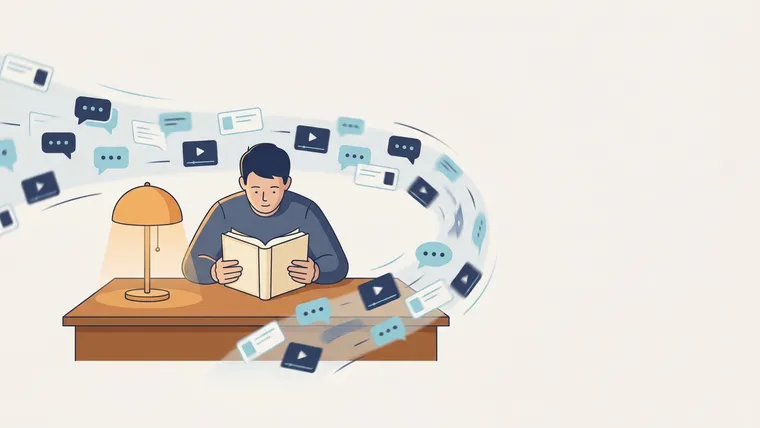
Does AI make information overload better or worse? It can go either way. An AI tool can turn a messy pile of material into a clear outline in a minute, and it can just as easily write a confident, nicely formatted answer that is simply wrong. Whether you end up calmer or more anxious depends on what you bring to it: the books you have read, the things you have lived through, and how well you know your own field.
Below are the questions people ask most about AI and information anxiety, with real examples and a few checks you can start using today.
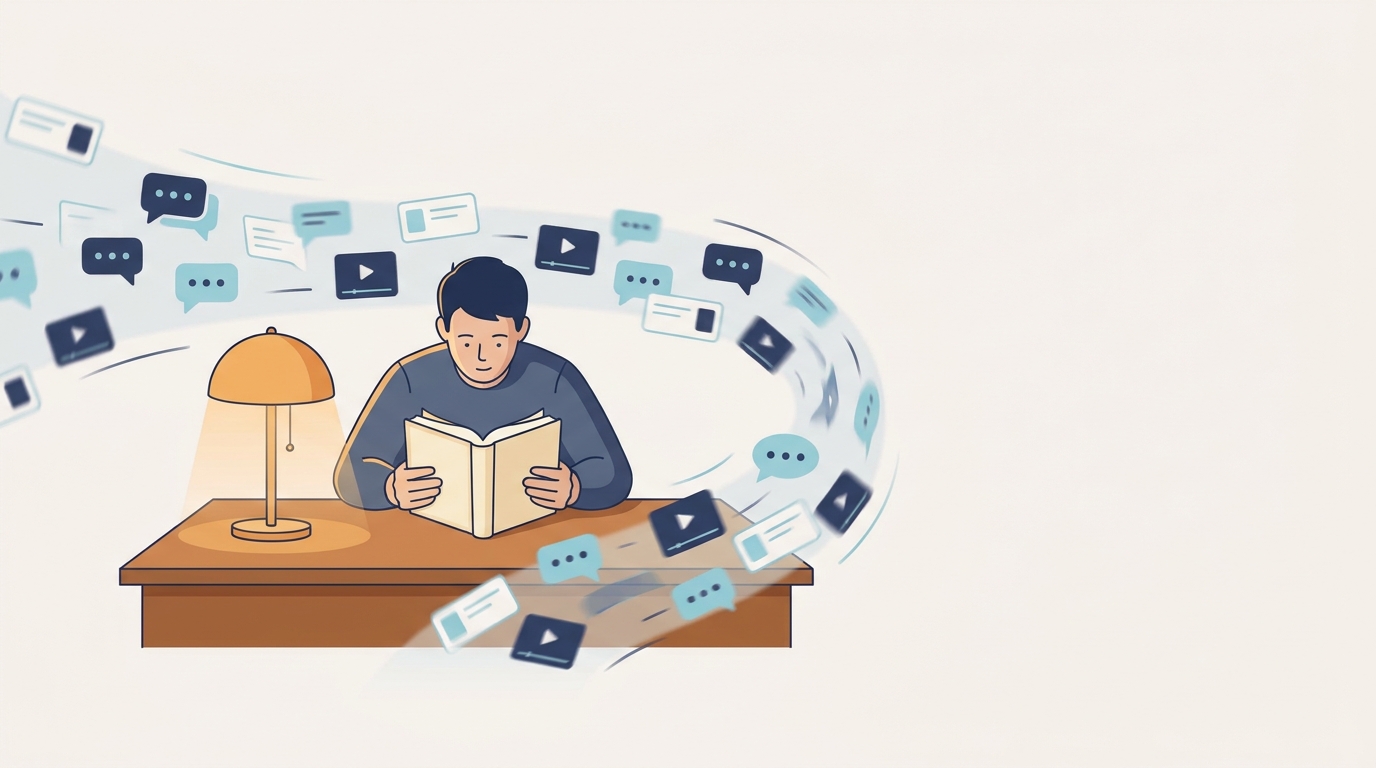
The information keeps flowing past. The book in your hands still has to be read by you.
Information overload started long before AI
Three terms help here. PGC (professionally generated content) is what newsrooms, broadcasters, and publishers produce. UGC (user-generated content) is what ordinary people post, which covers most of what you see on TikTok, Instagram, YouTube, or Reddit. AIGC is content generated by AI.
AIGC became the buzzword of this AI wave, but the flood started earlier. Mobile internet and UGC had already made information explode, and phrases like “information overload” and “filter bubble” caught on back then. They all describe the same problem: there is far more information than anyone can digest.
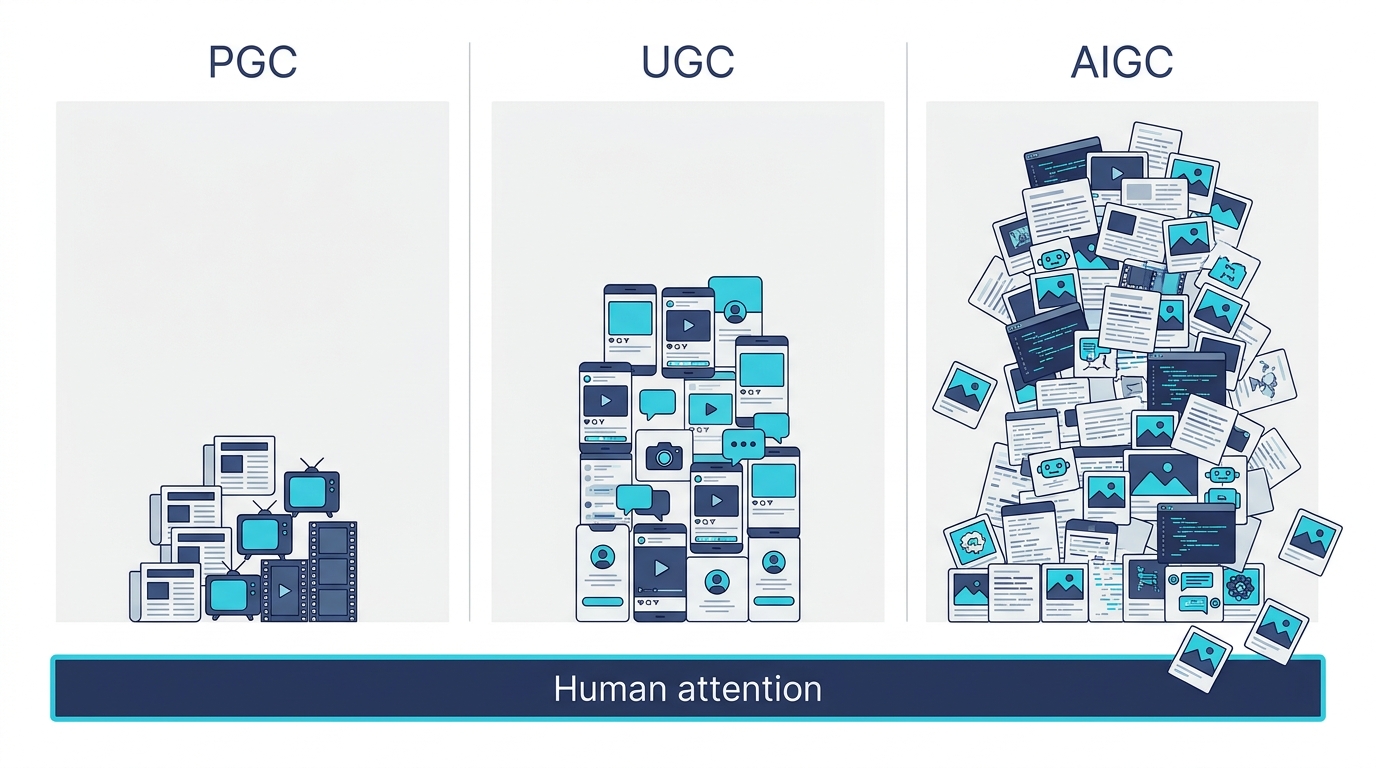
From PGC to UGC to AIGC, the pile keeps growing. Human attention barely has.
Each layer adds more content, while the attention you can spend each day stays about the same. AI adds one more chore on top. Besides picking what is worth reading, you now have to figure out which parts a machine made up.
AI also pushes in the other direction. Ask ChatGPT or DeepSeek a question and it often shows its reasoning; even when two questions seem far apart, it tries to work out how they connect. Used well, it can untangle information and take some of the digesting off your plate.
Filter bubbles are real, but they aren’t airtight
The idea of the “information cocoon” comes from Harvard Law School professor Cass Sunstein, who described it in 2006. English speakers more often call it a filter bubble or an echo chamber: over time, the information you see narrows and the views you meet get more and more alike.
You can feel it happening. Platforms learn what you like and serve more of it. Support a public figure and your feed fills with praise for them; dislike a company and you see nothing but bad news about it. The optimistic view is that this is a stage AI-driven media has to pass through, and that people will not stay led by it forever.
Researchers add both reassurance and a warning. Chen Changfeng, a professor at Tsinghua University’s School of Journalism and Communication, argues in a commentary that there is almost no empirical evidence that algorithms inevitably trap people in bubbles. People live in varied information environments, rarely avoid opposing views entirely, and bring a “general skepticism” to what they see. Scholars quoted in a 2026 report in Chinese Social Sciences Today point out the risk: algorithms filter quietly in the background, so your range can shrink without you noticing, and because platforms optimize for time spent, that narrowing can be a business outcome.
Put the two together and you get a practical answer. You can get out of the bubble, as long as you know it is there and do something about it. China’s rules on algorithmic recommendation, in force since March 2022, require platforms to tell users how recommendations work and let them opt out, and many apps now have a switch for personalized recommendations in their settings.
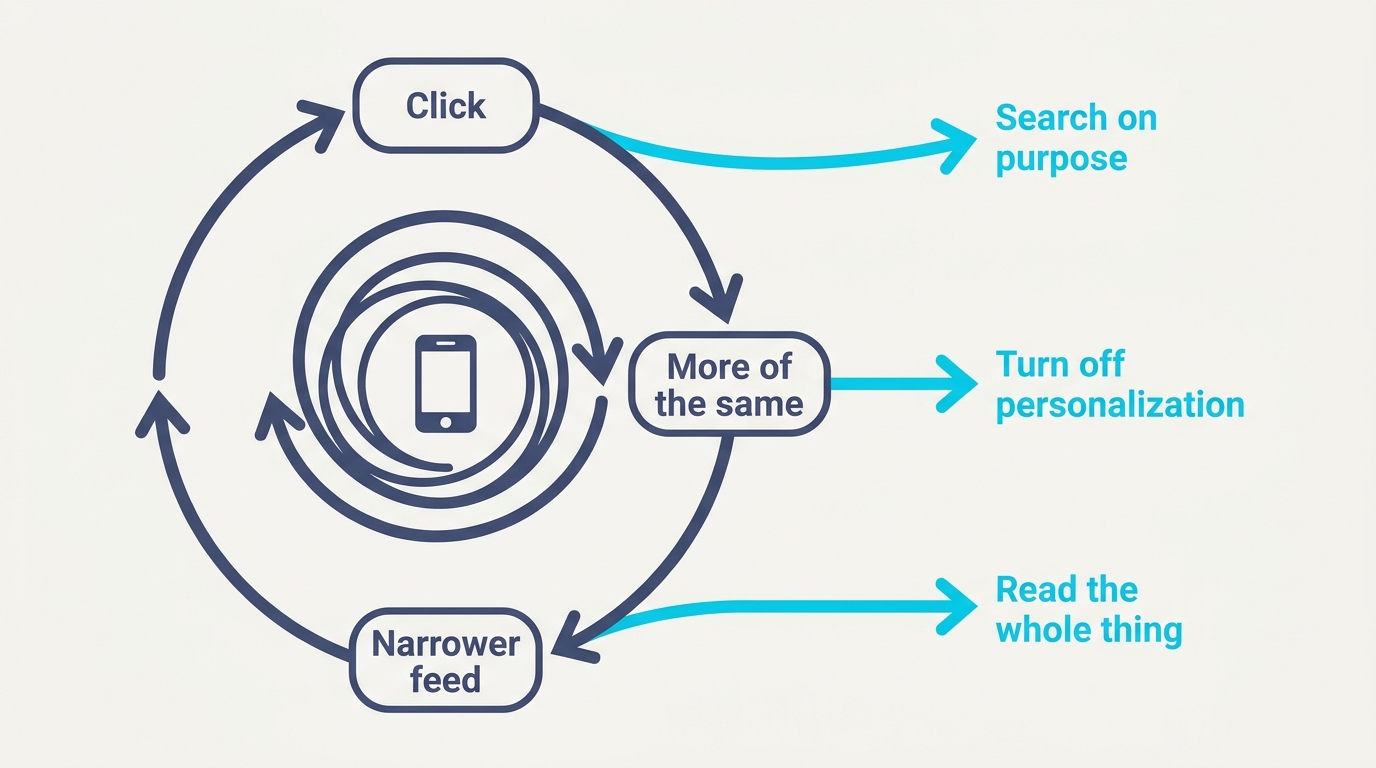
The more you click, the more alike your feed gets. Searching on purpose, turning off personalization, and reading the whole thing are all ways out.
The fixes are simple:
- When you want to understand something, search for it yourself instead of waiting for it to show up in your feed.
- Find the personalized recommendations setting in an app you use a lot, turn it off for a while, and see how your feed changes.
- When a conclusion catches your eye, go to the original article, film, or book and get through the whole thing.
Movie recaps save time and can still trap you
Those “a whole movie in three minutes” and “a book in one minute” videos are a good example. They have real uses. Nobody can watch every film. A recap can tell you whether the original deserves your evening, and a good one can remind you of something you saw years ago, sometimes with more insight than you had the first time.
The downside is just as easy to see. Watch a few recaps in one week and the algorithm keeps serving more, and your time slips away.
People who manage to step out of the overload and the bubble usually lean on what they have built up over years. The harder case is the generation that grew up mobile-first. Some have never watched a full film or read a whole book, and the three-minute version was their first contact.
What an AI summary misses compared with reading the book
In theory, AI can read every book ever written overnight and answer your question instantly. Take Somerset Maugham’s The Moon and Sixpence. AI can tell you it is about looking up at the moon while still minding the sixpence at your feet. If you have not read the novel, that line will not carry much weight.
AI is good at quick readings and main ideas. The feeling of following a character all the way and getting hit by one scene only comes from reading it yourself. So it is still worth watching films and reading books, and letting part of yourself actually go there. Most of us are consumers of information, after all.
Technology will keep changing. What you have lived through and felt cannot be replaced by any AI. Why can some people ask AI great questions? Because they are curious and want to explore the world, and that curiosity comes from their own experience.
How to tell when AI is confidently making things up
Almost anyone who uses AI regularly has caught it being wrong.
Here is one example. Someone asked DeepSeek about the future potential of data as a factor of production. It produced a long, paper-like answer that started out plausible and got stranger as it went. Asked “Are you making this up?”, it admitted the later part was invented. Without that follow-up, it would be easy to take the answer as serious research.
Mistakes are easier to catch in a field you know. In one case, DeepSeek answered a question about neurons in the human brain incorrectly, and only after being sent the right paper did it fix the answer. In another, several AI tools were asked to identify the artist behind a European painting, and every one of them got it wrong. The correction came from searching the painting’s past auction records and sending them screenshots.
That is what makes it unsettling. If it gets wrong the things you know, what about everything you cannot check? How many times have you believed it without realizing?
Why does this happen? In September 2025, OpenAI published Why Language Models Hallucinate, which offers one explanation. Current training and evaluation reward guessing, while saying “I don’t know” earns no credit, so models learn to give plausible answers even when they are unsure. The researchers compare it to a multiple-choice test, where guessing beats leaving the answer blank.
Some AI tools now do the opposite. After answering, a tool might add: “Sorry, I couldn’t find a reliable answer to this. If you find one another way, could you let me know?” That is an AI that has learned how to talk with people. It admits uncertainty and is willing to learn. An AI that can say “I don’t know” is easier to trust.
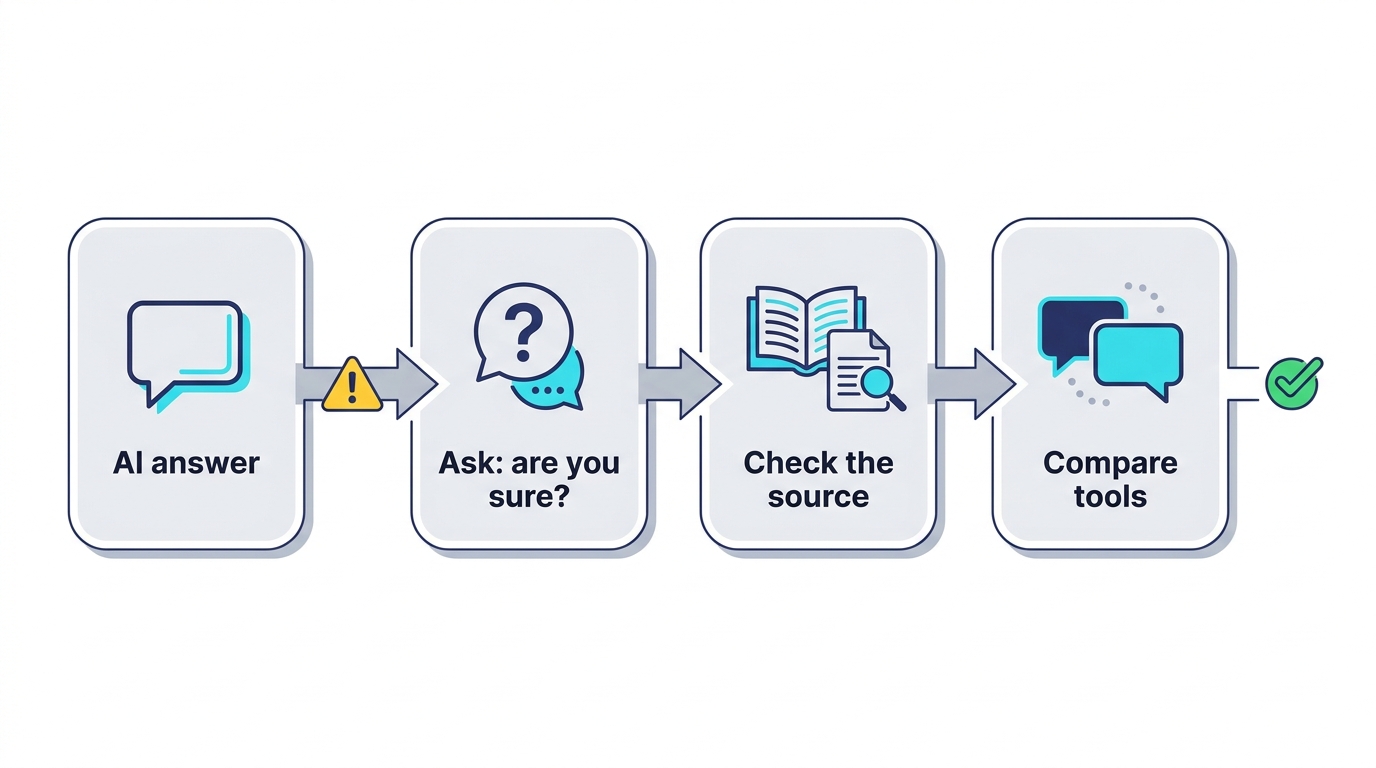
Once you have an answer, push back once, check the source, and compare tools.
When an answer feels off, work through this table:
| What you notice | What to do |
|---|---|
| The answer gets more polished and detailed the further it goes | Ask directly: “What is this part based on? Is it your guess?” |
| It involves research, data, authorship, or citations | Ask for sources, then check the originals |
| The topic is completely new to you | Test the tool first with a question from your own field |
| The conclusion affects money, health, or a big decision | Cross-check with two or three AI tools, then confirm with reliable sources or a professional |
A sensible balance is to split your questions roughly half and half between AI and regular search. In the social media era, people talked about information literacy: not falling for obvious fake news, and noticing when a post is designed to make you angry so you will share it. In the AI era that skill needs one more step, which is recognizing AI hallucinations. There is no quick course for it. Much of it comes from years of life and reading. If you want a step-by-step checking routine, see how to use ChatGPT for data analysis without trusting it blindly.
Pick AI tools by how much time they save you
Using several AI tools at once is perfectly normal. Social platforms work differently. TikTok, Instagram, YouTube, and X compete for your time, so if you scroll three hours a day and one app takes two of them, the others get less. That is why people drift toward one platform.
Tool-type AI works the other way around. Mainstream internet products are built to hold your attention longer; a good tool is built to get you the result quickly and in the simplest way. It is the early internet’s almost puritan habit of getting out of the user’s way.
Two things are worth checking when you pick a tool. First, structure and logic. A good answer is tight enough that you can grab the point fast, even if it is shorter than what other tools give you. Second, how easily you can take the result with you. Anyone who has pasted a comparison table or test data into a chat app knows it falls apart; a tool that exports the result as an image in one click skips that problem. Some products still feel crammed and noisy, like an AI version of a search results page or a short-video feed. The better ones feel more like Wikipedia: clean and ready to use.
The simplest test: after using an AI tool, ask yourself whether you got what you needed faster or just lost another half hour. For low-stakes questions, like what a trending term means, just ask and do not worry if it is a little off. For things that matter, go back to the checks above.
Why well-designed answers are easier to absorb
Many people assume that making a product beautiful takes an artist. You can also get there with math. Programmers judge code by whether it is concise, logical, and well structured, and that is what they mean by “elegant.” An AI tool whose output is concise, logical, and structured is beautiful in the same way. Science, aesthetics, philosophy, even mysticism tend to arrive at the same point eventually, and that point is never ugly. From Western architecture to classical Chinese buildings, beauty, function, and technology have always been bound together.
A lot of tools just dump information on you. Most people do not have the patience for long content, and even when they read it they miss the point. For information anxiety, “beautiful” means something concrete: clear structure, a main point you can find at a glance, and formatting that survives copy and paste. For someone who is already overloaded, that directly cuts the cost of digesting.
Images and color matter as well. When you remember your childhood, you usually see a picture, because images stay with us longer than text. Color is tied tightly to emotion. A glass of oddly blue water might remind you of toilet cleaner, while yellow or red makes you think of juice. Those gut associations are wound up with experience and feeling, and they are hard for AI to truly have. Seen this way, AI answers need good layout too.
Products built for everyone can still aim for beauty
AI will eventually be used by everyone, so it has to suit most people’s taste. Is there a tension between mass appeal and beauty?
Media faced this question long ago. Around 2000, Chinese papers such as Southern Weekly and 21st Century Business Herald already had clean, restrained layouts, while many city tabloids went loud and bold to grab attention at newsstands. Some in the industry worried that elegant pages would not sell and that most readers would not accept them. Those papers kept selling well.
The idea that you have to cater to the majority to survive does not always hold. Plenty of people never studied design and still want beautiful things. Apple is the obvious example. Some people buy its products for status, security, or other reasons, and many simply think they look good, even if they cannot explain why.
Another objection goes like this: many technical people do not care much about beauty and want everything quantified and structured, so are technology and beauty at odds? Beauty is something a person pursues, and it is also a threshold. Education may have neglected it, yet since ancient times people have stuck animal fur in their hair and hung pretty shells around their necks. Each of us can raise that threshold a little.
Does beauty still matter when AGI is about to change everything?
The Yungang Grottoes in Datong, Shanxi, were carved during the Northern Wei dynasty. Standing in front of those statues, what hits you is that people reached this level more than a thousand years ago. That pursuit of beauty runs deep, and it is worth waking up again.
Think of two cups. When getting clean water is a struggle, any container will do. Once water is no longer a problem, people get fussy: this cup for coffee, that one for tea. Every civilization, past a certain point, moves from the merely useful toward the beautiful.
So when someone asks why anyone would talk about beauty when AGI is about to change the world, the answer is short. Beauty matters, it can change the world, and it lasts.
When the anxiety hits, do one small thing
Back to the opening question. When information anxiety shows up, look at yourself before you look at the tool, and ask whether you have your own judgment. An independent mind and free thinking matter. AI could be trimmed down to a single voice, and that trimming is best done by you. Hand two people knives made from the same fine steel: one uses it as a blade, the other only scrapes dirt with it. Same tool, different hands.
If you only do one thing today, pick one of these:
- Ask your usual AI a question from the area you know best and see where it goes wrong.
- Turn off personalized recommendations in the app you scroll most, then check your feed a week later.
- Pick a film you have only seen a recap of, or a book you have only read a summary of, and get through the whole thing.
To keep your judgment sharp while using AI, read how to use AI without losing critical thinking. To rethink where your information comes from, try how to curate your information diet without an echo chamber. For a daily routine, see 7 daily exercises to improve critical thinking.