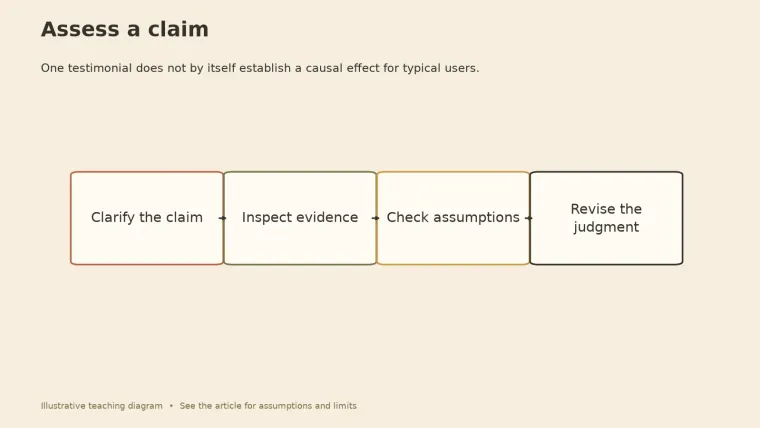
In September 1904, a panel of thirteen people in Berlin, including a veterinarian, a circus manager, a cavalry officer, several schoolteachers, and the director of the Berlin zoo, watched a horse named Hans tap out answers to arithmetic and calendar questions. They found no trickery, and the horse kept getting answers right. Then a psychologist changed who knew the answer, and the ability vanished.
Critical thinking is the deliberate evaluation of evidence, assumptions, and reasoning to decide what a claim actually justifies. It means clarifying the claim, checking how the evidence was produced, weighing other explanations, and holding a conclusion only as firmly as the support allows. It does not mean doubting everything or distrusting expertise.
The experts answered the wrong question
Hans belonged to Wilhelm von Osten, a mathematics teacher and amateur horse trainer who exhibited him across Germany and never charged admission. Asked “If the eighth day of the month comes on a Tuesday, what is the date of the following Friday?”, Hans tapped eleven times. Public interest grew until the German board of education appointed a commission, led by the psychologist Carl Stumpf. It concluded in September 1904 that no tricks were involved.
On that narrow point the commission was right. Von Osten was not signaling the horse on purpose, and since he charged no admission, a money motive was unlikely. The panel had tested for fraud. The claim on the table was bigger: that Hans could calculate.
Oskar Pfungst, a co-worker at Stumpf’s Psychological Institute, took the question further. He isolated horse and questioner from spectators, used questioners other than von Osten, fitted Hans with blinders, and, in a key move, varied whether the questioner knew the answer.
When Hans could see the questioner, he was right 89% of the time (50 of 56). When he could not, he was right 6% of the time (2 of 35). He also failed when the questioner did not know the answer. Hans was reading people. As the taps neared the correct number, the questioner’s posture and face tightened, then relaxed at the final tap. Von Osten never knew he was giving a signal, and he was never persuaded by the findings. He kept showing Hans to enthusiastic crowds.
The six skills, in the order Pfungst used them
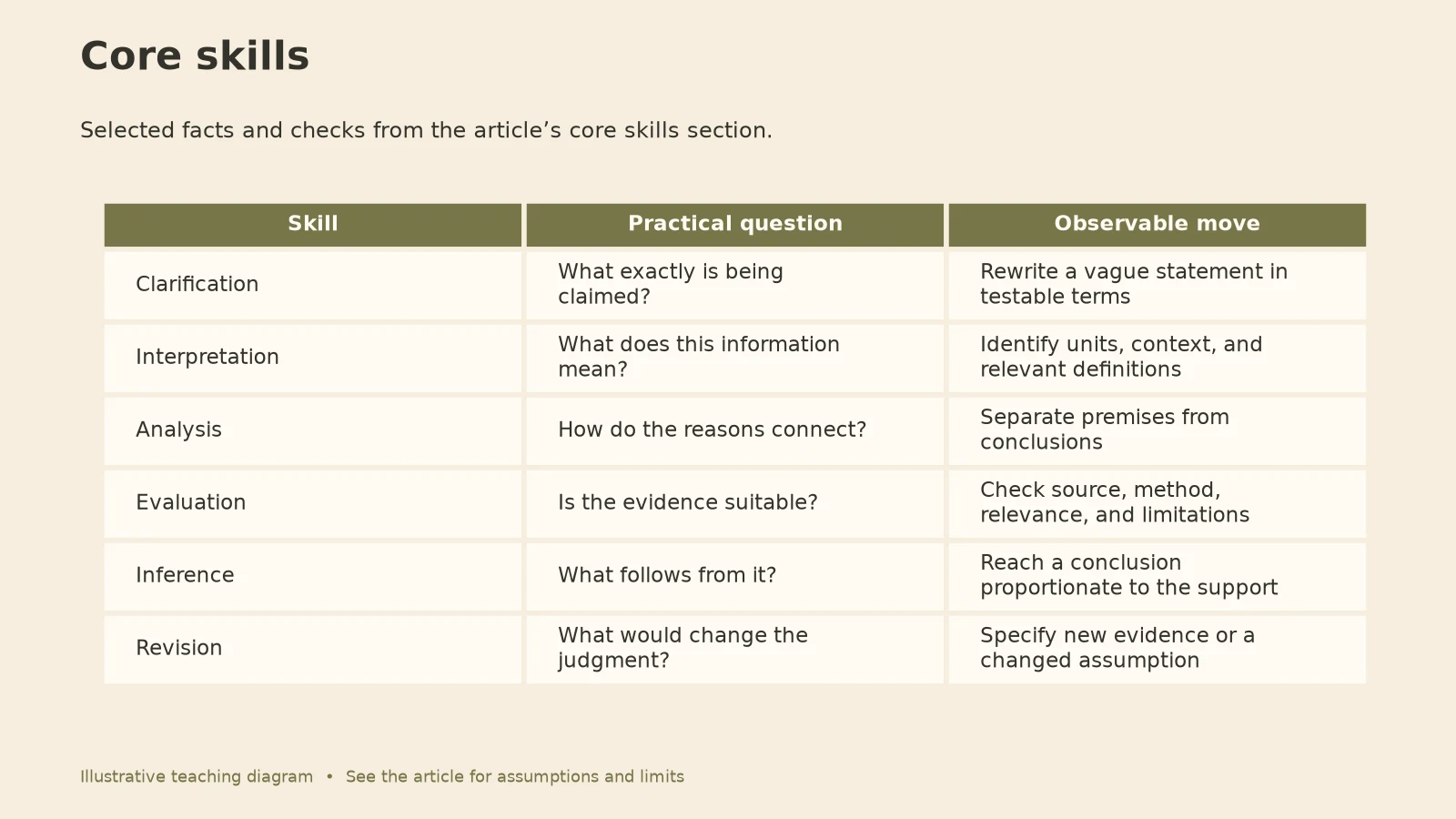
The Foundation for Critical Thinking’s definition centers on disciplined evaluation and reasoning. The Hans case shows what that discipline looks like when it is done step by step.
| Skill | Practical question | Observable move |
|---|---|---|
| Clarification | What exactly is being claimed? | Rewrite a vague statement in testable terms |
| Interpretation | What does this information mean? | Identify units, context, and relevant definitions |
| Analysis | How do the reasons connect? | Separate premises from conclusions |
| Evaluation | Is the evidence suitable? | Check source, method, relevance, and limitations |
| Inference | What follows from it? | Reach a conclusion proportionate to the support |
| Revision | What would change the judgment? | Specify new evidence or a changed assumption |
Clarification turned “Hans is clever” into “Hans can compute answers no one gives him.” Evaluation noticed that every correct answer came from a session where someone present knew it. Revision meant designing the one test that could separate calculation from cue-reading. The six skills are a teaching arrangement. Several often happen at once.
For the difference between judging a conclusion and breaking a problem into parts, see critical thinking vs analytical thinking.
Doubt is cheap, and a good test costs effort
People often confuse critical thinking with suspicion. The Hans case shows three different responses to the same evidence.
| Response | What it asks | What it would have concluded about Hans |
|---|---|---|
| Credulity | Does the result look impressive? | The horse can do arithmetic |
| Blanket skepticism | Who is cheating? | Von Osten must be signaling, which the commission ruled out |
| Critical thinking | What else could produce these right answers? | Hans responds to cues from people who know the answer |
Blanket skepticism would have been wrong too. It assumed fraud, found none, and had nothing left to say. The productive question was about the conditions that produced the evidence.
This is why the confirmation-bias guide recommends writing down a second hypothesis before you look at more data. Pfungst’s second hypothesis, accidental cueing, told him which variable to change.
When critical thinking backfires
Asymmetric doubt. Demanding flawless evidence for a claim you dislike while accepting a weak anecdote you like is motivated reasoning wearing a lab coat.
Rejecting expertise wholesale. Stumpf’s commission did not settle the big claim, but the method that did came from Stumpf’s own institute. Experts who address the actual question with appropriate methods deserve weight.
Treating one good test as the final word. Critics later pointed out that Pfungst never reliably made Hans give wrong answers by deliberately acting out the cues. His conclusion has held up, and that gap was still worth naming.
Doubting past the point of use. A reversible decision rarely needs a commission. Weigh the cost of being wrong against the cost of more checking.
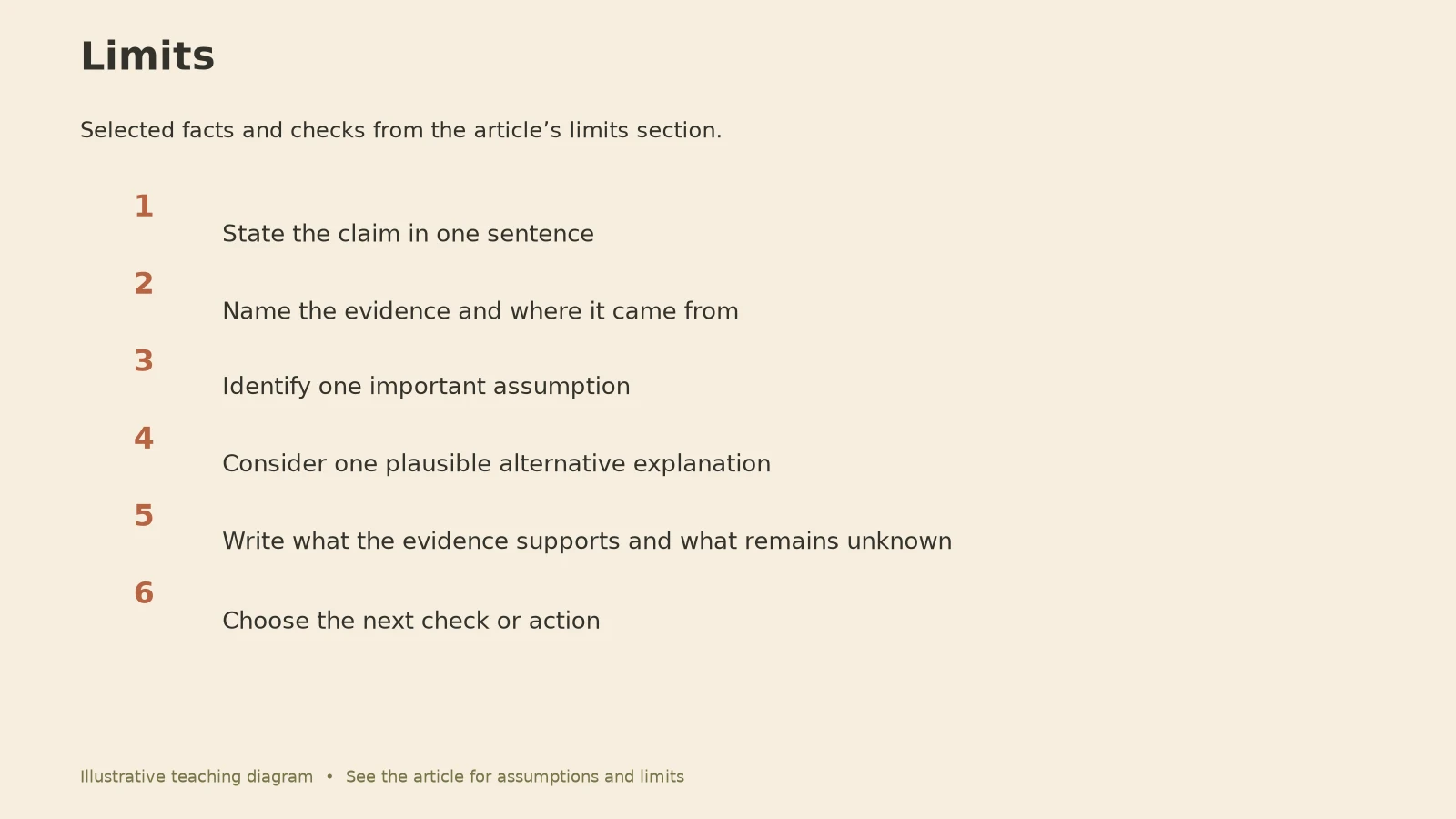
Your 5-minute claim check
1. State the claim in one sentence:
2. Name the evidence and where it came from:
3. Identify one important assumption:
4. Consider one plausible alternative explanation:
5. Write what the evidence supports and what remains unknown:
6. Choose the next check or action:
Pick one claim from today’s article in Daily Read and run it through the card. Step 4 is where Hans was caught: ask who knew the answer when the evidence was produced.
Questions
Is critical thinking the same as intelligence?
No. The Hans commission was full of capable people. Critical thinking describes how evidence is evaluated, and knowledge, time, and the setup of a task all affect how well anyone does it.
Does the Clever Hans effect still matter?
Yes. It is the reason many experiments are double-blind. A UC Davis study found that drug-sniffing dogs’ handlers can telegraph cues and produce false alerts. In machine learning, “Clever Hans” describes models that score well by exploiting an unintended shortcut in the data.
Does it require treating both sides equally?
No. Give evidence the weight it earns. A weak claim does not deserve equal credibility because it opposes a well-supported one.
Where should I go next?
For daily exercises, see how to improve critical thinking. Teachers can use how to teach critical thinking, and teams can start with critical thinking in the workplace.