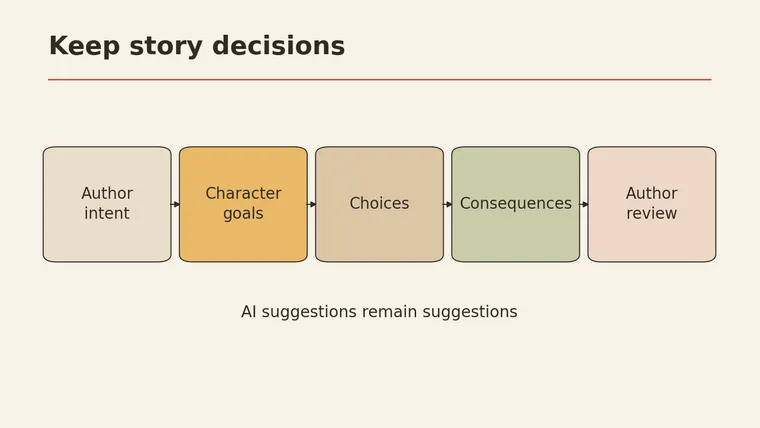
This AI writing fiction guide is built on one rule: the tool can offer options, but you make the story decisions. Characters, plot turns, and what the book is about stay yours. Use AI for clearly bounded jobs, such as listing possible conflicts, checking an outline for gaps, drafting a single practice scene inside limits you set, or pointing out continuity slips. Ask for suggestions, keep the rewriting for yourself, and record which ideas you accepted. Meta’s own guide to writing a book with AI walks through the same stages, from brainstorming and outlining to drafting, editing, and consistency checks (Meta AI). Before you upload a manuscript anywhere, check confidentiality and any contract terms, because you remain responsible for the work you hand in (Authors Guild).
Everything below uses one original, fictional story setup created for this article. You’ll get a decision card for characters, prompts that ask for options instead of answers, a check for characters knowing too much too soon, and a story record that keeps your choices separate from AI suggestions.
Decide what you want help with
Before opening any tool, decide which jobs you want help with and which you’ll keep. This keeps the tool from drifting into decisions you didn’t hand over.
| Job | AI can help by | You keep |
|---|---|---|
| Brainstorming | Listing possible conflicts, settings, or complications | Choosing which one is your story |
| Outlining | Spotting gaps, repeated beats, or missing causes | The order of events and the ending |
| Drafting | Writing a rough practice version of one scene | The final prose and voice |
| Revision | Pointing out unclear passages or slow spots | Every actual change to the text |
| Consistency | Checking names, timelines, and who knows what | What’s true in your story world |
This table reflects this article’s judgment. Adjust it to how you work. Some writers never let a tool draft a word; others use it only for continuity. Either is fine, as long as you choose on purpose.
One limit to set from the start: don’t ask a tool to imitate a specific living author’s distinctive style. Describe the qualities you want instead (“short sentences, dry humor, close third person”).
Brainstorming
Brainstorming works best when you bring a setup and ask for several different directions. One “best” plot gives you less to choose from.
The fictional setup used in this guide
The Salt Ledger (original, fictional). Mara, 34, runs the weighing station at a small fishing harbor. After her father’s death she finds his private ledger. It shows that for years he recorded lower catches for one boat, the Gull, than it actually landed. The Gull belongs to the family of Joss, Mara’s oldest friend. Joss doesn’t know the ledger exists.
Prompt: three conflict directions
Here is my story setup. Don't change any fact in it.

[paste setup]

Suggest three different conflict directions. Each should push
the story in a different way (for example: outside pressure,
a relationship under strain, an inner choice). For each give:
- The pressure in one sentence
- What Mara could lose
- One question the story would have to answer
Don't write scenes. Don't pick a favorite. Don't add new
main characters.
Three directions, written for this article as an illustration (not model output):
- Outside pressure: A new harbor inspector starts auditing old records. Mara could lose her job if the ledger surfaces. Question: does she hand it over before it’s found?
- A relationship under strain: Joss asks Mara to back up his family’s catch history for a bank loan. Mara could lose the friendship either way. Question: does she tell Joss the truth first?
- An inner choice: Mara is offered her father’s old post as harbor master, which means vouching for the records. She could lose her sense of who she is. Question: can she accept a role built on her father’s lie?
These aren’t three versions of the same plot. Each one makes a different book. That’s the point: the tool widens your view, and you pick the story you want to tell, or none of them.
Outlining
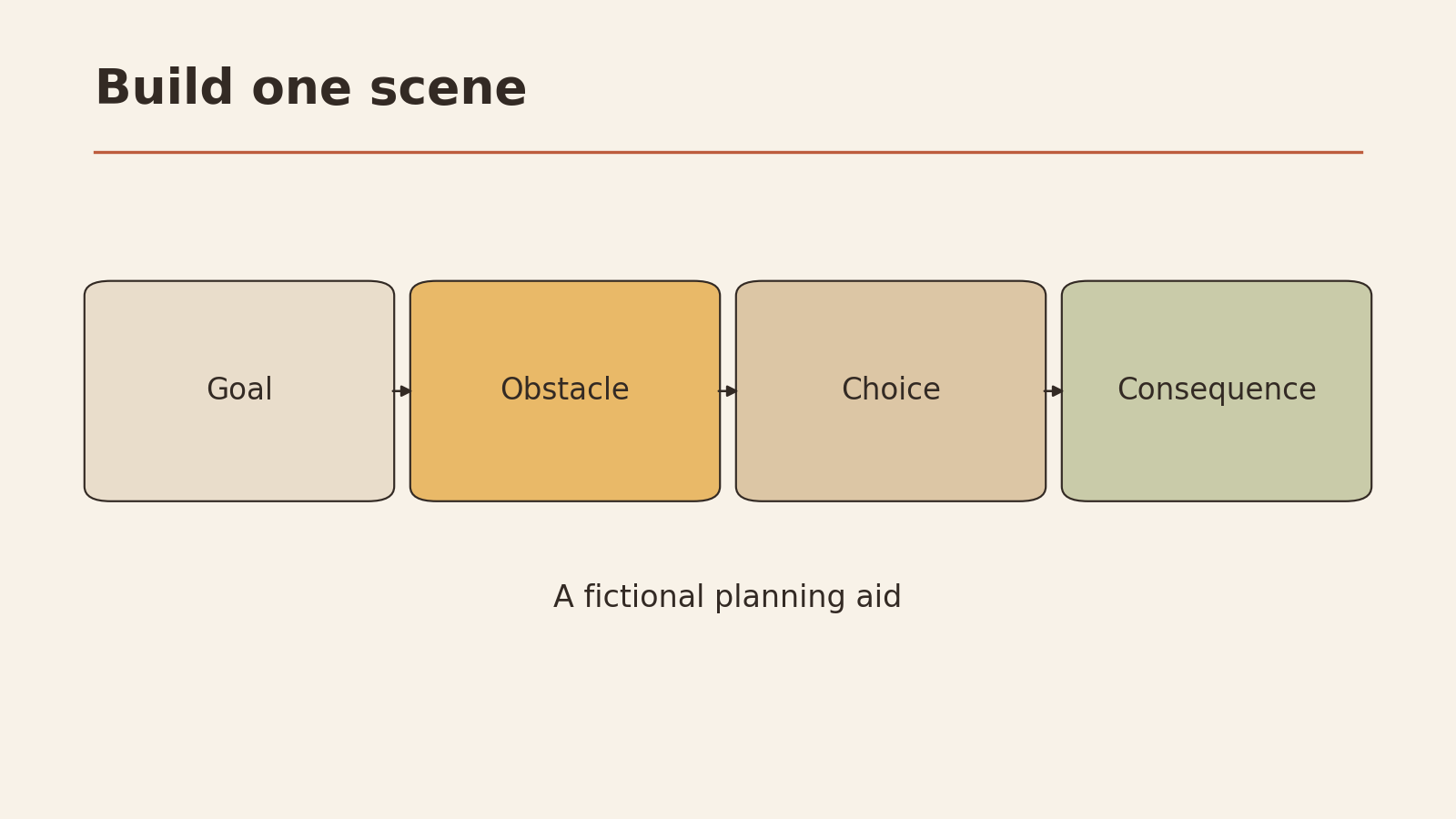
Once you’ve chosen a direction, build the main character’s arc yourself. This card, designed for this article, helps you see whether each step of the plot comes from a real choice.
Character decision card
| Goal | Obstacle | Choice | Consequence |
|---|---|---|---|
| What the character wants now | What stands in the way | What they decide to do | What changes because of it |
| Mara wants to protect Joss (fictional) | Joss needs the records to look clean for the loan | Mara stays quiet and signs the summary | She’s now part of the lie; the inspector’s audit becomes a threat to her, too |
Fill one row per major turning point. If a row has no clear choice, things are just happening to your character, and the outline may feel flat there.
Prompt: check the outline, don’t rewrite it
Here is my outline as character decision cards
(Goal / Obstacle / Choice / Consequence), one row per turning point.

[paste]

Check it and report only:
- Rows where the choice doesn't follow from the goal and obstacle
- Rows where the consequence doesn't lead to the next row
- Any turning point that seems to be missing
Don't rewrite rows. Don't change the ending. Ask me questions
instead of filling gaps.
Meta’s guide treats outlining as its own stage before drafting (Meta AI). Keeping the outline in your hands means the structure reflects your decisions, even if you get help finding weak spots.
Draft one scene with clear limits
If you want to see a scene from a different angle, a tool can write a rough practice version. Keep it to one scene with clear limits, and treat the result as a sketch. The manuscript stays yours to write.
Prompt: one bounded practice scene
Write a rough practice draft of ONE scene, about 400 words.

Story facts (don't change any):
[paste setup + relevant cards]

This scene:
- Where: the weighing station, early morning
- Who: Mara and Joss
- What happens: Joss asks Mara to sign the catch summary
  for the loan
- How it ends: Mara says she needs a day to think
- Mara knows about the ledger. Joss does NOT.

Limits:
- No new characters, places, or backstory
- Joss must not mention, hint at, or seem to know about the ledger
- Close third person on Mara; plain style; short sentences
- Don't imitate any real author
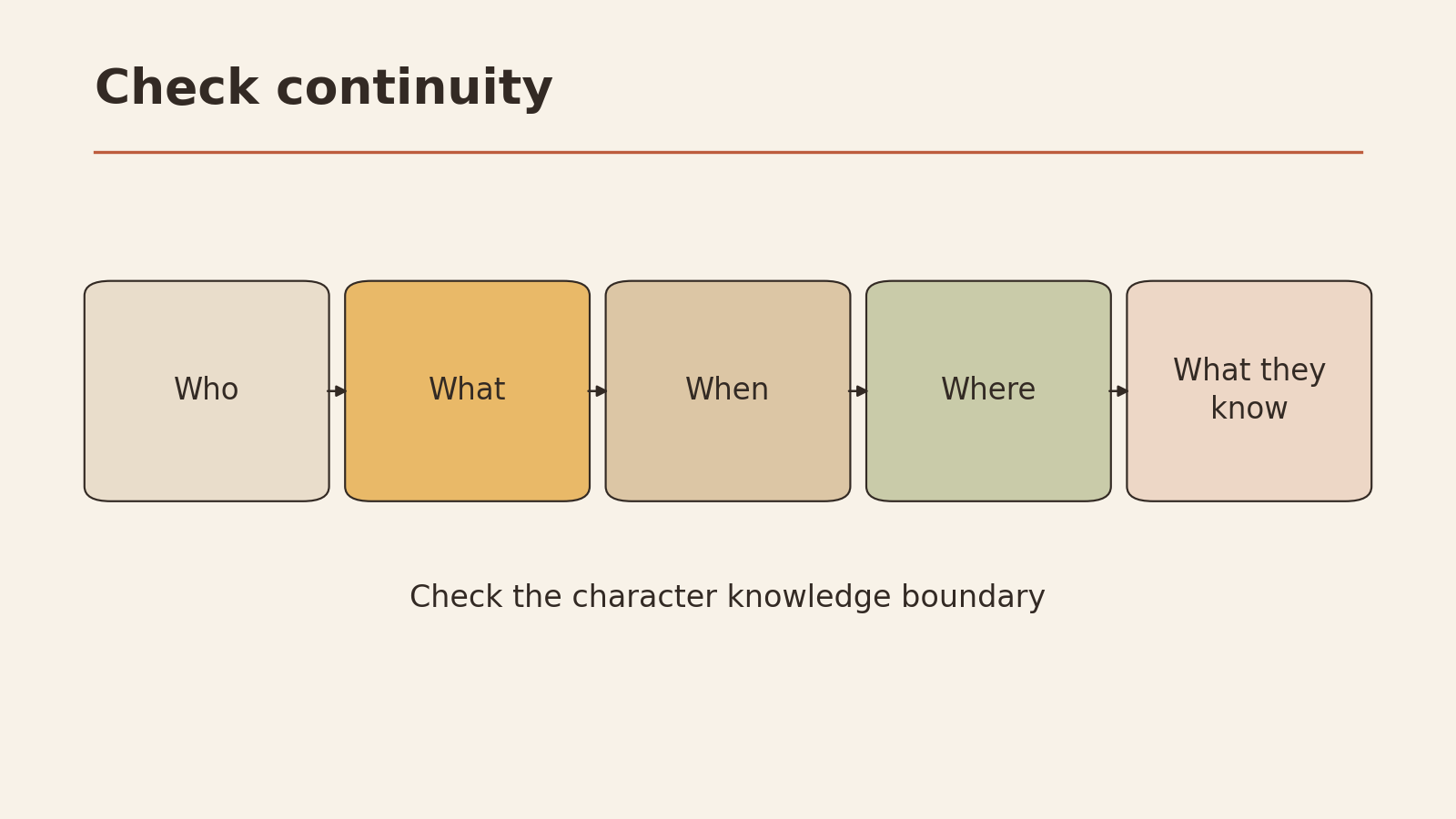
The line “Joss does NOT know about the ledger” is a knowledge boundary: a note of what each character knows at this point in the story. It’s the most common thing to slip in an AI draft, and in your own drafts too.
Knowledge boundary check
Before and after any draft, fill in this check (designed for this article):
KNOWLEDGE BOUNDARY CHECK

Scene: ____________   Point in story: ____________

Secret or key fact: ____________
Who knows it at this point:   ____________
Who does NOT know it yet:     ____________

Read the scene and mark:
[ ] A character who doesn't know says or hints at it
[ ] A character reacts as if they know (too calm, too suspicious)
[ ] The narration reveals it from that character's point of view
[ ] Dialogue gives away more than this character could know

If any box is marked: note the line, decide the fix yourself.
Fictional example of a slip: In a practice draft, Joss says, “Your dad kept good books, I’m sure. Better than most.” On its own that’s harmless. But if he says it while glancing at the locked drawer where Mara keeps the ledger, it suggests he knows. The check catches the glance, and you decide whether to cut it or turn it into a deliberate clue.
Revision
In revision, it’s tempting to paste a chapter and ask the tool to “make it better.” That hands over your voice. Ask for notes instead.
Prompt: suggestions only
Read the passage below and give editing notes only.
Don't rewrite any sentence. Don't change character facts,
names, or plot.

For each note give:
- Where (quote up to 10 words)
- What you noticed (unclear, slow, repetitive, out of character,
  timeline issue, knowledge boundary issue)
- One question I could ask myself to fix it

Up to 8 notes. If something works well, you may list up to 2.

Story facts for reference:
[paste character cards + knowledge boundaries]

Passage:
[paste]
Then go through the notes one by one. Accept, adjust, or ignore each. If a note suggests changing who a character is, that’s a story decision. Make it yourself or leave the character as they are.
For more on keeping your own judgment when working with AI, see how to use AI without losing critical thinking. For help phrasing requests clearly, see how to ask better AI questions.
Keep a story record
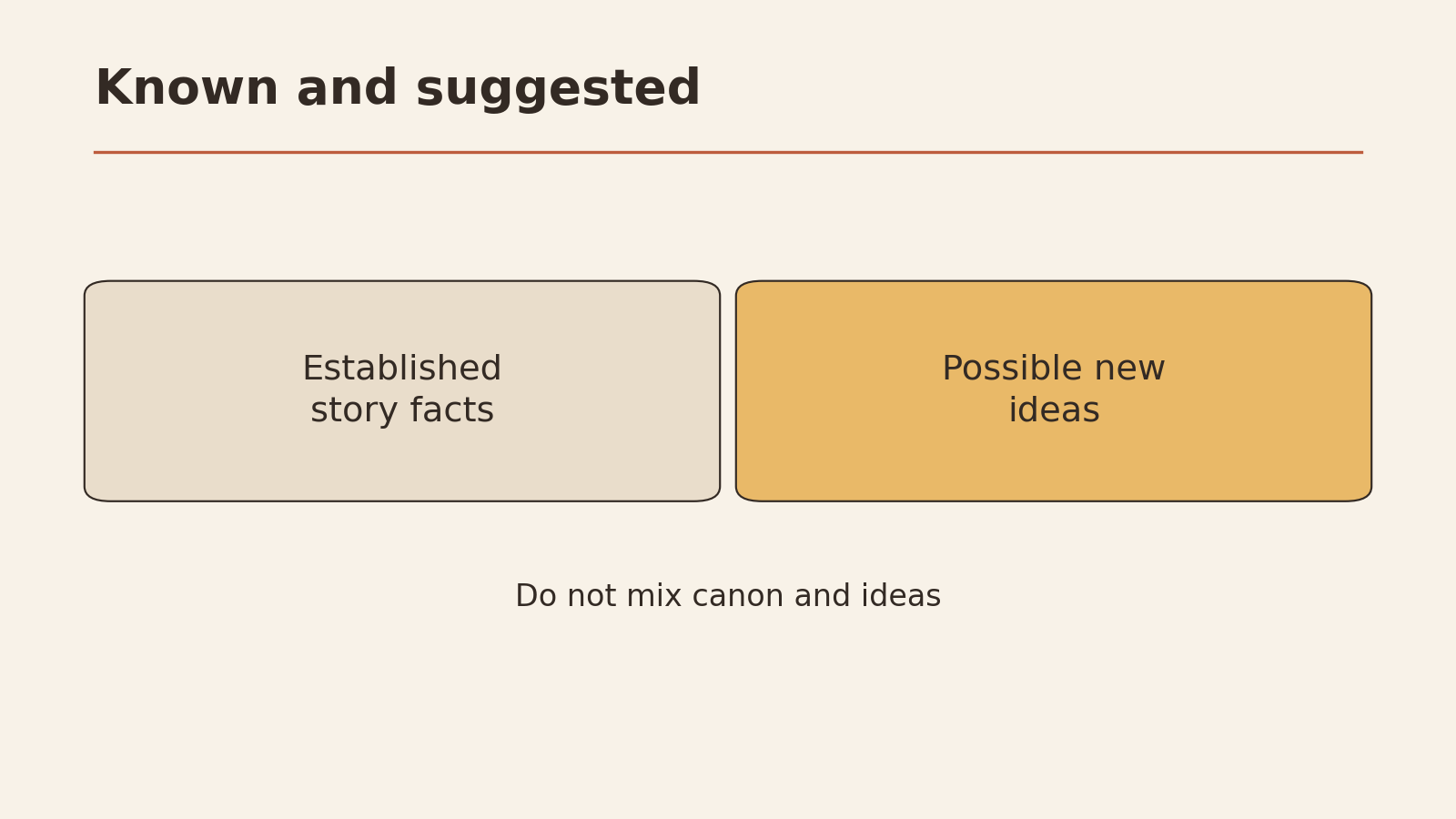
A story record is a running document of facts about your story: names, ages, places, timeline, and who knows what. With AI in the mix, it should also show where each idea came from.
Continuity record (template)
STORY RECORD - The Salt Ledger (fictional example)

FACT                         STATUS              SOURCE
Mara is 34                   Decided by me       Me
Father died before ch. 1     Decided by me       Me
The Gull is Joss's family's  Decided by me       Me
Harbor inspector subplot     AI suggestion       Brainstorm, round 1
                             -> Accepted, edited by me
Joss's sister works at bank  AI suggestion       Draft, scene 4
                             -> Not accepted
Ledger kept in locked drawer Decided by me       Me

KNOWLEDGE BOUNDARIES
Ch. 1-6: Mara knows about ledger; Joss doesn't
Ch. 7:   Joss finds out (how: decided by me, see outline row 5)

OPEN QUESTIONS
- When does the inspector arrive? (undecided)
Rules for the record:
- Only “Decided by me” and “Accepted” items count as story facts.
- “AI suggestion” stays a suggestion until you accept it.
- When you give a tool story facts, paste only the decided and accepted items, so rejected ideas don’t creep back in.
Before you share a manuscript
Uploading a manuscript to an AI tool, or sharing AI-assisted work with an agent or publisher, raises practical questions. The Authors Guild points out that uploading work can involve confidentiality, contract, and rights issues, and that authors remain responsible for what they deliver (Authors Guild). This article can’t tell you how those rules apply to your contract or your work. If you have a contract, read it, and ask a qualified person if you’re unsure.
A practical checklist before you share:
- I’ve checked the tool’s terms on how uploaded text is stored and used
- I’ve checked any contract I’ve signed for terms about AI or confidentiality
- My story record shows which elements came from AI suggestions
- Every AI-suggested element I kept, I’ve reviewed and rewritten in my own words
- No passage copies protected text from another work
- I can explain every major story decision as my own choice
- I’ve thought about what, if anything, I need to disclose, and to whom
Your fiction check card
This card was designed for this article. Fill it in for your current project.
FICTION + AI CHECK CARD

Project: ____________
Jobs I'll use AI for:  Brainstorm / Outline check / Practice scene /
                       Revision notes / Consistency check
Jobs I keep entirely:  ____________

Character decision cards done for main turning points?   Y / N
Knowledge boundaries written for current chapter?        Y / N
Story record separates "decided" from "AI suggestion"?   Y / N
Prompts ask only for options or notes?                   Y / N
Any request to imitate a living author's style?          Y / N -> remove
Tool terms and contract checked before uploading?        Y / N

Next low-risk step: ____________
Your next low-risk step
Take one scene you’ve already written. Fill in its knowledge boundary check, then run the “suggestions only” prompt on it. Go through the notes yourself and record any change you make in your story record.