
Take a fictional community project. Mina has spent several months organizing it. At the public wrap-up, most of the credit goes to another organizer.
She wants her work acknowledged. She also wants the project to run next year, and the other organizer controls access to the venue. He has helped the project in real ways. Correcting the account in front of everyone could damage a cooperation she still needs.
Mina has a reason to act and a reason to hesitate. If you are working out how to write character motivation, this is a useful place to stay for a while. What she says next depends on which of those concerns she is prepared to put at risk.

A character weighs what the next choice may cost.
Give the same event two plausible responses
Suppose Mina’s first priority is public credit. She might thank the other organizer for securing the venue, then state what she and the team actually did. She corrects the account while the audience can still hear it. The cooperation may become uncomfortable afterward, and she may have to defend the correction.
Now suppose keeping next year’s project alive matters more to her. She might let the event finish, then ask for a private conversation about credit and responsibilities before agreeing to continue. That preserves some room for cooperation. It also means sitting through a public account she finds unfair, with no guarantee that a later conversation will repair it.
Both choices fit the same facts. Either could carry a scene. The difference lies in the priority she acts on and the cost she accepts.
There could be other versions. She might decide she has no leverage today and begin making another arrangement. She might speak impulsively, then regret the way she did it. A writer can explore those possibilities without deciding that every response proves a fixed personality type.
For the version you choose, carry the cost forward. If Mina makes a public correction and everyone immediately admires her, all future cooperation remains easy, and the project loses nothing, the choice has become much lighter than the setup promised.
The next scene can grow from that difficulty. Someone asks her to substantiate the claim. The other organizer becomes less willing to cooperate. A teammate feels relieved that someone spoke up. Each is a possible consequence, to be chosen according to the story you are actually writing.
The goal becomes clearer when you ask why this person needs it
“Get recognition” gives Mina a goal. It leaves several important questions open. Is she trying to protect future work? Does being publicly overlooked hurt in a way she cannot bear? Is she speaking because the team’s contribution is disappearing along with hers?
Those possibilities change the scene. Someone concerned about future work may want an accurate record and a clear division of responsibility. Someone desperate to avoid humiliation may be tempted by an immediate response that creates later trouble. Someone protecting a team may be willing to take a personal cost she would avoid for herself.
You don’t need to put all the answers into the dialogue. You need enough of an answer to choose what the character notices, fears, and does.
Janice Hardy’s guide to stronger motivation separates the question of what a character wants from why they want it. That distinction is useful when a plot objective feels mechanically attached to a person. “Reach the city” gets someone moving; why reaching it matters helps you decide what they would give up to get there.
To find a plausible action, follow the connection from an event to the character’s interpretation, feeling, and desire. The same event can mean different things to different characters. A failure may look like a threat, a relief, or permission to leave. Choosing the interpretation helps you find the action.
An external goal and an inward concern can share a scene. Mina can be trying to correct a public record while worrying about whether she has any standing in the group. You can show both through the request she makes and the sentence she cannot quite bring herself to say.
Let the other people keep their intelligence
Give allies and opponents advantages of their own. If everyone around the protagonist becomes foolish whenever the plot needs an opening, the protagonist’s choices reveal less about them.
The other organizer in Mina’s scene has contributed to the project and controls something valuable. He may have his own understanding of how the credit was distributed. You can decide that understanding is self-serving or mistaken without removing his competence.
That gives Mina something to deal with. A public correction now involves a person with a position, resources, and possible responses. You can make the confrontation tense without making him incapable of understanding a plain sentence.
Keep the writer’s knowledge separate from the character’s. A writer can pause, research, seek feedback, or ask AI for alternatives. A character has to act with the information available in the scene. The writer’s ability to investigate the whole situation does not give the character access to it.
If Mina suddenly knows the other organizer’s private intentions because you need her to win the exchange, check how she learned them. A suspicion can influence her behavior while remaining uncertain. She can choose to ask, test, wait, or take a risk. Giving her the answer without a source removes some of the problem she was meant to face.
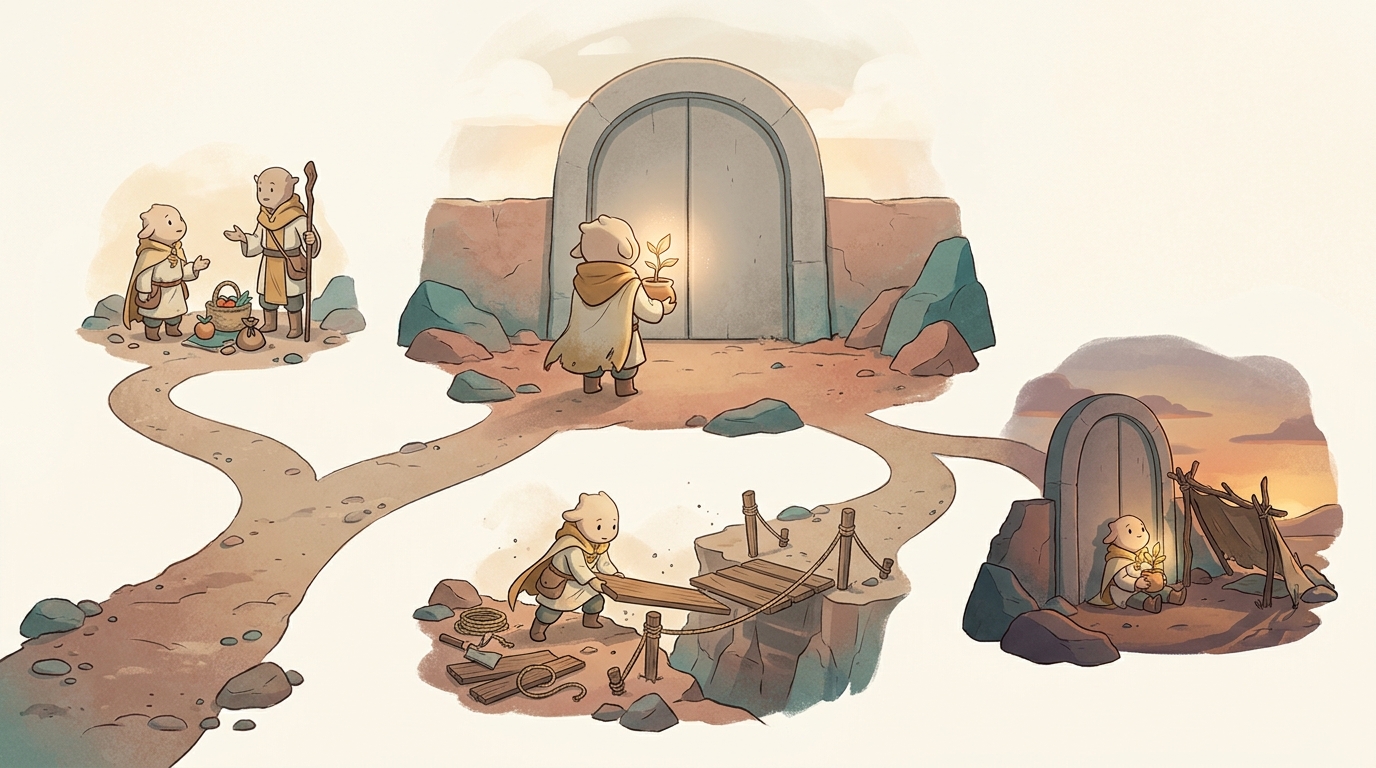
Different priorities leave the traveler with different choices.
Use backstory where it changes the choice
A long biography can leave the current scene almost untouched. What matters here is the part of the past that changes what the character expects or is willing to do.
If an earlier experience matters to Mina’s response, find its effect in the present. Perhaps it makes her insist on a written agreement, hesitate before speaking, or recognize a pattern. Those details would be additions to this example. Keep the ones that help this version of Mina make sense.
Worldbuilding establishes the setting’s rules, institutions, and possibilities. Building an elaborate system for one plot device can burden a scene with explanations it barely uses. Before expanding the setting, ask which pressure in the scene needs the explanation. Some details will matter later. Others can wait outside the draft.
Motivation can appear in conduct without a paragraph naming the trait. A character who is cold may dismiss an appeal, withhold help, or treat two people differently. The exact act gives the reader something to interpret. Repeating “she was cold” supplies less to work with.
For revision, a short worksheet can expose a missing connection:
| Question | What the Mina scene currently gives you |
|---|---|
| What happened? | The public account gives another organizer most of the credit. |
| What does Mina think it means? | This still needs a decision in your version of the scene. |
| What does she want now? | Recognition, with the next project also at stake. |
| What limits the easy response? | The other organizer’s role and control of the venue. |
| What does she choose? | Public correction, private negotiation, or another route. |
| What remains difficult afterward? | A consequence that follows from the chosen route. |
The blank is useful. You can see where you have supplied an event and an action while skipping the character’s understanding of what happened.
Try the scene before asking for more possibilities
You can ask AI for ten motives and get ten fluent explanations. To judge them, you still need to know what kind of story you want and what this character has already shown.
Draft a version first. Then ask for alternatives under the same constraints: keep the venue dependency, keep the other organizer competent, and change one priority at a time. Compare how each priority changes the action and its cost. Reject suggestions that rely on information Mina cannot have.
A 2024 experiment involving 293 writers, eight-sentence stories, and 600 evaluators found that access to AI-generated ideas could improve individual story ratings while making the resulting stories more similar to one another. That is a finding about a short experimental task. It cannot settle how AI affects an entire novel, but it is a good reason to examine whether a suggestion has made your scene more particular or more interchangeable.
If preparation keeps expanding, choose one passage and a work interval in which to draft it. Leave setup ideas on a separate list until the interval ends. A focus timer can help protect that time; turning saved ideas into daily action offers more examples of choosing a small, finishable attempt.
With Mina, you can finish on a concrete decision. Write the sentence she says at the public event. Then write what that sentence makes harder in the scene that follows. You will have something much more useful to revise than another list of possible motives.