In April 1902, brown rats had overrun the new sewers under Hanoi’s French Quarter, and plague was spreading through the region. When sewer workers refused to keep hunting them, colonial officials offered a bounty: a few cents for every rat tail delivered to the police station.
Days of 7,000 to 14,000 dead rats became common. Then officials began seeing rats with no tails. People were cutting off the tails and releasing the rats to breed. Some were farming rats, and smugglers brought in more from across the region (Michael Vann interview, 2020).
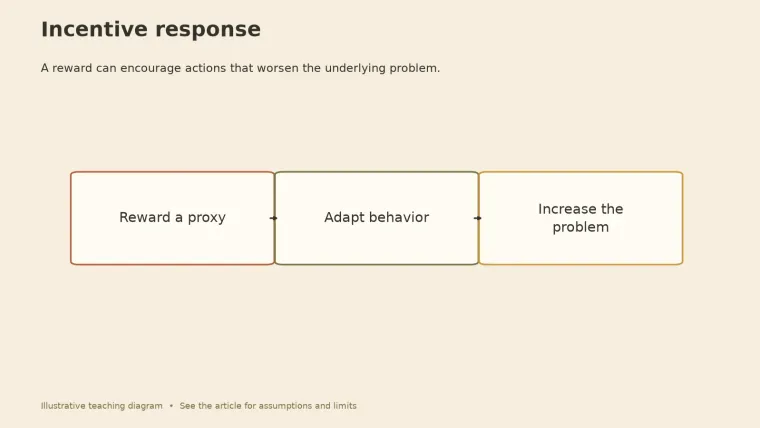
The cobra effect happens when an incentive meant to reduce a problem ends up rewarding behavior that makes the problem worse. It usually starts when people are paid for a countable stand-in, like a tail or a closed ticket, that they can produce more cheaply than the real result.
Michael Vann, the historian who found the Hanoi records in colonial archives, has argued that the idea deserves a new name: the rat effect. The cobra story behind the usual name is much harder to verify.
The bounty paid for tails, and tails were cheaper than dead rats
Officials wanted fewer plague-carrying rats. They paid for tails. Those two things overlap only if every tail comes from a rat that stays dead, and nothing in the rule enforced that.
| What officials wanted | What the bounty paid for | Cheapest way to qualify | |
|---|---|---|---|
| Hanoi, 1902 | Fewer rats in the city | One tail at the police station | Cut the tail off and release the rat |
Once the cheapest route existed, the loop fed itself:
bounty paid per tail
        |
        v
cheapest route: cut tail, release rat
        |
        v
released rats breed ---> more rats to catch
        ^                        |
        |                        |
        +------------------------+
   tail counts rise, and so does the problem
On the worst day, more than 20,000 rats were reported killed. Even so, the counts were shaky. Vann notes that figures from that era, from the city’s population to the daily tally of dead rats, were “really a best guess.” The tally measured bounty claims. It said little about how many rats were left. That gap between what gets counted and what matters is Goodhart’s law, and the Hanoi bounty went one step further by making the problem itself grow.
So where does the cobra come from?
The famous cobra story is harder to verify than the rats
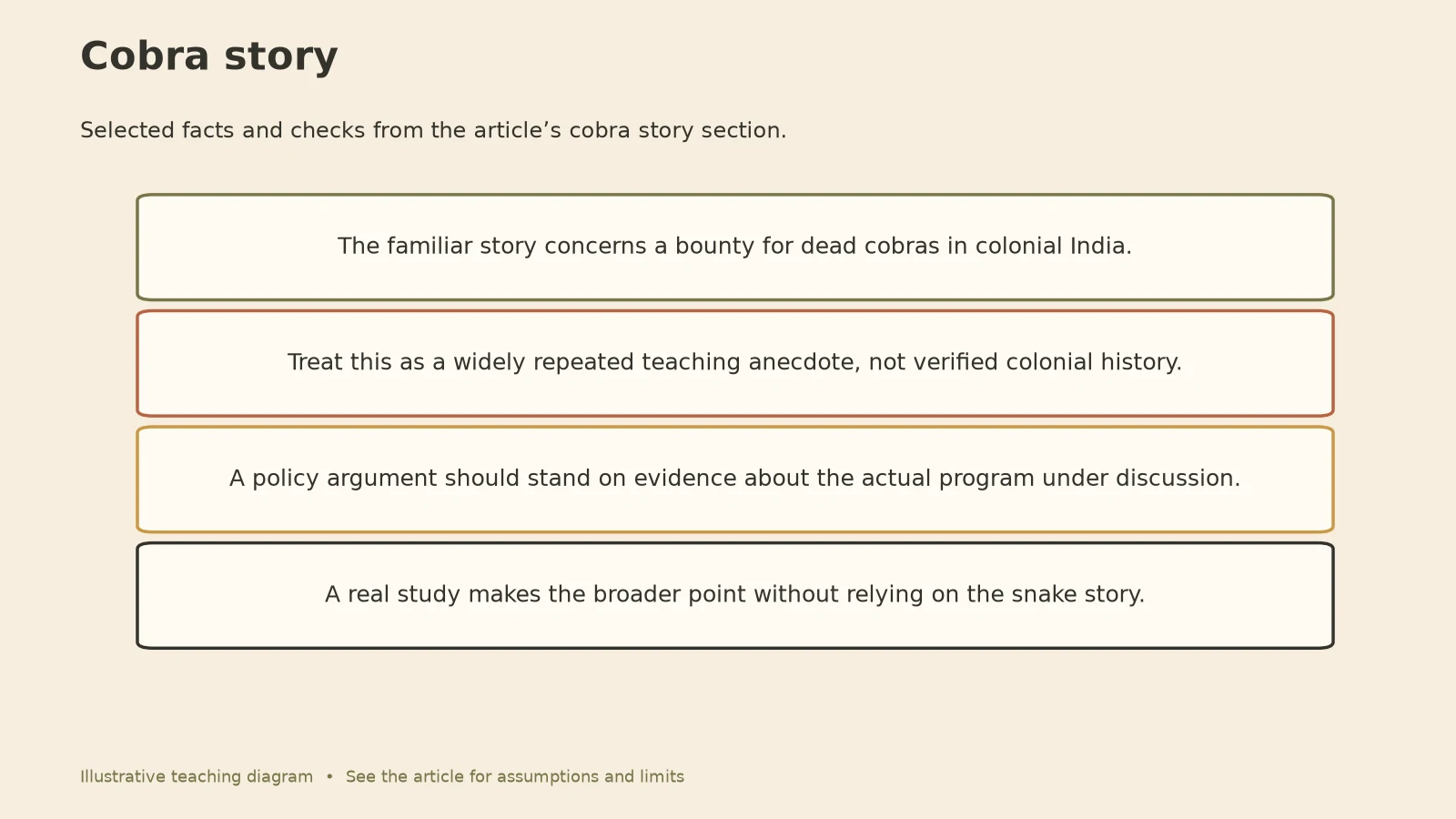
The familiar story concerns a bounty for dead cobras in colonial India. People bred cobras to collect it. When the bounty ended, they released the snakes, and the problem grew.
Treat this as a widely repeated teaching anecdote, not verified colonial history. No one has produced the records that Hanoi’s archives supply: dates, officials, counts. The mechanism is plausible, but repetition is not evidence.
A policy argument should stand on evidence about the actual program under discussion. Quoting the snake story cannot prove that a current policy will fail.
A real study makes the broader point without relying on the snake story. When Israeli daycare centers introduced a fine for late pickup, late pickups increased (Gneezy and Rustichini, “A Fine Is a Price”). Parents appear to have treated the fine as a price for extra time.
The same loop shows up in ordinary incentives
| Intended outcome | Rewarded proxy | Possible adaptation | What to check |
|---|---|---|---|
| Fewer software defects | Reports closed | Manufacture easy reports or close too early | Reopened defects and user-visible failures |
| Customers receive lasting help | Tickets handled per hour | End conversations before resolution | Repeat contact and unresolved issues |
| Fewer preventable incidents | Low recorded incident count | Discourage reporting | Reporting access and independent observations |
| More meaningful learning | Completed activities | Choose easy tasks and skip difficult practice | Demonstrated understanding in a new task |
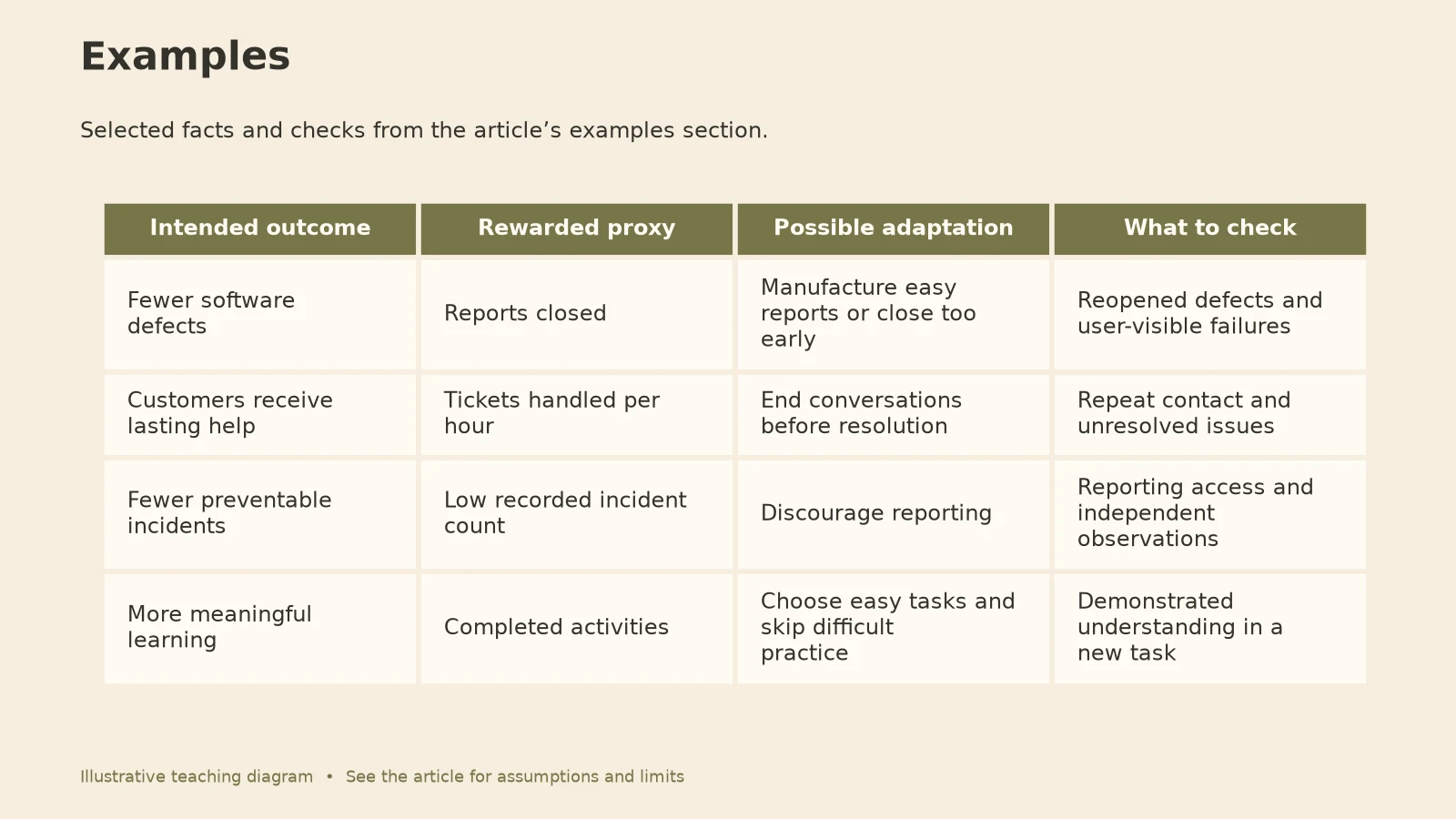
These rows describe risks, not proven outcomes. The incident row shows the line between the two ideas. If recorded incidents fall while real danger stays the same, the metric is distorted. It becomes a cobra effect only if the incentive increases danger, for example by hiding information people need to prevent the next accident.
Five questions to ask before you pay for a result
- Write the outcome in plain language. “Fewer rats alive in Hanoi” is clearer than “rat control.”
- Name what is paid for. Specify the unit, who records it, and when the reward is earned. Hanoi paid per tail, at the police station, with no check on the rest of the rat.
- Find the cheapest qualifying action. Think about splitting, reclassifying, hiding problems, picking easy cases, and importing units from elsewhere. Hanoi got the import route too.
- Check whether that action damages the outcome. Draw the steps in between. A released rat that breeds is a direct path to more rats.
- Choose an independent check and a stopping rule. Decide what evidence would make you change or end the policy. Tailless rats in the street should have been that signal.
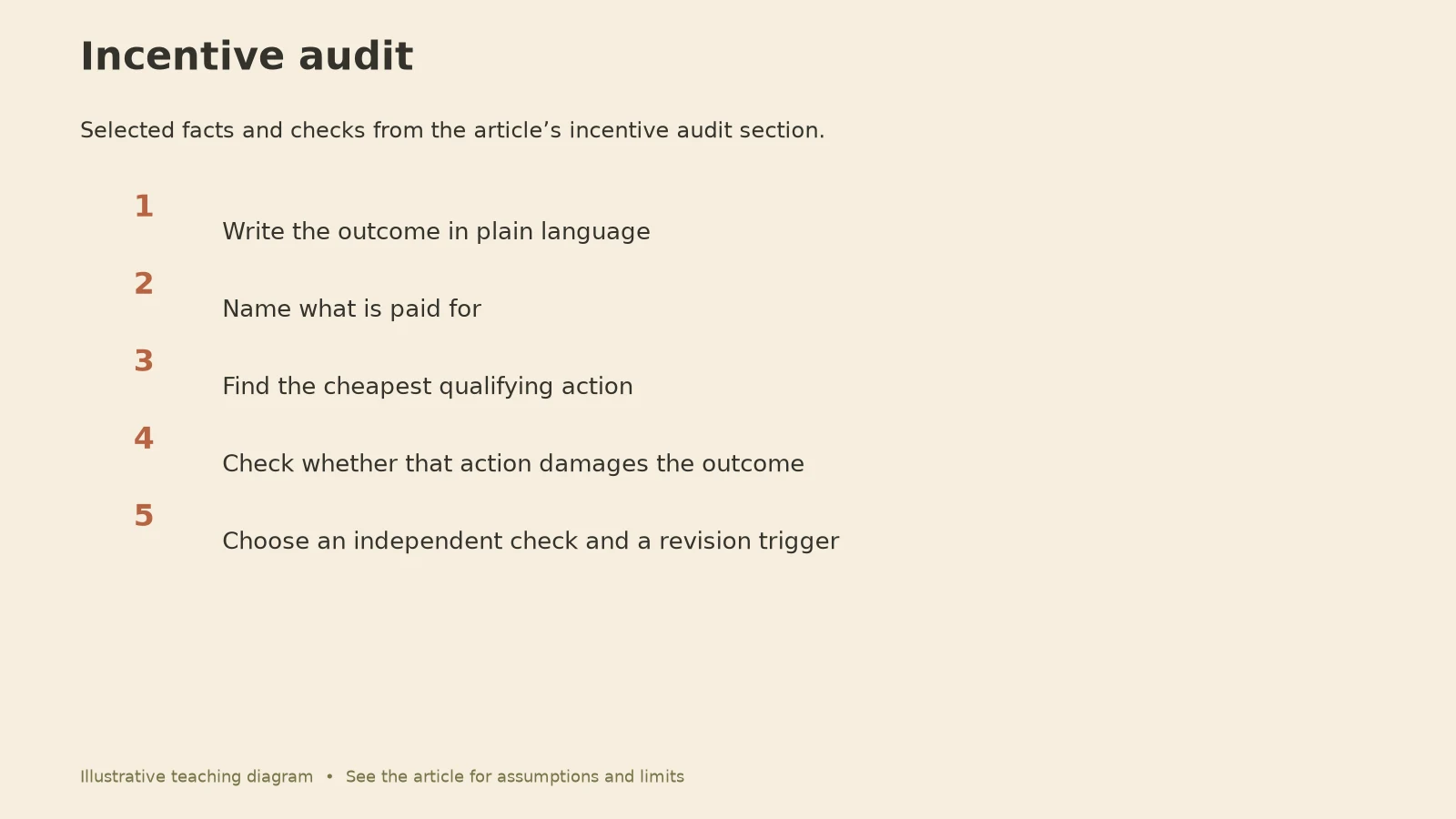
Question 3 is the one most people skip. Ask it as the most cynical participant would. Second-order thinking helps trace what that person does next.
When fear of the cobra effect does harm
- Every disappointment gets the label. A failed policy is not automatically a cobra effect. You need the chain: reward, adaptation, and more of the original harm.
- All incentives get dropped. Rewards work when the cheapest qualifying action also advances the goal. Pay for outcomes that are hard to fake.
- The alternative is assumed to be free. Hanoi’s officials switched to quarantines, burned belongings, and seized corpses. Vann describes those measures as more effective against plague, and deeply resented by residents.
For the wider view of how institutions reward behavior, read why absurd systems make sense once you follow the incentives.
Questions people ask about the cobra effect
Did the cobra effect really happen?
The Indian cobra version is not well documented. The Hanoi rat bounty of 1902 is documented in colonial archives and studied by historians.
Is the cobra effect the same as an unintended consequence?
It is one kind. Unintended consequences have many causes. A cobra effect specifically involves an incentive response that makes the original problem worse.
How can you spot it early?
Watch for a reward count that climbs while independent signs of the problem stay flat or worsen. In Hanoi, the warning sign was walking around the streets without a tail.
Find the cheapest route to your own reward
Before you launch a bonus, a bounty, a quota, or even a personal reward system, spend five minutes on this card:
What I want to happen: ___
What I am actually paying for or counting: ___
Cheapest way to earn it without the goal: ___
Would that make the original problem worse? yes / no / unsure
A check that does not depend on the count: ___
To stress-test it further, ask an AI to play the most cynical person your incentive applies to and list every shortcut. The Save Effort prompt community collects self-check prompts for this kind of review.