On March 8, 2023, Silicon Valley Bank announced a $1.8 billion loss on a securities sale and a plan to raise capital. The next day, depositors pulled about $42 billion. That night, the bank told supervisors it expected more than $100 billion in withdrawals on March 10. It was closed that morning. Panic had fed on itself.
Feedback loops in systems thinking are chains of cause and effect that circle back to where they started. A reinforcing loop amplifies a change: more leads to more. A balancing loop counteracts it and pulls the system back toward a level. Most real behavior comes from both kinds interacting, with delays between them.
The SVB run: a reinforcing loop on a smartphone
The Federal Reserve’s review of Silicon Valley Bank describes the mechanics. At the end of 2022, about 94 percent of SVB’s deposits were uninsured, against a peer average of 41 percent. Uninsured depositors read the March 8 announcement “as a signal that SVBFG was in financial distress.” The run “appears to have been fueled by social media and SVB’s concentrated network of venture capital investors and technology firms that withdrew their deposits in a coordinated manner with unprecedented speed.”
Traced as a loop:
Withdrawals → visible stress at the bank → fear among uninsured depositors → more withdrawals
| Link | Direction | What drove it |
|---|---|---|
| Withdrawals to visible stress | Positive | Each outflow drained cash and became news |
| Visible stress to fear | Positive | Founders and investors shared warnings in tight networks |
| Fear to withdrawals | Positive | With most deposits uninsured, leaving early was rational for each depositor |
Every link is positive, so the loop is reinforcing. The Fed’s Inspector General put the March 9 outflow at almost 25 percent of the bank’s roughly $166 billion in deposits, in one day.
The balancing loop came from outside. On March 12, the Treasury, the Fed, and the FDIC announced that “depositors will have access to all of their money starting Monday, March 13.” That statement cut the link between fear and withdrawal: if every deposit is safe, nobody gains by running.
Fear → withdrawals → government guarantee → less fear
The last link is negative, so the loop balances. It arrived too late for SVB. The reinforcing loop ran in under two days; the balancing response took a weekend. That gap between the two is the main lesson. The guarantee also did not save every bank: First Republic failed that May.
Signs describe direction, not good or bad
A positive link means that, other things equal, an increase in one variable pushes the next one up. A negative link pushes it the other way. To find a loop’s polarity, follow an increase all the way around. If it comes back as an increase, the loop reinforces; if it comes back as a decrease, it balances. In a simple loop, an odd number of negative links means balancing.
| Question | Reinforcing loop | Balancing loop |
|---|---|---|
| What it does | Amplifies a change | Pulls toward a level |
| In the SVB story | Withdrawals breed fear, fear breeds withdrawals | The guarantee removes the reason to run |
| When it helps | Learning, compounding savings, word of mouth | Thermostats, inventory control, a steady workload |
| When it hurts | Bank runs, burnout spirals, price bubbles | Resisting a change you want |
The same two loops in a work queue
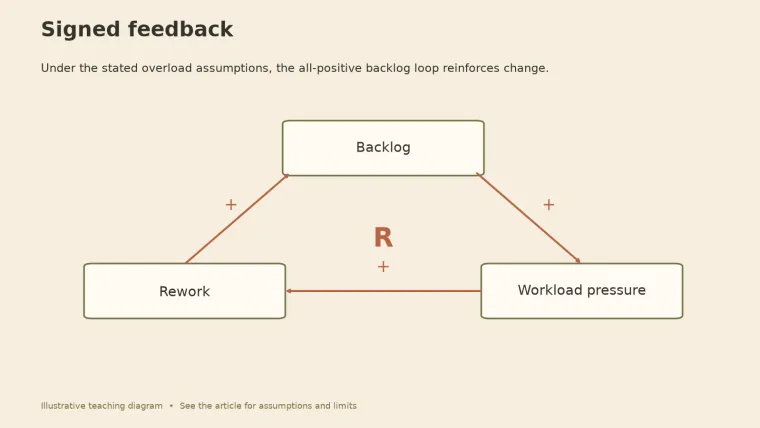
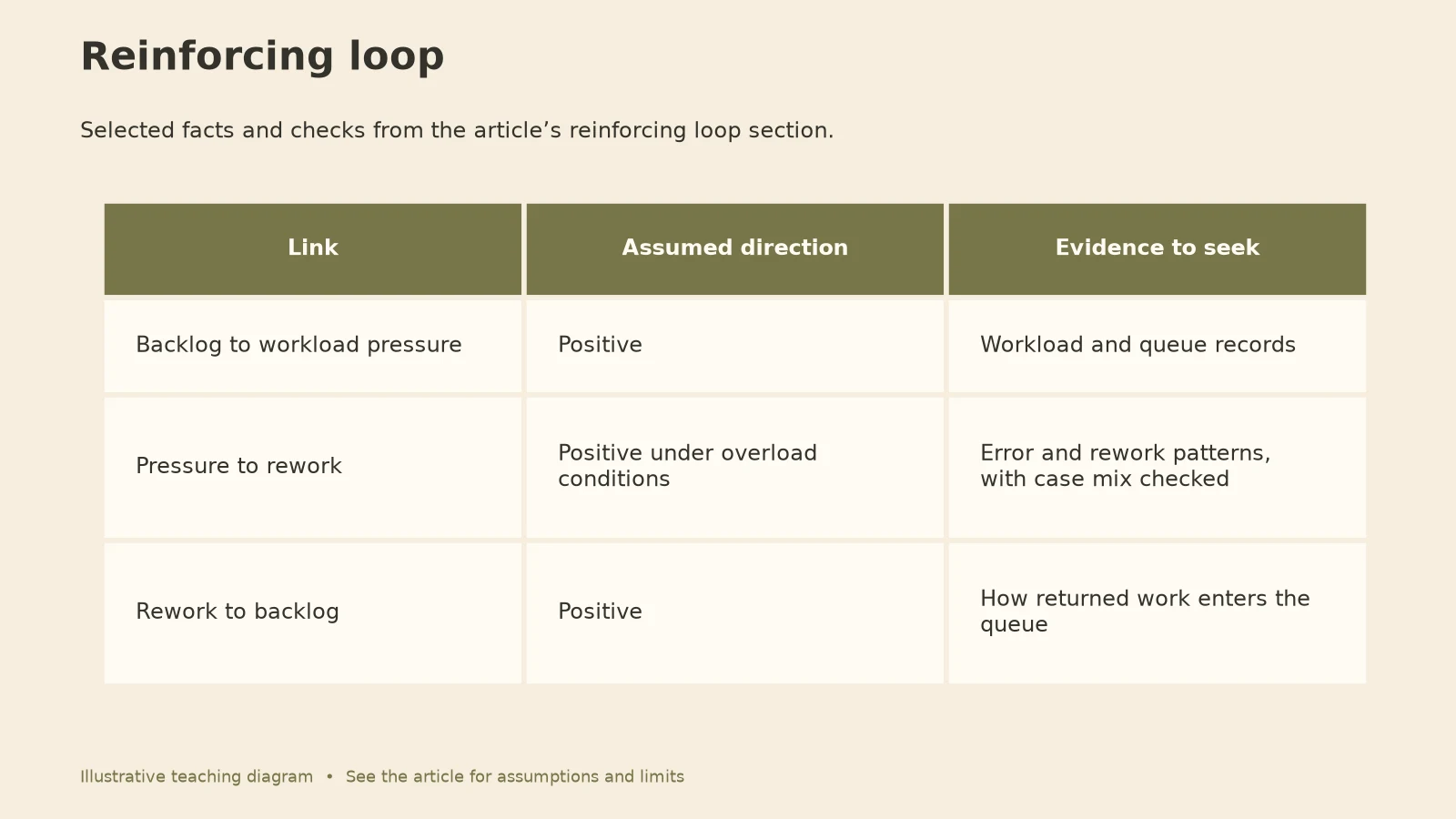
Teams run these loops at a smaller scale. A growing backlog raises workload pressure; under overload, pressure increases mistakes; rework then lands back in the backlog.
| Link | Assumed direction | Evidence to seek |
|---|---|---|
| Backlog to workload pressure | Positive | Workload and queue records |
| Pressure to rework | Positive under overload conditions | Error and rework patterns, with case mix checked |
| Rework to backlog | Positive | How returned work enters the queue |
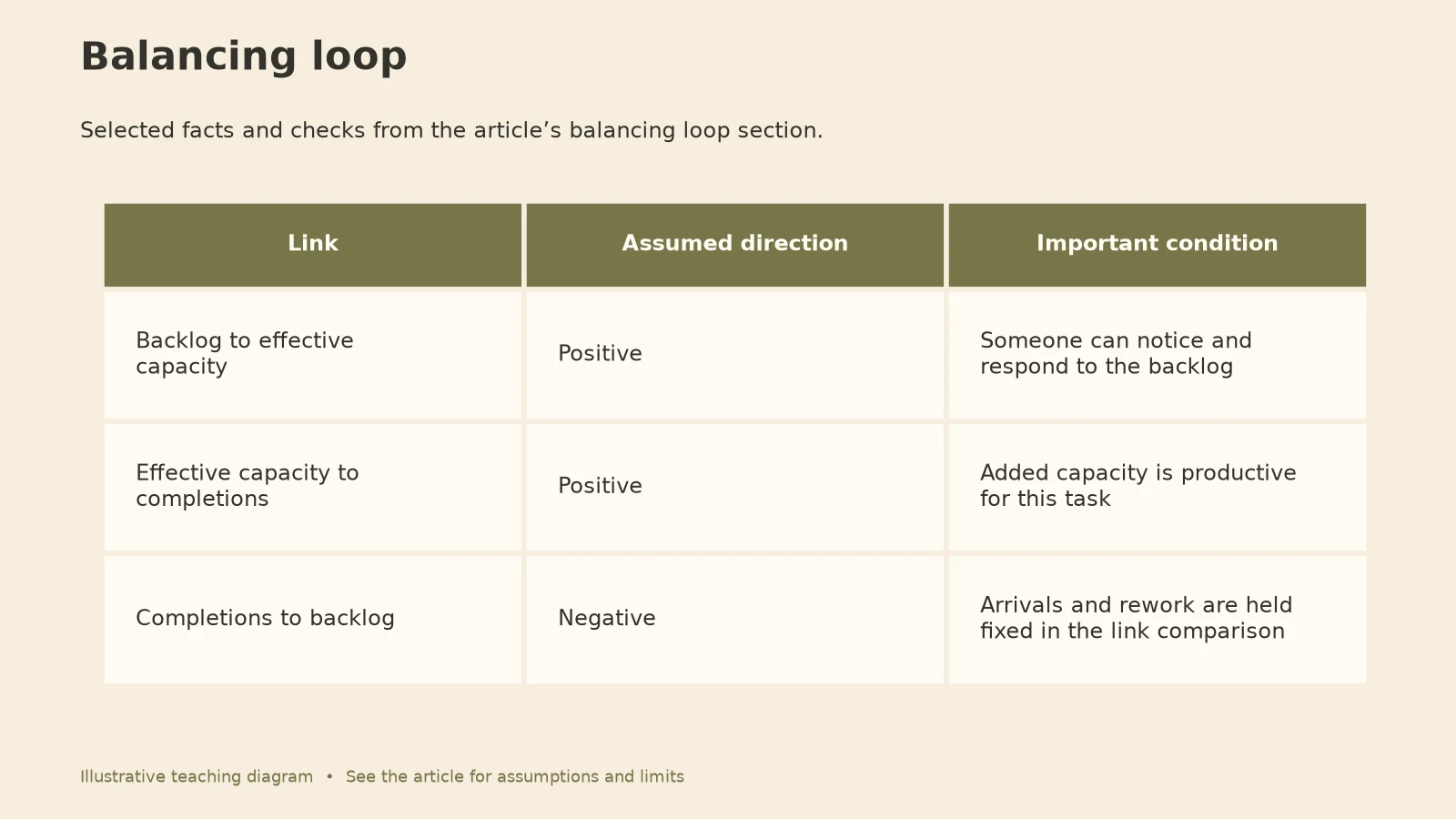
The balancing response is adding capacity:
| Link | Assumed direction | Important condition |
|---|---|---|
| Backlog to effective capacity | Positive | Someone can notice and respond to the backlog |
| Effective capacity to completions | Positive | Added capacity is productive for this task |
| Completions to backlog | Negative | Arrivals and rework are held fixed in the link comparison |
As at SVB, timing decides which loop wins. New hires take weeks to train and temporarily pull experienced staff away, so the reinforcing loop can run for a while before the balancing one catches up.
How to read a loop
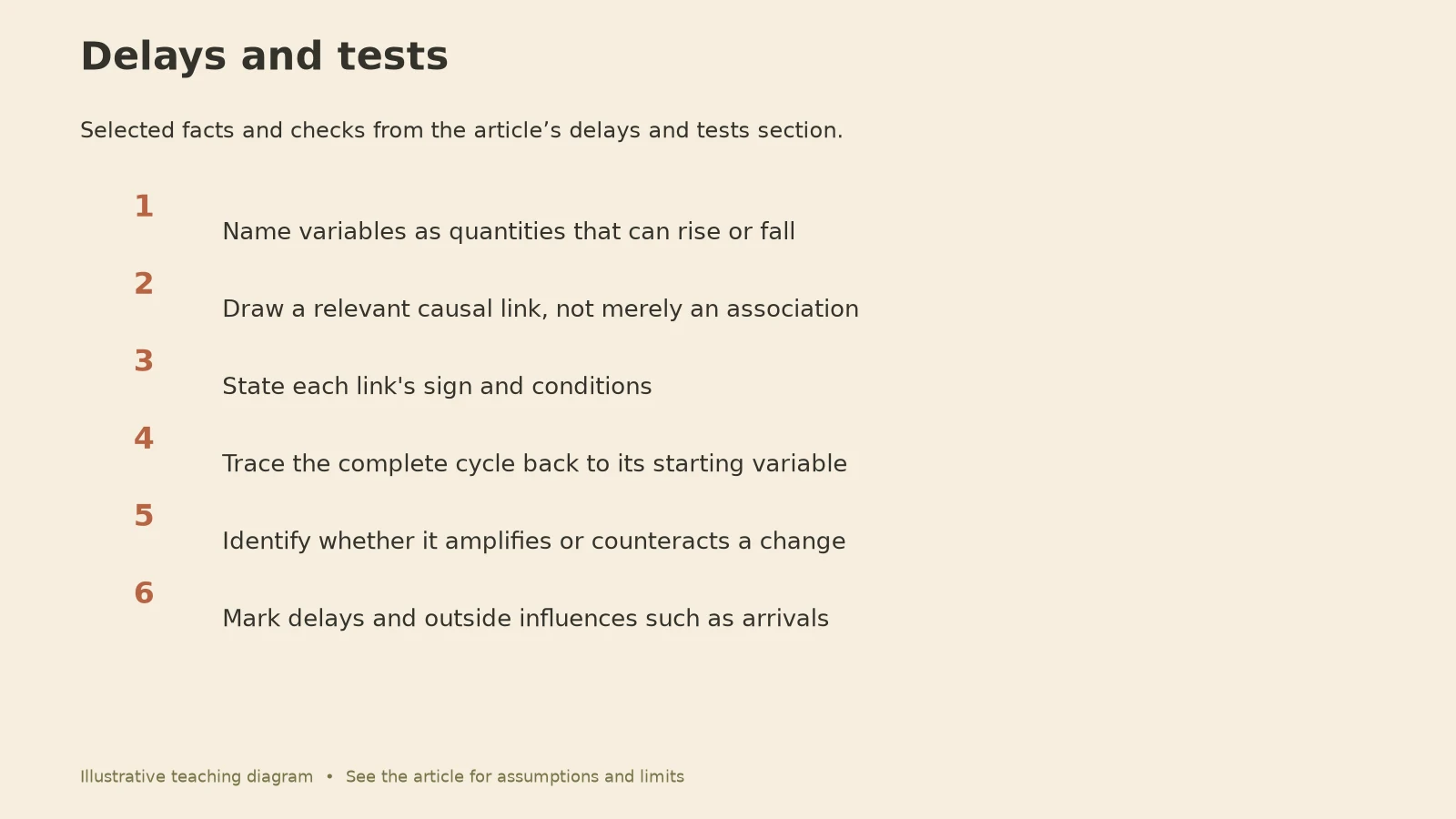
- Name variables as quantities that can rise or fall.
- Draw a relevant causal link, not merely an association.
- State each link’s sign and conditions.
- Trace the complete cycle back to its starting variable.
- Identify whether it amplifies or counteracts a change.
- Mark delays and outside influences such as arrivals.
Then pick evidence or a small change that could prove the loop wrong. A falling backlog does not prove the balancing loop worked if new arrivals also dropped. For stocks, flows, and boundaries, see systems thinking; for the four-level worksheet, see the iceberg model.
When loop thinking backfires
Drawing a loop for an association. Two numbers rising together do not prove either causes the other.
Forgetting the delay. Reacting again before the last fix has taken effect is how teams overcorrect. The second-order thinking guide covers what happens after people respond.
Treating a balancing loop as a guarantee. It can be too weak, too slow, or overwhelmed, as the SVB timeline showed. A fix can also feed the problem it targets, the pattern behind the cobra effect.
Questions
Is positive feedback good and negative feedback bad?
No. The terms describe direction around a loop. That is why many writers prefer “reinforcing” and “balancing.”
Does a balancing loop guarantee stability?
No. Delay, strength, outside inputs, and other loops all affect behavior.
Can I break a reinforcing loop?
Usually by weakening one link. Deposit insurance does this for bank runs: it removes the reason for fear to become withdrawals.
Your 5-minute loop sketch
Something that keeps getting better or worse:
What does it push up or down?
What does that push next?
Does the chain come back to the start? (Yes = loop)
Count the negative links. Odd = balancing, even = reinforcing.
Longest delay in the loop:
One link I could weaken or strengthen this week:
If the loop is a habit, like skipped workouts leading to lower energy and more skipped workouts, track one link for a week in Sweat.