On January 15, 2009, US Airways Flight 1549 hit a flock of birds shortly after takeoff from LaGuardia and lost thrust in both engines. Less than four minutes later, the Airbus was floating on the Hudson River, and all 150 passengers and 5 crew got out. In those minutes, two pilots used four different ways of deciding at once.
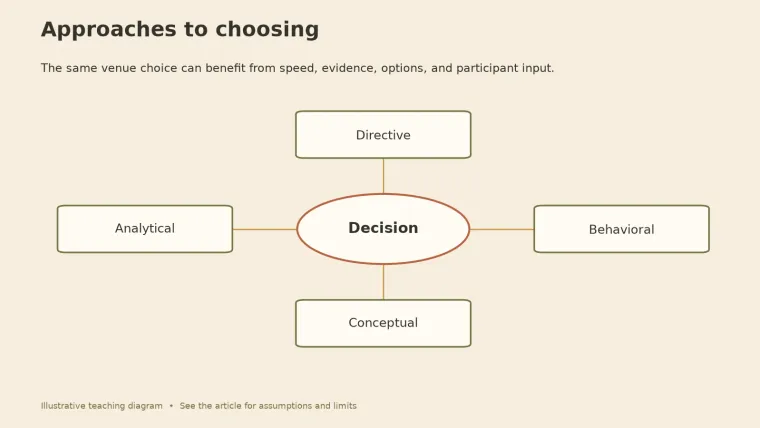
Decision making styles are recurring approaches to choosing: acting quickly on a clear direction, analyzing evidence, exploring unusual possibilities, or focusing on people and coordination. One common framework names them directive, analytical, conceptual, and behavioral. They describe approaches you can switch between. They are not fixed personality types.
Flight 1549 used all four styles in under four minutes
The NTSB accident report lays out the cockpit timeline. Each style shows up in it.
Analytical. Within seconds, First Officer Jeffrey Skiles had the Engine Dual Failure checklist out and was working through it line by line. The NTSB later noted that the checklist did not fully fit the situation, since it assumed more altitude and time than the crew had. It was still the most applicable procedure available, and using it was correct.
Directive. At 3:28:05 p.m., about a minute after the strike, a controller offered a runway back at LaGuardia. Captain Chesley Sullenberger answered: “we’re unable. we may end up in the Hudson.” He also started the auxiliary power unit early, a critical step the checklist would not have reached in time.
Conceptual. Landing an airliner on a river was not in the playbook. The airline’s ditching checklist assumed at least one engine was running, and ditching was not part of simulator training. The option the captain chose came from outside the procedures.
Behavioral. Both pilots told investigators that crew coordination was central. Each had a specific role and knew what the other was doing. After the ditching, flight attendants managed a fast evacuation despite problems at their exits.
No single style saved the flight. The crew split the work, so analysis, decisive action, a new option, and coordination ran in parallel.
Hindsight analysis can miss the clock
Investigators then asked the analytical question: could the plane have made it back to an airport? In simulators, pilots who turned toward LaGuardia immediately after the bird strike could reach a runway.
But an immediate turn ignores the time needed to understand what happened and decide. When the NTSB added a 35-second delay for recognition and decision, the one attempt to return to LaGuardia failed. The slower, more complete analysis would have produced a worse decision in the air.
That is the core lesson about styles. The right one depends on the clock, the stakes, and what the situation actually allows.
Four styles at a glance
The four-style vocabulary comes from the decision style inventory developed by Alan Rowe and colleagues, used in studies such as this one with the Rowe and Boulgarides inventory. Here the labels are a teaching lens, not a scored test.
| Style | Typical emphasis | Contribution | Risk to watch |
|---|---|---|---|
| Directive | Clear action and a limited set of options | Speed and straightforward execution | Missing an important alternative or assumption |
| Analytical | Information and careful comparison | Inspecting evidence and uncertainty | Delaying while seeking excessive information |
| Conceptual | Broad possibilities and longer-term implications | Generating different routes to the goal | Ideas that cannot be carried out |
| Behavioral | People, relationships, and acceptance | Understanding effects and gaining input | Avoiding a necessary disagreement |
Any style can be done well or badly. A careful analysis can be fast, and a quick call can be well informed.
Styles are also separate from decision rights. Command, consultation, consensus, and delegation describe who decides. Group decision making covers that question.
Choose the style the situation needs
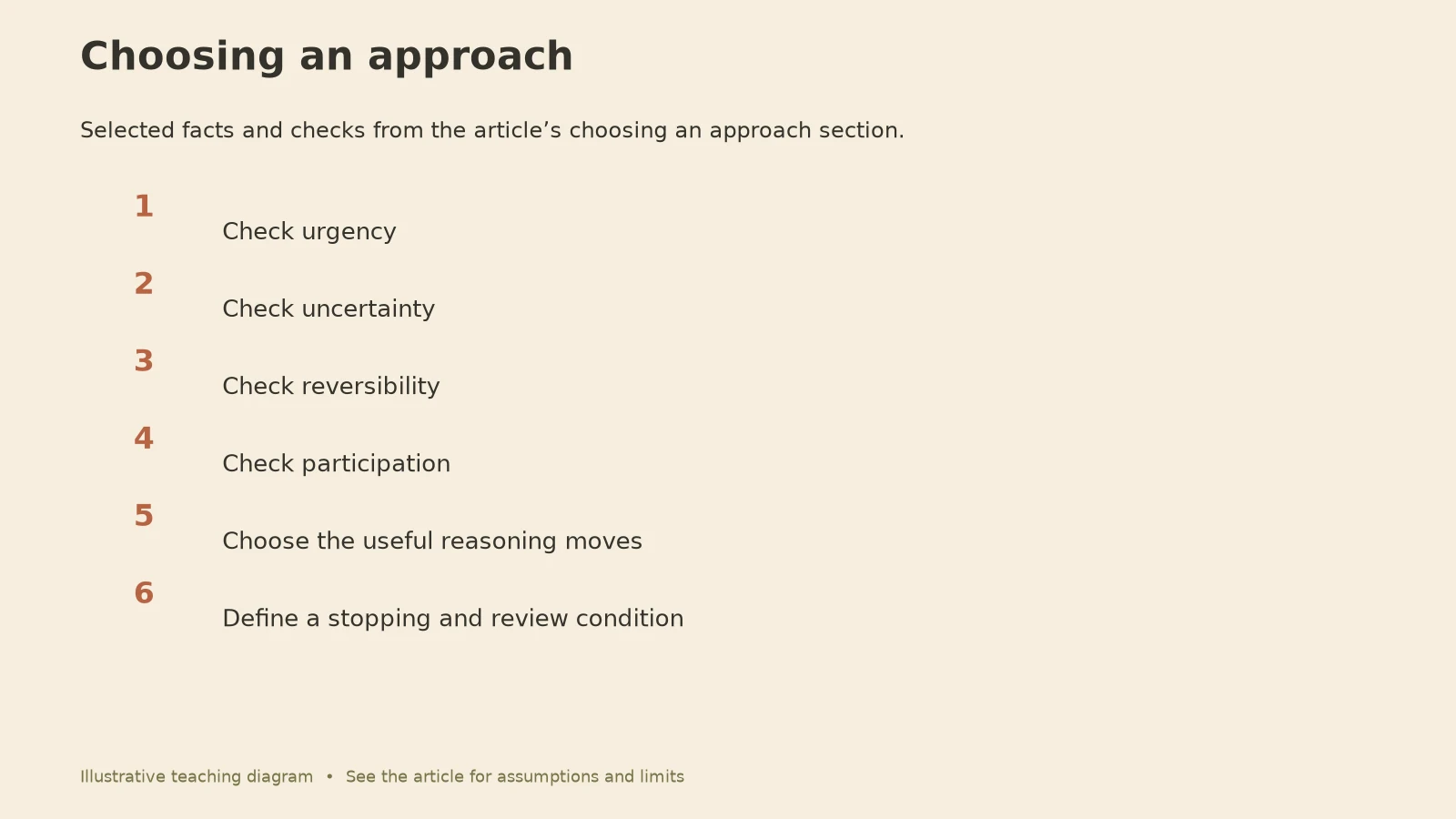
- Check urgency. What happens if you wait, and what is the real deadline?
- Check uncertainty. Which missing fact could change the action?
- Check reversibility. How costly would it be to change course later?
- Check participation. Who has relevant knowledge, and who bears the consequences?
- Choose the useful reasoning moves. Combine styles when they cover different needs.
- Define a stopping and review condition. Avoid both impulsive commitment and endless analysis.
Flight 1549 scored extreme on urgency and irreversibility, so the directive call carried the most weight, with analysis running alongside. A team choosing next year’s software has weeks, so analytical and behavioral moves deserve more time.
OpenStax’s discussion of bounded rationality explains why complete information is rarely available. The response is to find the decisive facts, not to label yourself analytical or intuitive. The rational decision-making model shows how to make criteria explicit, and decision-making frameworks helps size the process to the stakes.
When style labels backfire
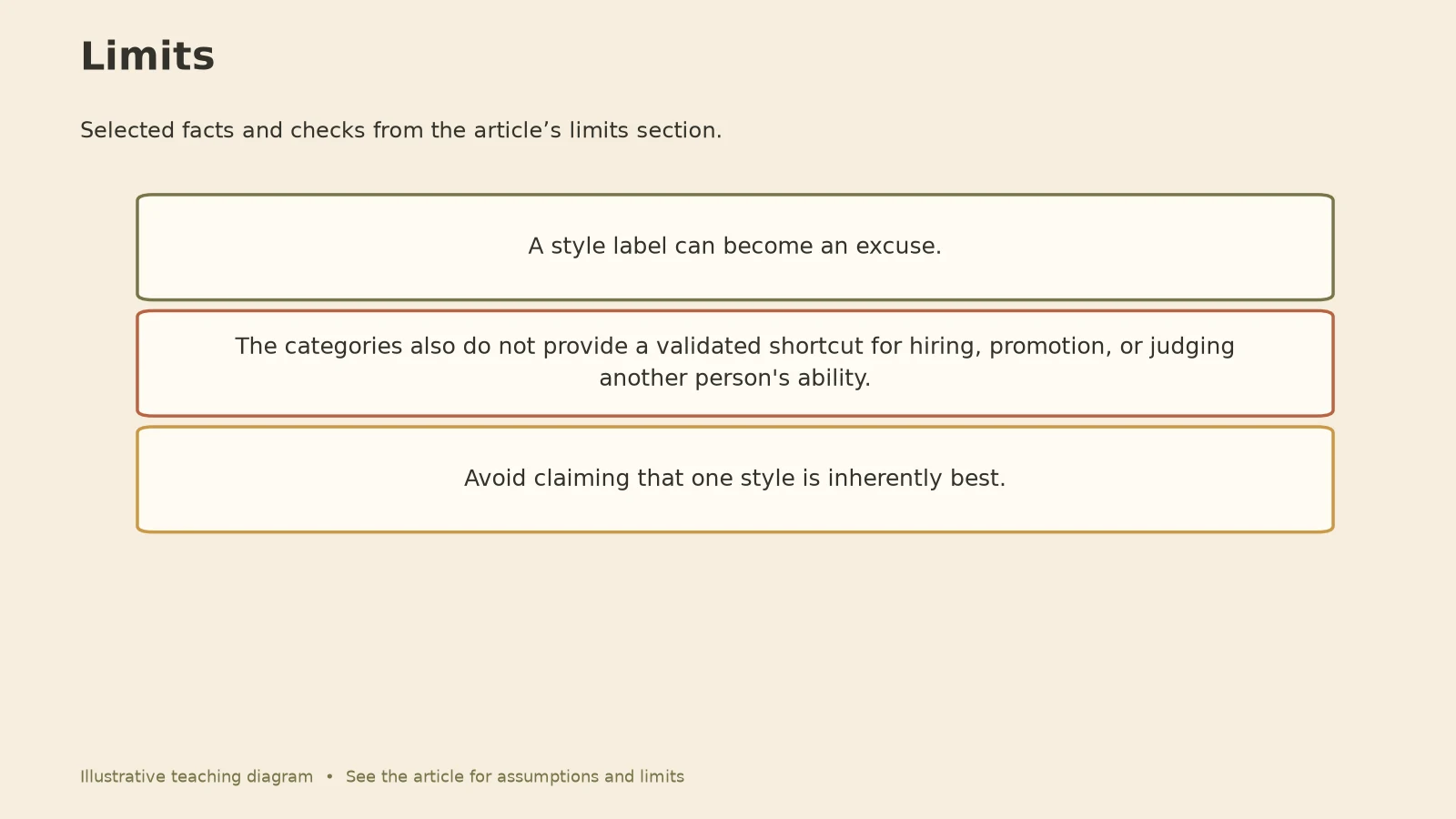
A style label can become an excuse. “I’m directive” does not license ignoring evidence, and “I’m behavioral” does not mean avoiding hard disagreements. Describe what you actually did and what it caused.
The categories also do not provide a validated shortcut for hiring, promotion, or judging another person’s ability. Context, knowledge, time, and organizational pressure all shape behavior.
Avoid claiming that one style is inherently best. Flight 1549 is famous for a decisive captain, but the checklist work, the coordination, and years of training mattered too. Copying the decisiveness without the rest is how confident mistakes happen.
For the full process these styles plug into, see the decision-making overview.
Questions
Can I have more than one decision-making style?
Yes. Most people lean toward one or two but switch depending on the task. The useful question is whether your approach fits the decision in front of you.
Are decision-making styles the same as personality types?
Not as used here. They describe approaches and emphases, and this guide does not score a personality inventory.
Which style is best under pressure?
There is no universal answer. Under extreme time pressure, a clear call based on the minimum decisive facts often beats a fuller analysis, as the Flight 1549 simulations showed. Under moderate pressure, set a deadline and gather only what could change the action.
Your 5-minute style check
Decision:
Real deadline:
Reversible? (cheap / costly / impossible)
The one fact that could change my mind:
Who knows something I don't?
Style I'm defaulting to:
Style this decision needs most:
Second style to run alongside:
If the last two lines differ from your default, that gap is worth noticing. A Slow Down focus timer keeps the check to five minutes.