On the evening of January 27, 1986, engineers at Morton Thiokol told NASA they could not recommend launching the space shuttle Challenger below 53°F, the lowest temperature of any previous flight. The next morning it was 36°F. Between those two facts sat a 30-minute caucus, a worry about waiting until April, and one sentence: take off your engineering hat and put on your management hat.
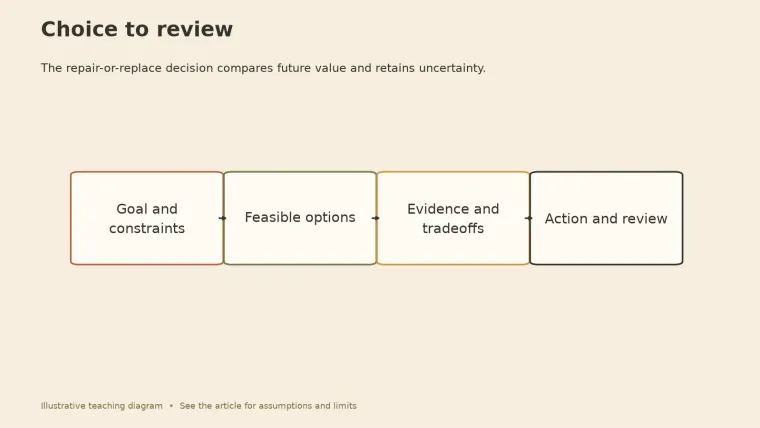
Decision making is the process of choosing among available actions in light of a goal, the information you have, and the consequences you expect. A sound process frames the choice, sets constraints, compares real options, and names who owns the call. It cannot remove uncertainty, but it can stop pressure from quietly rewriting the question.
The night the burden of proof flipped
The Rogers Commission report reconstructs the evening in detail. A teleconference between Thiokol and NASA’s Marshall Space Flight Center began at 8:45 p.m. Thiokol’s vice president of engineering, Bob Lund, presented the conclusion: do not fly until the O-ring temperature reaches 53°F. The worst seal damage so far had come on a January 1985 flight at that temperature.
NASA managers pushed back. Larry Mulloy pointed out there was no launch rule for joint temperature and that with this one, “we may not be able to launch until next April.” George Hardy said he was “appalled” by the recommendation.
Thiokol asked for a five-minute offline caucus. It lasted about 30 minutes. Engineers Arnold Thompson and Roger Boisjoly objected strongly. Then four senior managers held a final review among themselves, and Jerry Mason asked Lund to take off his engineering hat and put on his management hat. Around 11 p.m., Thiokol recommended launch.
Boisjoly later quoted a colleague: it was “up to us to prove beyond a shadow of a doubt that it was not safe to do so. This is in total reverse to what the position usually is.”
Challenger lifted off at 11:38 a.m. on January 28 in air 15 degrees colder than any previous launch. It broke apart 73 seconds later, and all seven crew members died. The commission’s verdict was blunt: “The decision to launch the Challenger was flawed.” The people who made the final call did not know about the contractor’s original written recommendation or the engineers’ continuing opposition.
Most bad decisions go wrong at the framing step
Nobody that night chose to accept a catastrophe. What changed was the question. Before a flight, engineers normally had to show it was safe to fly. That evening they had to prove it was unsafe, with no data from temperatures that cold.
Lund described it to the commission: “We had to prove to them that we weren’t ready… and we were unable to do that.” Same data, different burden of proof, opposite decision.
That is why framing comes first. Who has to convince whom is part of the decision, even when nobody writes it down.
Six steps, and where each one broke that night
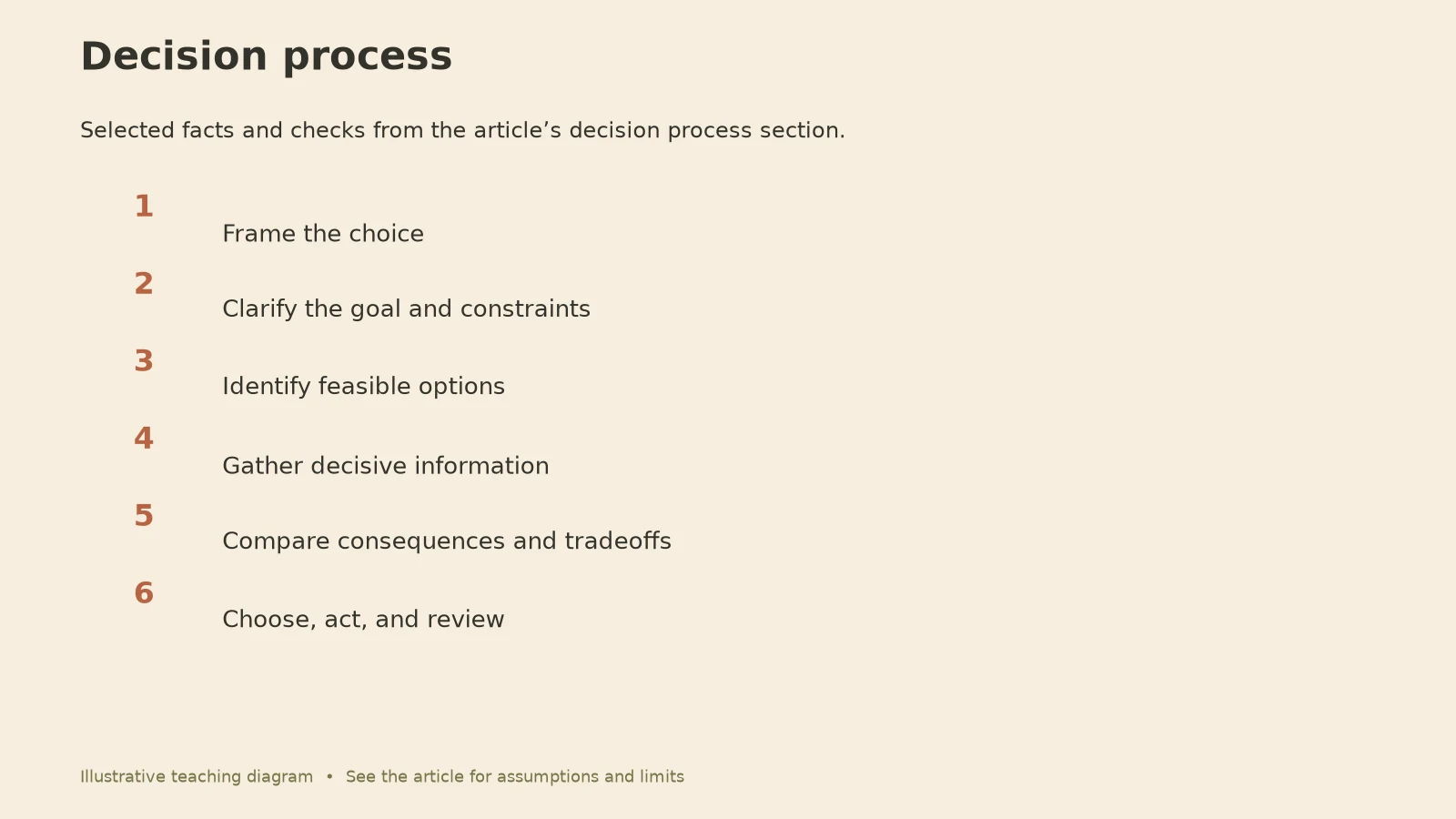
- Frame the choice. What action needs to be taken, by whom, and when?
- Clarify the goal and constraints. Keep nonnegotiable requirements separate from preferences.
- Identify feasible options. Include waiting or keeping the current arrangement when that is a real option.
- Gather decisive information. Focus on facts that could change the choice.
- Compare consequences and tradeoffs. Keep assumptions and uncertainty visible.
- Choose, act, and review. Name who owns the decision and when it will be revisited.
| Step | What happened on January 27 | Question to ask yourself |
|---|---|---|
| Frame | Engineers had to prove danger instead of safety | What would have to be true for us to say no? |
| Constraints | Schedule pressure sat beside safety limits | Which limit is truly nonnegotiable? |
| Options | Waiting until April was framed as a heavy cost | Is waiting a real option here? |
| Information | No flight data existed below 53°F | What do we not know about these conditions? |
| Consequences | The downside could not be undone | Which mistake could we reverse? |
| Owner | Four managers decided; senior NASA officials heard only that the concern was resolved | Who decides, and who needs to hear the dissent? |
The steps can loop. A new constraint may require a new option, and a trial may show the goal was vague. For structured methods, see decision-making frameworks and the rational decision-making model.
Common pitfalls
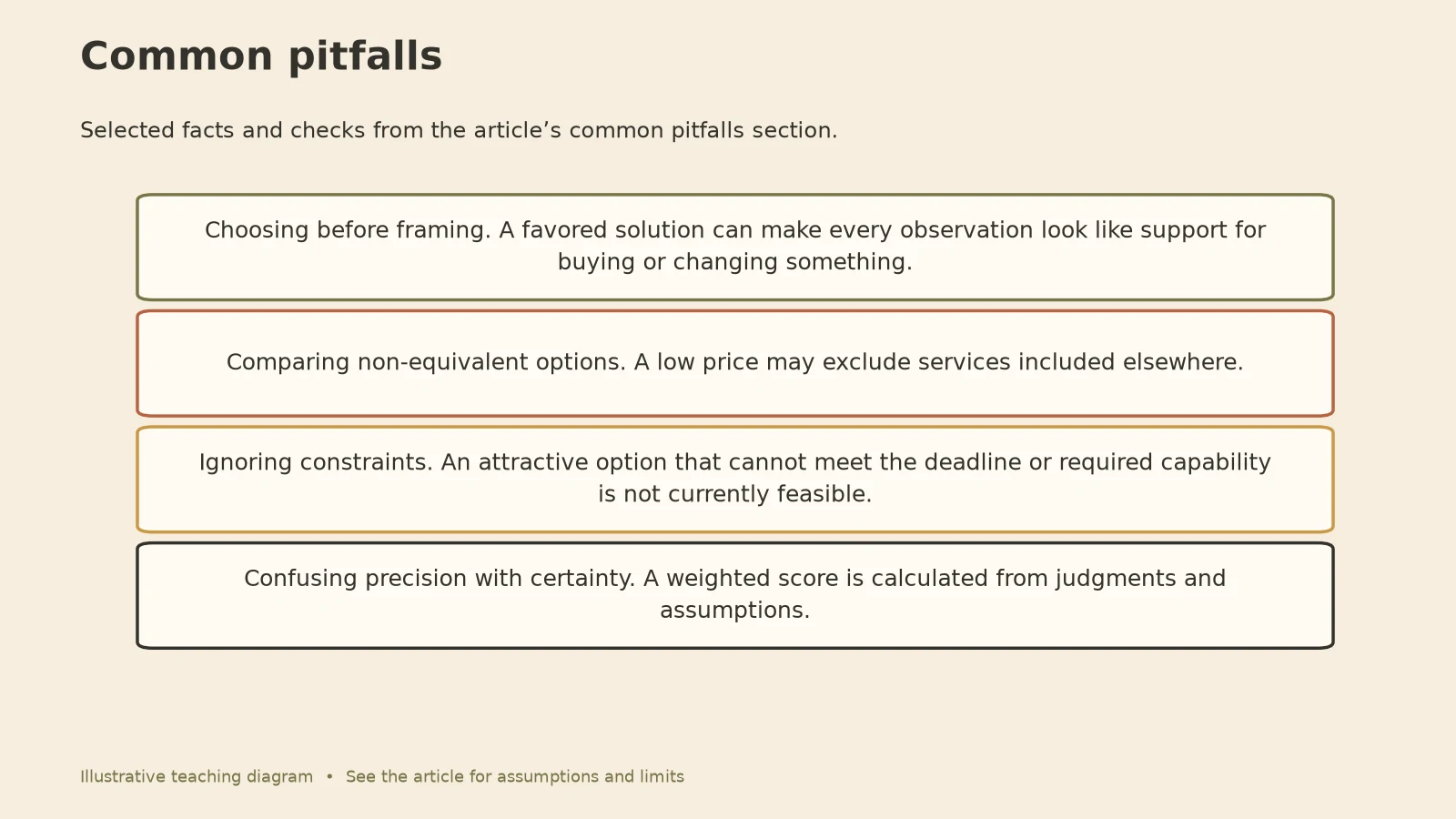
Choosing before framing. A favored solution can make every observation look like support for buying or changing something. State the problem first.
Comparing non-equivalent options. A low price may exclude services included elsewhere. Check that each option covers the same scope.
Ignoring constraints. An attractive option that cannot meet the deadline or required capability is not currently feasible.
Confusing precision with certainty. A weighted score is calculated from judgments and assumptions. More decimal places do not make those assumptions true.
Judging only by the outcome. Mulloy noted that shuttles had flown 24 times under the existing rules. Flights that survived seal damage were treated as proof of safety. Surviving is different from having margin.
Bounded rationality describes the real limits on what people can know and process. Those limits are a reason to focus on the information that matters, and no excuse to skip it. Opportunity cost helps you see what each option gives up, and the sunk cost fallacy helps separate past spending from future choices.
When more process makes things worse
The Challenger lesson is easy to misread as “add more steps.” That night already had charts, data, and hours of discussion. What was missing was a protected place for dissent and a clear rule about who had to prove what.
Heavy process can also backfire. For a cheap, reversible choice, a long meeting costs more than a quick trial. A decision record written after the fact can make a hunch look like analysis. And OpenStax’s account of reactive and reflective thinking notes that fast, familiar judgments often work well.
A good stopping question: what fact would change the action, and is learning it worth the time? If nothing plausible would, take a reversible step and set a review date.
Context changes the right method. Decision-making styles compares approaches, group decision making covers decision rights and disagreement, and ethical decision making handles obligations a score cannot settle.
Questions
What makes a decision good?
It rests on relevant evidence, real options, explicit tradeoffs, and honest attention to uncertainty. The outcome matters, but a good decision can still turn out badly, and a bad one can get lucky.
Is intuition always unreliable?
No. In familiar situations, experience supports fast and accurate judgments. Check whether today’s situation really matches that experience, especially when an error would be costly.
How do I decide with incomplete information?
Identify the uncertainty that matters most, gather evidence in proportion to the stakes, and prefer actions you can reverse. Say plainly what you still do not know.
Your 5-minute decision card
Decision:
Owner (one name):
Deadline:
Nonnegotiable limits:
Options (including wait):
Who must prove what? (safe to go, or unsafe to go?)
Strongest objection, in the objector's words:
Fact that would change my mind:
Review date:
If you cannot fill in the strongest objection, you have not heard it yet. A Slow Down focus timer keeps the card to five minutes.