In late September 1982, seven people in the Chicago area died after taking Extra-Strength Tylenol capsules laced with cyanide. Investigators said the tampering happened after the bottles left the factory, so Johnson & Johnson was a victim too. A few days later, chairman James Burke pulled every Tylenol capsule off American shelves anyway.
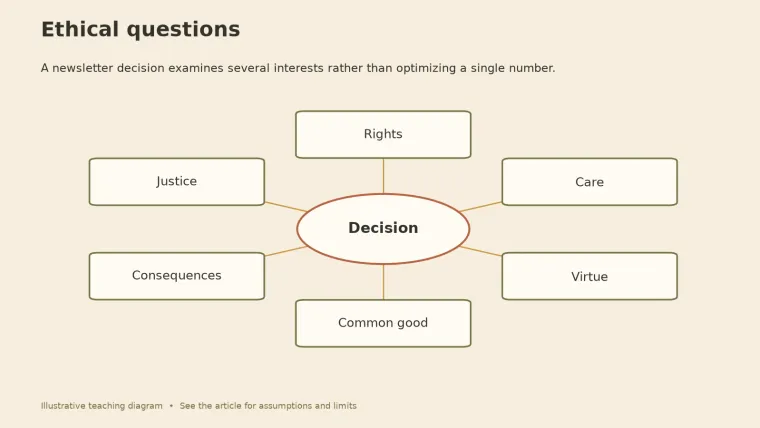
Ethical decision making is the process of working out what you ought to do when a choice affects other people, obligations, or shared values. A useful process identifies who is affected, checks the facts, compares feasible actions through several ethical lenses, and explains the choice in a form others can review.
Tylenol 1982: not at fault, and recalled anyway
The authorities urged caution. According to Fortune’s 1982 account, Burke began advocating a recall of all Extra-Strength capsules, and both the FBI and the FDA counseled him against recalling the drug precipitously.
Three days into the crisis, Burke still went to his son’s parents’ weekend at Middlebury College. He took eight of his son’s friends to dinner. “He sat and he asked each one of them, ‘If you were me, what would you do?’” his son told The New York Times.
Then a man in Oroville, California, fell ill after taking capsules laced with strychnine. Officials saw no direct link to Chicago. Johnson & Johnson announced a nationwide recall of all Tylenol capsules and halted production. The company put the cost at $100 million, and Tylenol’s share of the pain-reliever market fell from more than 35 percent to under 8 percent, PBS reports.
Within months, Tylenol returned in tamper-resistant packaging. A year after that, it was the top-selling over-the-counter pain reliever again.
Blame and responsibility are separate questions
Burke told Fortune that 87 percent of Tylenol users surveyed knew the maker was not responsible for the deaths. Yet 61 percent said they were unlikely to buy Extra-Strength capsules again. If ethics stopped at blame, the analysis would have ended at the first number.
Burke asked a different question: what does the company owe the people who use its products when a risk is real but its size is unknown? Johnson & Johnson’s Credo, first written in 1943, answers in its opening line: “We believe our first responsibility is to the patients, doctors and nurses, to mothers and fathers and all others who use our products and services.” Stockholders come last.
That ranking existed before the crisis, so nobody had to invent priorities under pressure. A written order of obligations, agreed in calm times, is a highly practical ethics tool. A shopper cannot inspect a capsule for poison, so the party able to act on the risk carries more of the duty. The information-asymmetry guide covers what changes when one side can see or control a risk the other cannot.
Six lenses, applied to the recall
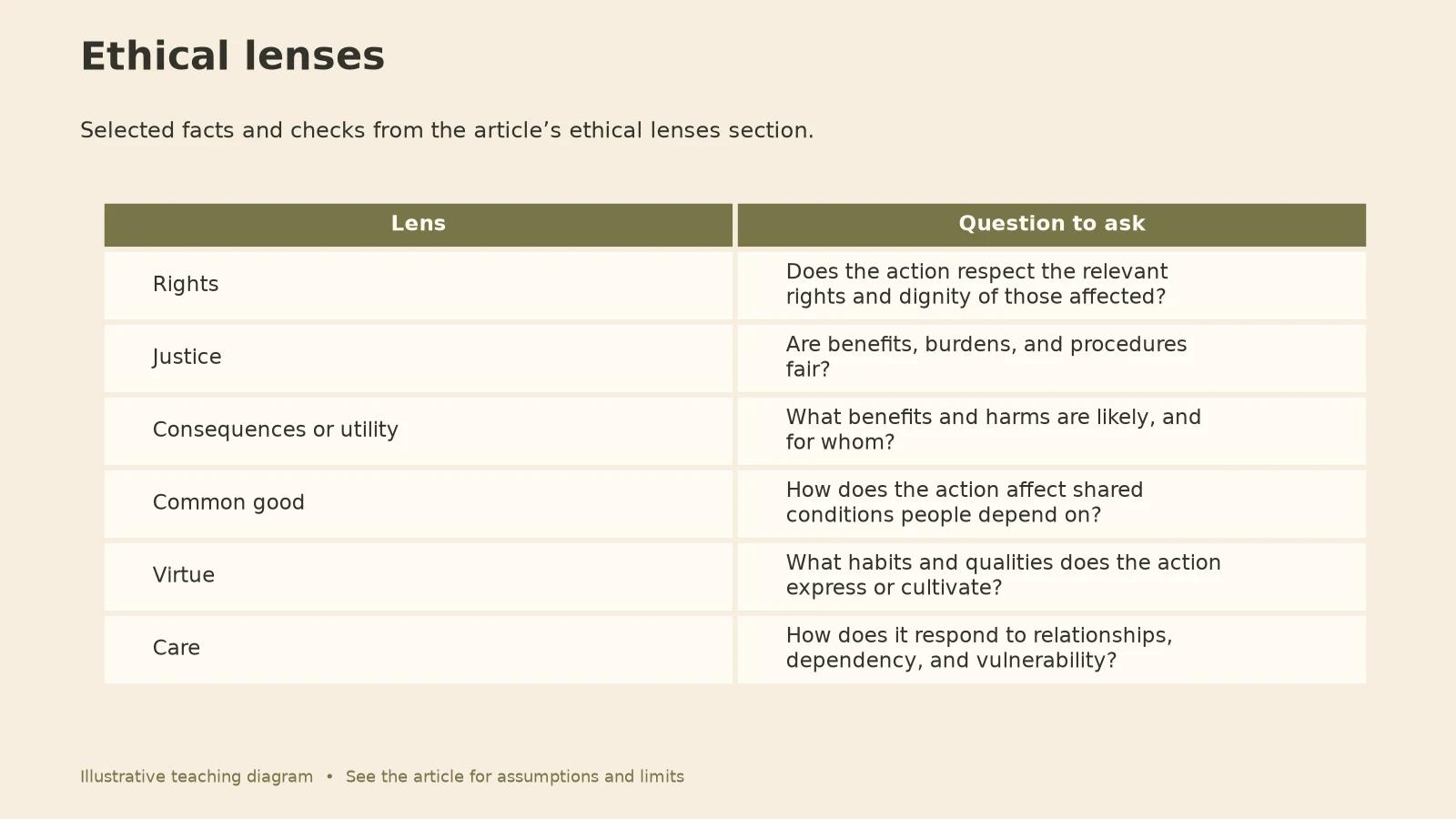
Santa Clara University’s framework offers six lenses as a reasoning aid. It is not an ethics algorithm.
| Lens | Question to ask |
|---|---|
| Rights | Does the action respect the relevant rights and dignity of those affected? |
| Justice | Are benefits, burdens, and procedures fair? |
| Consequences or utility | What benefits and harms are likely, and for whom? |
| Common good | How does the action affect shared conditions people depend on? |
| Virtue | What habits and qualities does the action express or cultivate? |
| Care | How does it respond to relationships, dependency, and vulnerability? |
Here is how the lenses read against the 1982 facts. The table is a teaching interpretation, not a record of what executives said.
| Lens | Question in 1982 | What the recall did |
|---|---|---|
| Rights | Can customers judge a risk they cannot see? | Took the hidden risk off shelves |
| Justice | Who should carry the cost of a stranger’s crime? | Put it on the company, not shoppers |
| Consequences | Small chance of more deaths against a $100 million loss | Accepted the certain loss |
| Common good | Can anyone trust a bottle from a store shelf? | Led toward industry-wide tamper seals |
| Virtue | What would a trustworthy maker do? | Acted before being forced to |
| Care | Who is most exposed, such as children and the sick? | Protected people with the least information |
The lenses agreed unusually well here. Usually they pull apart, and you have to say which concern gets more weight and why. A veil of ignorance test helps: choose the rule you would accept without knowing whether you were the shopper or the shareholder.
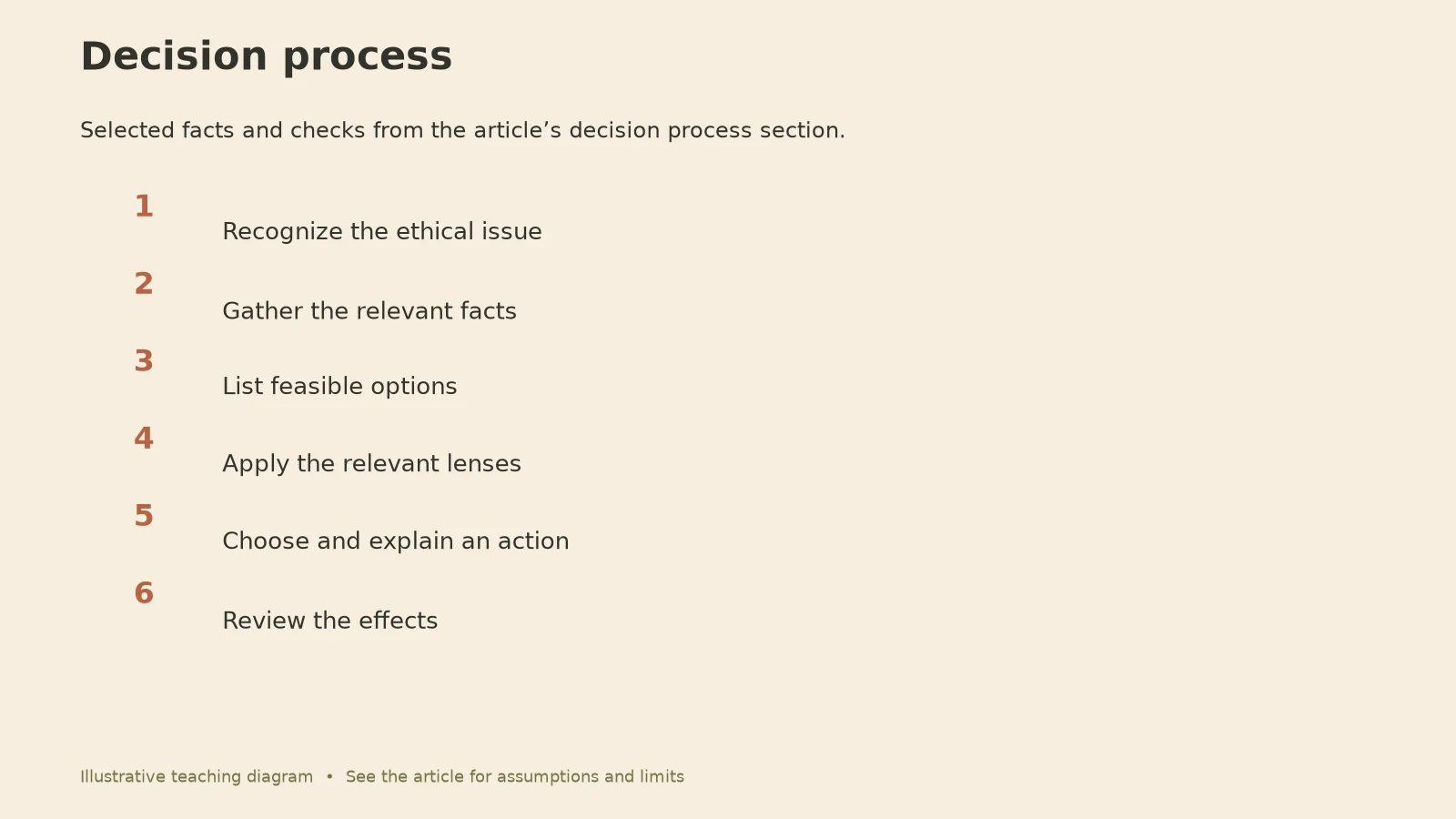
Run the decision process
- Recognize the ethical issue. State the specific concern rather than labeling a person good or bad.
- Gather the relevant facts. Include what is known, who is affected, and what information is missing.
- List feasible options. Look beyond the first proposed action and its simple opposite.
- Apply the relevant lenses. Explain the reasoning and conflicts behind each label.
- Choose and explain an action. State who is responsible and what safeguards are needed.
- Review the effects. Decide what feedback or changed facts would warrant reconsideration.
Step 3 is where Burke’s dinner question helps. Asking outsiders “If you were me, what would you do?” surfaces options insiders have already filtered out. For running that kind of input inside a team, see group decision making.
A good explanation in step 5 can be checked later: “We are withdrawing all capsules because we cannot rule out further tampering, and we will return only with packaging that shows if a bottle has been opened.” “We did the ethical thing” cannot be checked.
When ethical frameworks backfire
Scorecards hide rights. Turning six lenses into six numbers and picking the highest total lets a serious rights concern disappear into a small penalty. Decision-making frameworks can compare practical options, but keep numerical preference scores separate from ethical obligations.
A happy ending can launder the reasoning. Tylenol recovered, so the recall is remembered as smart business. A choice can be right even when it costs you, and a profitable outcome does not prove the reasoning was sound.
The first fix is treated as final. After another poisoning in 1986, the company stopped selling over-the-counter capsules entirely. Asked whether he was sorry it had not acted sooner, Burke answered: “Yes, indeed I am.” Step 6 exists for this.
Facts go untested. Critical thinking checks the factual claims an ethical judgment rests on. A strong value applied to a wrong fact still produces a wrong decision.
Questions
Is an ethical decision always the legal decision?
Legal and ethical questions overlap but are not identical. Tylenol shows the gap: the FBI and FDA advised caution, and the company went further. Check legal requirements through the appropriate process, then examine the effects a minimum rule leaves open. This page explains ethical reasoning and does not replace legal or professional advice.
What if two ethical lenses disagree?
Describe the disagreement, the affected interests, and why you give one concern more weight in this situation. Look for an option or safeguard that reduces the conflict instead of hiding it.
Can a framework guarantee the right answer?
No. It makes the reasoning more systematic and visible. Facts, interpretation, responsibility, and review still matter.
Your 5-minute ethics check
Decision:
Who is affected, and who has the least information?
Which obligation comes first, and was it written down before today?
Options beyond "do it" and "don't":
Lens that argues hardest against my preferred option:
One-sentence explanation someone could check later:
What new fact would make me reverse this?
For real cases to practice on, take one story from Daily Read, run it through the card, and see which lens you skipped.