In the summer of 1772, the chemist Joseph Priestley was offered a well-paid post as librarian to Lord Shelburne. He was torn, so he asked Benjamin Franklin for advice. Franklin declined to say what he should choose. Instead, in a letter dated September 19, he explained how to choose, a method he called “Moral or Prudential Algebra.”
The rational decision making model is a step-by-step method for choosing: define the problem, set criteria, list options, weigh each option’s likely consequences, and pick the best. It is a benchmark for clear reasoning. It does not describe how people usually decide, and it cannot make subjective weights objective.
Franklin’s prudential algebra is the model in miniature
Franklin’s diagnosis still holds. Hard choices are hard, he wrote, because “all the Reasons pro and con are not present to the Mind at the same time.” One set of reasons shows up, then another, and we swing between them.
His fix: divide a sheet into Pro and Con columns and add reasons over “three or four Days.” Then weigh them. Where a pro and a con seem equal, strike both out. If one pro equals two cons, strike all three. Keep going until you see “where the Ballance lies,” wait another day or two, and decide if nothing new appears.
He was candid about the limit: the weight of reasons “cannot be taken with the Precision of Algebraic Quantities.” But with everything in one view, he found he was “less likely to make a rash Step.”
The method did not make the choice quick. According to the editors of Franklin’s papers, Priestley wrestled with it until December before accepting.
The six steps
Teaching versions split the process differently. The core moves are:
- Define the decision and desired outcome.
- Identify feasibility requirements and relevant criteria.
- Generate and inspect available options.
- Make assumptions and evidence explicit.
- Compare the options using suitable methods.
- Choose, implement, and review the action.
Franklin’s sheet covers steps 3 to 5. The step people most often skip is the second one: separating requirements from preferences. A requirement is a condition every option must meet. A preference only ranks options that pass. A venue without enough seats should never win because it is cheap.
A weighted comparison can end in a tie
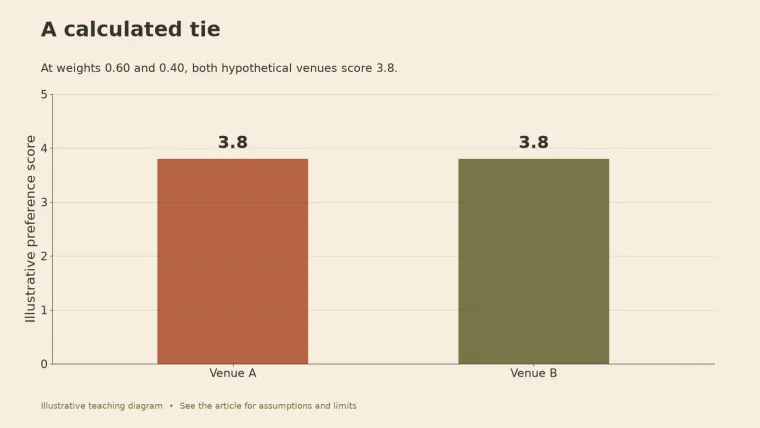
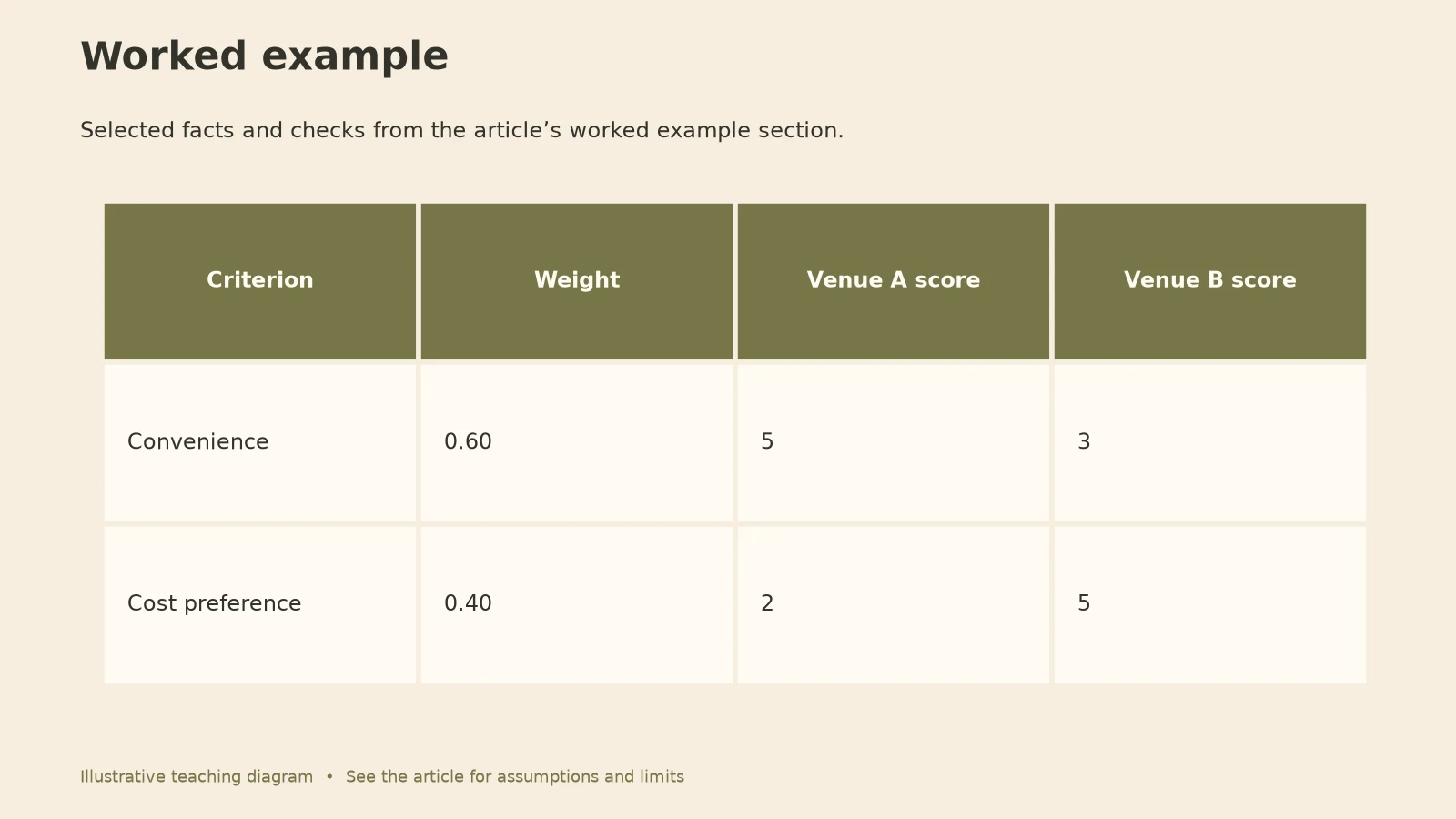
Franklin struck out reasons by eye. Modern versions put numbers on the same idea. Suppose a team picks between two fictional venues that both meet the capacity and accessibility requirements. It scores convenience and cost from 1 to 5, higher is better, and weights convenience at 0.60 and cost at 0.40.
| Criterion | Weight | Venue A score | Venue B score |
|---|---|---|---|
| Convenience | 0.60 | 5 | 3 |
| Cost preference | 0.40 | 2 | 5 |
A scores 0.60 × 5 + 0.40 × 2 = 3.8. B scores 0.60 × 3 + 0.40 × 5 = 3.8.
The matrix has found a balance, just as Franklin’s columns sometimes do. That is a result: it says the decision turns on something the scores have not captured yet. The arithmetic is exact, but the inputs are judgments. A score of 5 is not five times as good as a 1.
A sensitivity check finds the weight that flips the answer
Let w be the weight on convenience and 1 − w the weight on cost. A scores 2 + 3w and B scores 5 − 2w, so they tie at w = 0.60.
| Convenience weight | A total | B total | Higher score |
|---|---|---|---|
| 0.50 | 3.5 | 4.0 | B |
| 0.60 | 3.8 | 3.8 | Tie |
| 0.70 | 4.1 | 3.6 | A |
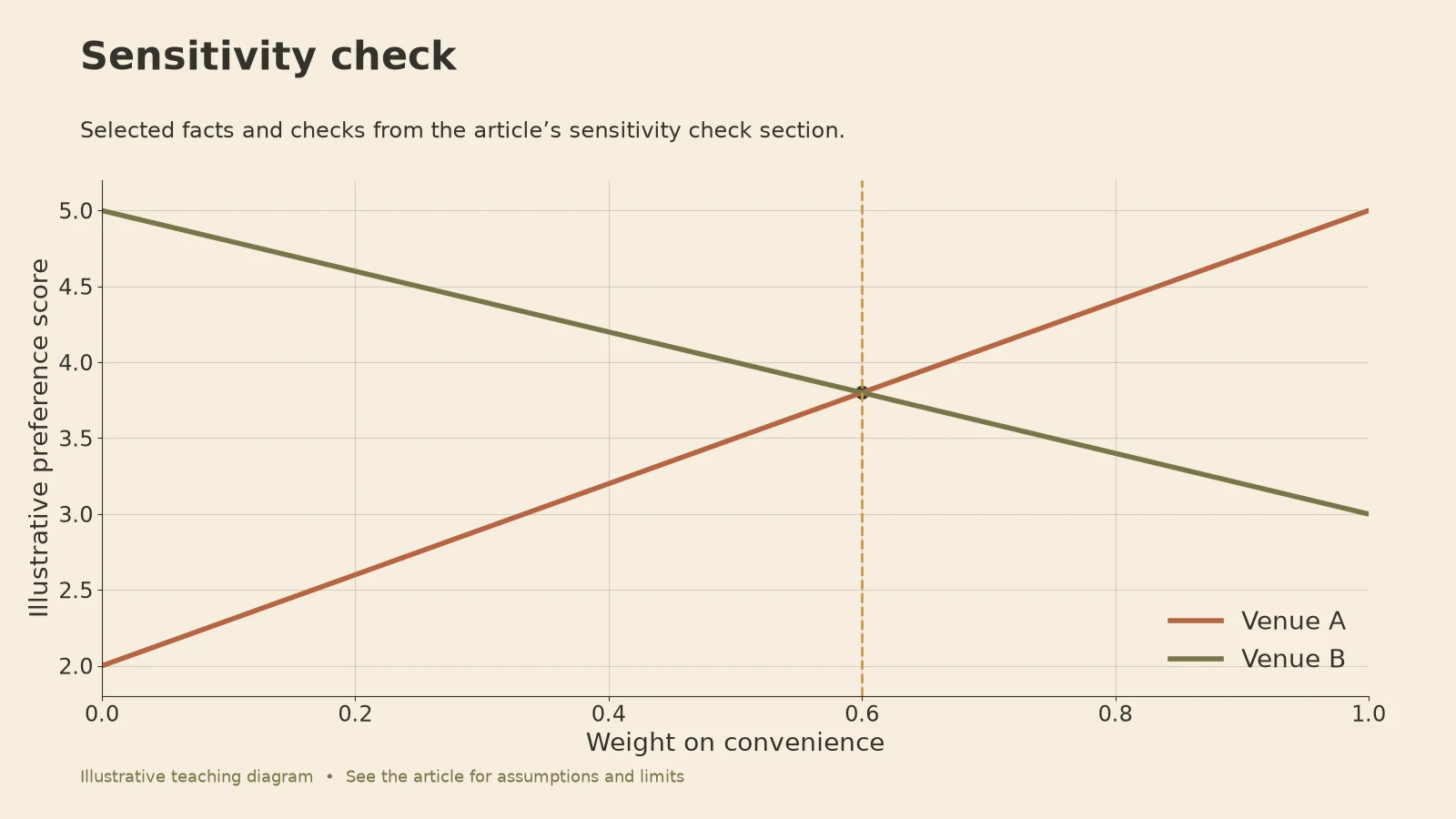
So the real question is how much this team values convenience over cost. If people disagree, record that, and settle who has the authority to decide. Nudging the weight until a favorite wins is the model’s most common abuse. Group decision making covers how to gather independent views first, and critical thinking helps test the evidence behind each score.
Darwin’s list shows what the model leaves out
In July 1838, Charles Darwin wrote “This is the Question” at the top of a page and split it into Marry and Not Marry. For: children, a “constant companion… better than a dog anyhow.” Against: “Freedom to go where one liked” and the “Loss of time.” He concluded “Marry—Mary—Marry Q.E.D.,” then immediately faced the next question: “When? Soon or Late.”
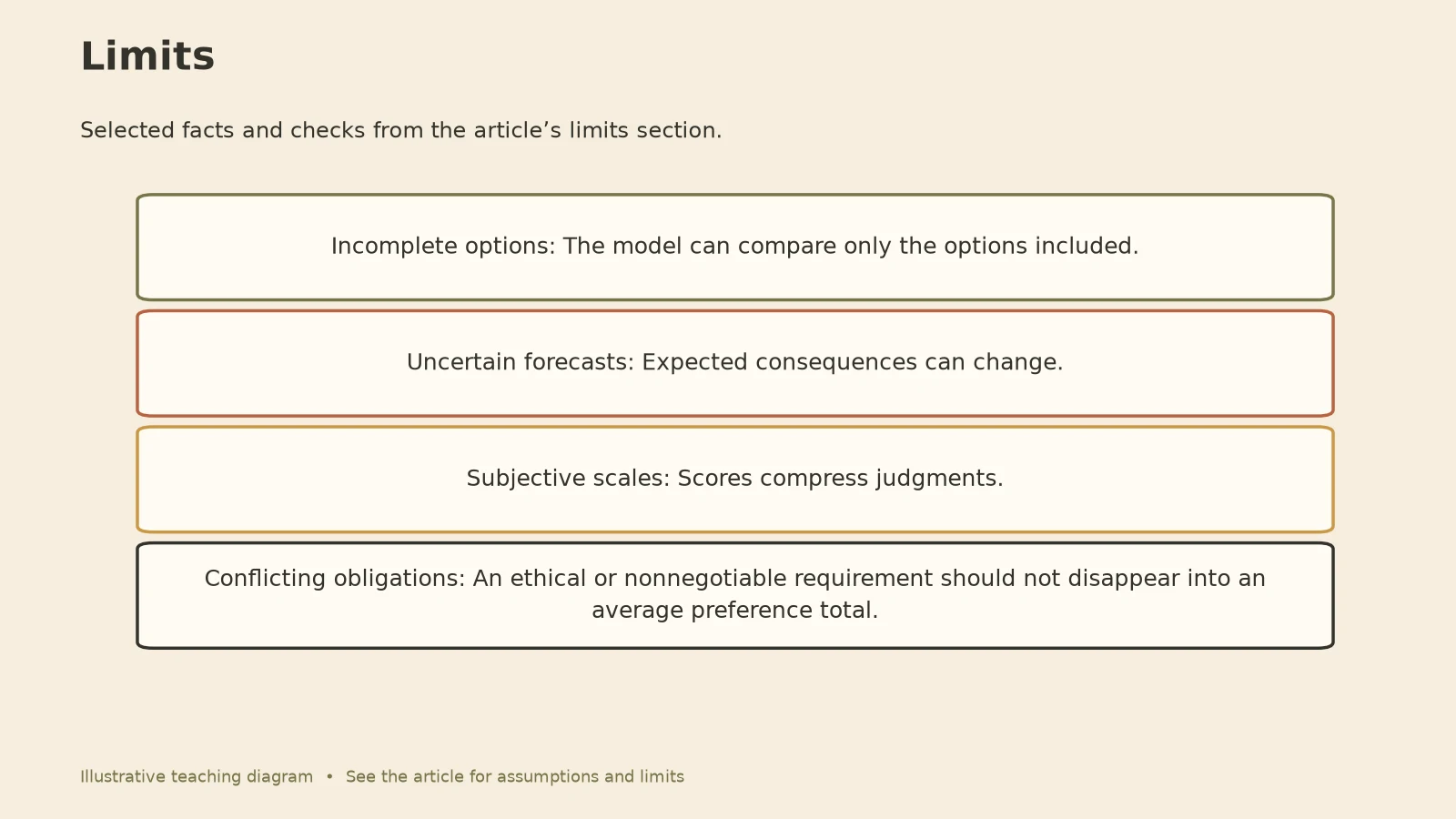
His list never weighed anything, and it did not end the thinking. That points to the model’s main limits:
Incomplete options: The model can compare only the options included. Darwin’s sheet had two.
Uncertain forecasts: Expected consequences can change. A projected benefit is not an observed one.
Subjective scales: Scores compress judgments. Say what each number means.
Conflicting obligations: An ethical or nonnegotiable requirement should not disappear into an average preference total.
Information cost: More analysis delays action. Ask whether the next fact would change the decision.
When the rational model works against you
OpenStax’s account of bounded rationality explains why complete information and exhaustive comparison are rarely available. Pretending otherwise causes three problems.
The spreadsheet launders a gut call. Weights chosen after you know which option you like produce a score that only looks neutral.
Small choices get big process. For a reversible decision, a full matrix costs more than a quick trial. Decision-making frameworks shows how to size the process to the stakes.
Values hide inside numbers. A fairness concern weighted at 0.1 has still been weighed away. Ethical decision making handles obligations a total cannot settle, and the decision-making overview covers the wider process.
Questions
Is the rational model the same as a weighted matrix?
No. A weighted matrix is one comparison tool inside the model. Defining the problem, screening requirements, and reviewing the result still matter.
What if the top score fails a requirement?
Then the option is out. Screen requirements before ranking preferences.
Does a more detailed score mean a better choice?
No. Detail helps only when the criteria and evidence fit the decision. Precise arithmetic is not certain judgment.
Your 5-minute prudential algebra
Decision:
Must-haves (any option failing these is out):
Pro                         | Con
                            |
Strike out pairs of equal weight.
What is left on each side?
What would I need to learn to break a tie?
Sleep on it. Anything new tomorrow?
Franklin gave himself three or four days. A Slow Down focus timer helps you protect the first five minutes.