In April 1961, President Kennedy approved a CIA plan to land Cuban exiles at the Bay of Pigs. Adviser Arthur Schlesinger Jr. doubted it and mostly kept quiet. Eighteen months later, in the Cuban Missile Crisis, many of the same officials argued openly before choosing a blockade. The people barely changed. The process did.
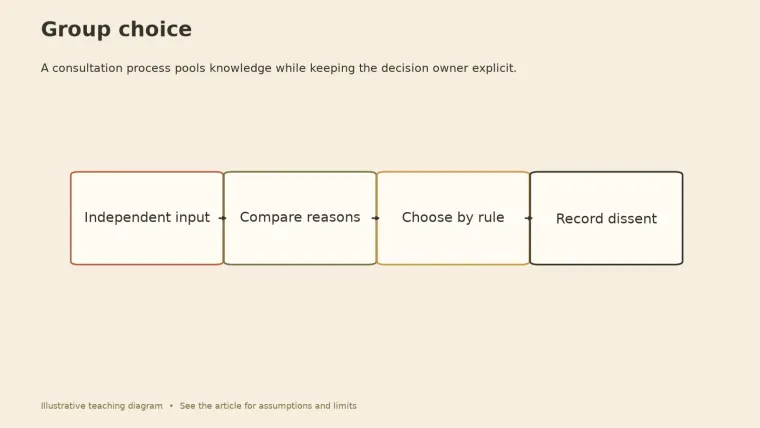
Group decision making is the process of combining the knowledge and judgments of several people to choose an action. It works when the group defines the decision, gathers views independently, compares the reasons, and uses a declared rule for choosing. It fails when members stay quiet to protect agreement.
The Bay of Pigs shows what a polite room costs
According to the JFK Library, the plan, inherited from Eisenhower, assumed that the Cuban people and parts of the Cuban military would support the invasion. On April 17, 1961, Brigade 2506 landed and came under heavy fire. Almost 1,200 members surrendered, and more than 100 were killed.
Schlesinger later wrote: “In the months after the Bay of Pigs I bitterly reproached myself for having kept so silent during those crucial discussions in the Cabinet Room.” Objecting, he added, would have accomplished little except to earn him “a name as a nuisance.”
The doubt existed, and the meeting gave it no safe route to the table. In Victims of Groupthink (1972), psychologist Irving Janis made the Bay of Pigs his central example of groupthink: a close-knit group wants agreement so badly that it stops testing its own plan.
The ExComm changed the room, and the people stayed
On October 16, 1962, Kennedy assembled the advisers who became the ExComm to deal with Soviet missiles in Cuba. Janis pointed out that its key members, including the President and his Secretaries of State and Defense, were largely the officials who had approved the Bay of Pigs.
Three habits stand out.
The leader sometimes left the room. At a 2002 JFK Library forum, Kennedy’s counsel Ted Sorensen recalled that with the President present, State Department experts such as Tommy Thompson tended to whisper to the Secretary of State instead of speaking up. “We felt we were getting a more candid and open discussion if he could absent himself from time to time,” Sorensen said. “And he did.”
Options competed. The main contest was a surgical air strike against a naval blockade. Janis noted that even after the group leaned toward a blockade, Kennedy called in Air Force experts, who told him a surprise strike could be expected to reach no more than 90 percent effectiveness.
One person still decided. The ExComm advised, and Kennedy chose the “quarantine” after many long meetings. The crisis ended with the Soviets agreeing to dismantle the sites in exchange for a US pledge not to invade Cuba, plus a secret deal to remove US missiles from Turkey.
| Bay of Pigs, 1961 | Cuban Missile Crisis, 1962 | |
|---|---|---|
| Starting point | An inherited plan waiting for approval | An open question: how to get the missiles out |
| Dissent | Held back to protect agreement | Drawn out; the leader skipped some meetings |
| Options | One plan | Air strike and blockade tested against each other |
| Decision right | President, advised by a cohesive group | President, after open debate |
| Result | About 1,200 captured, more than 100 killed | Missiles removed without war |
Pick the decision rule before the debate
The ExComm was a consultation: many voices, one named owner.
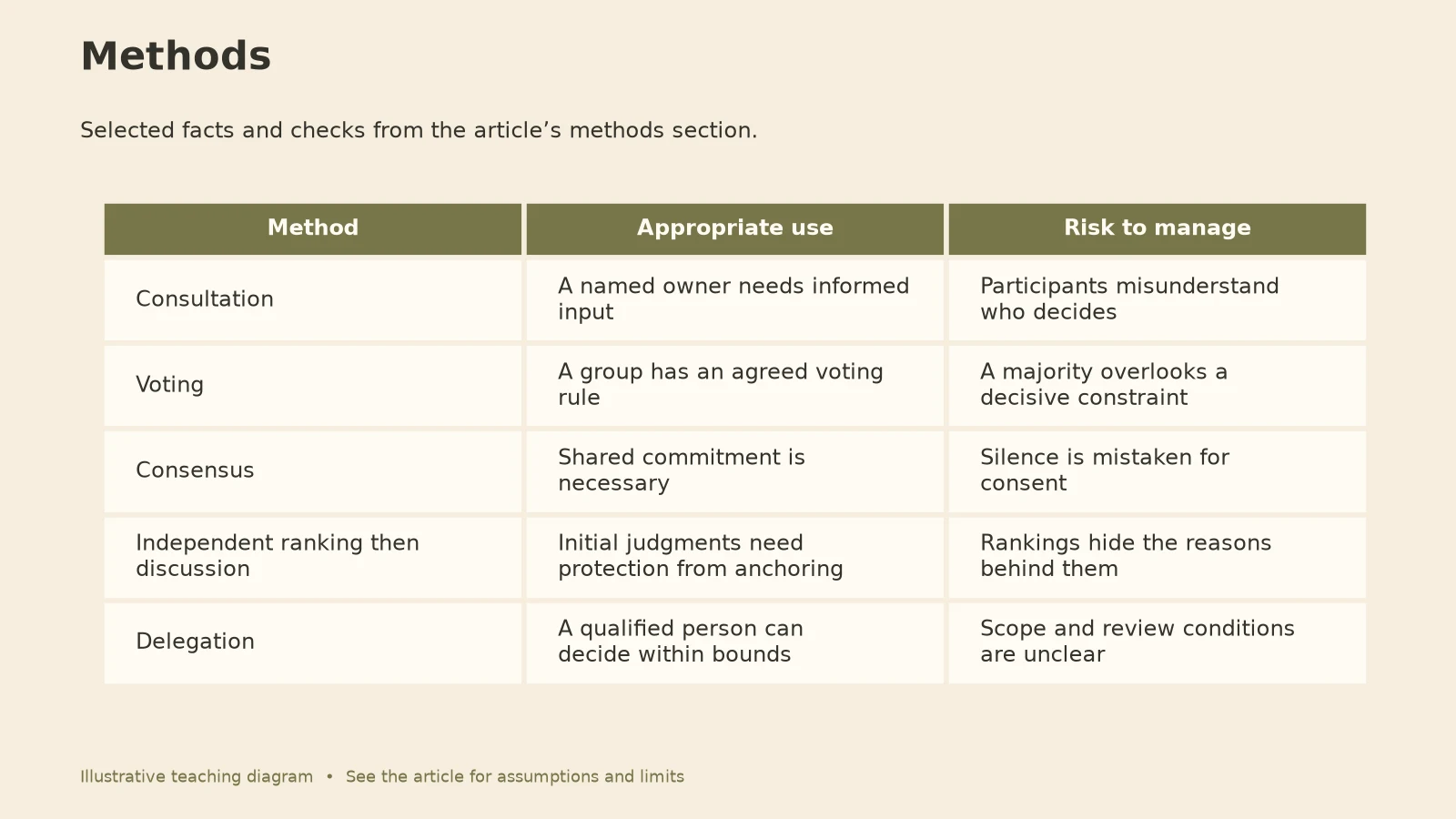
| Method | Appropriate use | Risk to manage |
|---|---|---|
| Consultation | A named owner needs informed input | Participants misunderstand who decides |
| Voting | A group has an agreed voting rule | A majority overlooks a decisive constraint |
| Consensus | Shared commitment is necessary | Silence is mistaken for consent |
| Independent ranking then discussion | Initial judgments need protection from anchoring | Rankings hide the reasons behind them |
| Delegation | A qualified person can decide within bounds | Scope and review conditions are unclear |
No method is universally best. A vote also cannot rescue an option that breaks a hard requirement, so check nonnegotiable constraints before choosing among preferences. For a numerical comparison, use the rational decision-making model.
Treat silence as missing data
Schlesinger’s silence and the whispering experts are one problem: rank and loyalty decide what reaches the table. The workplace power-dynamics guide shows who controls information and approvals in your own meetings.
Separate three questions: who knows something relevant, who is affected, and who decides. Then collect views before discussion, so the first confident speaker cannot anchor everyone. Anonymous input helps surface concerns, but a shared mistake can survive it, since people who agree may share the same confirmation bias.
A meeting plan that makes dissent cheap
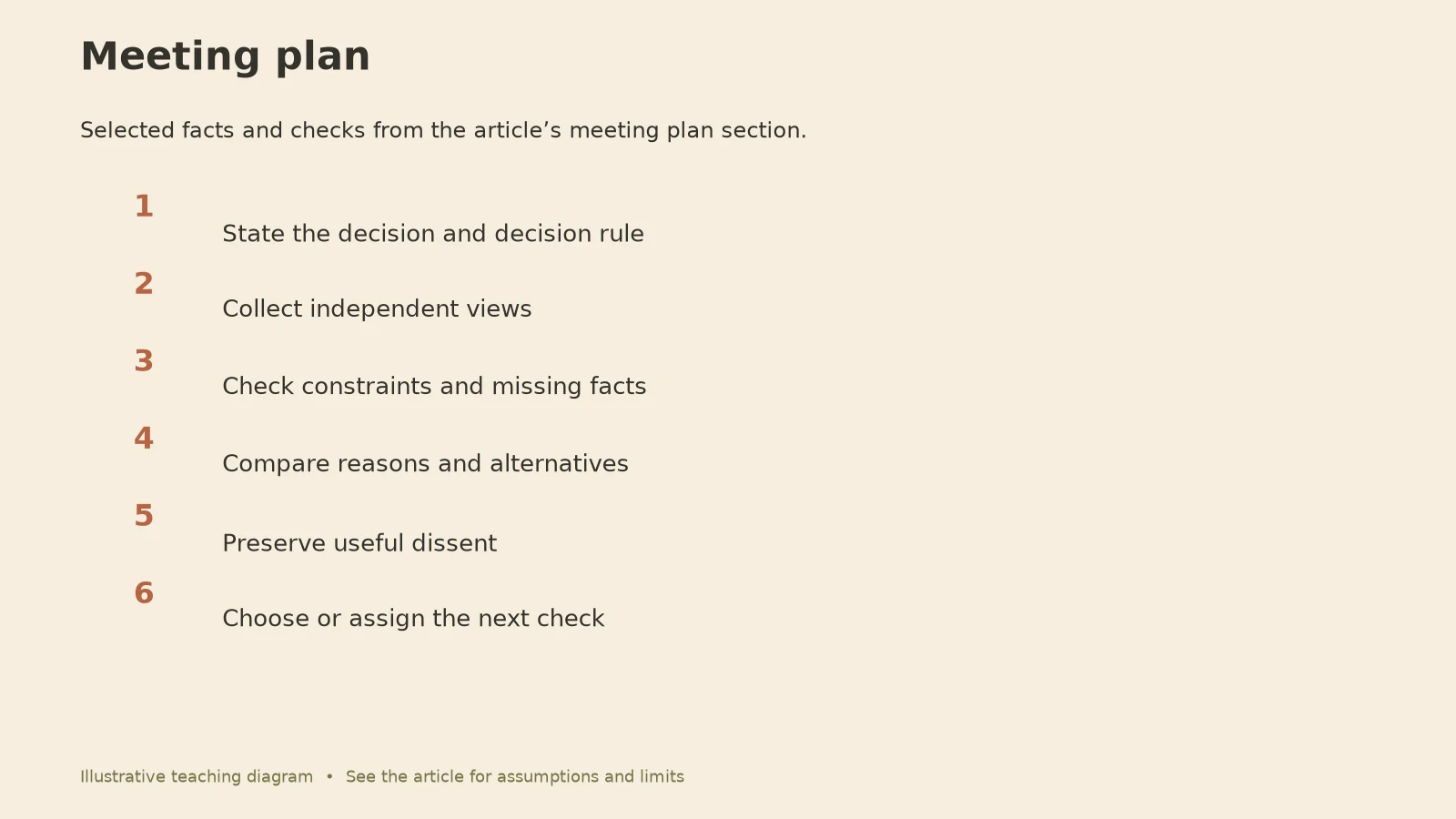
- State the decision and decision rule. Explain whether the meeting advises, votes, or seeks consensus.
- Collect independent views. Give participants a way to contribute before group discussion.
- Check constraints and missing facts. Separate feasibility from preference.
- Compare reasons and alternatives. Ask what evidence each recommendation depends on.
- Preserve useful dissent. Record a concern that could inform a later review.
- Choose or assign the next check. Name an owner and an appropriate deadline.
Afterward, review the effect against the original goal. For matching process to stakes, see decision-making frameworks.
When group process backfires
The absent leader returns to a consensus he dislikes. Janis warned that a burned leader may then attend every meeting and steer.
Process becomes theater. Calling a meeting “consultation” while treating disagreement as disloyalty recreates the Bay of Pigs room.
“More research” replaces a decision. Ending without a choice helps only if the next check has a question, an owner, and a deadline.
The success story is too tidy. Janis noted that almost all ExComm accounts come from participants with a stake in looking good. Process mattered, but it did not produce the outcome alone.
Questions
Does consensus mean nobody objects aloud?
No. Silence may reflect confusion, fatigue, or the fear of becoming “a nuisance.” Use an explicit process for checking agreement and unresolved concerns.
Is there time for this in a crisis?
Often, yes. Janis observed that the missile crisis put policymakers under more time pressure than any fiasco he studied, and the group still examined many alternatives critically.
How do I handle a minority view?
Check whether its evidence reveals a constraint or material risk. A view is not wrong because few people hold it. If the group goes another way, put the concern on the review list.
Your 5-minute group decision card
Decision:
Who decides, and by what rule (consult / vote / consensus / delegate):
Views collected before discussion? (yes / no)
Strongest objection, in the objector's words:
Option nobody has seriously tested:
Owner and next check date:
Dissent to revisit at review:
Before the meeting, paste the plan into a prompt from Save Effort and ask for the strongest case against it. That puts one objection on the table that nobody had to risk their standing to raise. For effects on people outside the room, see ethical decision making.