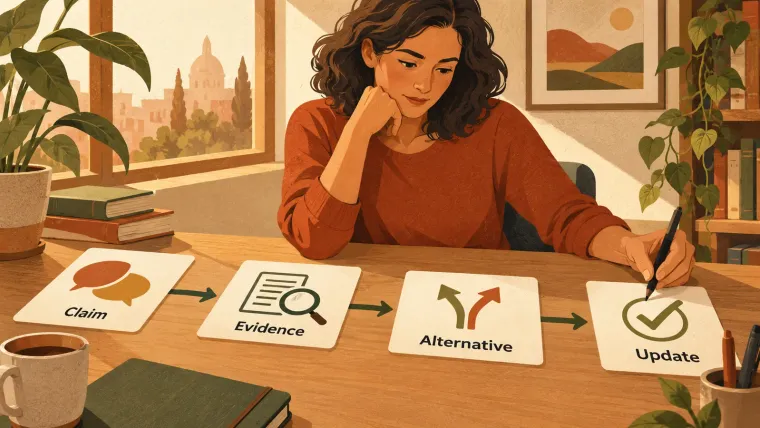
Learning how to improve critical thinking starts with a small routine: state a claim clearly, separate what you observed from what you inferred, check the evidence, consider another explanation, and decide what would change your mind. Practice on an ordinary decision rather than waiting for a major dispute. The seven exercises below produce something you can inspect: a clearer question, a source trail, a competing explanation, or a revised judgment. A short daily log can reveal repeated habits in your reasoning. It is a practice tool, not an intelligence test or a promise of improvement within a particular number of days.
What is critical thinking in everyday life?
Critical thinking means examining whether a judgment is supported and whether your reasoning fits the question. It involves both skills and willingness: finding information does little if you dismiss it whenever it challenges your preferred conclusion.
You can practice while reading an alarming headline, considering a purchase, planning work, or interpreting a colleague’s behavior. The aim is a better-grounded judgment that supports an appropriate action. Automatically doubting everything can be as unhelpful as accepting everything.
The Foundation for Critical Thinking’s everyday strategies emphasize regular reflection, clear questions, and examining your own reasoning. The exercises here turn those activities into concrete outputs. They are written for adults practicing independently; they are not a classroom curriculum.
Seven exercises to practice critical thinking
1. Turn a reaction into a question you can answer
“This meeting was useless” is difficult to investigate. “Which decision was the meeting supposed to produce, and was that decision recorded?” gives you something to check.
- Write your first reaction in one sentence.
- Underline vague words such as better, fair, successful, or everyone.
- Replace one with a question about an observable event or a stated criterion.
Practice output: one clear question. For a purchase, this might be: “Does this product meet my three required uses within my budget?” Do not keep expanding the question until it becomes impossible to answer.
2. Separate observations from inferences
Suppose a colleague has not replied to a message by the end of the day.
| Type | Statement |
|---|---|
| Observation | I sent the message this morning and have not received a reply. |
| Inference | The colleague is ignoring me. |
| Other possible explanation | The message may not have reached their attention, or they may be busy. |
| Information still needed | Was the message received, and when is a response reasonable to expect? |
The inference could be true. The observation alone does not establish it. Write both separately before responding. This creates room to investigate without pretending that every explanation is equally plausible.
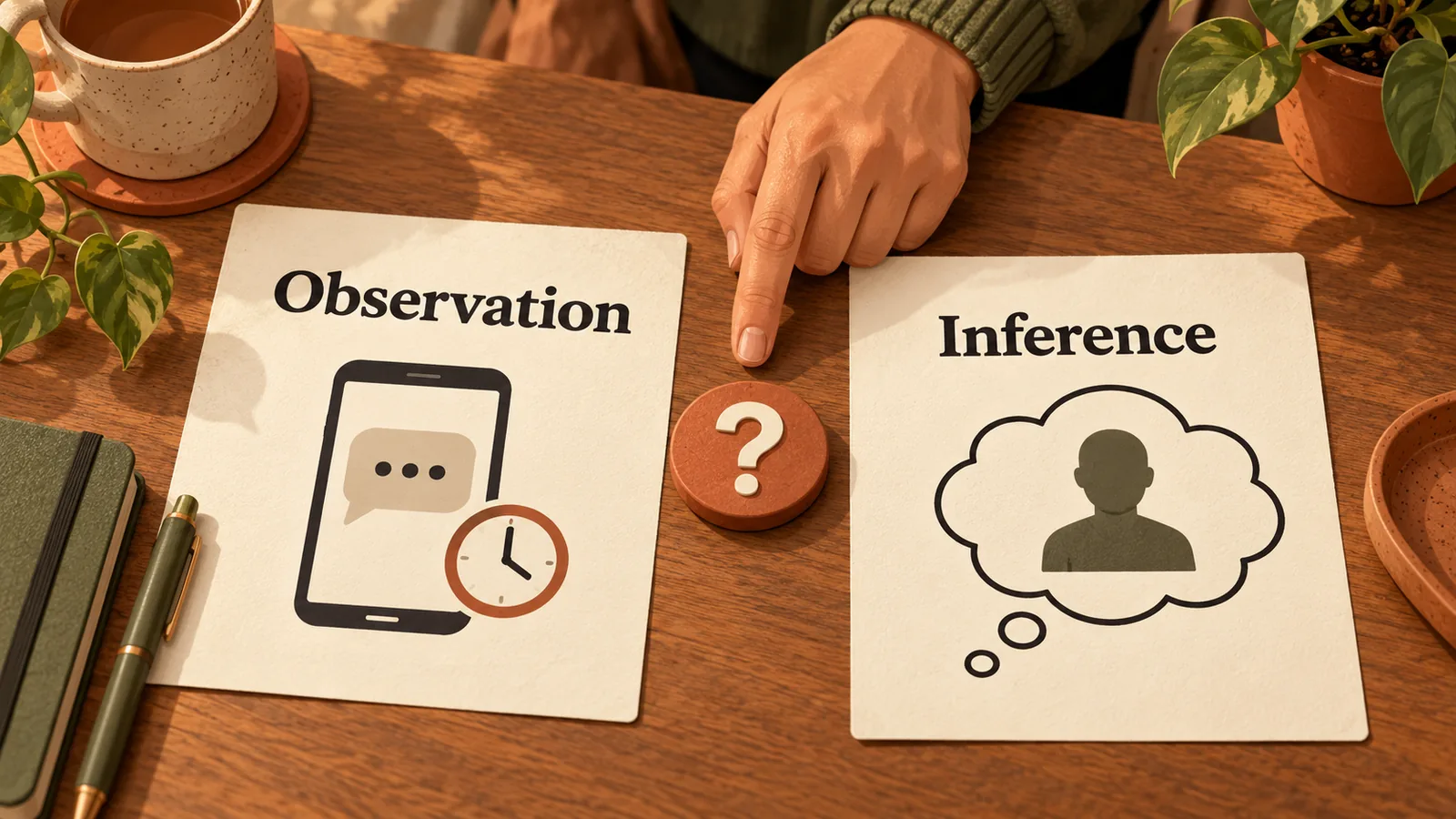
“No reply yet” is an observation. “They are ignoring me” adds an interpretation.
Practice output: one observation and two possible interpretations. Our guide to Hanlon’s razor discusses why assuming intention too early can mislead you.
3. Check evidence by leaving the page
A professional design and a confident tone do not tell you whether a claim is reliable. Check who is behind it, whether better coverage exists, and whether the quoted evidence says what the page claims.
Mike Caulfield’s SIFT guidance describes four moves: stop, investigate the source, find better coverage, and trace the claim to its original context. Use them when a claim could affect your action.
- Pause before sharing or acting.
- Look up the source independently. What relevant expertise or interests can you verify?
- Find another account that provides evidence, rather than merely repeating the first page.
- Open the original study, document, quote, or image when possible. Check date, population, conditions, and surrounding context.

Several pages repeating one report are one evidence trail, not several independent confirmations.
Practice output: a short source trail and one limitation. A study involving a particular group may not answer a question about everyone. If the original source is unavailable, record that gap rather than claiming you verified it.
4. Build the strongest reasonable alternative
For a view you disagree with, write a version its thoughtful supporter could recognize. Then ask which assumption differs from yours.
For example, one person prefers remote work because it reduces commuting. Another prefers office work because their task depends on rapid in-person coordination. The disagreement may involve different work requirements rather than different levels of intelligence.
The University of Wisconsin’s practice guidance includes considering other viewpoints and questioning assumptions. You can do that without giving unsupported claims equal weight.
Practice output: the competing view, its strongest reason, and the condition under which it would make sense. If you cannot explain it without mockery, return to the person’s actual argument.
5. Design a check that separates alternative explanations
Return to the unanswered-message example. Two explanations are “the request was unclear” and “the colleague is unwilling to help.” Sending another equally unclear message would not separate them well.
Try a brief follow-up that names the action and deadline: “Can you confirm the two figures by Thursday afternoon? Please let me know if another person handles them.” A useful reply could resolve uncertainty about clarity or responsibility. Continued silence alone still would not prove motive.
Before checking, write:
- What result would make explanation A more plausible?
- What result would make explanation B more plausible?
- What result would leave the question unresolved?
Practice output: a bounded check and an honest unresolved case. This habit prevents you from treating every possible outcome as proof of the belief you started with.
6. State a revision trigger before committing
Write your current conclusion, how strongly you hold it, and one observation that would justify changing it.
“I prefer option A, with moderate confidence, because it meets the deadline. I would reconsider if its delivery date moves beyond the project cutoff” is more useful than “I will change my mind if something convincing happens.”
A revision trigger should match the stakes. You do not need a research project to choose lunch. A costly, difficult-to-reverse commitment deserves better evidence and a clearer review point.
Practice output: one concrete update condition. If admitting uncertainty feels threatening, closed mindset examples can help identify the behavior without turning it into a permanent label.
7. Review reasoning separately from the outcome
A choice can succeed by luck, and a well-supported choice can still have a bad outcome. Review what information you had, which assumptions you made, and what you could reasonably have checked at the time.
Ask: “Did I use an unavailable fact in hindsight?” and “Would I use the same reasoning again under similar uncertainty?” Do not grade your earlier judgment only by what happened later.
Practice output: one assumption to keep, revise, or investigate next time. Second-order thinking adds a way to examine consequences beyond the immediate result.
A simple reflection log
Use one real situation per entry. Keep the wording specific enough that you could review it a week later.
| Field | Filled example |
|---|---|
| Question | Why has the requested information not arrived? |
| Observation | No response to this morning’s message by the end of the day. |
| Initial inference | The colleague is deliberately avoiding the request. |
| Alternative | The request is unclear or belongs to someone else. |
| Check | Send a clear action, deadline, and routing question. |
| Revision trigger | A reply identifying an unclear request or another responsible person. |
| Current judgment | Motive remains unknown; clarify the request first. |
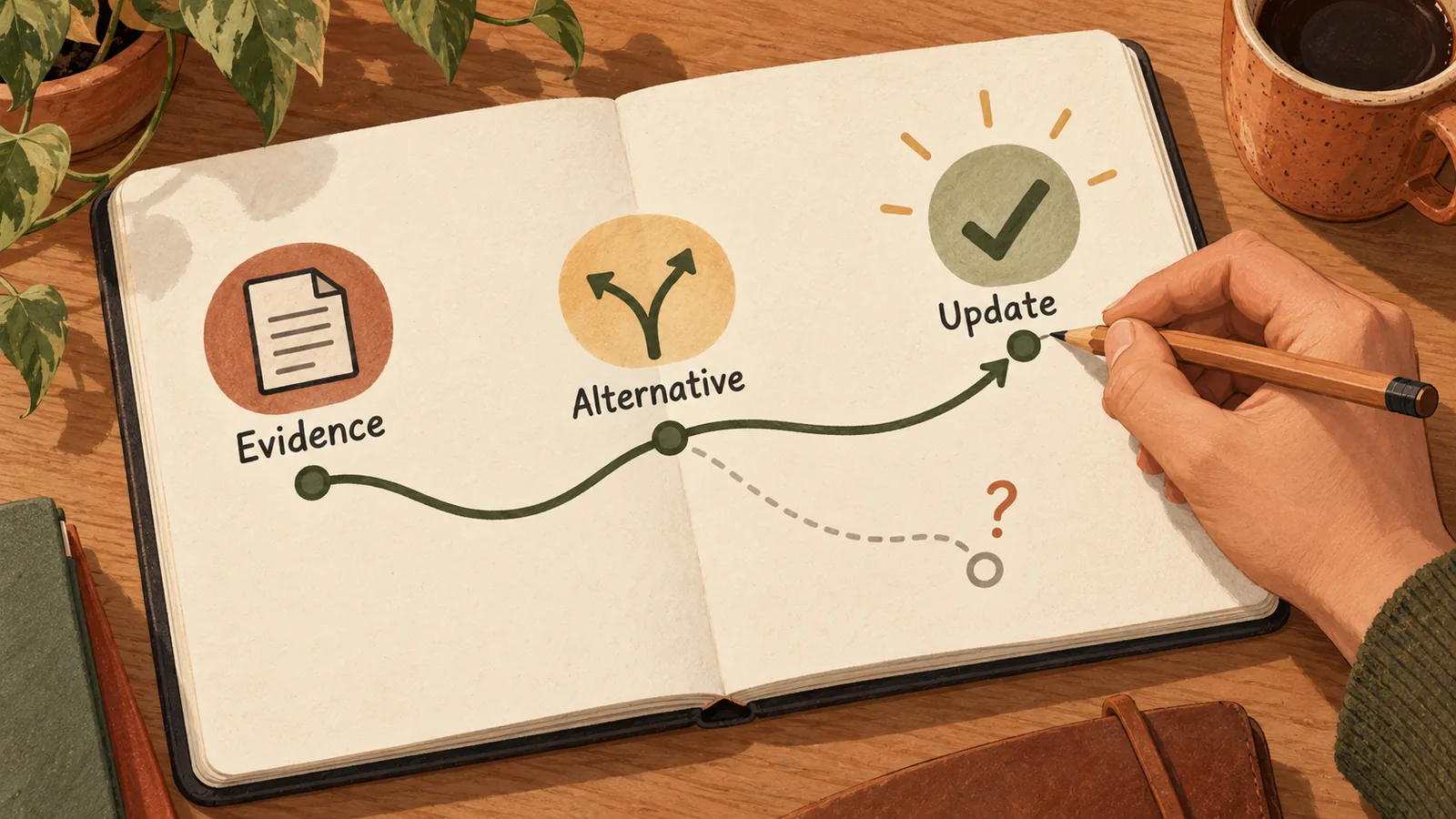
A useful log records what would change the judgment, as well as what supports it.
Copy the fields into your own notes: question, observation, inference, alternative, check, revision trigger, current judgment. This is an original practice format, not a validated assessment of ability.
A seven-day practice schedule
| Day | Exercise | Save this output |
|---|---|---|
| 1 | Clarify a question | One observable question |
| 2 | Separate observation and inference | Two labeled statements |
| 3 | Trace a claim | Original source and one limitation |
| 4 | Explain another viewpoint fairly | Its strongest reason and condition |
| 5 | Test rival explanations | A check with possible outcomes |
| 6 | Name a revision trigger | A specific update condition |
| 7 | Review one entry | One assumption to keep or change |
Repeat the routine with a different situation if it is useful. Seven days is a convenient starting schedule, not an evidence-based deadline for improvement. Look for changes in your records: clearer questions, traceable sources, fewer unsupported leaps, and revisions when warranted.
Frequently asked questions
How do I improve my critical thinking skills?
Choose a real question, record what you know, examine the source of that knowledge, and test another explanation. Keep a short log so you can review the reasoning rather than relying on memory. Practice one exercise consistently before adding more.
How can you practice critical thinking?
Use ordinary decisions: check a headline’s original source, separate a person’s behavior from your interpretation of it, or state what evidence would change a purchase decision. Produce a record you can inspect. Reading advice alone does not show whether you applied it.
What are some critical thinking exercises?
Question clarification, observation-versus-inference labeling, source tracing, fair reconstruction of another view, testing rival explanations, setting revision triggers, and reviewing a decision log are all usable exercises. Pick one that addresses the habit you notice in your own reasoning.