What Does It Really Mean to Win an Argument?
Most people think winning an argument means crushing the other side with flawless logic, leaving them speechless and defeated. But if you’ve ever ‘won’ that way, you probably noticed the other person didn’t change their mind. They just got quieter, angrier, or more defensive. In real life, a genuine win is when the other person walks away thinking, ‘Hmm, maybe they have a point.’ Or when you reach a solution that works for both of you.
This article pulls together practical advice from psychology, communication experts, and even ancient Roman rhetoric to show you what actually works.
Does Arguing Ever Actually Work?
It has become fashionable to say that nobody ever changes their mind. The evidence says otherwise.
For the distinction between an appeal and a supported conclusion, compare ethos, pathos and logos.
A 2025 study from Northwestern University’s Institute for Policy Research asked more than 400 ordinary people to write an argument aimed at someone who disagreed with them about immigration, climate change, or transgender rights. Over 3,000 other people read those arguments and rated their own position before and after, producing more than 9,000 argument evaluations. About 30% of the persuasion attempts moved the reader, and attempts that worked far outnumbered attempts that backfired (Northwestern University, 2025).
That second half matters, because the “backfire effect” — the idea that correcting someone makes them cling harder to the wrong belief — has been oversold. Brendan Nyhan, the researcher whose work produced the term, published a paper in PNAS in 2020 arguing that his original finding had been stretched far past what it supported, and that backfire effects are rare in practice (PNAS, 2020). A 2022 paper in Journal of Experimental Psychology: General went further: apparent backfire results were strongly tied to unreliable measurement, and the authors told communicators not to withhold corrections out of fear of backfire.
Read those findings together and the practical lesson is uncomfortable: the most common way to lose an argument is to avoid having it. What the research does warn about is staying power. Nyhan’s review found that the gains from a correction often fade, or get drowned out by louder voices, so one good conversation rarely settles anything permanently.
The Counter-Intuitive Secret: Give Ground First
One of the most effective ways to win an argument is to give ground first on something meaningful but not critical. This sounds backwards, but it works. When you concede a minor point, you show that you’re reasonable and not just stubbornly defending your position. That builds trust and makes the other person more willing to listen to your main points.
For example, if you’re arguing about where to go on vacation, you might say, ‘You’re right that the beach is relaxing, and I can see why you want that. But I’m worried about the cost. What if we find a beach that’s within our budget?’ You’ve given ground on the beach idea, but you’ve steered the conversation toward your real concern: cost.
💡 Giving ground isn’t surrender. It’s a strategic move that makes your opponent more receptive to your key points.
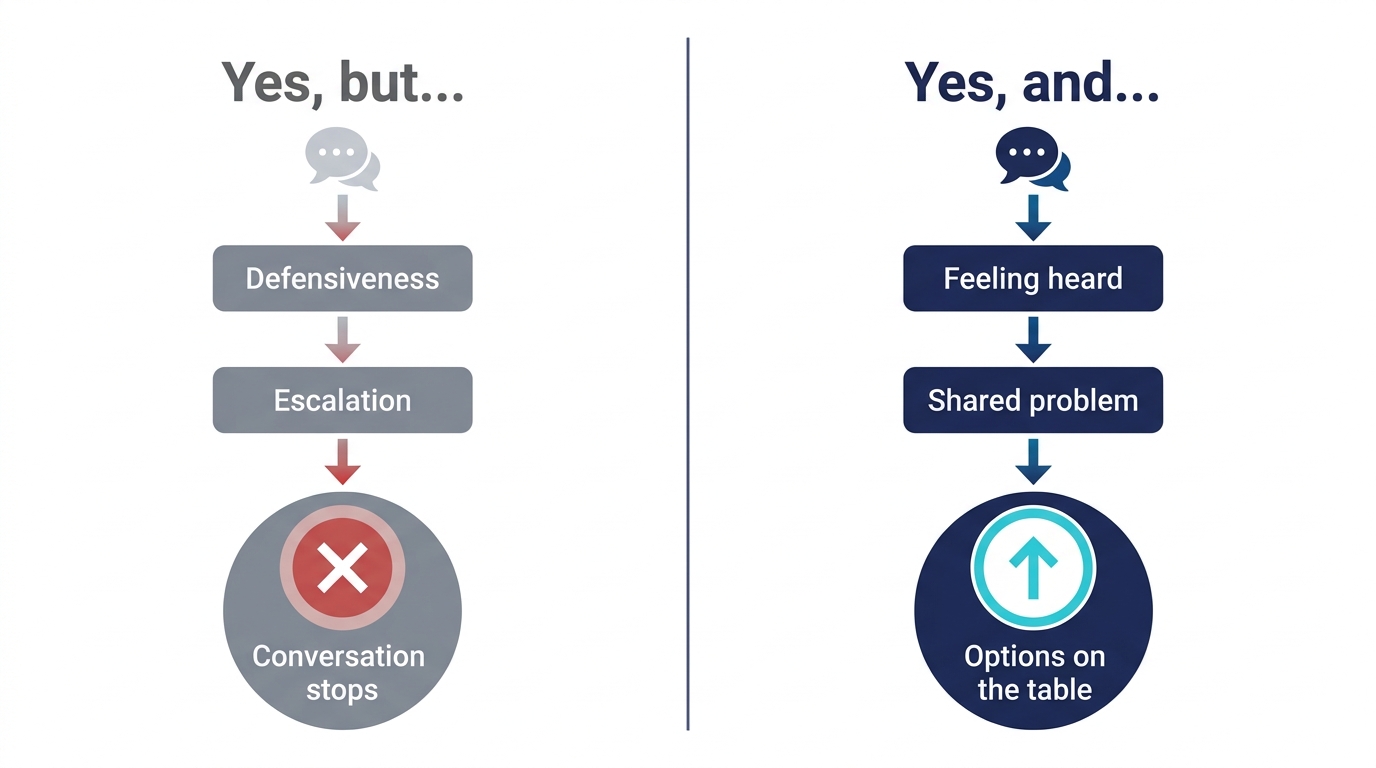
The Power of ‘Yes, And…’ Instead of ‘Yes, But…’
When you’re in an argument, it’s tempting to say ‘Yes, but…’ to counter everything the other person says. But ‘but’ is a verbal eraser. It tells the other person that everything they just said doesn’t matter. Instead, try ‘Yes, and…’ This technique, borrowed from improvisational theater, acknowledges their point and then adds your own.
For instance, if someone says, ‘We should eat Italian tonight,’ you could say, ‘Yes, and maybe we can find an Italian place that also has gluten-free options for me.’ You’re not rejecting their idea; you’re building on it. This keeps the conversation collaborative rather than combative.
The Three-Step Method to Persuade, Not Fight
Communication expert Don Schindler suggests a simple three-step method for winning arguments when your goal is persuasion:
- Never argue back. Arguing back puts the other person on the defensive. Instead, listen and ask questions.
- Define what ‘win’ means to you. Is it getting your way, or is it finding the best solution? If it’s the latter, you can both win.
- Use ‘Yes, and…’ to reframe. Acknowledge their point and then steer toward a mutually agreeable outcome.
This method works because it focuses on understanding and collaboration, not combat.
The Real Skill Being Tested Is Listening
The people who argue for a living, in situations where losing means somebody gets hurt, do not treat argument as a talking contest. The FBI’s Crisis Negotiation Unit teaches the Behavioral Change Stairway Model: active listening, then empathy, then rapport, then influence, and only then behavioral change, in that order. In the FBI Law Enforcement Bulletin’s 50-year retrospective on crisis negotiation, the unit reports that making active listening the foundation of the process pushed resolution success rates into the mid- to high-90th percentile (FBI Law Enforcement Bulletin).
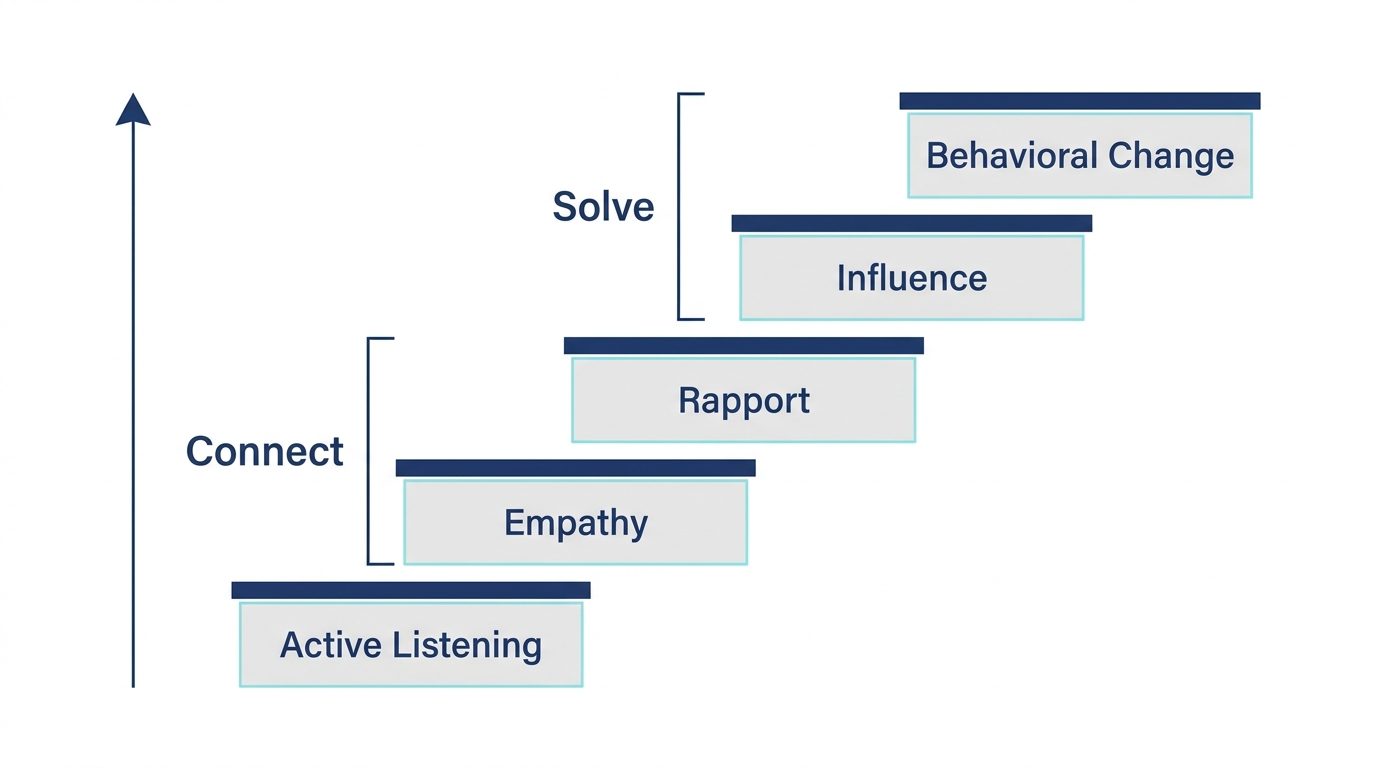
Notice where “influence” sits. It is step four. Everything most people think of as arguing happens after three steps of relationship work. The core listening skills that carry those steps are concrete and learnable:
- Open-ended questions that cannot be answered with yes or no.
- Deliberate pauses, letting silence do some of the work.
- Minimal encouragers — short signals like “yes” or “I see” that show you’re still there.
- Mirroring — repeating the last two or three words the other person said.
- Paraphrasing — saying their point back in your own words.
- Emotion labeling — naming the feeling behind the words (“it sounds like this feels unfair”).
- Summarizing — pulling the whole picture together before you respond to it.
Field experiments point the same way. In a 2016 study published in Science, 56 canvassers had roughly ten-minute doorstep conversations with 501 voters in South Florida, built around inviting people to take someone else’s perspective rather than delivering facts. The conversations measurably reduced prejudice toward transgender people, the effect held for at least three months, and roughly one in ten voters shifted — a change larger than the average decline in American homophobia between 1998 and 2012 (UC Berkeley; Science, 2016).
Compare that with the same researchers’ review of 49 field experiments on conventional campaign contact and advertising, which concluded that the best estimate of their effect on voters’ candidate choice in general elections is zero. Roughly the same amount of talking, opposite results. The difference is who does the talking. Follow-up work by the same team suggests that simply hearing one specific person’s experience — what researchers call perspective-getting — carries much of the effect on its own.
Psychological Tricks That Work
Several psychological principles can give you an edge in arguments:
- Start with agreement. Find something you both agree on and start there. This sets a cooperative tone.
- Focus on facts. Stick to objective facts rather than personal opinions, and name where they come from.
- Stay calm and avoid yelling. Yelling escalates emotions and shuts down rational thinking. A calm voice is more persuasive.
- No name-calling or cussing. These are verbal attacks that make the other person defensive and less likely to listen.
⚠️ The goal is to win the argument, not to humiliate the other person. Once they feel attacked, they’ll stop listening.
The Variable Almost Everyone Ignores: Make It About Them
We now have an unusually clean measurement of what actually moves people, and it comes from an odd source: machines.
In May 2025, Nature Human Behaviour published a study in which people held short online debates against either another person or GPT-4. When the model was given a few basic details about its opponent — things like age, gender, education level, employment status, and political leaning — and allowed to tailor its arguments, it was more persuasive than the human 64.4% of the time in matchups where one side clearly did better, which the authors report as an 81.2% increase in the odds of the opponent moving toward its position. Stripped of that personal information, GPT-4 was no more persuasive than an average person (Nature Human Behaviour, 2025).
A second study points the same direction. In Science in 2024, 2,190 people described a conspiracy theory they believed and the specific evidence they thought supported it, then had a three-round conversation with GPT-4 Turbo that responded to that exact evidence. Belief dropped by about 20% on average, held for at least two months, and shifted even people whose beliefs were tied to their identity. A professional fact-checker reviewed 128 claims the model made and rated 99.2% of them true, with none false (Science, 2024). One caveat worth stating plainly: Science later issued an editorial expression of concern about reporting inconsistencies in that paper, so treat the exact figure as provisional even though the direction matches the personalization result.
The transferable lesson has nothing to do with technology. Neither system won by being eloquent. They won by answering the particular reason that particular person held the belief. In a real argument that looks like asking two questions before you make your case: What convinced you of this? and What would change your mind? Then aim at those answers instead of the generic version of the opposing view.
It cuts the other way too. If someone arguing with you knows your job, your politics, and your family situation, assume the argument you’re hearing was built for you specifically. That’s worth knowing before you decide it feels compelling.
How “Winning an Argument” Works in the Real World
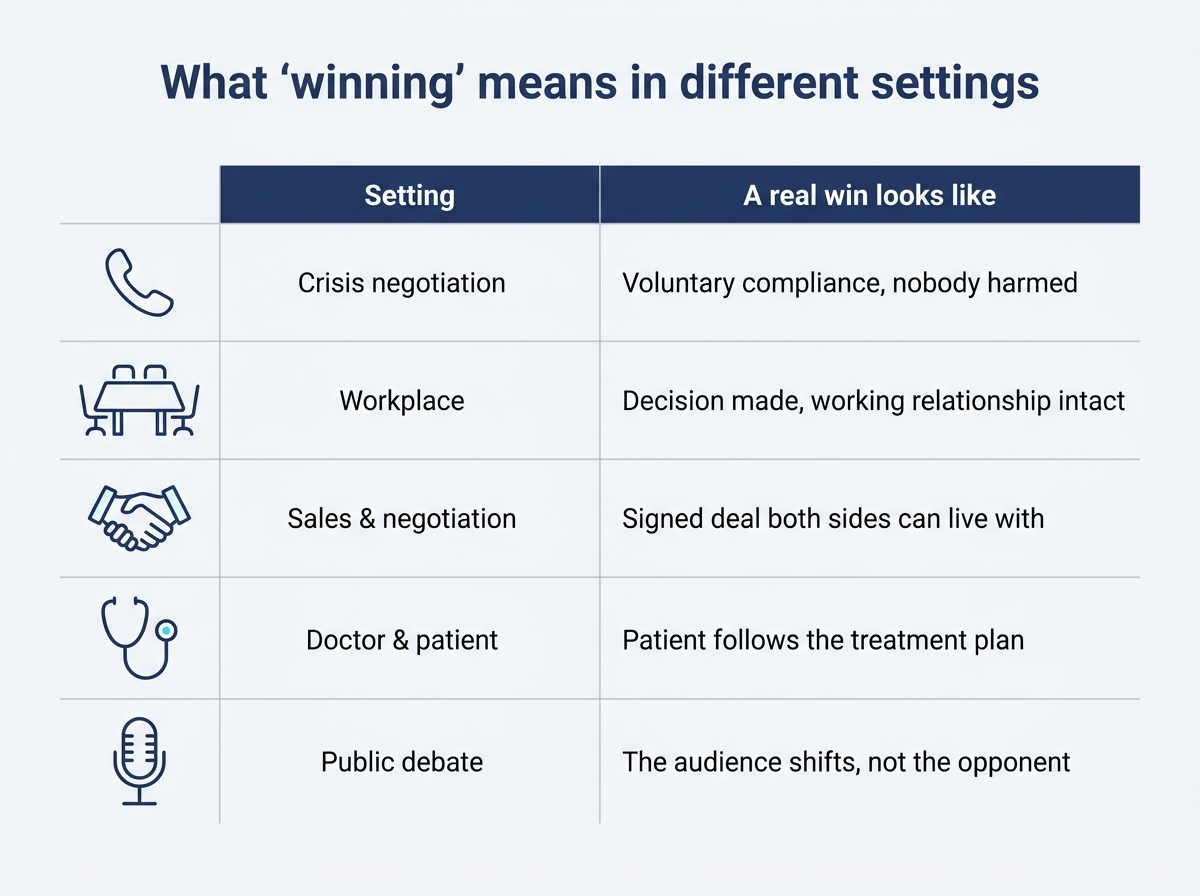
The advice above sounds abstract until you look at the jobs where argument is the work. In each one, the definition of a win is set by the situation, not by who sounded smarter.
Crisis negotiation: the win is voluntary compliance
A police negotiator never needs the other person to agree that they were wrong. The only outcome that counts is a person walking out safely. That is why the stairway model puts listening first and treats persuasion as the last step — and why negotiators debrief afterward to work out what did and didn’t move the conversation. Police training material built on the same model summarizes it bluntly: the first three steps are about connecting, the last two are about problem-solving.
The workplace: the win is a decision that survives the meeting
Workplace argument is expensive when it’s handled badly. The CPP Global Human Capital Report surveyed 5,000 employees across nine countries and found that 85% of employees experience conflict, and that US employees spent an average of 2.8 hours a week dealing with it — roughly $359 billion in paid hours at the time of the study (CPP Inc., 2008). In the UK, Acas estimated the total annual cost of workplace conflict to employers at £28.5 billion, about £1,000 per employee per year (Acas, 2021).
Those two numbers come from different countries, years, and methods, so they shouldn’t be averaged into one figure. They agree on the shape of the problem: the cost of a badly run argument is measured in hours and attention, not in who was right. Practically, that means the win at work is a decision people actually carry out afterwards, with the working relationship still functional.
Sales and negotiation: the win is a deal both sides can live with
Negotiators are the most experimental users of these techniques. A 2023 Negotiation Journal experiment on the blunt opener “What is your best price?” found that people answer it far more often than expected, that the answer usually isn’t their true limit, and that asking anyway shifts first offers, concession patterns, and final outcomes — with no measurable damage to how the other side felt about the negotiation.
Questions do double duty here. Harvard researchers found across three studies of live conversations that people who ask more questions, especially follow-up questions, are better liked, because follow-ups signal that you were actually listening (Journal of Personality and Social Psychology, 2017).
Public health and fact-checking: the win is a belief that stays corrected
For anyone correcting misinformation — a doctor with a hesitant patient, a moderator in a comment thread — the research says two things at once. Corrections usually do improve accuracy, so give them. But their effect tends to decay unless it’s reinforced, which makes repetition and follow-up part of the job rather than a sign that the first conversation failed.
Schools and courtrooms: the win is decided by a third party
In a trial or a formal debate, nobody is trying to convert the opposing side. The audience decides. That changes the tactics: you argue for the judge, jury, or room, which rewards clarity and concession over domination. Structured practice seems to pay off well beyond the debate round — research presented through the American Educational Research Association on Boston Public Schools students found that taking part in interscholastic policy debate was linked to gains in English language arts and higher rates of postsecondary enrollment (AERA, 2023).
Online: the argument is permanent, public, and increasingly assisted
An online argument has an audience you can’t see, a written record, and often an opponent with help. The personalization findings above suggest a defensive habit: separate whether an argument is true from whether it feels tailored to you.
What to Say in an Argument to Win
Sometimes, the right phrase can defuse tension and move things forward. Here are some evidence-backed lines:
- ‘I see your point of view, and I understand where you’re coming from.’ This validates their feelings and makes them more open to yours.
- ‘Let’s take a step back and try to understand each other better.’ This shifts the focus from winning to understanding.
- ‘You’re right about that.’ Conceding a minor point shows you’re reasonable.
- ‘Could you help me understand why you feel that way?’ This invites explanation rather than defensiveness.
- ‘What convinced you of this?’ This is the question that gives you the one thing worth arguing with: their actual reason.
How to Shut Down an Argument (When You Need To)
Sometimes, the best way to win is to not engage at all. If the argument is going nowhere or becoming toxic, you can shut it down gracefully:
- ‘Let’s agree to disagree.’ This acknowledges the disagreement without trying to resolve it.
- ‘I think we’re both too emotional to discuss this right now. Let’s talk later.’ This gives both of you time to cool off.
- ‘I’m not going to argue about this.’ This sets a firm boundary.
Remember, not every argument is worth winning. Sometimes, preserving the relationship is more important than being right.
Common Mistakes That Make You Lose
Even with the best strategies, people often sabotage themselves. Avoid these common pitfalls:
- Getting emotional. When you get angry, you lose your ability to think clearly and make rational points.
- Interrupting. Interrupting shows disrespect and makes the other person less likely to listen to you.
- Bringing up past grievances. This derails the current argument and makes it personal.
- Trying to win every point. You don’t need to win every minor point to win the overall argument. Letting some things go can help you win the bigger picture.
- Walking away before you start. Assuming nobody ever changes their mind is the one mistake the evidence contradicts outright.
Learning from the Masters: Books on Winning Arguments
If you want to go deeper, several books offer timeless wisdom:
- ‘How to Win an Argument’ by Marcus Tullius Cicero – This ancient Roman’s guide to persuasion is still relevant today. It covers proof based on rational argumentation, character, and emotion, as well as the parts of a speech and different styles of delivery.
- ‘Thank You for Arguing’ by Jay Heinrichs – A modern classic that teaches persuasion using Aristotle, Lincoln, and even Homer Simpson.
- ‘Good Arguments’ by Bo Seo – A former world debate champion explains how debate can teach us to listen and be heard.
📚 Reading about argumentation is like practicing a sport. You need to apply the techniques in real conversations to get better.
Putting It All Together: A Practical Framework
Here’s a step-by-step framework you can use next time you’re in an argument:
- Pause and breathe. Take a moment to calm your emotions.
- Listen actively. Let the other person finish without interrupting, then paraphrase what you heard.
- Acknowledge their point. Say something like, ‘I understand why you think that.’
- Ask what convinced them. Their reason is the thing you actually need to address.
- Find common ground. Identify something you both agree on.
- Present your perspective. Use ‘Yes, and…’ to add your point, aimed at their reason rather than the general position.
- Propose a solution. Suggest a compromise or a way forward.
- Expect to come back to it. Corrections fade, so treat one conversation as a step, not a verdict.
This framework works because it respects the other person and keeps the conversation productive.
Frequently Asked Questions
What to say in an argument to win?
Start by acknowledging the other person’s point, then present your own using ‘Yes, and…’ For example, ‘I see why you think that, and I also think…’ This keeps the conversation collaborative and makes the other person more receptive.
How do I shut an argument down?
If the argument is unproductive, you can say, ‘Let’s agree to disagree’ or ‘I think we’re both too emotional to discuss this right now. Let’s talk later.’ Setting a boundary is sometimes the best way to win.
How to outsmart someone in an argument?
Outsmarting isn’t about trickery. It’s about being prepared. Stick to facts, ask clarifying questions, and avoid emotional traps. Use the ‘Yes, and…’ technique to steer the conversation.
How to win a fight with words?
Winning a verbal fight is about persuasion, not aggression. Stay calm, use logic, and appeal to the other person’s values. The goal is to change their mind, not to defeat them.
Conclusion
Winning an argument isn’t about crushing your opponent. It’s about communicating effectively, understanding the other person, and finding a solution that works. By giving ground, using ‘Yes, and…’, and staying calm, you can turn arguments into productive conversations. And sometimes, the best way to win is to know when not to argue at all.
Remember, the next time you’re in an argument, ask yourself: ‘What do I really want to achieve?’ If it’s a genuine change of mind or a better outcome, then these strategies will help you get there.