
A method can sound useful when you find it and become almost invisible once you save it. You agreed with it, but that agreement never found a place in your day.
I wanted Daily Read to give one of those ideas a place to return to. Choose one thought you want to keep in view, make its meaning clearer, and try something small. The rest can wait in a library.
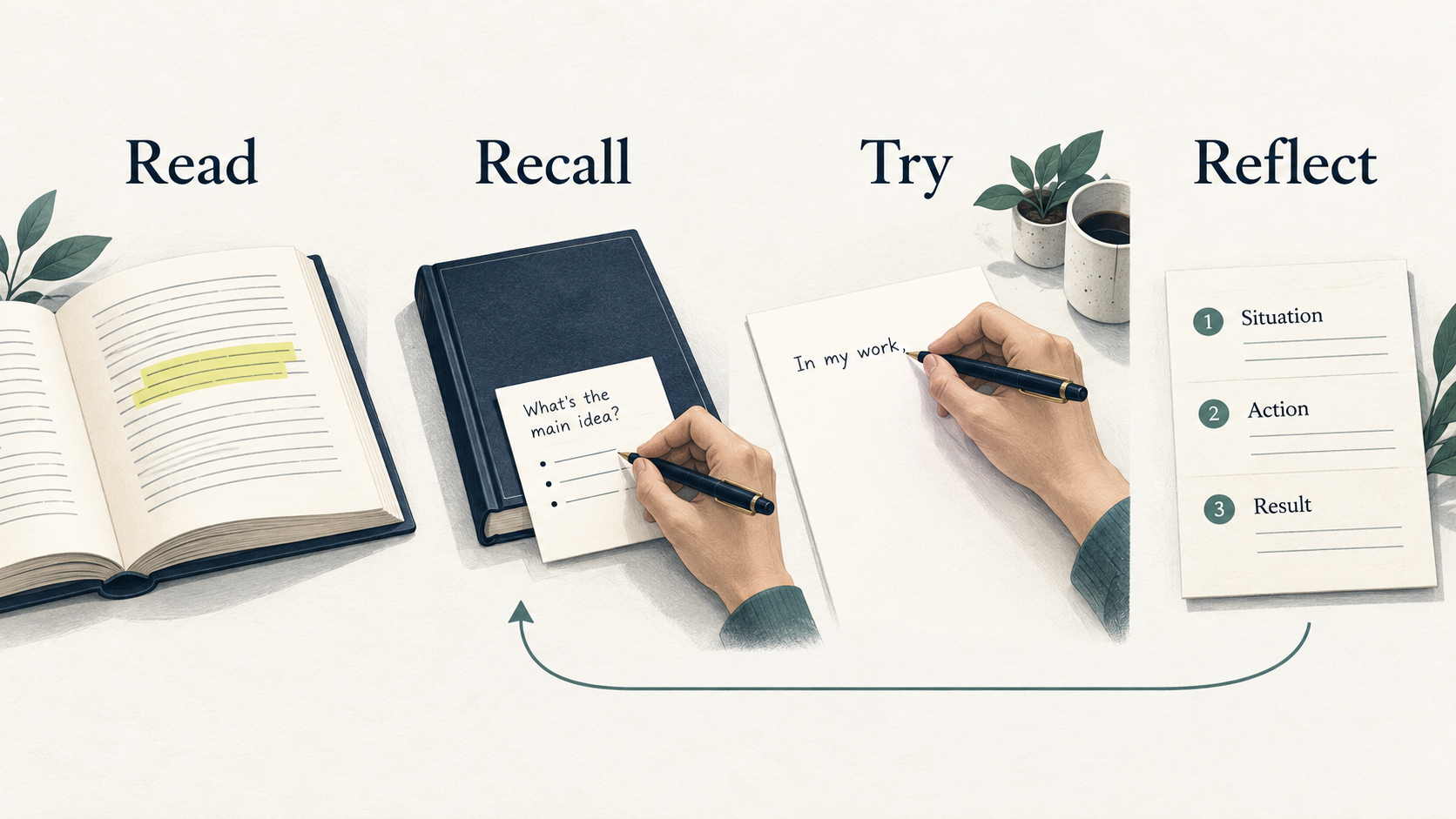
Choose one idea, look away and recall it, then try it in something you do today.
Read one idea with a question in mind
The authors of Make It Stick explain why rereading and familiarity can feel more useful than they are. They discuss retrieval, spacing, and practice as ways to support learning. The application here is modest: briefly look away from the text and try to explain what you remember.
Then ask when the idea would be useful. “Start small” is easy to recognize. “When I avoid writing, draft one sentence before planning the whole article” connects it to a situation and an action.
Daily Read does not calculate a spaced-repetition schedule or automatically test your memory. You can choose to revisit an idea later, especially when you find it difficult to recall or use.
Give one reminder three parts
Open Daily Read and sign in to keep reminders and reflections in your account. Write the thought you want to remember, why it matters to you, and one small action you could take today. The thought is required; the reason and action are optional.
For example, these are working examples you can adapt:
| Part | Example |
|---|---|
| Thought | Make the first step smaller. |
| Reason | A large plan can keep me from beginning. |
| Action | Open the document and draft one sentence. |
Pin the reminder for today, or keep it in the library for another time. Give it a category that will help you find it again. You can search and filter the library, edit a reminder, or archive one you no longer need in view.
Take the idea out of the page
Read the selected reminder. Use the focused-reading view if a quieter screen helps. Then close the text for a moment and ask yourself what it means in your own words.
Try the action in a real situation. In the example above, you would open the document and write a sentence. The useful evidence is that an action happened; a reading mark on its own says only that you marked the reminder as read.
Return to the reflection field and write what you noticed. Did the small step help you begin? Did you need a different cue? Did the advice turn out to be a poor fit for the situation? A short honest answer is enough.
Familiarity and recall can tell different stories
In Roediger and Karpicke’s 2006 experiments, students studied prose and were tested after 5 minutes, 2 days, or 1 week. More study helped on the immediate test, while earlier recall practice helped on delayed tests. Feeling familiar with a sentence is therefore a different check from remembering it later. Original research in Psychological Science.
Close the page before judging what you remember
In the repeated-practice experiment summarized by the Association for Psychological Science, the tested group recalled 61% after a week, compared with 40% for repeated study. These are results from that study, not a promised improvement from Daily Read. APS’s account of the 2006 experiment.
A modest application is to write one sentence from memory before reopening the source, then correct what you missed. The correction keeps a confident mistake from becoming your saved version.
Test an action separately from a memory
The experiment tested retention, not whether a reader made better life decisions. Treat “I recalled it” and “I used it successfully” as separate observations.
For example, recalling “make the first step smaller” does not show that it solves your writing problem. Try one smaller step, note what happened, and keep the conditions in your reflection. This is a practical extension of the evidence, not a result the study measured.
Keep a way to return
Past days let you revisit the reminder and reflection from that day. You can bring an earlier thought back into today when it is useful again. Original reading notes are also kept behind their own control, where a selected line can become an editable reminder.
The English and Chinese interfaces share the same account records. Your own words stay unchanged when you switch languages. Cloud changes save automatically, and the page reports whether saving has succeeded. If a connection fails or another device changes the record, follow the retry or draft-export message before leaving unsaved work behind. You can also export your records as a backup.
Leave evidence you can return to
A reflection can be specific: “Reducing the task to one sentence helped me begin, but notifications interrupted me again.” Next time, you have a reason to keep the smaller step and also address interruptions. You can write “I tried this and it did not help,” then note what was missing. A saved sentence can gradually become a personal example with conditions attached.
If a sentence sounds good but you cannot identify a situation where it helps, pause before adding another one. Clarify the reason or archive it. A smaller library of ideas you can find and actually try is easier to bring into daily life.
Record one discovery after trying. A situation, an action, and an outcome give your future self something to compare.
There is no need to add a new lesson every morning. A thought that is still useful can stay. The point of Daily Read is to close the gap between noticing an idea and doing something with it, one reminder at a time.