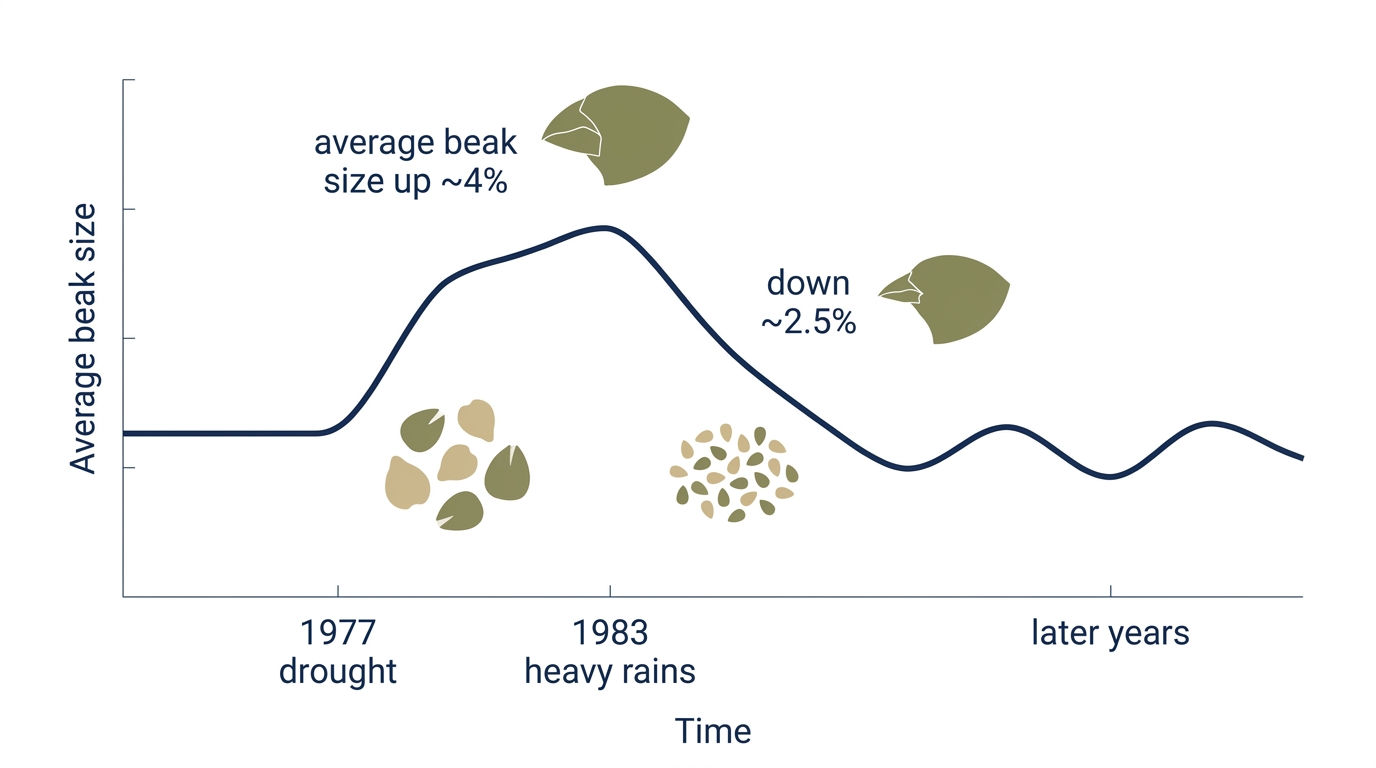
In 1977, a drought hit Daphne Major, a tiny Galápagos island where Peter and Rosemary Grant’s team was measuring medium ground finches. The small, soft seeds ran out first. The birds that made it through were mostly large ones with deep beaks, able to crack the hard seeds left behind. A few years later, heavy rains turned that advantage around.
Survival of the fittest is Herbert Spencer’s 1864 phrase for natural selection. In biology, “fit” means well matched to a particular environment, measured by how many surviving offspring an organism leaves. It does not mean strongest, smartest, or best, and the fittest trait can change when the environment does.
The finches show fitness changing with the weather
Peter Boag and Peter Grant reported the drought results in Science in 1981. Survival “was nonrandom,” they wrote: “Large birds, especially males with large beaks, survived best because they were able to crack the large and hard seeds that predominated in the drought.” The selection they measured was the strongest yet recorded for a vertebrate population. The next generation, as PBS’s Evolution course summarizes, had deeper beaks on average.
Then the El Niño rains of 1982–83 flooded the island with small seeds. Selection reversed and favored smaller birds, a pattern H. Lisle Gibbs and Peter Grant later described as oscillating selection. Same island, same species, opposite direction, within one research career.
The lesson is the whole concept in one place. A deep beak was “fittest” in 1977 because of the seeds that year, and less so once the seeds changed.
Spencer coined it, and Darwin borrowed it
Charles Darwin did not invent the phrase. According to the Darwin Correspondence Project, Herbert Spencer first used it in an 1864 instalment of Principles of Biology. In 1866 Alfred Russel Wallace urged Darwin to adopt it in place of “natural selection.” Darwin added it to the fifth edition of On the Origin of Species in 1869, but, as the project’s commentary notes, he never abandoned “natural selection” and treated the new phrase as a synonym.
That history matters because Spencer was also a social theorist. He used evolutionary language to argue for laissez-faire economics and a minimal state, so the phrase traveled into politics almost from the start.
Fit means matched to a place
In evolutionary biology, fitness is an organism’s ability to survive and reproduce in its specific environment. It is measured by how many offspring it leaves that go on to reproduce themselves. Physical strength or intelligence counts only if it helps with that.
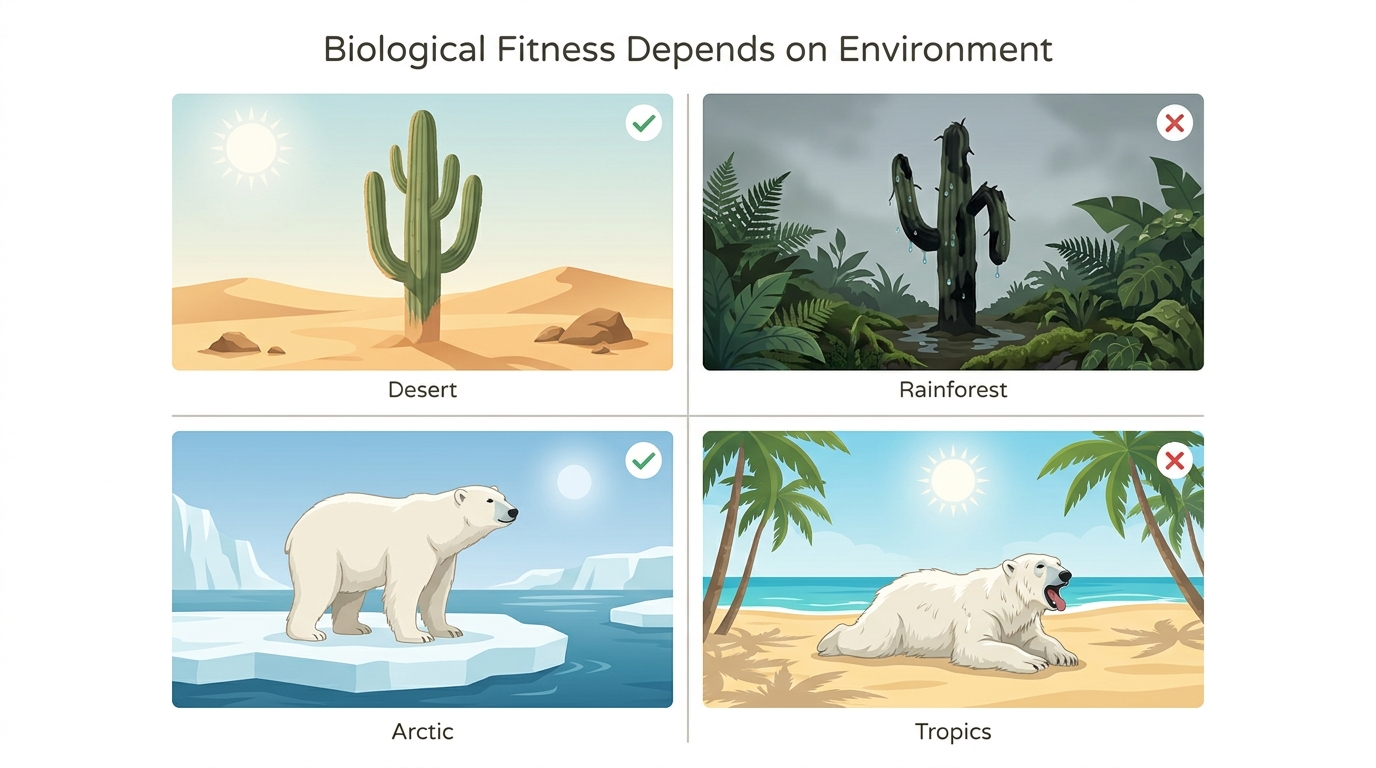
A cactus is fit for a desert and would die in a rainforest. A polar bear is fit for the Arctic and would overheat in the tropics. Fitness is always relative to a setting.
Survival is also often about being good enough. Many organisms persist because their traits are adequate, or because they were lucky, and evolution produces organisms that work in their current environment rather than perfect ones.
The adaptability quote Darwin never wrote
“It is not the strongest of the species that survives, nor the most intelligent that survives. It is the one that is most adaptable to change.” This line is widely attributed to Darwin, but it does not appear in his writing. It is usually traced to a 1963 speech by management professor Leon C. Megginson paraphrasing Darwin. The idea that adaptability matters is closer to biology than “survival of the strongest,” though the words are not Darwin’s. Checking a famous quote’s source is a small critical thinking habit worth keeping.
Three reversals side by side
Read together, the classic examples show that being the fittest has an expiry date.
| Case | Direction of selection | What happened next |
|---|---|---|
| Daphne Major finches | Larger, deeper beaks after the 1977 drought | Selection favored smaller birds after the 1982–83 rains |
| Peppered moths, Manchester | Dark carbonaria form about 90% in 1983 under industrial soot | Below 10% by the late 1990s after clean-air controls |
| Resistant bacteria | Resistance spreads where antibiotics are heavily used | Reversal is slow and often incomplete when use drops |
The moth figures come from Cook and colleagues’ Manchester survey. The bacteria row is the one that hurts. A 2022 Lancet study estimated that 4.95 million deaths in 2019 were associated with bacterial antimicrobial resistance, 1.27 million of them directly attributable. The WHO reported that about one in six laboratory-confirmed bacterial infections worldwide in 2023 were resistant to antibiotic treatment.
Antibiotic use is a feedback loop: heavy use rewards resistant strains, which then require more or stronger drugs. That is why “the fittest will survive” is a poor forecast. It tells you who won the last round under the last conditions.
| Everyday reading | What biology means |
|---|---|
| The strongest win | The best-matched to current conditions leave more offspring |
| Winners are better | Winners fit this environment, for now |
| Evolution climbs toward progress | Evolution branches with no goal |
| Nature endorses competition | Nature describes outcomes and sets no moral rules |
Common misconceptions
”Fittest” means strongest or most intelligent
A cheetah is fast and would not survive in the ocean. A dolphin is intelligent and would not survive on land. Traits count only where they help an organism survive and reproduce.
Evolution is about progress
Evolution works like a branching tree, with no direction or goal. A bacterium is as evolved as a human; it is adapted to a different environment. The Red Queen effect shows why species can keep changing without getting “ahead.”
The phrase justifies social inequality
Social Darwinism, a label that spread in the late 19th century, used the phrase to argue that the rich and powerful are naturally superior and that helping the poor defies nature. The ideology was used to support racism and eugenics. Biologists and philosophers overwhelmingly reject it.
Darwin’s own writing points another way. In The Descent of Man he argued that “those communities which included the greatest number of the most sympathetic members would flourish best.” Duke evolutionary anthropologist Brian Hare’s 2017 review in the Annual Review of Psychology, “Survival of the Friendliest,” argues that tolerance and cooperation were central to Homo sapiens’ success.
Where the logic does real work today
Cancer treatment that deliberately spares some cells
Maximum-dose chemotherapy kills drug-sensitive cells, which removes the competition holding resistant cells back. “Adaptive therapy” pauses treatment once a tumor shrinks and restarts when it grows, keeping sensitive cells alive to crowd out resistant ones. In a small, nonrandomized Moffitt Cancer Center study of metastatic castration-resistant prostate cancer treated with abiraterone, median time to progression was 33.5 months with adaptive therapy versus 14.3 months with standard care. Larger trials are still needed.

Virology: fitness as a growth rate
During COVID-19, epidemiologists estimated a variant’s fitness as its growth advantage over variants already circulating. Omicron’s large advantage reflected how fast it spread in a population that already had immunity to earlier variants. It said little about whether it was more dangerous.
Engineering: fitness as a line of code
In evolutionary computation, engineers write a literal fitness function that scores each candidate design, then keep, mutate, and rescore the best. An antenna designed this way flew on NASA’s Space Technology 5 mission. When requirements changed, the team rewrote the fitness function and evolved new designs within weeks. “Fittest” there means “scored highest on the criteria we wrote down,” which is a good reminder of what the biological version means too.
Business and politics: mostly rhetoric
Markets are often called Darwinian, but firms are rescued by bailouts, protected by regulation, and killed by unrelated shocks. Failure is a poor proxy for unfitness, and success a poorer proxy for merit. When someone uses the phrase to describe an outcome, that is description. When they use it to justify an outcome, they are borrowing biology’s authority for an argument biology does not make.
When the phrase backfires
- It turns circular. “Who survives? The fittest. Who are the fittest? Those who survive.” Biologists prefer “natural selection” or “differential reproductive success” for this reason.
- It excuses cruelty. Evolution describes what happens. It gives no instructions for how people should treat each other.
- It freezes a winner. A strategy that fit last year’s conditions can fail next year, as the finches showed. Mental models help you check which conditions an idea depends on.
Questions
What does survival of the fittest mean?
In biology, it means organisms best adapted to their environment are more likely to survive and reproduce. Fit describes a match to current conditions; strength and intelligence count only when they help.
Who said “survival of the fittest”?
Herbert Spencer coined it in 1864. Darwin adopted it in the fifth edition of On the Origin of Species in 1869, alongside “natural selection.”
What is a good example of survival of the fittest?
Antibiotic resistance. When antibiotics are used, resistant bacteria survive and multiply while others die, so resistance becomes more common.
Is the phrase still used in science?
Rarely as a technical term. Scientists usually say natural selection. The underlying logic is used in medicine, epidemiology, and engineering, while business and politics mostly use the phrase as rhetoric.
Your 5-minute fitness check
One habit or strategy that used to work for me:
The conditions it fit back then:
What has changed since (time, place, people, tools):
Does it still fit, or am I running on last round's win?
One small adjustment to test this week:
How I'll know it fits better:
Pick one routine that feels stale and track the adjustment for a week with Sweat.