In the first days of September 1854, cholera killed some 600 people around Broad Street in London’s Soho. Most authorities blamed foul air, a model of disease called miasma. A physician named John Snow used a different model: something in the drinking water. Both models explained why the dead were poor and lived among filth. Only one explained the brewery.
Mental models are simplified representations you use to explain a situation, predict what happens next, or choose an action. Each one highlights a few relationships and leaves the rest out. That makes a model useful for some questions and misleading for others, so choosing one starts with the question, not the label.
Two models, one outbreak
Snow noticed that the deaths clustered around a single public pump. A review of his investigation in the medical literature describes the detail that the miasma model could not handle: brewery workers and workhouse residents in the same streets largely escaped. They breathed the same air. They drank from their own wells.
He then found a sharper test. Two water companies served overlapping parts of south London. Lambeth had moved its intake upstream, away from sewage; Southwark and Vauxhall still drew from a heavily polluted stretch of the Thames. Neighbors on the same streets, breathing the same air, drank different water.
| Observation | Miasma (bad air) | Snow’s water model |
|---|---|---|
| Deaths concentrated in poor, foul-smelling districts | Explained | Explained: shared, contaminated water supplies |
| Brewery workers and workhouse residents nearby mostly spared | Hard to explain | Explained: separate water sources |
| Southwark and Vauxhall homes: 315 cholera deaths per 10,000 houses | Not predicted | Predicted |
| Lambeth homes: 37 deaths per 10,000 houses | Not predicted | Predicted |
The figures come from Snow’s 1855 report: 1,263 deaths in 40,046 houses supplied by Southwark and Vauxhall, against 98 deaths in 26,107 Lambeth houses. Snow persuaded the local Board of Guardians to remove the Broad Street pump handle. The outbreak, already fading as residents fled, ended within days.
The miasma model was not foolish. It fit most of what people could see and smell. It failed where the two models made different predictions, and Snow went looking for exactly those places.
A model earns its place by predicting something
A mental model works like a map. It leaves out most of the terrain so you can find a route. The trouble starts when the map stops being tested against the ground.
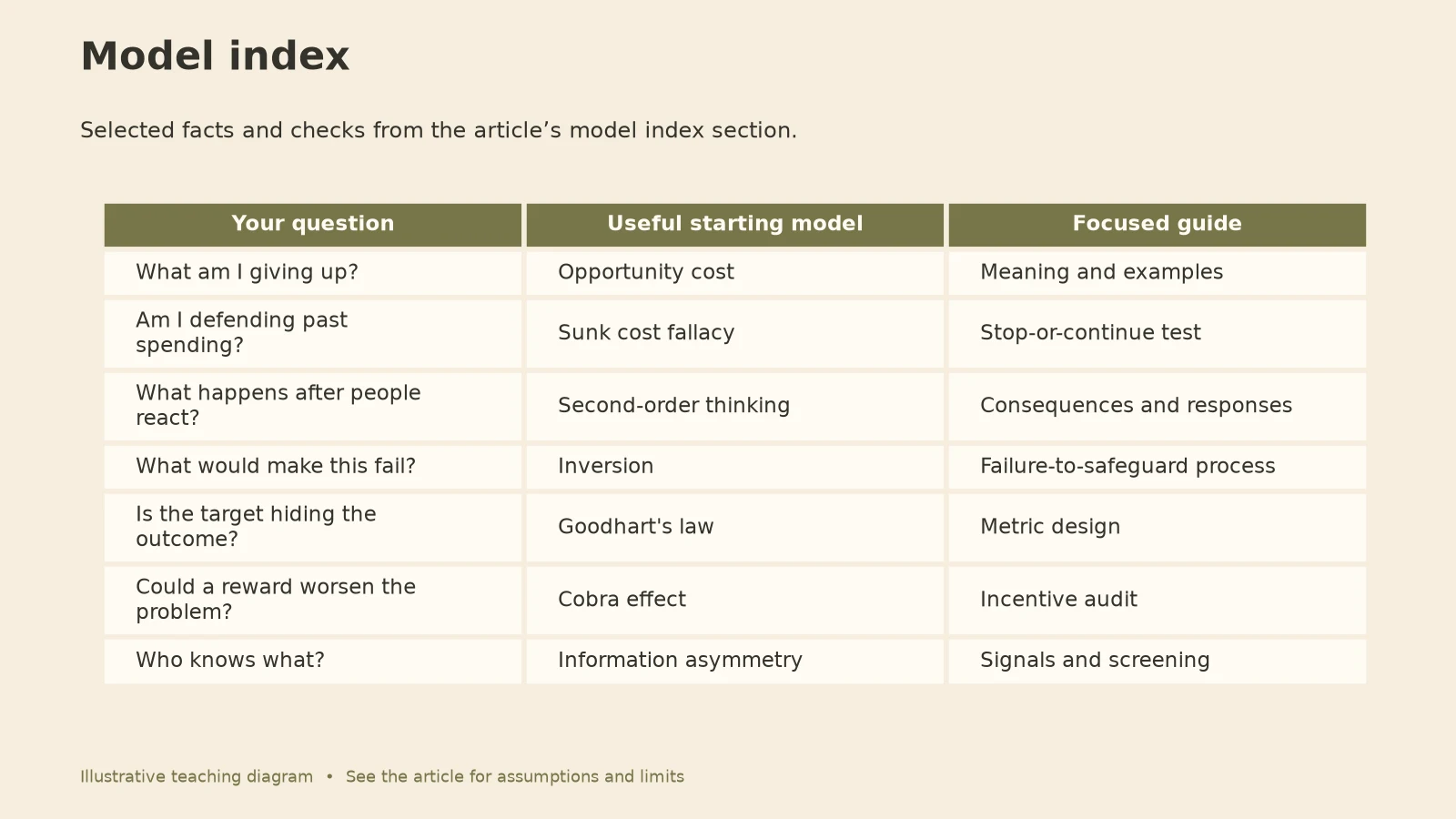
Some models are formal theories with precise conditions. Others are heuristics that organize questions. Both are useful, but they deserve different levels of trust. OpenStax’s cognition chapter describes how people represent and use information; the index below is a navigation aid for this site’s guides, not a theory of cognition.
Pick the model from the question
| Your question | Useful starting model | Focused guide |
|---|---|---|
| What am I giving up? | Opportunity cost | Meaning and examples |
| Am I defending past spending? | Sunk cost fallacy | Stop-or-continue test |
| What happens after people react? | Second-order thinking | Consequences and responses |
| What would make this fail? | Inversion | Failure-to-safeguard process |
| Is the target hiding the outcome? | Goodhart’s law | Metric design |
| Could a reward worsen the problem? | Cobra effect | Incentive audit |
| Who knows what? | Information asymmetry | Signals and screening |
| Is my preferred belief filtering evidence? | Confirmation bias | Two-hypothesis check |
| Is another explanation plausible? | Hanlon’s razor | Meaning and limits |
| Does my expertise fit this task? | Circle of competence | Task-based boundary |
| How do recurring events arise? | Iceberg model | Four-level worksheet |
| What loops keep the pattern going? | Feedback loops | Reinforcing and balancing |
| How do others’ choices affect mine? | Game theory | Players, strategies, and payoffs |
| Am I assuming every unequal result is the same distribution? | Power-law analysis | Scaling and evidence tests |
The index groups models by task instead of ranking them. Some questions need specialist knowledge or evidence that no short guide can supply.
Choosing a model
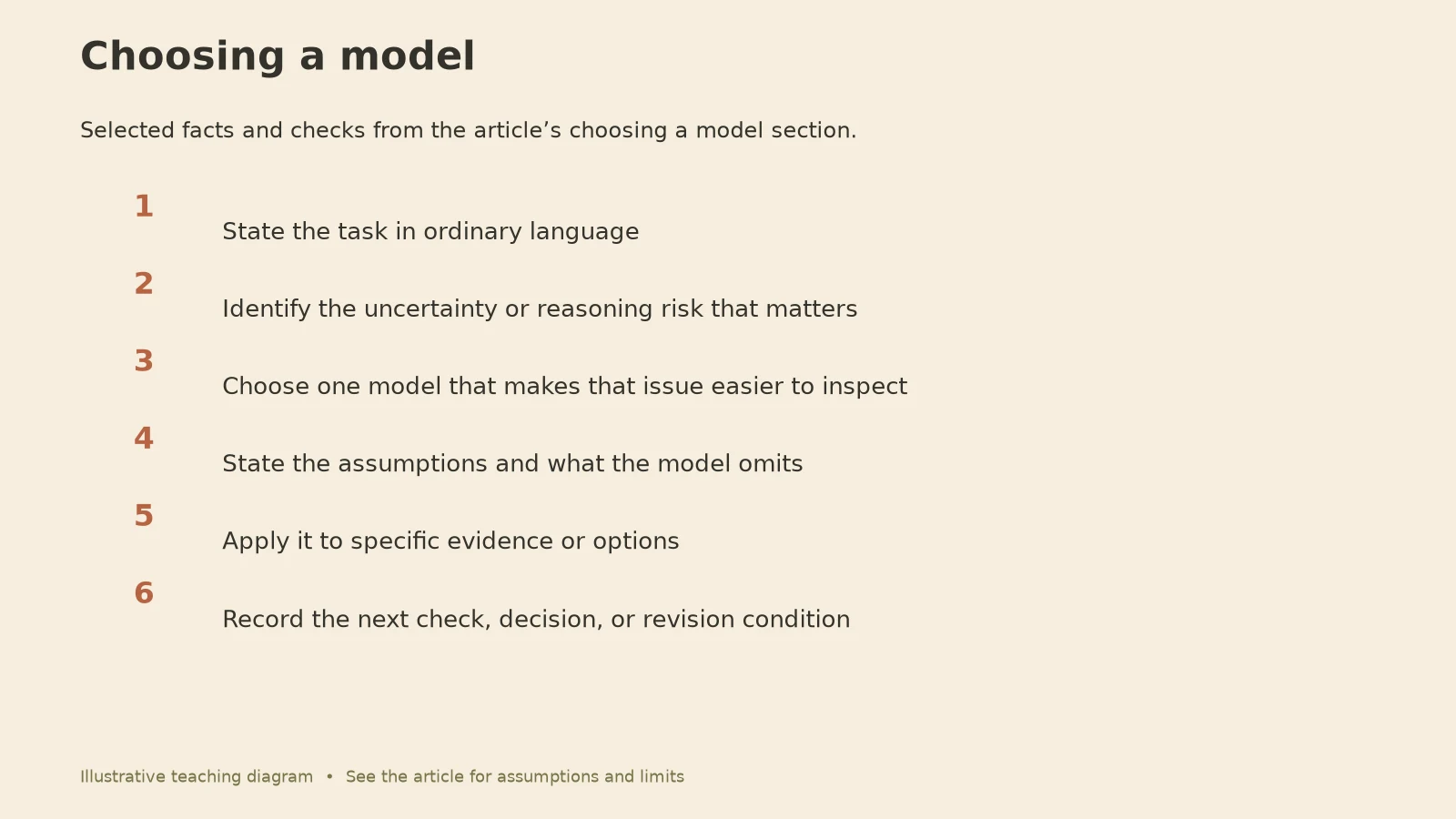
- State the task in ordinary language.
- Identify the uncertainty or reasoning risk that matters.
- Choose one model that makes that issue easier to inspect.
- State the assumptions and what the model omits.
- Apply it to specific evidence or options.
- Record the next check, decision, or revision condition.
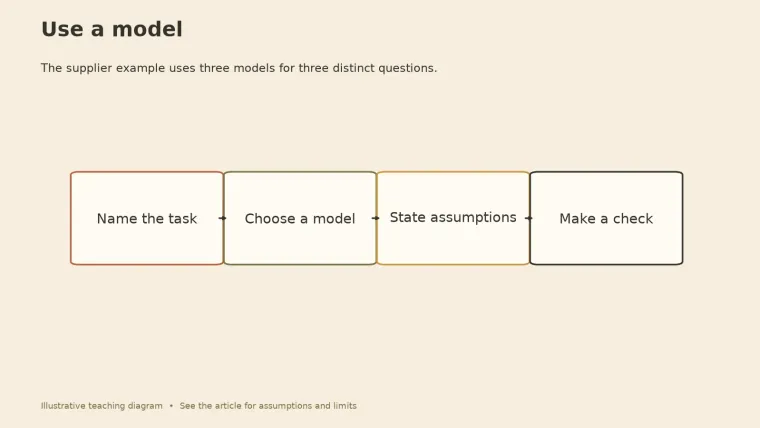
Snow’s version would read: stop the deaths; the open question is air or water; use a waterborne model; it assumes the agent travels in drinking water and omits everything else; test it on the brewery and the two water companies; remove the pump handle and keep counting.
When two models fit the same facts, look for the observation where they disagree. That single step does more than adding a third model.
When mental models backfire
Model collecting. “We used inversion, first principles, and systems thinking” says nothing about what changed. Show the assumption tested, the alternative compared, and the action that moved.
The favorite hammer. Forcing one model onto every problem hides the cases it cannot handle. A payoff matrix needs real players and payoffs; a power law needs distribution evidence.
A model that stops being tested. Miasma stayed the dominant view in British medicine for years after 1854. A model that only explains what you already believe, and predicts nothing new, has stopped working.
Borrowed expertise. A model can help you ask a specialist a better question. It does not qualify you to judge every technical answer. Critical thinking helps you inspect the evidence.
Questions
How many mental models should I know?
There is no quota. Learn the ones that fit your recurring decisions and practice using them on evidence. A small set you apply beats a long list you can recite.
Is a mental model always scientific?
No. Models range from tested theories to rules of thumb. Say which kind you are using and how much the conclusion depends on it.
Should I combine models for every decision?
Only when they answer different questions. Two models are most useful when they disagree, because the disagreement tells you what to check.
Your 5-minute model check
The decision or question:
Model I'm reaching for:
What it highlights:
What it leaves out:
A rival model that also fits the facts:
One observation where the two would predict differently:
How I'll check it:
Paste your answers into one of the Save Effort prompts and ask it to argue for the rival model as hard as it can.