In 1976, Daniel Kahneman’s team in Israel was writing a high school textbook on judgment and decision making. A year in, he asked each member to estimate privately how long the finished book would take. The answers clustered around two years.
Then he asked Seymour Fox, the team’s curriculum expert, how similar teams had done. About 40 percent never finished. None finished in under seven years. This team, Fox said, was “below average, but not by much.”
They kept going. The book was finished eight years later, the ministry had lost interest, and it was never used (Kahneman, “Beware the inside view”).
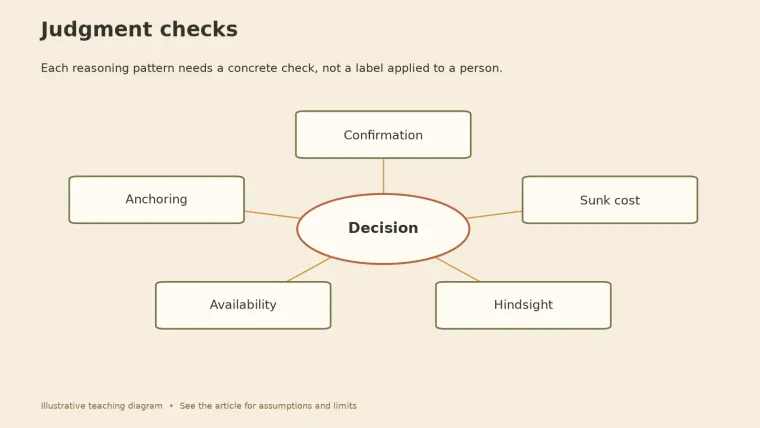
Cognitive biases are systematic errors in judgment: predictable ways that conclusions drift away from the evidence under particular conditions. Common types include confirmation bias, anchoring, availability, hindsight bias, and the sunk cost fallacy. Because they repeat under similar conditions, a fixed check catches them better than good intentions do.
The uncomfortable part is who fell for it: a future Nobel laureate in judgment research and a curriculum expert whose own guess had been just as rosy. This guide is the map: five common biases, why knowing them fails, and the checks that hold up.
The team’s forecast was built from the inside
Kahneman later called this the inside view: the team extrapolated from its own plan and the chapters already written. Fox carried the outside view, the record of comparable projects, but it never reached his forecast until a different question pulled it out.
| Inside view | Outside view | |
|---|---|---|
| Starting point | Our plan and progress so far | What happened to similar projects |
| Question asked | How long will our remaining chapters take? | How long do teams like ours take, and how many finish? |
| Answer in this case | About two years | Seven to ten years, with about 40 percent never finishing |
| Blind spot | Delays nobody can picture yet | Ways this project truly differs |
The resulting error is now called the planning fallacy. Kahneman and Dan Lovallo later wrote that the inside view “anchors predictions on plans and scenarios,” which is why such forecasts run optimistic (Kahneman and Lovallo, 1993).
This is the difference between a heuristic and a bias. The heuristic was the shortcut: judge the project by its plan. The bias was its predictable tilt: a forecast far too short. Most shortcuts serve us well until conditions quietly change.
The planning error was only one of the patterns in that room. Most decisions invite the same small set.
Each common bias has a check that answers it
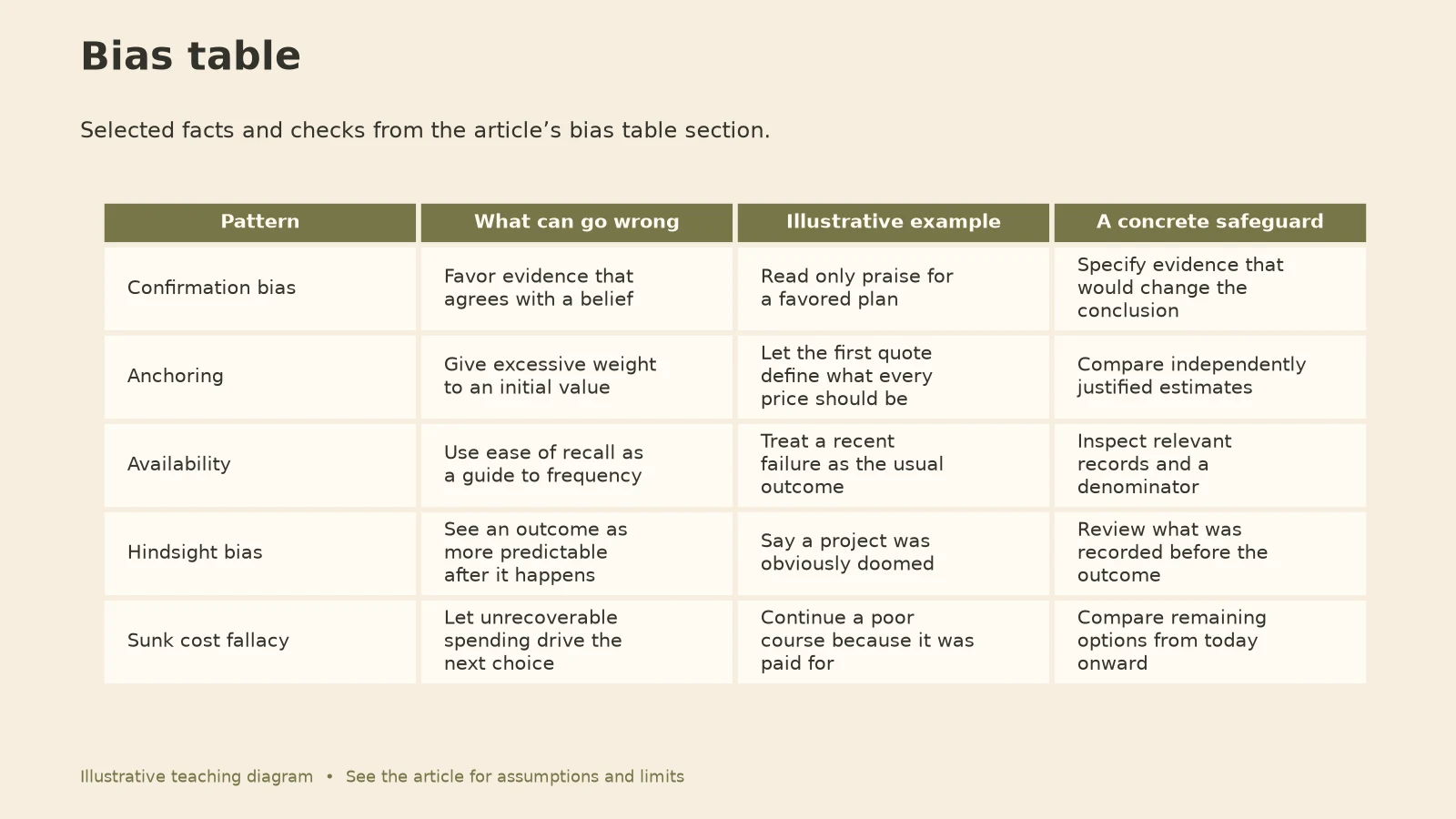
| Pattern | What can go wrong | Illustrative example | A concrete safeguard |
|---|---|---|---|
| Confirmation bias | Favor evidence that agrees with a belief | Read only praise for a favored plan | Specify evidence that would change the conclusion |
| Anchoring | Give excessive weight to an initial value | Let the first quote define what every price should be | Compare independently justified estimates |
| Availability | Use ease of recall as a guide to frequency | Treat a recent failure as the usual outcome | Inspect relevant records and a denominator |
| Hindsight bias | See an outcome as more predictable after it happens | Say a project was obviously doomed | Review what was recorded before the outcome |
| Sunk cost fallacy | Let unrecoverable spending drive the next choice | Continue a poor course because it was paid for | Compare remaining options from today onward |
Anchoring is the easiest to demonstrate. In a 1974 study, Amos Tversky and Kahneman spun a wheel of fortune in front of participants, then asked what percentage of African countries belonged to the United Nations. Groups that saw 10 gave a median estimate of 25 percent. Groups that saw 65 said 45. Paying for accuracy did not reduce the effect (Tversky and Kahneman, 1974).
A first quote can still be informative. The safeguard asks whether each piece of evidence gets the weight it deserves. Two of these have their own guides: how confirmation bias led the FBI to the wrong fingerprint, and the sunk cost fallacy and when to stop.
If the checks are this simple, why did a room of experts skip them?
Knowing the names did not protect the experts
Fox knew the history of other teams. Kahneman knew the research. Neither fact touched the forecast. “Until I prompted him, there was no connection in his mind between his knowledge of the history of other teams and his forecast of our future,” Kahneman wrote.
My reading: knowledge of a bias is stored in one place, and decisions get made somewhere else. A list of names helps only when the process forces the right question at the right moment.
Even the spoken warning failed. “None of us was willing to invest six more years of work in a project with a 40 percent chance of failure,” Kahneman wrote. They debated for a few minutes and carried on.
So the fix has to live in the procedure.
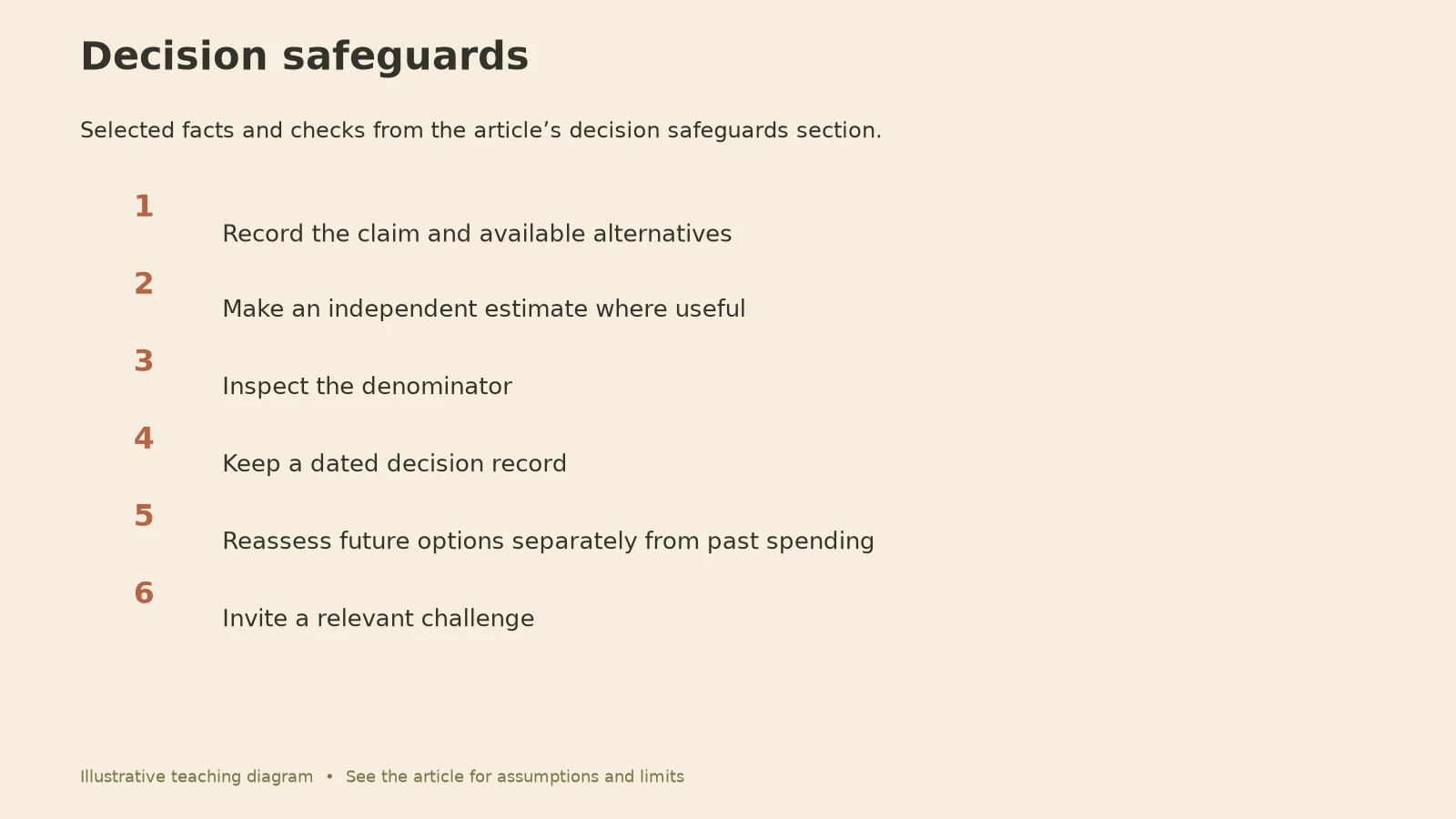
Six checks that change the decision itself
- Record the claim and available alternatives. “A finished textbook in two years” can be tested. So can the alternative: stop, or shrink the project.
- Make an independent estimate where useful. Kahneman got this right: private estimates, collected before discussion, exposed the consensus.
- Inspect the denominator. Fox’s answer counted the teams that quit. Success stories leave those out.
- Keep a dated decision record. Assumptions written before the outcome protect you later, when everyone “always knew” it would drag on.
- Reassess future options separately from past spending. The first year was gone either way. The live question was whether several more years justified roughly a 60 percent chance of finishing.
- Invite a relevant challenge. Fox held the key information, and someone still had to ask. Assign one person to name the comparable cases.
Even done well, bias-spotting has failure modes of its own.
Bias-spotting backfires when it replaces evidence
- Every mistake gets blamed on a bias. Missing information, incentives, and bad luck explain plenty. A late project can simply be unlucky.
- The wrong comparison group. The outside view helps only if the comparison projects truly resemble yours.
- Theater replaces substance. Writing “we considered alternatives” proves little if only one option got serious attention.
For building these habits into daily reasoning, see how to improve critical thinking.
Questions people ask about cognitive biases
How many cognitive biases are there?
Lists range from a handful to well over a hundred, depending on how researchers group them. No count is official. The five above come up often, which makes them a sensible start.
Does knowing about biases make you less biased?
Not reliably. Kahneman’s team knew the research and still ignored the base rate. Procedures that force a check help more than awareness does.
Ask the Seymour Fox question before your next estimate
The next time someone asks you for a deadline, a budget, or a forecast, spend five minutes on this card before you give a number:
Projects like this one: ___
How many of them finished: ___
How long they usually took: ___
Why ours would be faster or slower: ___
My estimate after this check: ___
Prefer to think it through with an AI? Paste in your plan and ask it to name comparable projects and their usual outcomes. The Save Effort prompt community collects self-check prompts for exactly this.
If the outside number surprises you, treat that moment as a decision point. Kahneman’s team let it pass.