Around 1980, political scientist Robert Axelrod invited experts to submit computer programs that would play the prisoner’s dilemma against each other, about 200 rounds per match. Fourteen programs entered. The simplest one won. Called Tit for Tat, it cooperated on the first move, then copied whatever the opponent had just done.
In a second tournament, 62 entrants knew the first-round results, and some tried to improve on Tit for Tat. It won again (Axelrod, The Evolution of Cooperation). Yet it never scored more than the program it was playing.
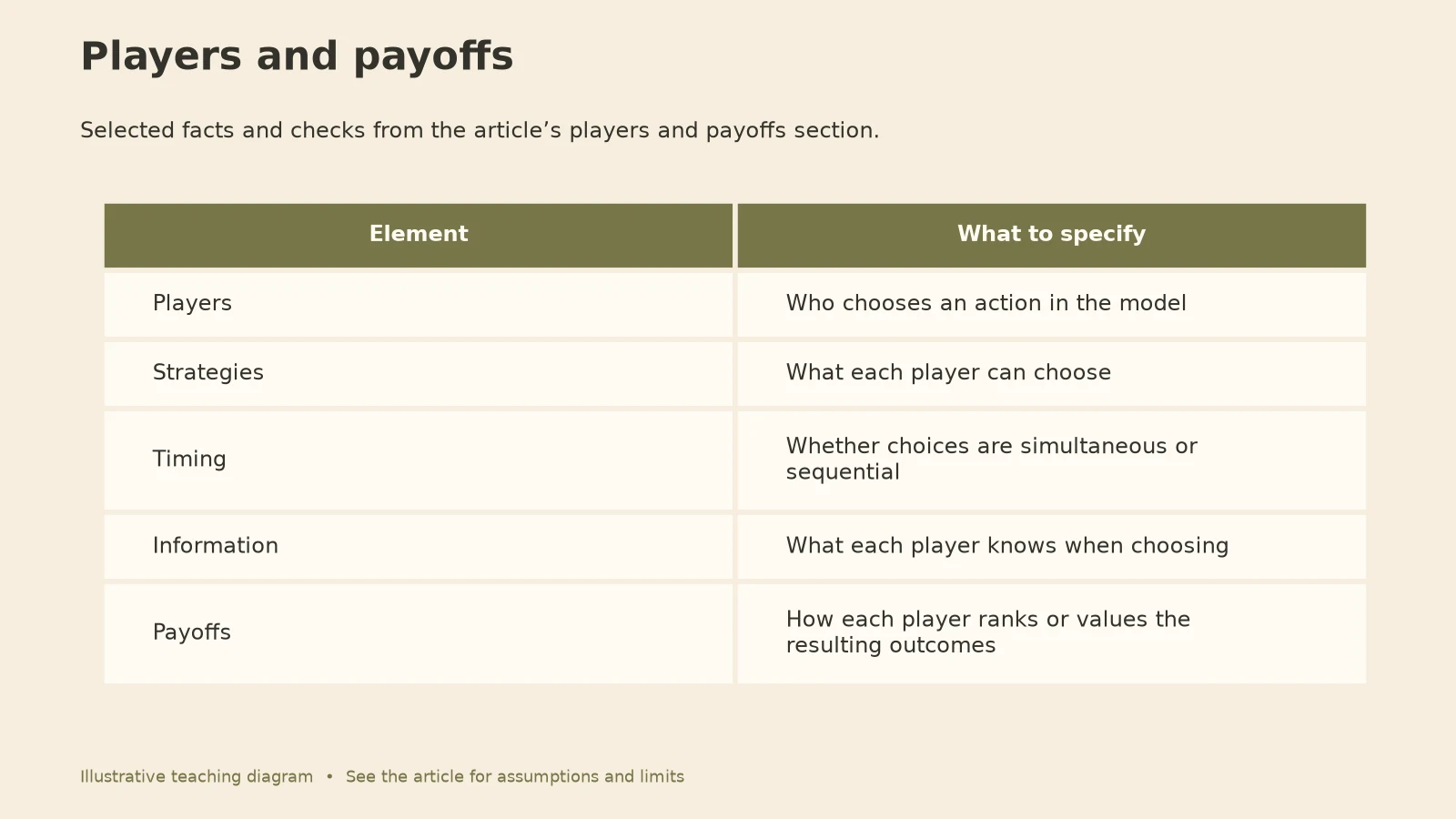
Game theory is the study of strategic situations, where the result of your choice depends on what others choose. A game is described by its players, the strategies each can choose, and the payoffs for every combination. The core move is simple: hold the other player’s choice fixed and ask what your best response is.
Every game has the same parts, and payoffs are the slippery one
| Element | What to specify |
|---|---|
| Players | Who chooses an action in the model |
| Strategies | What each player can choose |
| Timing | Whether choices are simultaneous or sequential |
| Information | What each player knows when choosing |
| Payoffs | How each player ranks or values the resulting outcomes |
In Axelrod’s tournament the parts were fixed by the rules. Two programs moved at the same time, each choosing to cooperate or defect, and each could see the other’s past moves. Points per round looked like this, with your points listed first:
| You / Other player | Other cooperates | Other defects |
|---|---|---|
| You cooperate | (3, 3) | (0, 5) |
| You defect | (5, 0) | (1, 1) |
Real payoffs are rarely this tidy. They can stand for money, time, reputation, or a ranking. Writing down what the numbers mean is where most models go wrong.
In a single round, defecting is the best response to anything
Hold the other player’s choice fixed and compare your options. If they cooperate, defecting earns 5 instead of 3. If they defect, defecting earns 1 instead of 0. Either way, defecting pays more. When one option beats the others whatever the opponent does, it is a dominant strategy, explained further in the dominant strategy guide.
The other player runs the same reasoning. Both defect, and each gets 1 point, though mutual cooperation would have paid 3 each.
That outcome is a Nash equilibrium: no player can do better by changing only their own choice. It is a stability condition, not a promise of a good result. The Nobel committee’s 1994 announcement explains why the concept became central to analyzing games like this one. For marking best responses cell by cell, see Nash equilibrium in game theory.
So how did a program that starts by cooperating win?
Repetition changed the game, and that is why Tit for Tat won
Axelrod’s programs met the same opponent round after round. Defecting today earns 5 points once, then invites retaliation for the rest of the match.
Axelrod traced Tit for Tat’s success to four properties:
- Nice. It never defected first, so it avoided needless fights.
- Retaliatory. It punished a defection on the very next move.
- Forgiving. It returned to cooperation as soon as the other side did.
- Clear. Opponents could quickly work out what it was doing.
Tit for Tat could never outscore the program in front of it, because it only defected after being defected against. It won on total points, by drawing many opponents into long runs of mutual cooperation.
This is the lesson I find most useful outside a lab: in a relationship you will repeat, the score that matters is your total across rounds, not whether you beat the person across the table this time.
Not every game is a dilemma
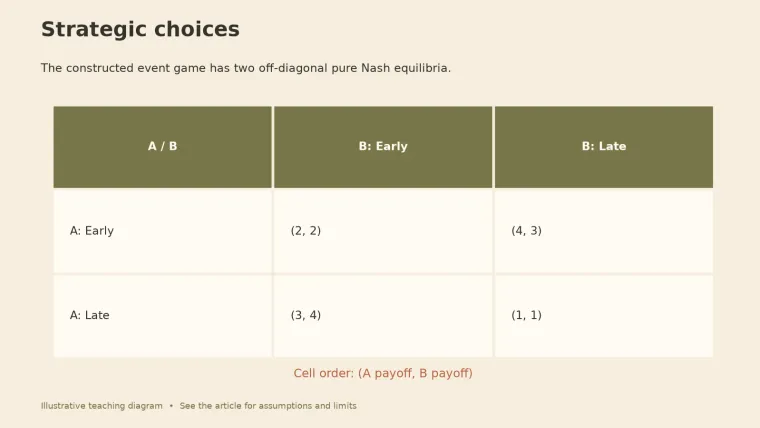
Some games reward coordination instead. Two organizers picking a time for separate events do best when they avoid each other. Cells show (A’s payoff, B’s payoff):
| A / B | B chooses early | B chooses late |
|---|---|---|
| A chooses early | (2, 2) | (4, 3) |
| A chooses late | (3, 4) | (1, 1) |
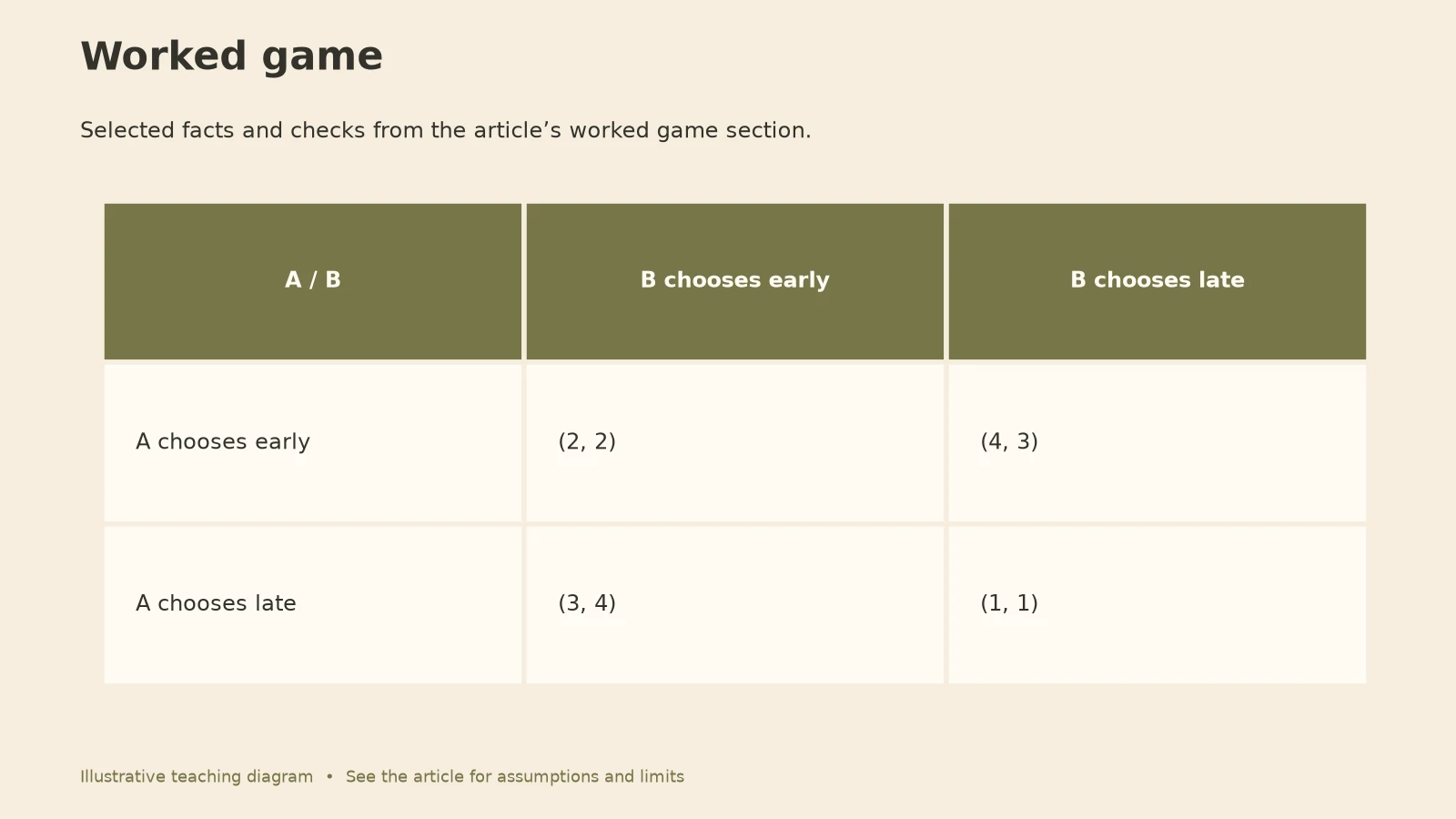
Neither player has a dominant strategy. Both off-diagonal cells are Nash equilibria, and the table cannot say which one will happen. Communication or habit usually settles it. The guide to classic game theory games walks through this and five other standard setups.
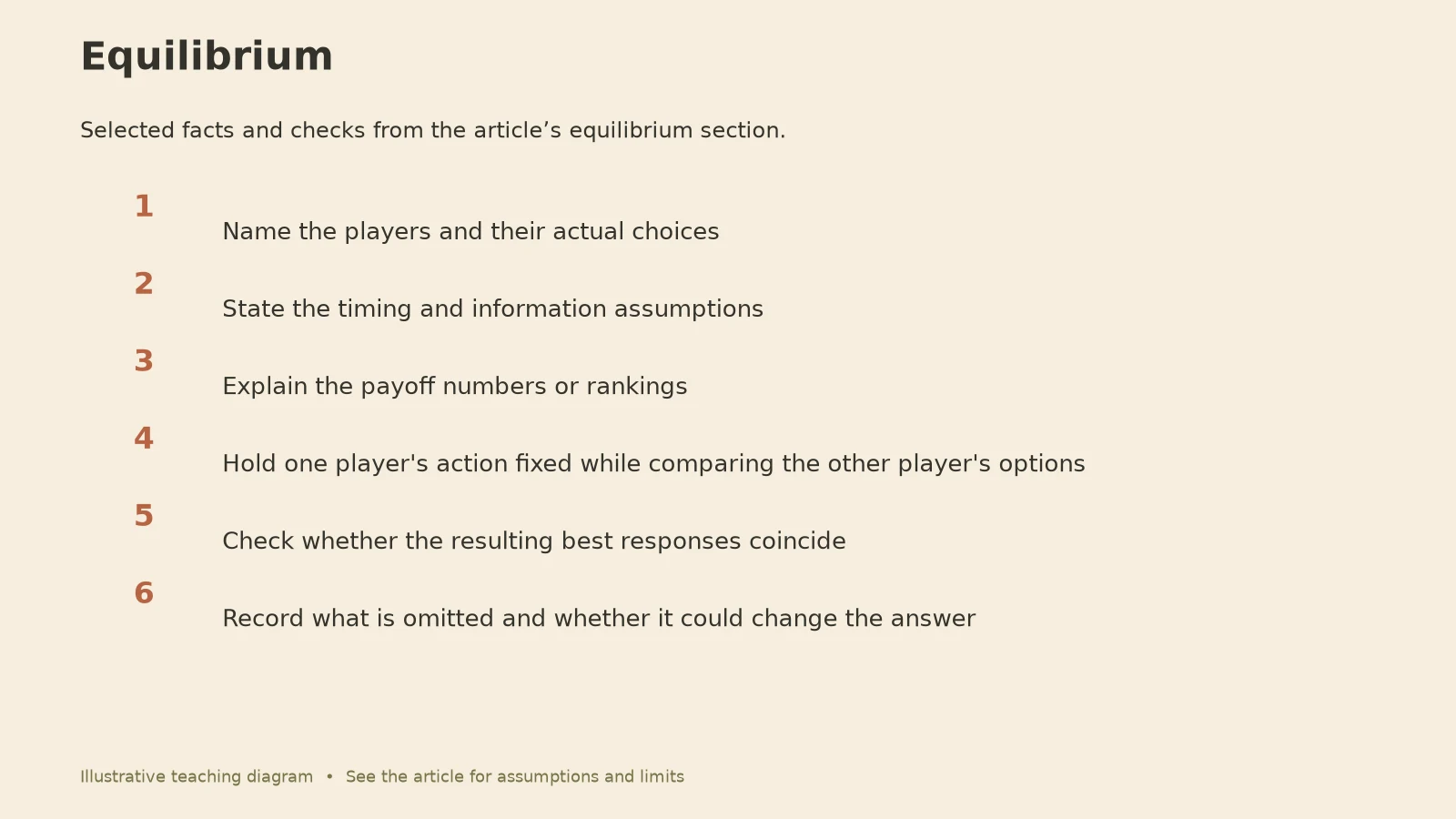
Six steps for reading any game
- Name the players and their actual choices.
- State the timing and information assumptions. Simultaneous or in turn? Who knows what?
- Explain the payoff numbers or rankings. Say what each number stands for.
- Hold one player’s action fixed while comparing the other player’s options.
- Check whether the resulting best responses coincide. Matching best responses mark an equilibrium.
- Record what is omitted and whether it could change the answer. Repetition alone flipped the prisoner’s dilemma.
When a payoff table misleads
- The payoffs are yours, not theirs. Fill the table with what you would want, and the model predicts your behavior.
- A one-shot model gets applied to a repeated relationship. The same table gives opposite advice depending on whether there is a next round.
- Tit for Tat gets treated as a universal law. When moves can be misread, one accidental defection can lock two Tit for Tat players into endless retaliation. Results also depended on the field of entries.
- The table hides the exits. Real players can talk, walk away, or change the rules.
Questions people ask about game theory
Does game theory assume everyone is selfish?
No. A payoff can include concern for others. Pure self-interest is a simplifying choice, not a claim about human nature.
Is a Nash equilibrium the best outcome?
Not necessarily. The prisoner’s dilemma equilibrium leaves both players worse off than cooperation would.
Is Tit for Tat the best strategy?
It performed best in Axelrod’s tournaments. With noisy moves or different opponents, more forgiving variants can do better.
Map your next negotiation as a repeated game
Before your next tense reply to a colleague, supplier, or partner, start a five-minute session on the Slow Down focus timer and fill in this card:
Players: me, ___
My options: ___ / ___
Their likely options: ___ / ___
Will we deal with each other again? yes / no
If yes, what will they remember from this round: ___
If the fourth line says yes, play for the total. A small win today that teaches the other side to defect will cost you more in later rounds.