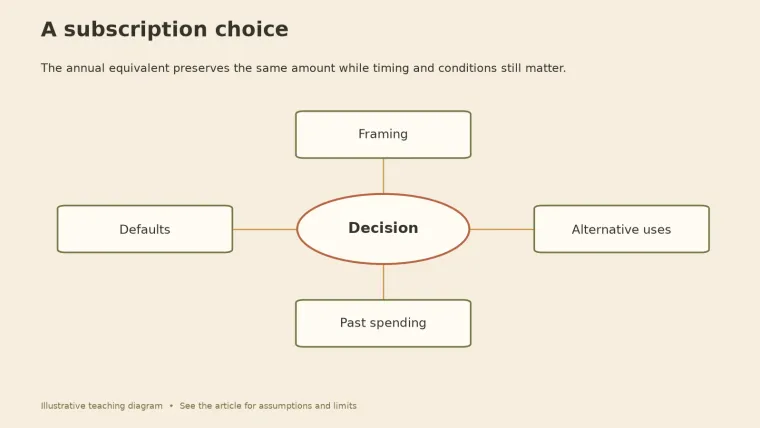
In the late 1990s, a large US company changed one setting in its 401(k) retirement plan. New employees used to have to sign up to save. Now they were enrolled unless they opted out. Nobody was forced to stay. Among employees 3 to 15 months into the job, participation jumped from 37 percent to 86 percent.
Behavioral economics studies how psychological factors such as attention, framing, habit, fairness, and self-control shape economic choices. A standard model predicts that a default you can change in two minutes should barely matter, because people choose what suits them. Behavioral economics studies why defaults, framing, and timing so often change the outcome anyway.
One default, 49 points of participation
The study is Brigitte Madrian and Dennis Shea’s “The Power of Suggestion,” published in the Quarterly Journal of Economics in 2001. Looking back in a 2024 NBER summary, Madrian and her coauthors describe the change: under automatic enrollment, employees “can always change their contribution rate or opt out entirely, but if they take no action, they will save the default percentage.”
The default did more than raise participation. The original paper found that “a substantial fraction” of employees hired under automatic enrollment stuck with both the default contribution rate and the default fund, “even though very few employees hired before automatic enrollment picked this particular outcome.”
The default number itself pulls people toward it. At another employer that tried both a 3 percent and a 6 percent default, at 15 to 24 months of tenure:
| Plan design | Employees saving 3% | Employees saving 6% |
|---|---|---|
| Automatic enrollment, 3% default | 28% | 24% |
| Automatic enrollment, 6% default | 4% | 49% |
Six percent was the lowest rate that earned the full employer match. Under the 3 percent default, many people stayed at 3 and left part of the match on the table. The researchers also note that automatic enrollment can lower saving for people who would otherwise have chosen more than the default.
Inertia is not irrational, and that is the point
Staying with a default is a reasonable shortcut. Choosing a contribution rate takes time and attention, and the default looks like the employer’s recommendation. That is why a design choice the employer barely thought about can end up shaping thousands of retirements.
The Nobel committee’s summary of Richard Thaler’s work groups these effects under limited rationality, social preferences, and self-control. A label is a starting point for a question, though. It does not explain why a particular person chose what they did.
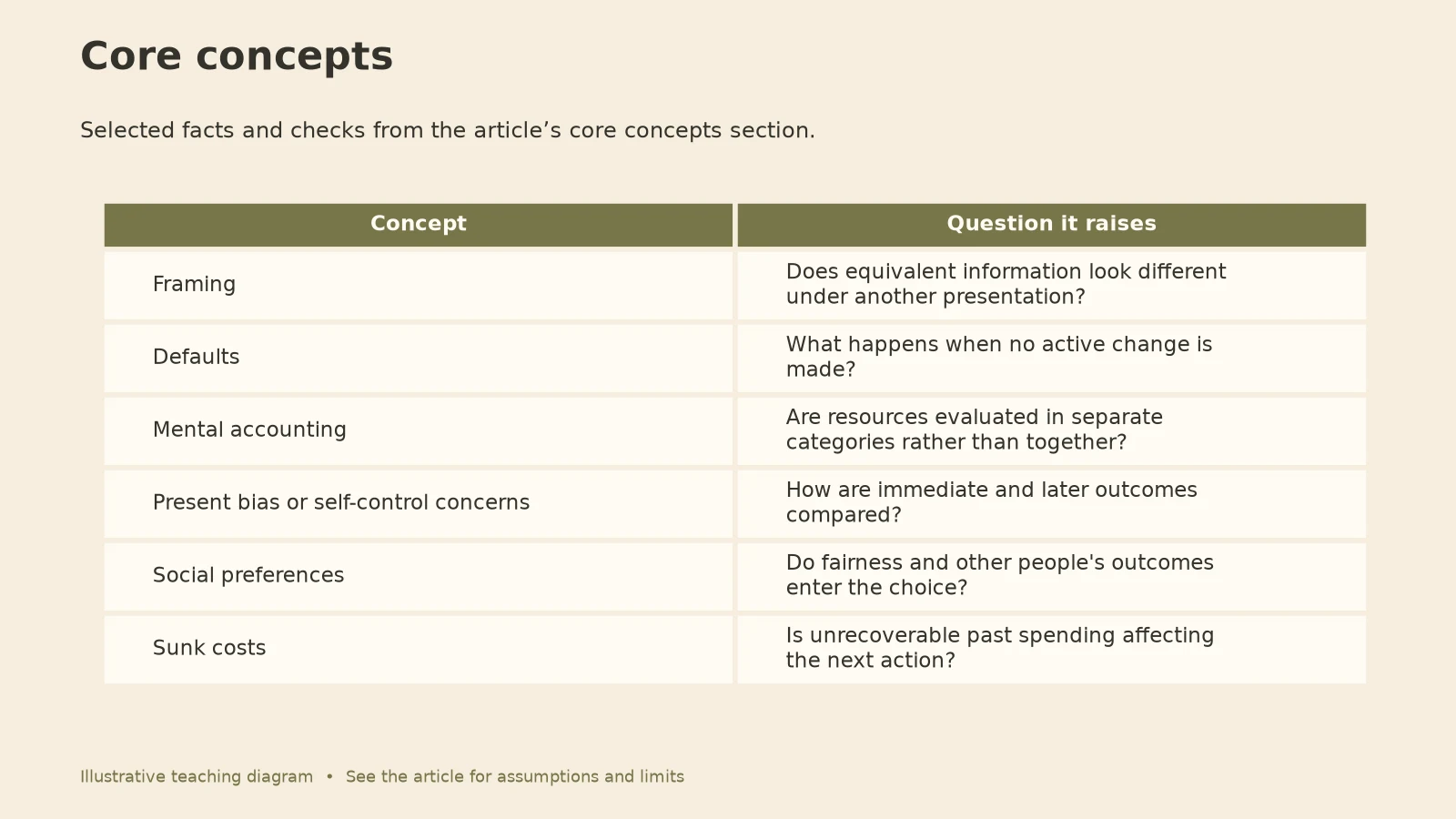
| Concept | Question it raises |
|---|---|
| Framing | Does equivalent information look different under another presentation? |
| Defaults | What happens when no active change is made? |
| Mental accounting | Are resources evaluated in separate categories rather than together? |
| Present bias or self-control concerns | How are immediate and later outcomes compared? |
| Social preferences | Do fairness and other people’s outcomes enter the choice? |
| Sunk costs | Is unrecoverable past spending affecting the next action? |
The 401(k) case touches at least three rows: the default, present bias (saving costs now, pays off decades later), and framing (the default reads as advice). For a wider list of judgment patterns, see cognitive biases.
The same forces in a subscription
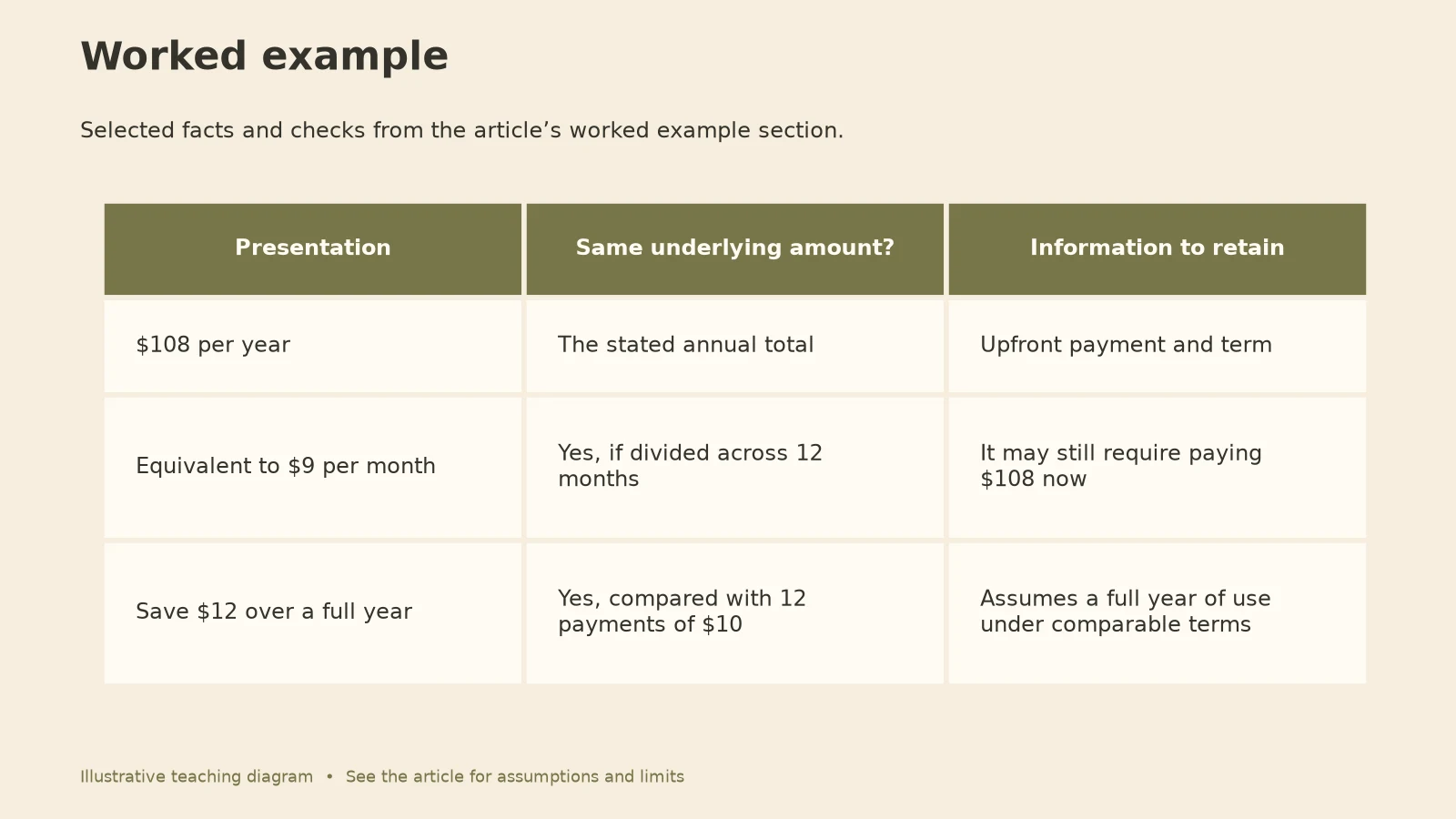
Consumer choices run on the same mechanics. Say a subscription costs $10 a month or $108 a year, and the annual plan is advertised as “only $9 a month.” Twelve monthly payments total $120, so the full-year saving is $12. But $9 is a monthly equivalent, and it still means paying $108 today.
| Presentation | Same underlying amount? | Information to retain |
|---|---|---|
| $108 per year | The stated annual total | Upfront payment and term |
| Equivalent to $9 per month | Yes, if divided across 12 months | It may still require paying $108 now |
| Save $12 over a full year | Yes, compared with 12 payments of $10 | Assumes a full year of use under comparable terms |
Then the default arrives: what happens at renewal if you do nothing? And after purchase, “I paid for it, so I should use it” is the sunk cost fallacy at work. The annual plan may still be the right choice if you will use it all year. The framing just should not make that choice for you.
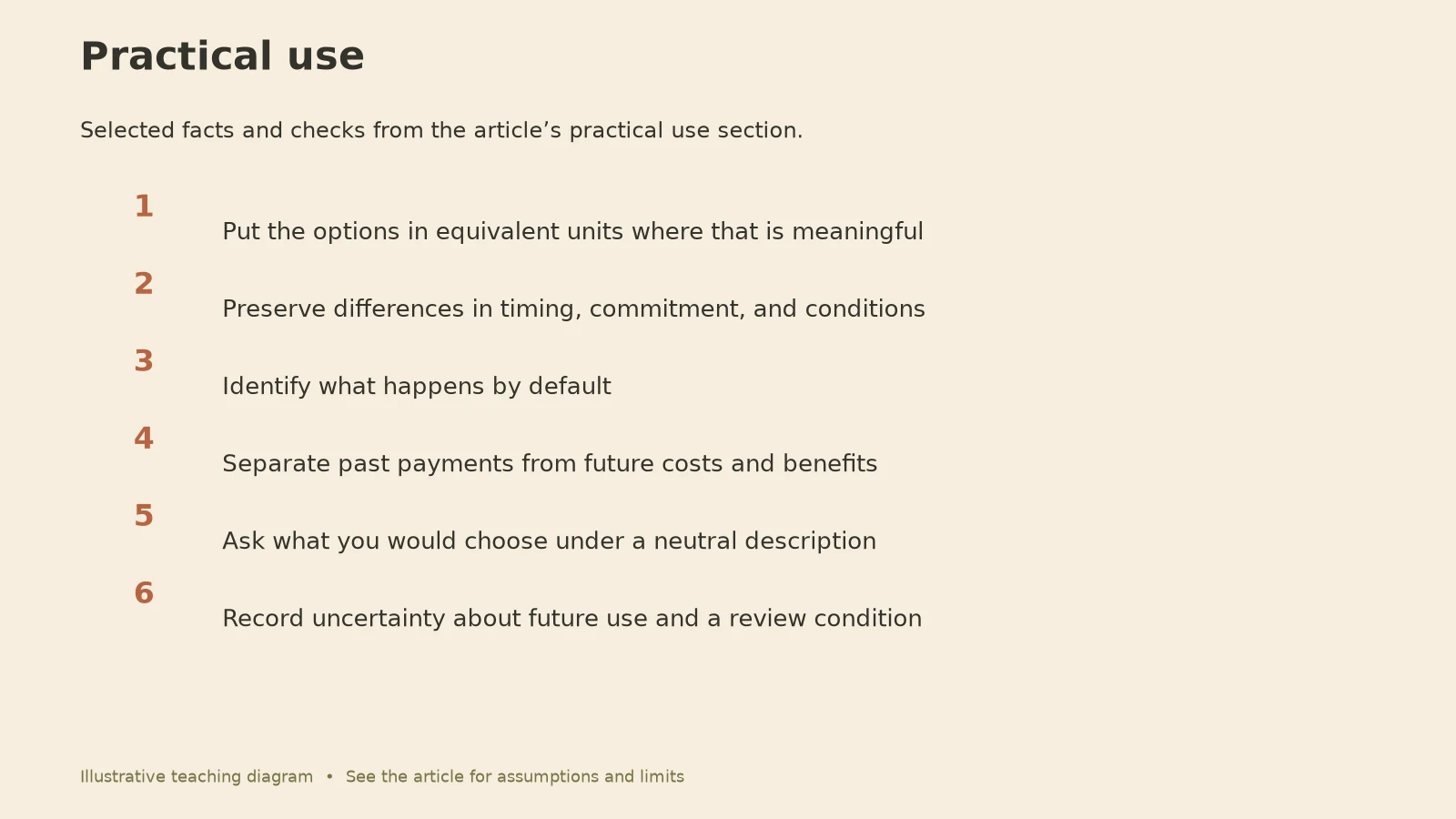
A choice-clarity checklist
- Put the options in equivalent units where that is meaningful.
- Preserve differences in timing, commitment, and conditions.
- Identify what happens by default.
- Separate past payments from future costs and benefits.
- Ask what you would choose under a neutral description.
- Record uncertainty about future use and a review condition.
Step 3 is the 401(k) lesson. Before you accept any default, from a savings rate to a renewal date, ask who chose it and what they were optimizing for. The follow-the-incentives guide helps with that question.
When behavioral economics backfires
A good default set at the wrong level. Automatic enrollment raised participation and also parked many savers at a rate below the full match. A default needs the same scrutiny as any other recommendation.
Steering without consent. Choice design can help people or quietly work against them. Ask who benefits, who bears the cost, and whether people can see and change the choice. Ethical decision making offers a test.
One study treated as a law. An effect found in one company, population, or decade may not carry over. Test it where you plan to use it.
Calling people irrational. A choice that looks odd may reflect constraints, information, or values the model left out.
Questions
Does behavioral economics mean people are irrational?
No. It studies systematic patterns in real choices under specific conditions. Sticking with a default can be a sensible shortcut that still produces a poor outcome.
Is it the same as psychology?
It draws on psychology but focuses on economic choices, incentives, and how scarce resources get allocated.
Can a concept predict my next choice?
Not with certainty. It can point to a likely mechanism. Your actual options, context, and constraints still decide.
Your 5-minute default audit
One recurring payment or setting I never chose actively:
What happens if I do nothing?
Who picked the default, and what do they gain?
What would I choose if it were presented neutrally?
Past money I'm counting that I can't get back:
Decision: keep / change / cancel
Reminder date to check again:
Pick one subscription or savings setting today and run it through Daily Read in five minutes.