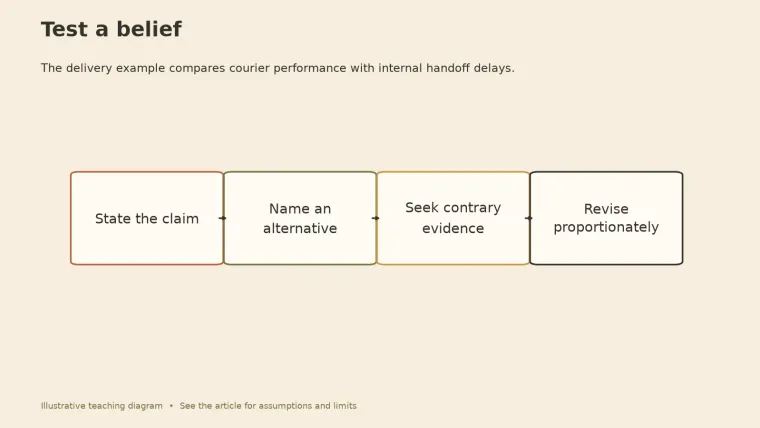
In March 2004, the FBI matched a fingerprint from a bag of detonators in Madrid to Brandon Mayfield, a lawyer in Oregon. A second FBI examiner verified the match. Mayfield was arrested as a material witness, and a court-appointed expert agreed with the identification.
The print belonged to someone else.
Confirmation bias is the tendency to search for, interpret, and remember information in ways that support what you already believe, while giving challenging evidence less attention or weight. People caught in it usually feel careful and fair. The practical defense is a procedure that gives contrary evidence a real chance to change your mind.
Nobody in this case was lazy. The examiners worked to a standard of 100 percent certainty and believed they had found at least 15 points of agreement. About two weeks after the arrest, Spanish police identified the true source: an Algerian national named Ouhnane Daoud. The Justice Department’s Inspector General later found that examiners had reasoned “backward” from Mayfield’s prints and begun to “find” features “that were not really there” (OIG review, 2006).
This guide follows one bias in depth. For the wider family of thinking errors, start with the overview of common cognitive biases.
The bias entered at three points, and each one felt like diligence
The bias usually builds through small steps that each look reasonable.
What you look for. A database search returned 20 candidate prints. Several experts on a panel the FBI convened afterward concluded that the first examiner had not fully analyzed the Madrid print before that search. Once Mayfield’s print was on the table, it shaped which features seemed worth noticing.
How you read ambiguous evidence. The Madrid print was blurry in places. Murky details became more points of similarity. Fine details that disagreed with Mayfield’s prints were discounted.
How much weight a challenge gets. On April 13, Spain’s national police lab reported a “negativo”: no match. Two days later, the FBI said it was “absolutely confident,” a full week before it met the Spanish lab.
belief: "the print is Mayfield's"
        |
        v
read the crime-scene print through Mayfield's print
        |
        v
ambiguous detail ---> counted as another match
        |
        v
confidence rises ---> contrary report treated as their mistake
        |
        +---------> belief gets harder to question
Here is the part I find most unsettling: every arrow in that loop is something a diligent person would do. So does expertise protect you at all?
Expertise does not switch the bias off
In 1960, psychologist Peter Wason told people that the numbers 2-4-6 followed a rule, and let them test any triple before naming it. Many kept offering triples that fit their own guess, such as 8-10-12, heard “yes,” and grew more confident. The rule was simply any ascending numbers. Only 6 of 29 participants announced the correct rule without first announcing a wrong one (Wason, 1960).
Expertise cuts both ways. It gave the examiners fast pattern recognition. Pointed at the wrong candidate, the same skill confirmed the error faster.
Context made revisiting harder. By the time the Spanish report arrived, the examiners had learned about Mayfield from the field investigation. One told the Inspector General that if the match had been someone like the “Maytag Repairman,” the lab might have revisited it with more skepticism.
Starting with a hunch is normal, and often useful. Trouble begins when supporting and challenging evidence are held to different standards.
You will probably never compare fingerprints. The same moves show up in much smaller decisions.
The same moves show up in ordinary work
| Situation | Possible biased move | A more informative check |
|---|---|---|
| A favored supplier performs well | Treat one successful order as proof | Compare relevant orders and alternatives |
| A disliked supplier performs badly | Notice every failure but ignore case difficulty | Use the same performance criteria for both |
| A product change receives praise | Read only favorable comments | Examine who responded and who did not |
| A headline matches your views | Accept the summary without checking | Read the original evidence and its limits |
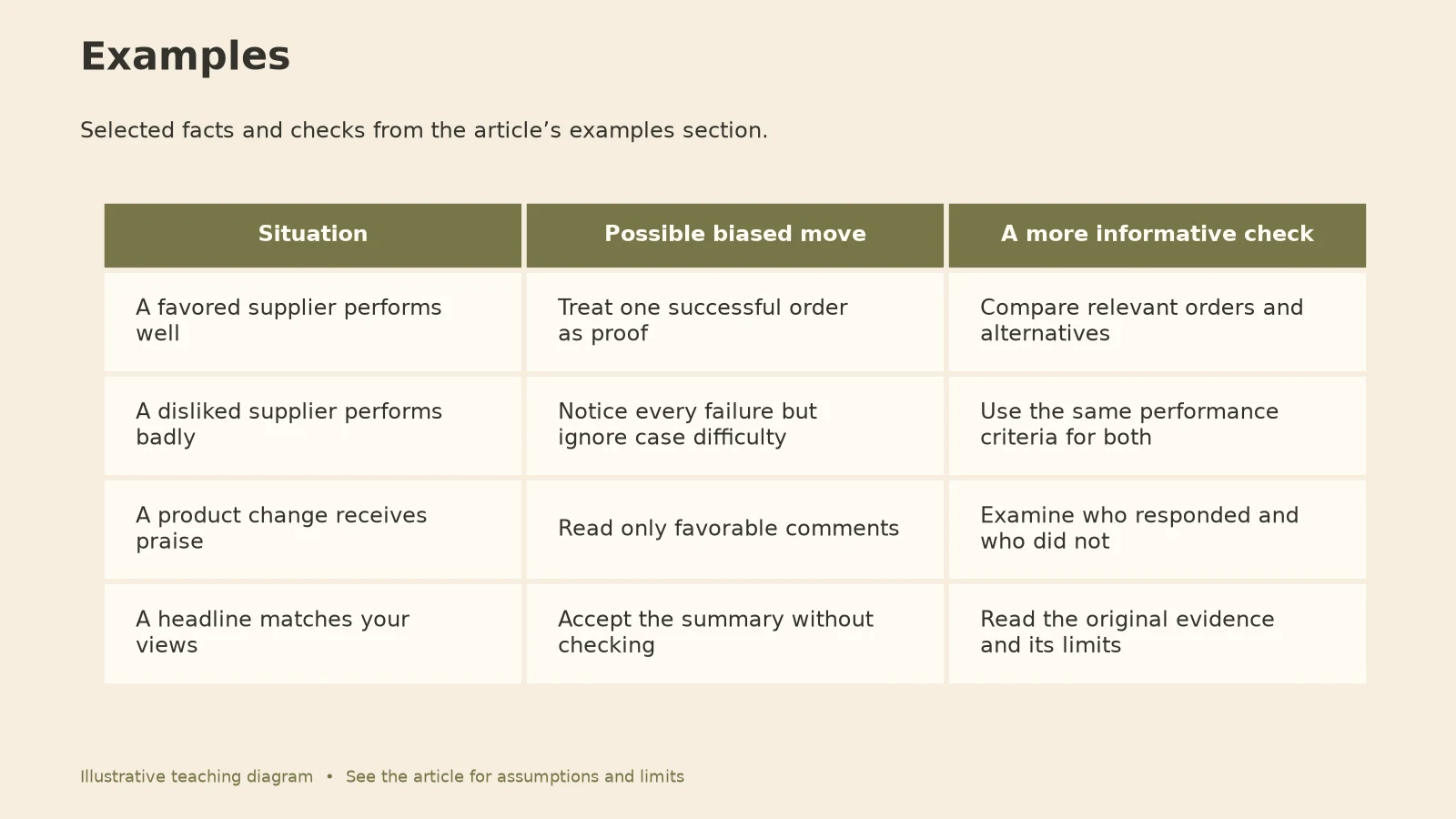
A favorable conclusion can still be correct. The check improves how you reach it.
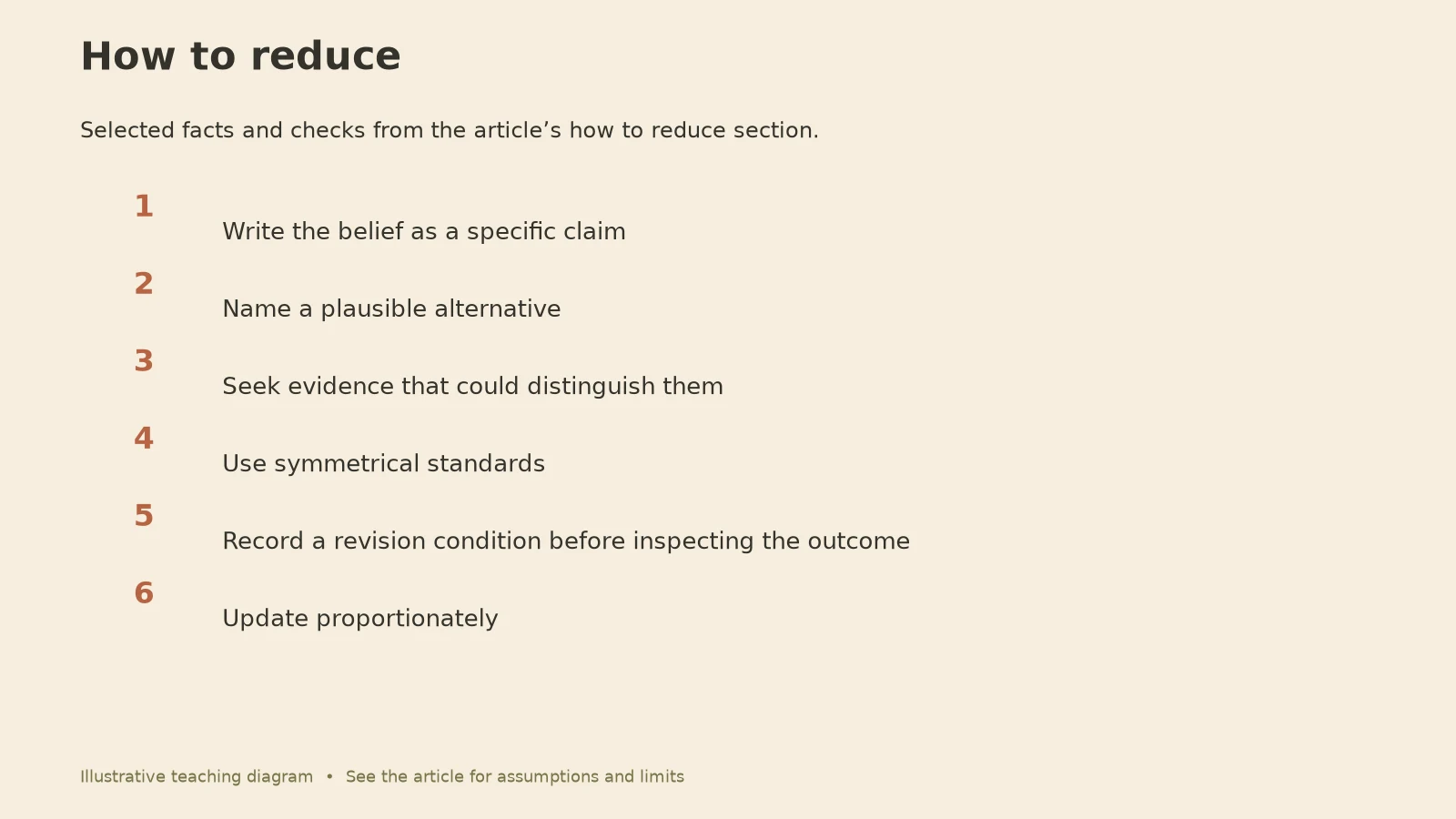
Six steps that would have caught the fingerprint error
- Write the belief as a specific claim. “The Madrid print came from Mayfield’s left index finger” can be tested. “We have our man” cannot.
- Name a plausible alternative. Here: someone outside the FBI database with a similar print. The Inspector General warned that database searches surface “the closest possible non-matches.” Inversion helps here: ask what would have to be true for your belief to be wrong.
- Seek evidence that could distinguish them. Look for the differences your favorite explanation cannot account for. FBI rules said one unexplained difference should block an identification; the Inspector General found that rule was not applied with enough rigor.
- Use symmetrical standards. The examiners leaned on fine details that agreed and discounted those that did not. Hold both sides to the same bar.
- Record a revision condition before inspecting the outcome. The Inspector General recommended documenting what a crime-scene print shows before comparing it to a suspect’s. Your version: write “I will reconsider if ___” before you see the results.
- Update proportionately. The Spanish report alone could not settle the question. It was enough to justify a fresh look by an examiner who had not already committed to an answer. The lab reaffirmed its match instead.
A second reviewer helps most when they work blind. The examiner who verified the Mayfield match already knew a colleague had made the identification. The Inspector General could not show this caused the error, but recommended blind verification procedures.
Push these steps too hard, though, and they create a different problem.
When fighting confirmation bias makes things worse
- The label becomes a weapon. Calling someone biased lets you skip their evidence. Check the reasoning first.
- Every rival gets equal weight. Two positions existing does not make them equally supported.
- Small decisions turn into investigations. A cheap, reversible choice needs a quick check at most. Save the full procedure for costly or hard-to-undo calls.
When the problem is a steady stream of one-sided sources rather than a single decision, curating your information diet without building an echo chamber deals with it at the source.
Questions people ask about confirmation bias
Is confirmation bias the same as being stubborn?
No. Stubbornness is refusing to change your mind. Confirmation bias is about how evidence gets gathered and weighed, and it affects people who change their minds often.
Should I always consider the opposite view?
Consider the strongest alternative. A weak rival does not earn equal credibility just because someone holds it.
Can you eliminate confirmation bias completely?
Probably not. Awareness alone does not make a judgment unbiased. Rules written down before the results arrive, such as a revision condition or a blind review, do more than good intentions.
Your five-minute belief check
The next time you are about to approve, forward, or sign off on something that proves you right, start a five-minute session on the Slow Down focus timer and fill in these four lines:
Belief: I think ___ because ___.
Best rival explanation: ___.
Evidence that would favor the rival: ___.
I will change or narrow my view if ___.
If you cannot fill in the last line, you are holding a conviction. Look at it once more before you act on it.