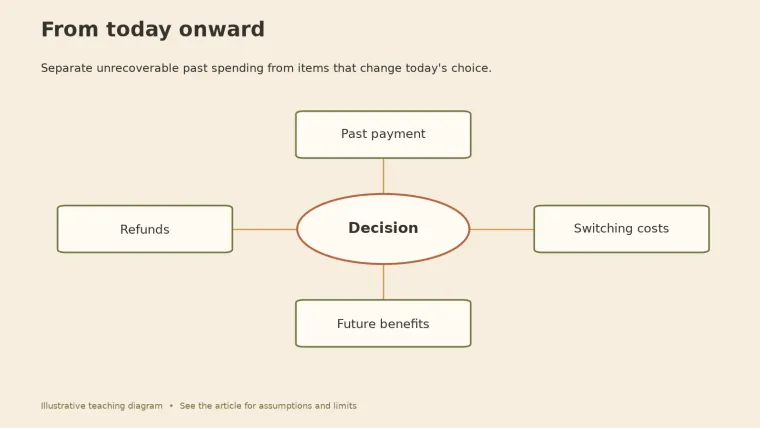
In late 1981, Congress was deciding whether to keep funding the Tennessee-Tombigbee Waterway, a canal meant to give barges a shorter route to the Gulf of Mexico. About $1.1 billion was already spent. Senator Jeremiah Denton argued: “To terminate a project in which $1.1 billion has been invested represents an unconscionable mishandling of taxpayers’ dollars.”
Congress kept paying. The waterway opened in 1985 after costing nearly $2 billion (Tenn-Tom history). The Army Corps of Engineers had projected 27 million tons of first-year cargo. It carried about 1.7 million (University of Tennessee study).
The sunk cost fallacy is the tendency to keep going with something because of the money, time, or effort already spent, even when that spending cannot be recovered and the future case is weak. The right question looks forward: starting from today, is the next step worth what it will cost?
Psychologists Hal Arkes and Catherine Blumer opened their 1985 paper on sunk costs with Denton’s quote. They noted that the senators may have had other motives. Still, the argument they chose to make in public was the sunk cost one, because it sounds responsible (Arkes and Blumer, 1985).
The $1.1 billion was gone whichever way Congress voted
A sunk cost is one you cannot get back through the decision in front of you. Stop the canal or finish it, the first $1.1 billion stays spent. So it cannot help choose between the two.
What could help was everything still ahead:
| Item in 1981 | Does it belong in the decision? |
|---|---|
| About $1.1 billion already spent | No. It is spent under either choice |
| Roughly $0.9 billion still to spend | Yes. Stopping avoids it |
| Projected barge traffic and shipping savings | Yes. This is the future benefit |
| Cost of shutting down half-built works | Yes. A future cost of stopping |
| Embarrassment of stopping | It is a real feeling, but the canal does not earn anything from it |
Recoverable value is different. A refund, resale value, or work you can reuse elsewhere belongs in the comparison. Check before you label any past payment as sunk.
If the numbers are this clear, why is it so hard to stop?
People pay extra to avoid feeling wasteful
Arkes and Blumer tested the pull with real money. At a university theater, they randomly gave some season-ticket buyers a discount. Over the next six months, the people who had paid full price went to more plays. Nothing about the plays differed. Only the price they had already paid did.
In a questionnaire from the same paper, people imagined holding nonrefundable tickets to two ski trips on the same weekend: a $100 trip to Michigan and a $50 trip to Wisconsin they expected to enjoy more. Of 61 respondents, 33 chose Michigan, the trip they expected to enjoy less.
My reading: the fallacy has less to do with arithmetic than with self-image. Quitting turns an “investment” into a “waste” at that moment, and finishing postpones that verdict. The authors traced the effect to a desire not to appear wasteful.
That instinct is sometimes right, though. Finishing is not automatically a mistake.
Sometimes finishing is the right call
Past work can change what remains possible. A nearly complete project may cost less to finish than any alternative costs to start. Stopping can also carry real future costs: contracts, people who depend on you, or the price of dismantling what exists. Those count, because they are about the future.
| Reason to continue | Relevant question |
|---|---|
| Useful benefits remain | Are they valuable enough for the remaining cost? |
| Most work is complete | What is left, and what would finishing enable? |
| Switching has costs | Are those costs avoidable and proportionate? |
| Other people depend on the commitment | What future responsibilities need addressing? |
| ”We have already spent too much to stop” | Does this add a future benefit, or repeat the sunk-cost argument? |
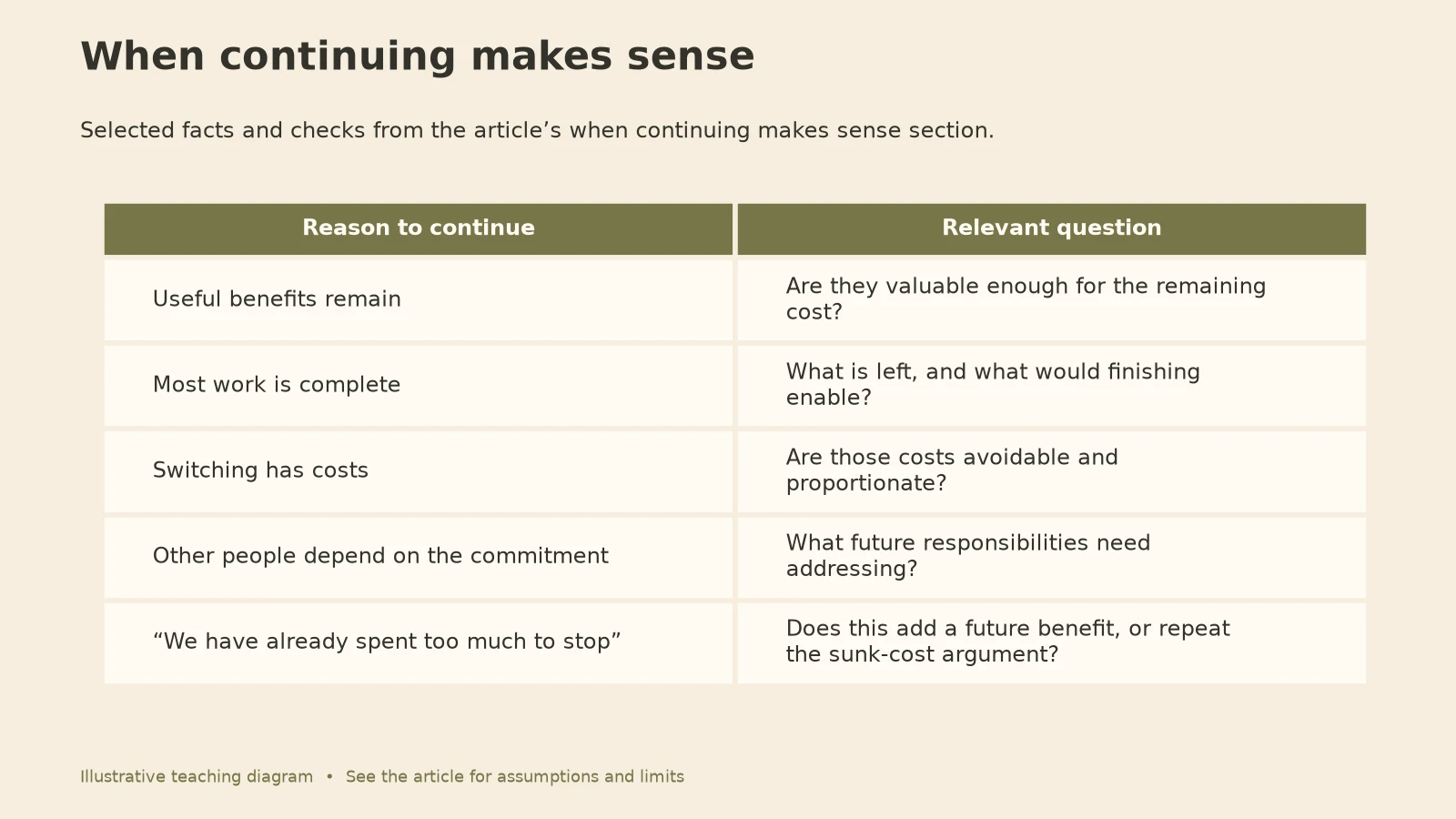
Look at the last row. Denton’s sentence lives there. A senator could have argued for the canal with traffic forecasts and remaining costs. The money already spent added nothing to that case.
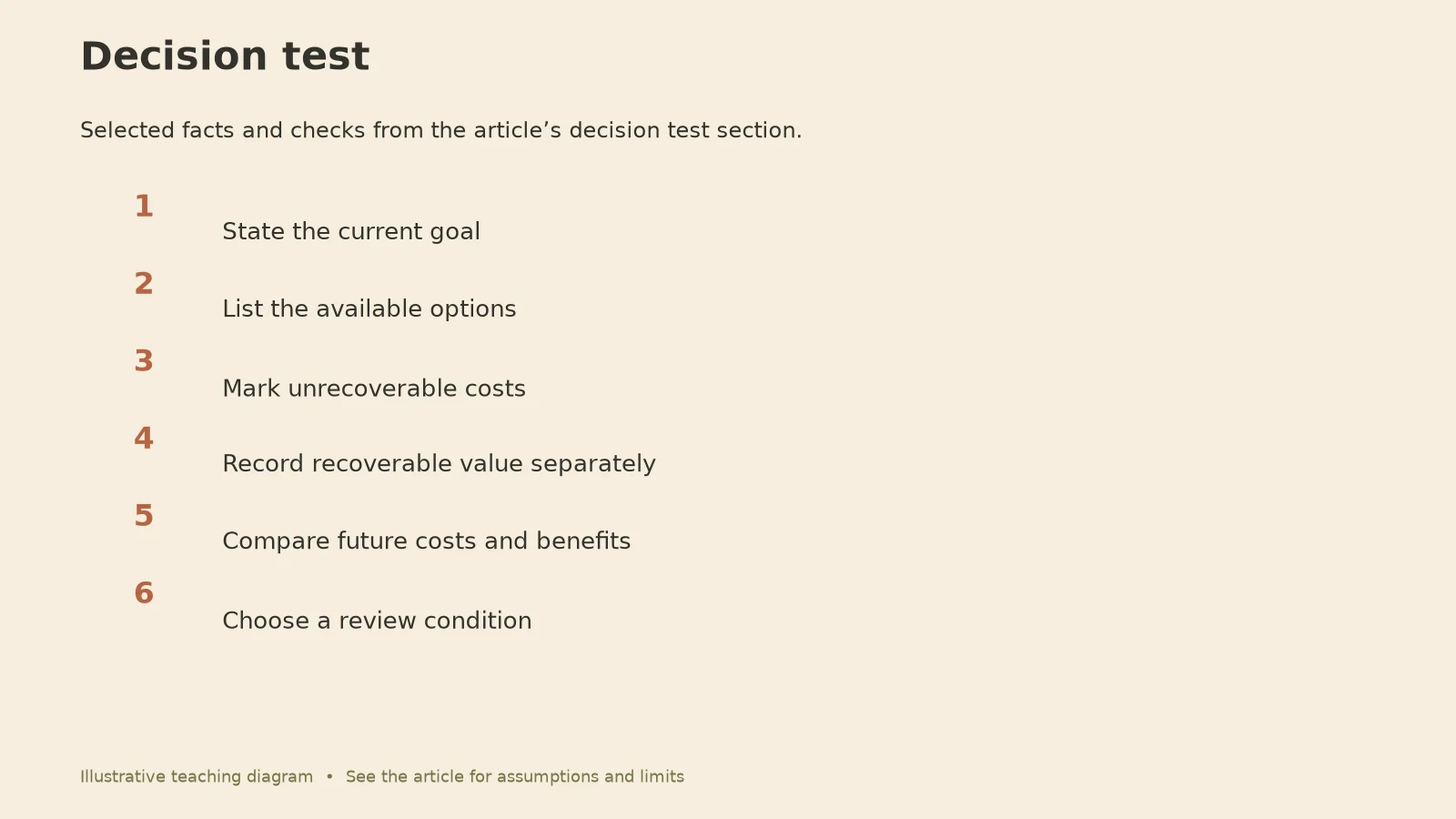
Six steps for a stop-or-continue decision
- State the current goal. Check whether it has changed since the commitment began. Barge markets in the 1980s looked different from the 1970s forecasts.
- List the available options. Include continuing, stopping, shrinking the scope, and switching.
- Mark unrecoverable costs. Write down why each one is the same whatever you choose.
- Record recoverable value separately. Refunds, resale, reusable work, and transferable skills go here.
- Compare future costs and benefits. Include effort, timing, obligations to others, and the cost of switching.
- Decide in advance what would make you stop. “If first-year traffic falls below half the forecast, we reassess” is a commitment you can keep.
The single most useful question: if you faced these remaining options today, knowing what you know now, which would you choose? It leaves your history intact. It just stops asking the next step to repay money that is gone.
For a team, ask someone outside the original commitment to review the comparison. Give them the facts, though. Distance alone does not make anyone’s judgment better.
When “ignore sunk costs” goes wrong
- It becomes an excuse to quit anything hard. Effort already spent often bought skill or progress that makes finishing cheaper. Count that.
- Outcomes get used as the verdict. Tenn-Tom traffic did grow after its first year, and a 1988 drought pushed more barges onto it. Judge the 1981 reasoning by what was known in 1981.
- Promises get treated as sunk. A commitment to other people is a future obligation. Breaking it has costs that belong in the comparison.
The sunk cost fallacy vs opportunity cost guide puts the backward-looking and forward-looking questions side by side.
Questions people ask about the sunk cost fallacy
Is finishing something always a sunk cost fallacy?
No. Finishing is the best option whenever the remaining benefits justify the remaining costs. The reasoning decides whether the fallacy is involved, not the act of continuing.
Why is it so hard to stop?
Stopping makes a loss feel final and can look like admitting a mistake. It sits alongside anchoring and confirmation bias among the most common cognitive biases. The theater study suggests the pull works even when the amount at stake is a ticket discount.
How is a sunk cost different from an opportunity cost?
A sunk cost is already spent and cannot be recovered. An opportunity cost is the value of the best alternative you give up by choosing now. The opportunity cost guide explains it through Warren Buffett’s $200 billion textile mistake.
Run the fresh-start test before the next payment
The next time you are about to put more money, time, or effort into something that is struggling, start a five-minute session on the Slow Down focus timer and fill in this card:
Already spent (gone either way): ___
Still to spend if I continue: ___
What finishing gets me: ___
Best other use of what is left: ___
Starting fresh today, would I begin this? yes / no
If the last answer is no, the money already spent cannot turn it into a yes.