A 32-year-old product owner, working remotely for about $100,000 a year, spent a Sunday doing the arithmetic on two pivots. One was an anesthesiologist assistant program: roughly $200,000 for the master’s, three years of school, and $220,000 to $250,000 a year afterward. The other was airline pilot training: about $100,000 in certifications, eight to ten years before the pay ceiling, then $300,000 to $500,000. He also held a $5 million rental property he expected to inherit and eventually manage.
He came out of it with one number: about half a million dollars.
The arithmetic is not wrong. The label is. And a label that is wrong in the direction of “too expensive” settles a decision before you have started asking questions about it. Here is how to build the number that belongs in the comparison, and what to do with the parts of the decision that will not fit into a number at all.
The number that is wrong: adding cost to forgone wages
Opportunity cost is the value of the next best alternative you give up. It is not a price, and it is not the sum of the two. The price is what you pay to get onto the new path; the opportunity cost is the alternative you walk away from. Both of them belong in the comparison, in different columns.
In his model, the $200,000 of student debt is the cost of the new path. It is money you pay only if you switch, and it buys you the thing you are switching for. The $300,000 of wages given up over three years of school is the opportunity cost, because those years and that income are the alternative you walk away from.
Adding them produces $500,000 and labels it the opportunity cost. The label is wrong: $500,000 is the total economic cost of the pivot, and a perfectly good number to know. It is not a substitute for the comparison.
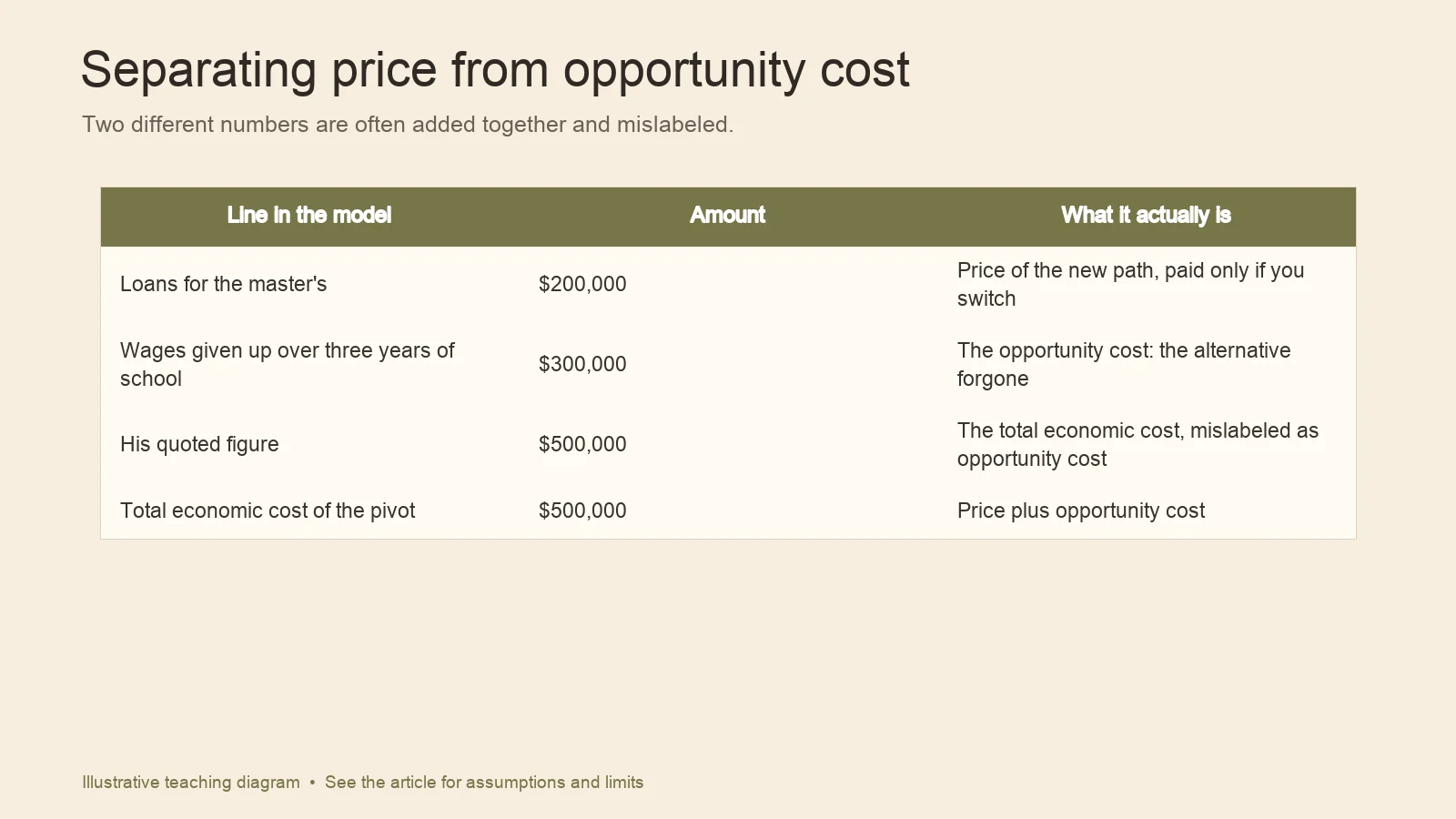
| Line in his model | Amount | What it actually is |
|---|---|---|
| Loans for the master’s | $200,000 | Price of the new path, paid only if you switch |
| Wages given up over three years of school | $300,000 | The opportunity cost: the alternative forgone |
| His quoted figure | $500,000 | The total economic cost of the pivot, mislabeled as opportunity cost |
| Total economic cost of the pivot | $500,000 | Price plus opportunity cost |
Here is why the distinction matters for the decision, not just for the vocabulary. The comparison you need is the future net cash of each path over the same horizon, side by side. Start with a simplified three-year picture that leaves interest and financing costs out of it. Stay in the current job and you are $300,000 richer in cash. Switch, and you pay $200,000 for the master’s, so you are $200,000 poorer. The gap between the two paths is $500,000, made of exactly two pieces: the $200,000 you pay only if you switch, and the $300,000 of wages that switching takes away from you. Count each piece once, and do not put the forgone wages on both sides of the ledger. Interest and financing costs are not in that $500,000, and they only widen the gap — which is why the real comparison has to run on a timeline.
Why the label matters so much: a mislabeled number travels. Call $500,000 the opportunity cost and every sentence after it inherits the error, including the conclusion that the switch is unaffordable because the forgone value is that large. The honest version is one side a $300,000 salary stream and the other a $200,000 bill: a three-year investment with a specific price, a specific payback period, and a real chance it does not work out.
Notice one more omission. The pilot path — $100,000 of certifications for $300,000 to $500,000 — sits in the same paragraph of his thinking and never enters the arithmetic at all.
Price the whole horizon, not year one
The second mistake is more common than the first: comparing the first year of one path against the tenth year of another.
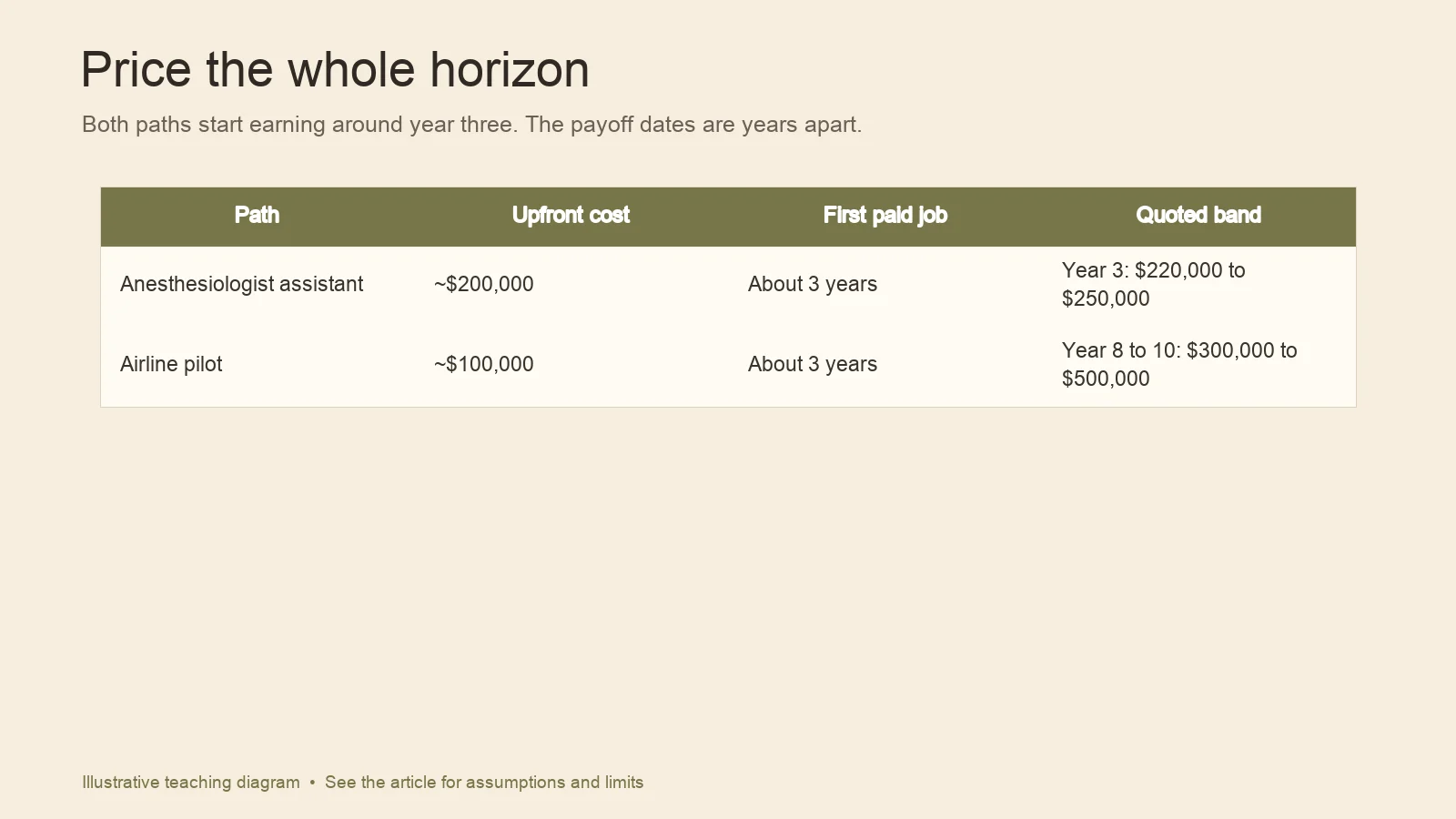
| Path | Upfront cost | Time to the first paid job | Time to the quoted band | The quoted band |
|---|---|---|---|---|
| Anesthesiologist assistant | ~$200,000 | About 3 years | Year 3 | $220,000 to $250,000 |
| Airline pilot | ~$100,000 | About 3 years | Year 8 to 10 | $300,000 to $500,000 |
The model he built ran three separate clocks together, and the table above separates them: how long the training takes, when the first paycheck arrives, and how long it takes to reach the top of the pay band. On the assistant path he has all three — prerequisites first, then a little over two years of school, and the quoted income starts right after. On the pilot path he has the first and the third but not the middle one: certifications and flight hours take roughly three years and end in a regional airline seat, and reaching a major airline’s $300,000 to $500,000 takes eight to ten years from today. What he does not have is what a regional airline seat pays, and that is the number that has to sit in the years between.
Put those two on one timeline and they start close together: year one of the pilot path is year one of the assistant path, because both training runs are about three years long. The gap opens later. The assistant path reaches its quoted band in year three and stays there; the pilot path spends another five to seven years climbing from a regional seat toward a major-airline band it may never reach. A model that compares year one against year one will always pick the three-year program, and it will pick it for a reason that has nothing to do with where the two paths end up.
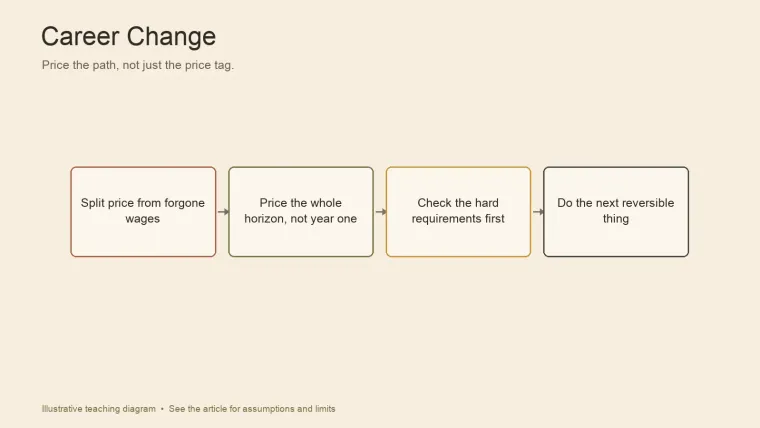
Here is the method:
- Lay both paths on a single timeline, year by year, running to the same end year.
- Track cumulative net cash on each side: what you have earned minus what you paid to get there.
- Find the year the two lines cross. That year is your break-even point, and it is the only number in this analysis that matters.
- Ask the question no spreadsheet can ask: will you still be in that role when you reach it? A path that does not reach its band until year eight to ten only pays if you stay, and staying is its own decision with its own cost.
Two adjustments belong here. First, treat your own projection as the optimistic case, not the expected one: people are reliably optimistic about what they will personally earn in the field they have chosen, even when they can rank fields accurately by pay. Second, discount the length of the climb. Two paths that both start paying in year three are still not the same decision: one is at its quoted band in year three, the other is still climbing in year eight, and both are followed by the same thirty working years.
Terms you cannot price in dollars
Some of the terms that decide this decision cannot be converted into a dollar figure without inventing precision. They still have to be compared — on their own sheet, side by side, rather than buried inside a made-up number.
| Term | What to compare instead |
|---|---|
| The day-to-day work | Which environment you can actually work in, and whether you would choose it on a bad Tuesday |
| Where you live | The city the training and the early jobs put you in, and what it costs to live there |
| Time off | What entry-level postings actually offer, not the version advertised to people who already have the experience |
| The property you manage | The hours a week the path leaves you, and what those hours are worth |
Take the third row carefully. Very few anesthesiologist assistant jobs give eight weeks of paid time off to someone with no experience. Most postings for entry-level candidates start at four to five weeks, with increases as tenure builds. If your model assumed the eight weeks from day one, model four.
The fourth row is where his $5 million of rental property belongs. It is not a salary and it is not a bonus; it is a commitment that competes for the same hours as the training, the early shifts, and the travel. A path that has to be done in one city, on a fixed schedule, in person, competes with managing a property portfolio. A remote-first path does not. Neither of those facts has a dollar value, and both of them are heavier than a rounding error.
The general rule: if you force these into the spreadsheet, you will produce a number that looks decisive and is not. Keep them on a separate sheet, compared in the same sitting as the money.
The option value of staying put
Staying put is not the absence of a decision. A remote role at $100,000 a year is an option you hold: you can learn the new thing, pick up the credential one piece at a time, and stay employed while you do it. That option has real value precisely because exercising it slowly costs you very little.
The most common way to waste it is to wait for the right moment. People wait for a better offer, a fatter savings account, a calmer quarter — and the wait turns into years, because the conditions you are waiting for are conditions you are also waiting to create. Meanwhile the evidence that would actually resolve the question does not arrive until you take a step.
So price the delay like any other alternative. On a three-year program, each year of waiting is a year of training you do not have. On the pilot path, where the top of the band is eight to ten years out, delay is more expensive, not less, because the climb is longer.
But keep the option open in a way that costs you almost nothing. Staying employed while you learn is cheap. Staying employed while refusing to learn anything is not staying — it is drifting, and it ends up in the same place, more slowly, with less to show.
Check the hard requirements first
Some questions end the conversation before any arithmetic is relevant. Check them first, because they are cheaper to answer and they can end the decision outright.
| Gate | The question | Why it comes before the money |
|---|---|---|
| Licensure scope | Where am I legally allowed to practice? | Anesthesiologist assistants are not licensed to practice in every state |
| What entry-level jobs really offer | What do postings for candidates with my experience say, about pay and time off? | The advertised version of a job is usually the version for people who already have the experience |
| The training runway | How many years before this pays anything at all? | It sets the length of the horizon your comparison has to cover |
| Prerequisites | What do I have to complete before I can apply? | The first year of a plan is often prerequisites, not the credential itself |
Add one more if you have an asset or a business on the side: write down the hours a week the new path demands, and compare them to the hours your other commitments take. Eight to ten years to the top of the band is a schedule, not just a number of dollars — a pilot who cannot fly on weekends has a different life from one who can.
Do the next reversible thing
Reversible steps buy information at a low price. Rewrite your resume so it targets the new role, and see what comes back. Get the missing experience or the credential that qualifies you to apply. Talk to someone who is already doing the job you are considering and ask what their first three years actually looked like. Each of these is cheap, each produces a fact, and none of them commits you to the $500,000 decision.
This step gets skipped because it feels like not deciding. It is deciding — several times, cheaply, while the expensive decision stays open. And it is the only way to get the thing that breaks the paralysis: evidence. A spreadsheet will hand you the same answer every time you check it. A rewritten resume hands you a new one.
If you have been circling this for a while, the next action is not a bigger model. It is the smallest reversible thing that would tell you something you do not already know.
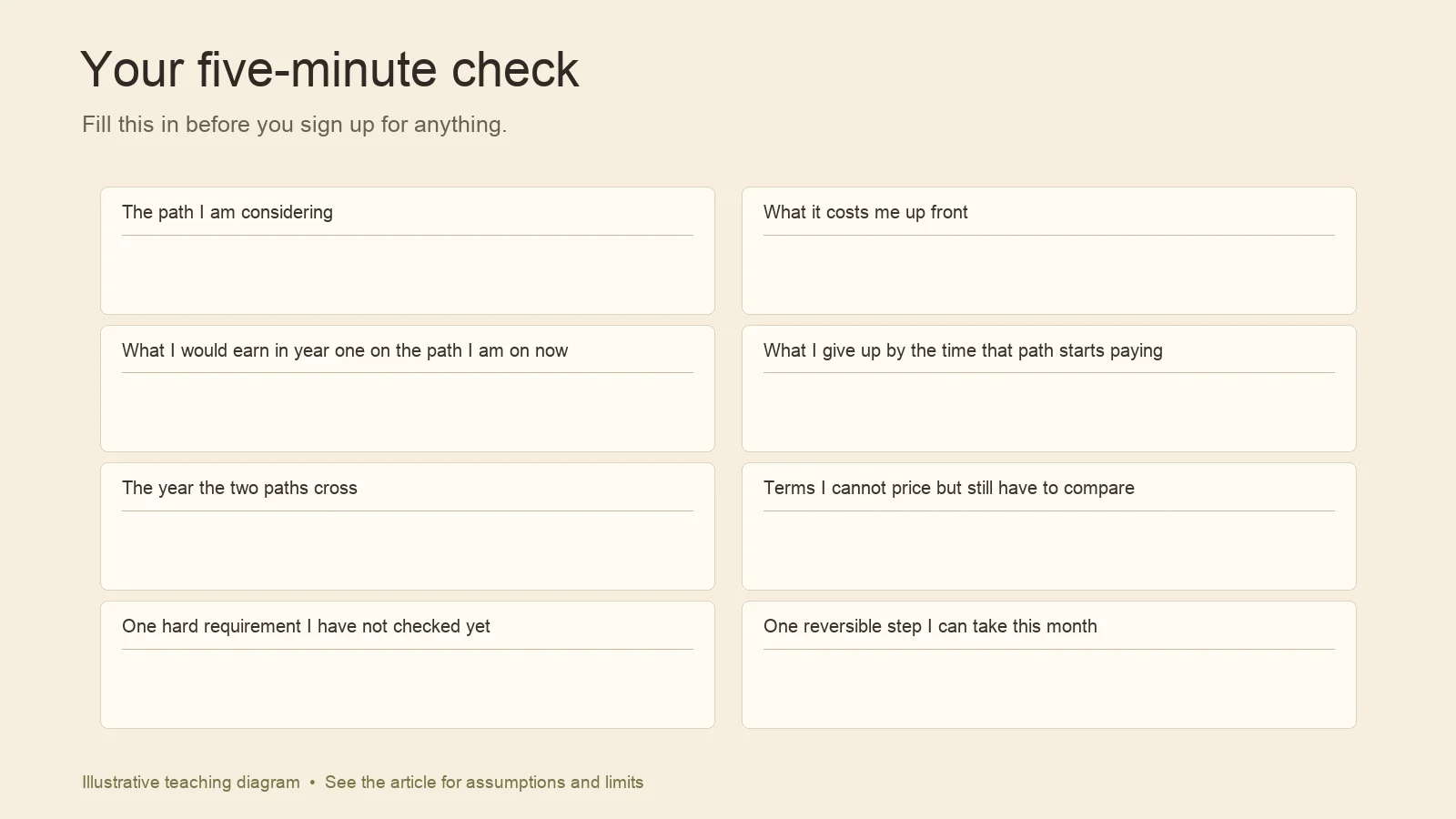
Your 5-minute career check
Before you run another scenario, fill this in:
The path I am considering: ___
What it costs me up front: ___
What I would earn in year one on the path I am on now: ___
What I give up by the time that path starts paying: ___
The year the two paths cross: ___
Terms I cannot price but still have to compare: ___
One hard requirement I have not checked yet: ___
One reversible step I can take this month: ___
The seventh line quietly decides most career changes, and it is the one people skip. A path that does not exist in your state, or that hands you four weeks of vacation instead of eight, is a different path from the one in your model.
For the underlying idea — what you gave up rather than what you paid — see the opportunity cost guide. For the arithmetic on a timeline, see how to calculate opportunity cost. To separate what you gave up from the options you merely rejected, see trade-off vs opportunity cost. And to keep one idea in front of you a day at a time, Daily Read turns it into a small daily action.