A 28-year-old lives with his parents. Most of his savings is already earmarked as a house deposit, with the rest sitting in index funds. He knows exactly what moving into a small place would cost him: his savings rate would fall from 40% of take-home pay to about 15%. He describes himself as somewhat mentally stuck, and every week he stays where he is, the two numbers sit there and neither one goes anywhere.
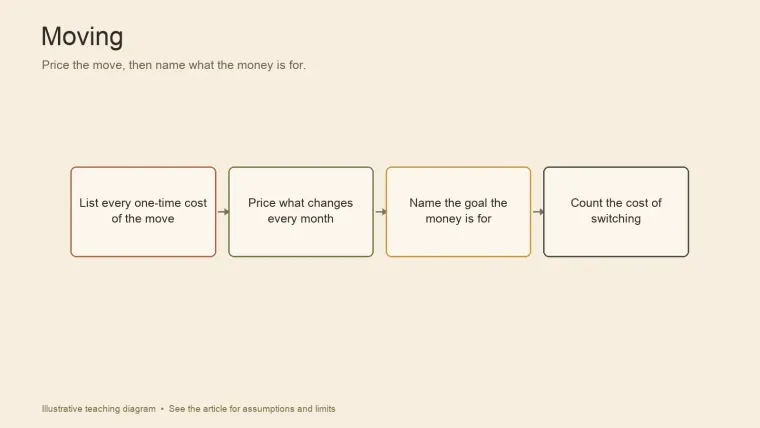
He has the arithmetic. What he does not have is a way to say what the money is for, and without that, 40% and 15% are just two numbers arguing with each other. Two questions settle this kind of move: what does the move actually cost, and what is the money for.
What a move actually costs
A move is not a rent payment. It is a pile of one-time costs that arrive before the first normal month in the new place, plus two permanent changes to numbers that used to be zero: your housing cost and your commute.
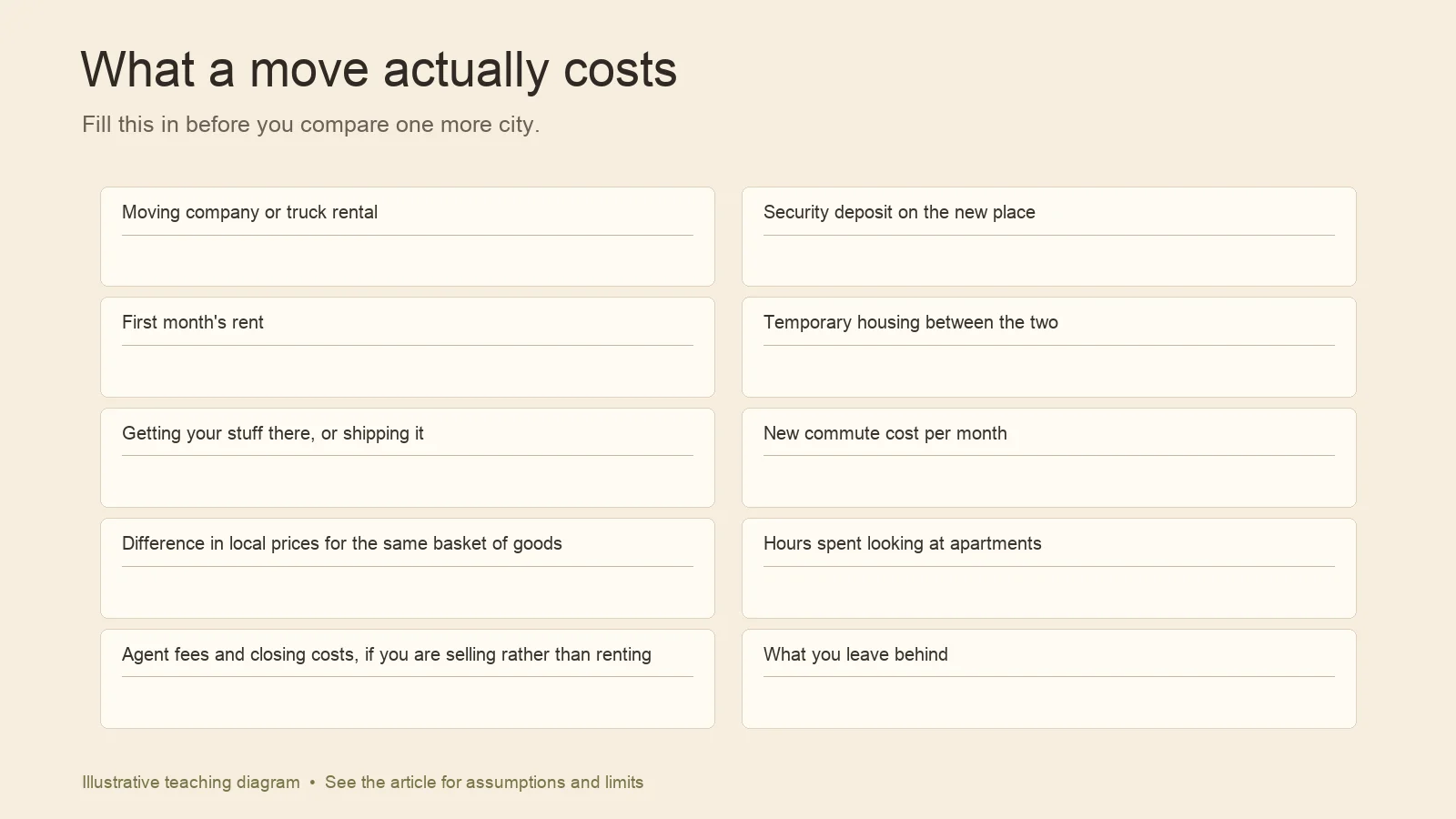
Here is the list most people are missing. Fill it in before you decide anything else.
Moving company or truck rental: ___
Security deposit on the new place: ___
First month's rent: ___
Temporary housing between the two: ___
Getting your stuff there, or shipping it: ___
New commute cost per month: ___
Difference in local prices for the same basket of goods: ___
Hours spent looking at apartments: ___
Agent fees and closing costs, if you are selling rather than renting: ___
What you leave behind: ___
Four of those lines need a note.
The temporary housing line is the one people skip, and it is the one that quietly doubles a move. If there is any gap between the end of one lease and the start of the next, you are paying for two places.
The commute line is bigger than it looks. Driving time added to a weekday is subtracted from the same hours you were counting on for the new path — the study, the training, the life. It does not show up as a bill, and it does not show up as a number, and it is still gone.
The price line needs care in both directions. A higher salary in a new city is not a raise if the cost of living moved with it. Compare the same basket of groceries, the same utilities, the same rent for the same kind of place in both cities. A city that looks generous on salary can be flat once the local prices are in the column, and that is how a move ends up buying a smaller life at a higher price.
The last line is easy to skip and hard to replace. Leaving a place means giving up whatever was free there: the furniture you owned, the cheap rent, the meals, the help with childcare, the person who would watch the dog. That had value, and it is not coming with you.
Add it all up before you convert any of it into a percentage of your income. The total tells you whether this is a two-month project or a two-year commitment.
Leaving home: the savings rate trade-off
The hardest version of this decision is not moving between cities. It is moving out of a parent’s house, because one option costs you almost nothing and pays you a 40% savings rate, and the other costs real money and pays you about 15%.
It sounds obvious that the money is bigger. But a savings rate is a flow, not a balance, and the two rates are not the same unit. The useful question is not whether 40% is better than 15%. It is whether moving still leaves the goal reachable on the date you need it.
Two tests keep this from turning into a coin flip. First, what is the upside of moving out? Do not do it just to do it — the version of this decision where nothing gets better except the postcode is expensive and empty. Second, the arrangement has to work for two people. If you can save money and your family is not tired of you, staying is a legitimate choice, and moving out because it looks like adulthood is a cost with no benefit attached.
And the delay is not free, but the savings from delaying are not the point either. Six more months at home adds six months of the higher savings rate. It also adds six more months before whatever you are buying with independence begins. Which of those two facts matters depends entirely on what the money is for — and that is the next question, not this one.
Name the goal the money is for
Here is the question that unlocks the decision, and it has one line: what is this money for?
In the case above, the money already had a name: a house deposit, with the remainder held in index funds. That single fact changes what 40% and 15% mean. They are not more money versus less money. They are two different speeds toward a specific date.
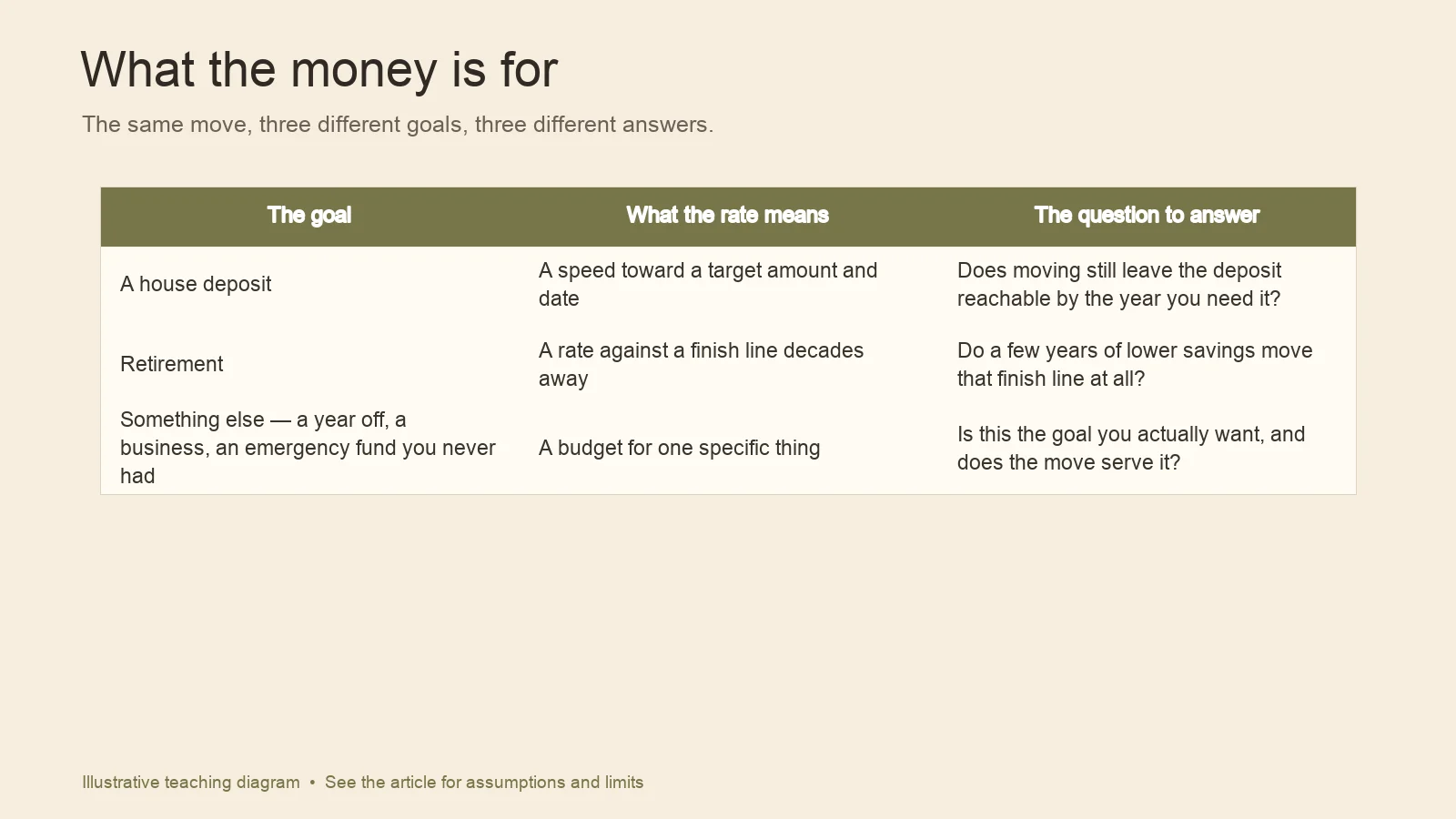
Name the goal before you model anything, because the same move produces a different answer under each one:
| The goal | What the rate means | The question you have to answer |
|---|---|---|
| A house deposit | A speed toward a target amount and a target date | Does moving still leave the deposit reachable by the year you need it? |
| Retirement | A rate against a finish line decades away | Does a few years of lower savings move that finish line at all? |
| Something else — a year off, a business, an emergency fund you have never had | A budget for one specific thing | Is this the goal you actually want, and does the move serve it? |
Under a long horizon, a move that improves the rest of your life can be worth more than the savings rate it costs.
Then check the assumptions, because the model is only as good as the places it guesses. A plan that assumes a double-digit annual return over a thirty-year horizon is not a plan; it is a wish with a decimal point in it. A plan that assumes you will earn the same in the new city as in the old one, or that the two cities will price the same things the same way, has two guesses doing the work of a fact.
And one last thing to name: some of what you have already spent is not part of this decision. The months you have lived at home are gone either way, and no choice made today brings them back. But the deposit saved so far is not spent money — it is cash sitting in an account, and whether it ends up as a down payment depends on what you decide next. The furniture you bought for that bedroom is the same: it has resale value, and it can come with you. Anything you cannot recover is out of the comparison. Anything that changes shape depending on which option you pick still belongs in it.
The cost of switching, including the switch itself
Every trade costs money to execute, and that cost is easy to leave out of the model, because you only pay it if you actually switch.
A car is the cleanest example. A driver with a 2025 Honda CR-V hybrid, 8,000 miles on it, $37,000 paid and $22,400 still owed at 4.49%, was weighing a trade for a $20,000 used vehicle to stop the depreciation. One offer on the table was $31,800 as a trade-in, plus about $1,760 in tax savings.
The gap between the two cars is about $10,000. The transaction costs about $10,000 too. The dealer buys the 2025 Honda for roughly $4,000 to $5,000 less than it is worth, and the $20,000 replacement is worth about $15,000 the moment it leaves the lot. Two sides of the same trade, and the fee comes out of the middle.
So the swap that was supposed to save money costs about what it saves. That is not an argument against ever switching. It is an argument for counting the switch: agent fees and closing costs if you are selling, movers, deposits paid twice, the value you leave behind in furniture and gear, the hours of hunting for a place. A plan to move in order to save money, with the switching cost left out of the model, is a savings plan with a hole in it.
Two questions settle a switch like this. First, is the difference big enough to be worth a new transaction — a $10,000 gap on a vehicle you may keep for years is not a financial event. Second, would you make the same purchase if you were not trying to optimize? A car that fits your life and a home in a place you want to be are worth having without a spreadsheet.
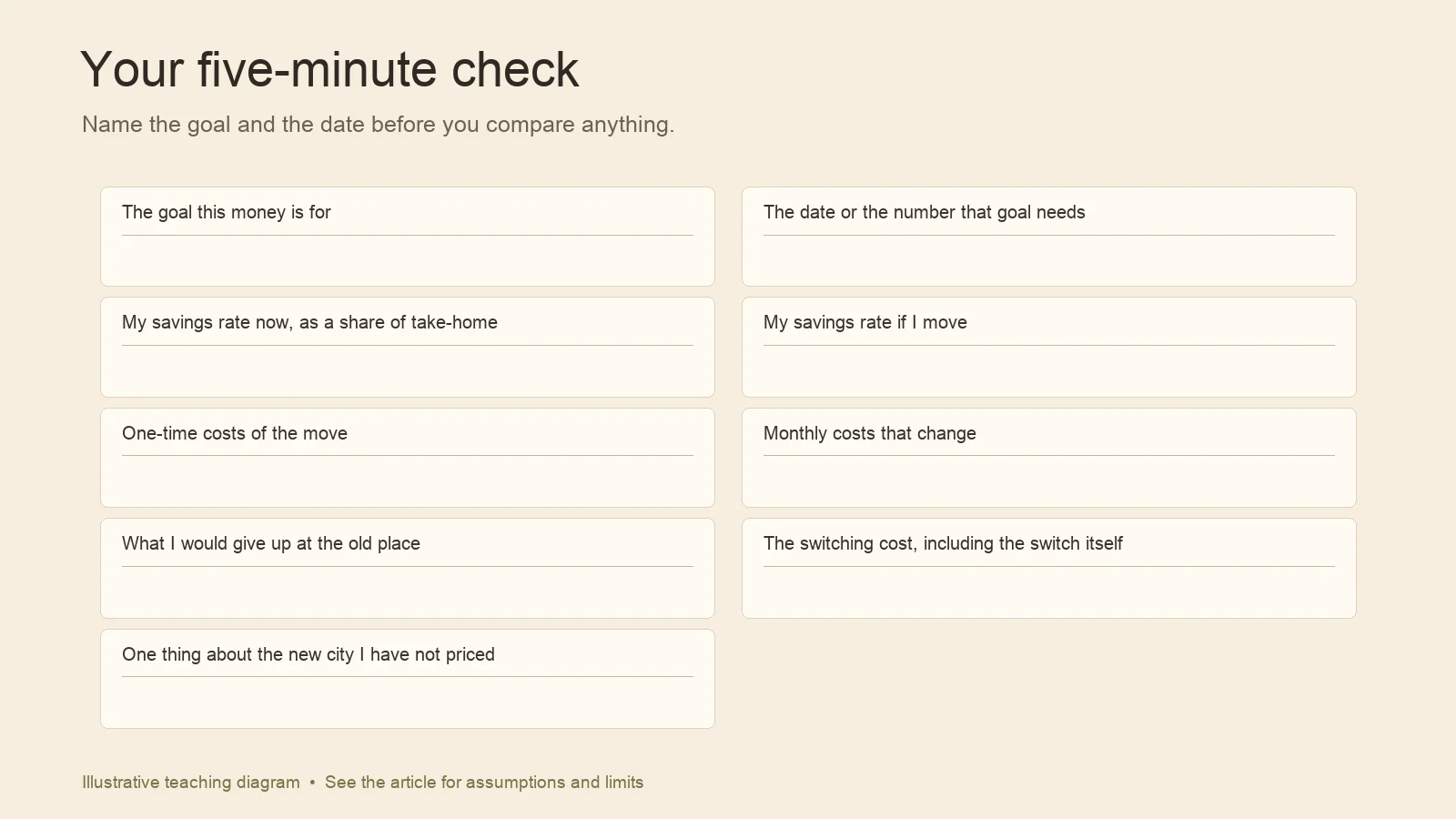
Your 5-minute move check
Before you compare one more city or one more apartment, fill this in:
The goal this money is for: ___
The date or the number that goal needs: ___
My savings rate now, as a share of take-home: ___ %
My savings rate if I move: ___ %
One-time costs of the move: ___
Monthly costs that change: ___
What I would give up at the old place: ___
The switching cost, including the switch itself: ___
One thing about the new city I have not priced: ___
Line two is the one that turns a preference into a decision. If you cannot name the goal and the date, the savings rate comparison will keep you stuck no matter how many times you run it.
For the underlying idea — what you gave up rather than what you paid — see the opportunity cost guide. For the arithmetic on a savings rate over time, see how to calculate opportunity cost. And for why the months you have already lived somewhere do not argue for staying there, see the sunk cost fallacy guide. To keep one idea in front of you a day at a time, Daily Read turns it into a small daily action.