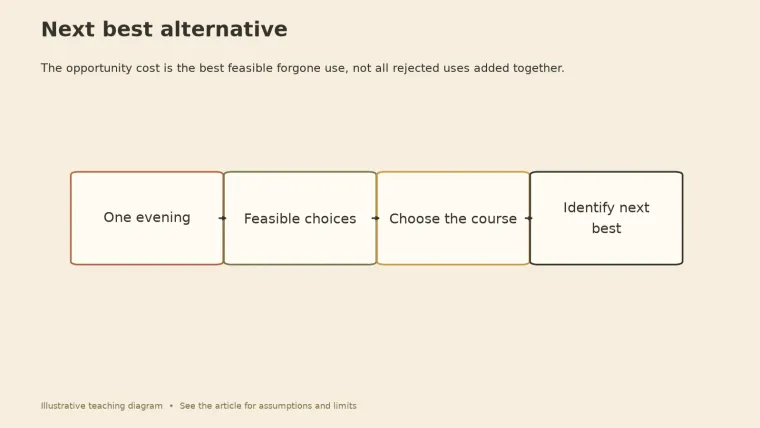
In 1964, Warren Buffett made a verbal deal with Seabury Stanton, the head of a struggling textile maker called Berkshire Hathaway. Stanton would buy back Buffett’s shares at $11.50. When the tender offer arrived in the mail, it said $11 3/8, an eighth of a point less.
Buffett felt “chiseled.” Instead of selling, he bought control of the company and fired Stanton. In 2010 he told CNBC that the decision cost him about $200 billion (CNBC transcript, 2010).
No one ever wrote Buffett a $200 billion bill. The figure measures a path he did not take.
Opportunity cost is the value of the next best alternative you give up when you commit a limited resource to one use. It is not the sum of every option you rejected, and it is rarely the same as the price. The quickest test: if your choice disappeared, what would you do instead?
This page covers what opportunity cost means and how to spot it. For the arithmetic, see the opportunity cost formula guide.
Buffett’s real cost was what the textile money could have become
Buffett’s own explanation is precise. He had “committed a major amount of money to a terrible business.” When a good insurance company came along in 1967, he bought it through Berkshire, which meant the new business started out carrying textile assets that were “earning nothing, year after year.” Had he put the same money straight into insurance, he said, “Berkshire would be worth twice as much as it is now.”
The price of the shares was visible on day one. The opportunity cost showed up over decades and never appeared on a statement.
| Price view | Opportunity cost view | |
|---|---|---|
| Question | What did I pay? | What would this money have done in its next best use? |
| Berkshire answer | Partnership money in a failing textile mill | Compounding inside an insurance business from the start |
| When it shows up | At the moment of purchase | Slowly, as the alternative grows and yours does not |
| How visible it is | Printed on the receipt | Never billed, so easy to ignore |
That last row is the whole problem. Forgone options leave no trace unless you name them on purpose.
How do you name the right one?
Five questions find the next best alternative
OpenStax defines opportunity cost as the value of the next best alternative forgone. These five questions turn that definition into a procedure.
| Question | Why it matters |
|---|---|
| What resource is constrained? | Defines why the uses conflict |
| Which alternatives are feasible? | Excludes imaginary options |
| Which alternative is next best? | Selects the relevant forgone use |
| In what units is its value meaningful? | Avoids false numerical precision |
| What assumption could change the ranking? | Makes uncertainty visible |
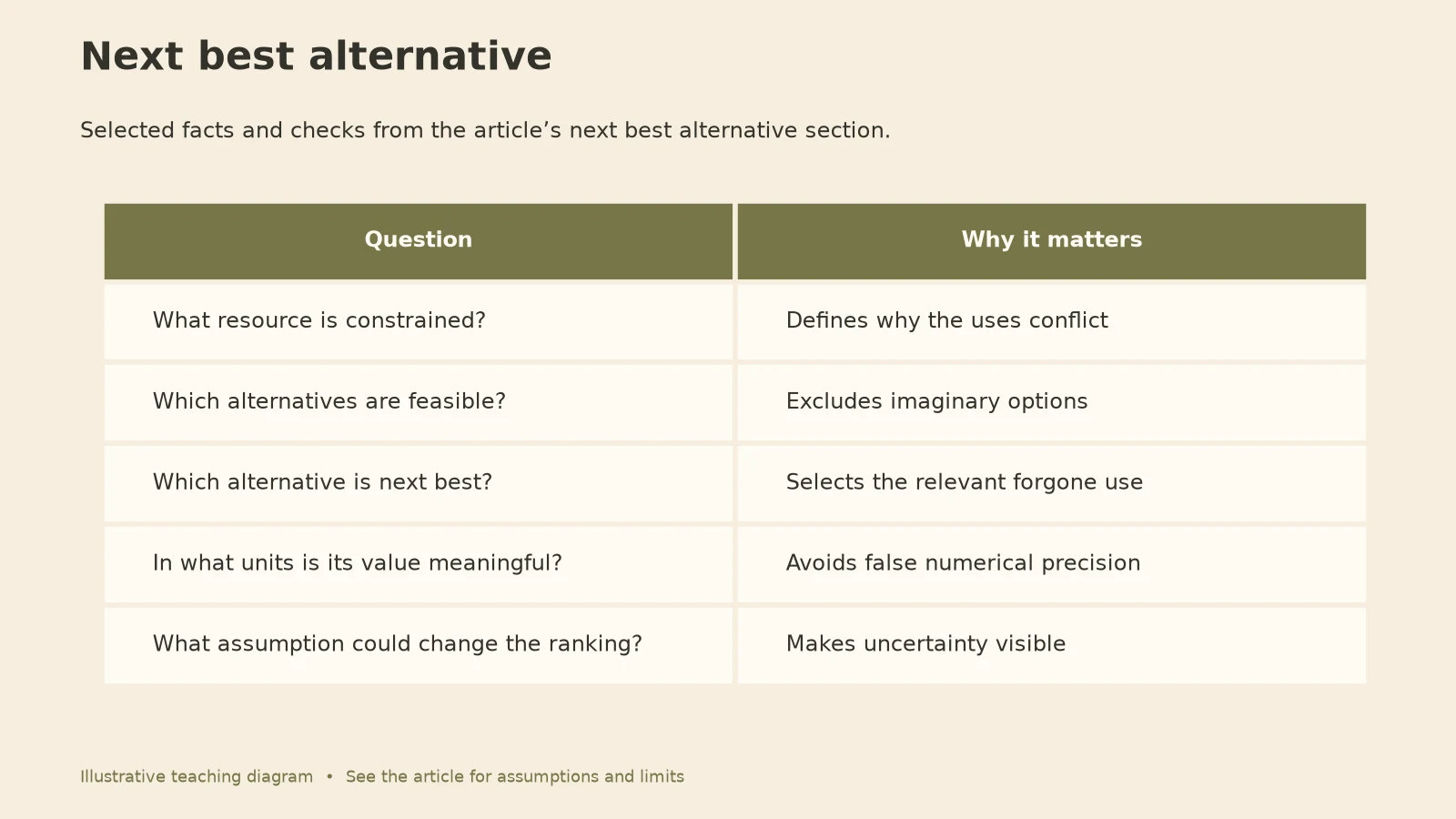
Run Buffett’s 1964 decision through them. The constrained resource was his partnership’s capital. The realistic options were to accept $11 3/8 and redeploy the cash, or to buy control. The next best use, by his own later account, was an insurance business. The meaningful unit was long-run return, not the eighth of a point he was angry about. And the assumption that could change the ranking: whether a good insurance deal would have come along without Berkshire as the vehicle.
Notice what the anger did. It pointed his attention at the $0.125 per share he was losing. The alternative he was giving up never came up at all.
Everyday choices hide the same cost
You will probably never buy a textile mill out of spite. The same structure appears whenever time, money, or space can serve one purpose at a time.
| Limited resource | Chosen use | Possible best alternative | What might be forgone |
|---|---|---|---|
| One evening | Take a course | Work an available shift | Net earnings from that shift |
| A room for one hour | Hold a team workshop | Run a booked client session | Value of that feasible session |
| A study period | Practice one subject | Practice another priority subject | Learning or preparation elsewhere |
| A fixed budget | Buy one required item | Buy another useful item | The benefit of the alternative purchase |
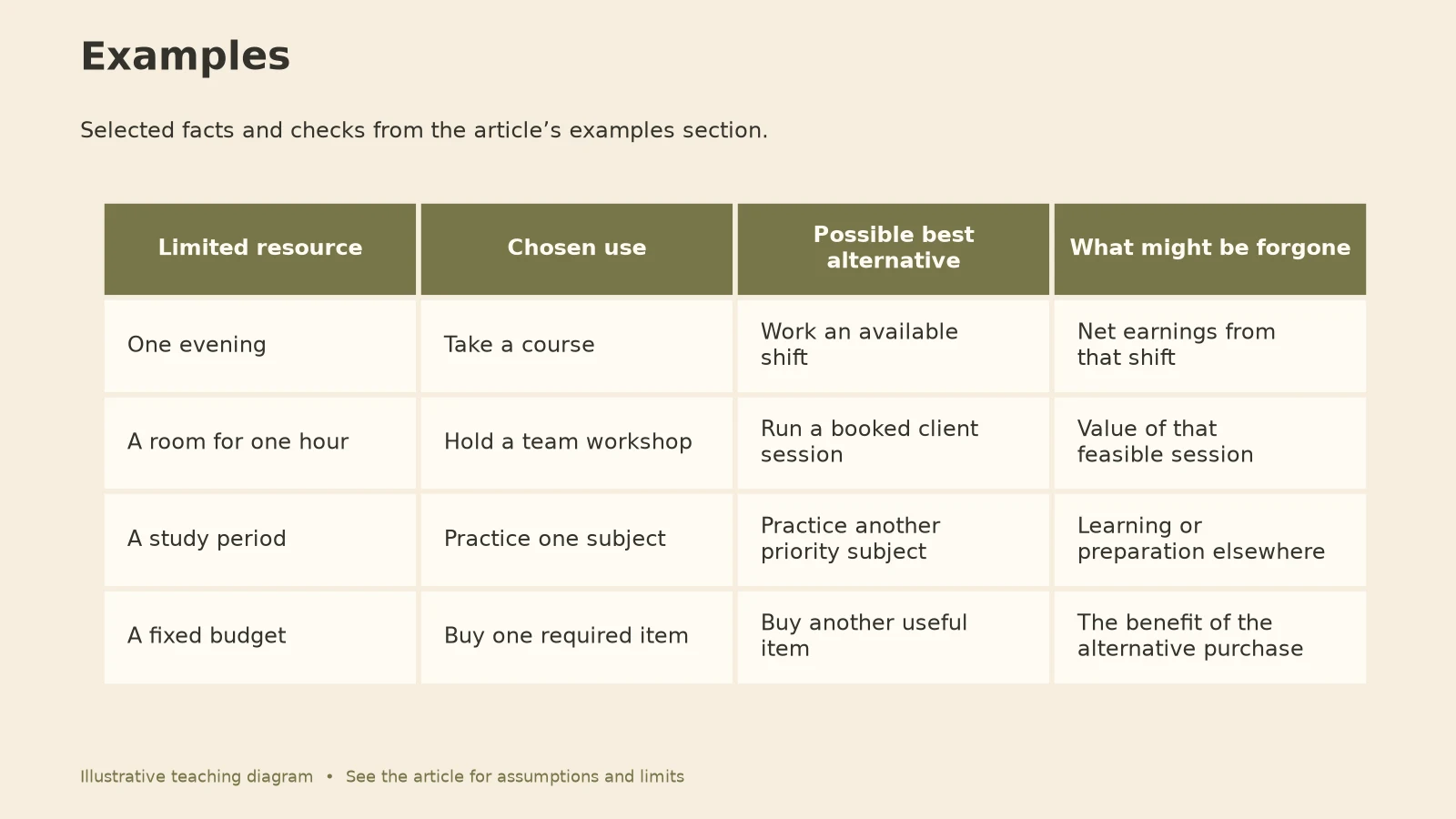
Money is sometimes the right unit, as with an offered shift. Sometimes the comparison is qualitative. A made-up dollar figure only hides the judgment.
Four mistakes distort the number
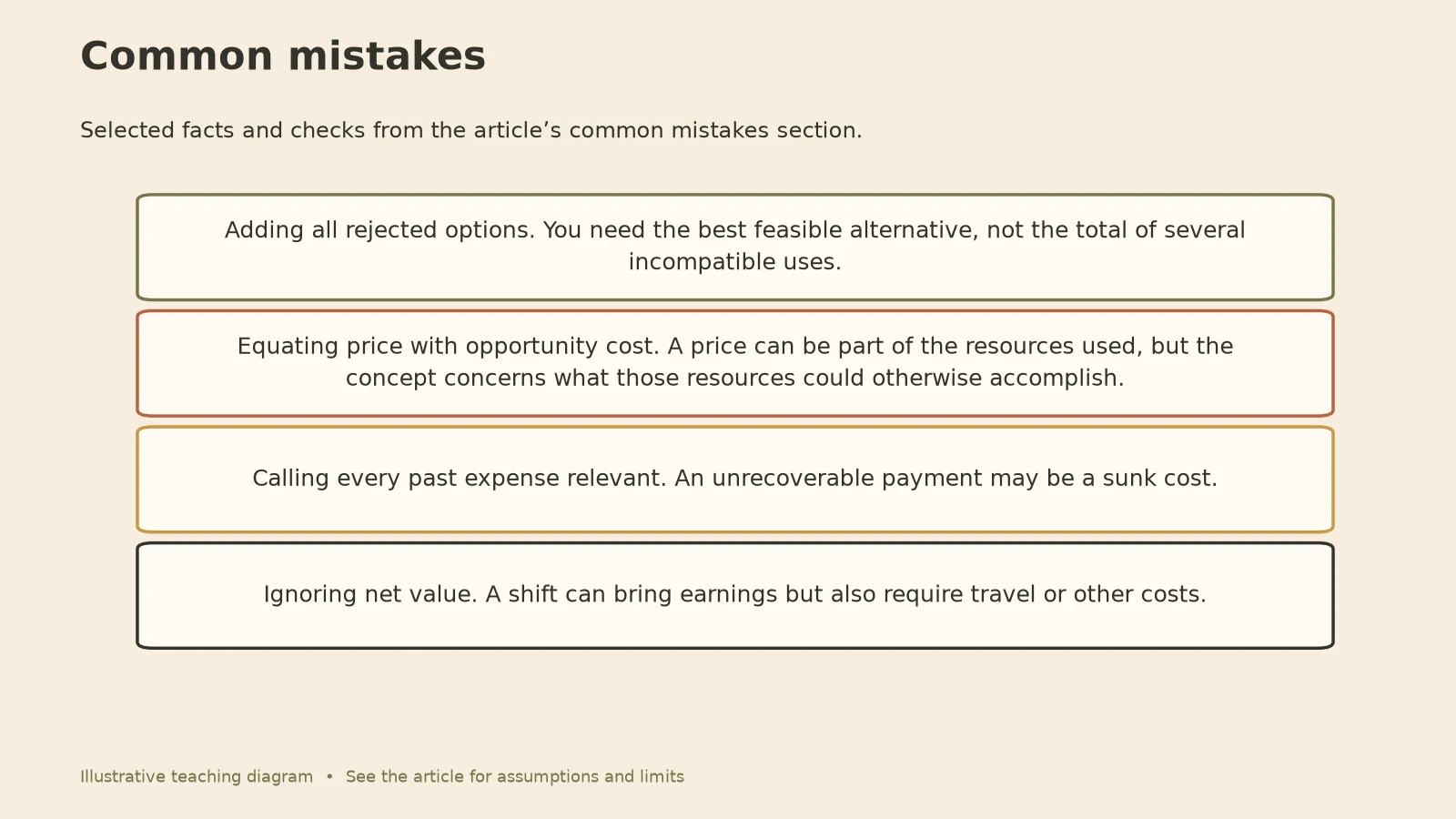
Adding all rejected options. Opportunity cost is the single best alternative you could actually have taken. Buffett could not have put the same dollars into insurance, railroads, and a stock fund at once, so the cost is not all three combined.
Equating price with opportunity cost. What Buffett paid for the shares was the visible cost. What mattered was what those dollars could have done elsewhere.
Calling every past expense relevant. Once the shares were bought, that money was spent. From then on, the live question was where the next dollar should go. The sunk cost fallacy vs opportunity cost guide separates the two.
Ignoring net value. An alternative has its own costs. An evening shift pays, but travel and fatigue come off the top. Compare net values, and count each item once.
Even with these fixed, the concept can still mislead you.
When opportunity-cost thinking leads you astray
- Hindsight picks the alternative. Buffett’s $200 billion is his own estimate, made decades later, when he knew insurance would boom. In 1964 that future was one possibility among many. Judge a choice by the alternatives you could see at the time.
- Every choice starts to look like a loss. Each constrained decision has an opportunity cost. That fact alone does not make the choice wrong. A course can be worth more to you than the shift.
- Constant comparison wears you down. Pricing every hour makes rest feel expensive. Save the analysis for large or hard-to-reverse choices.
Questions people ask about opportunity cost
Can opportunity cost be zero?
Only if the best alternative has no value to you. Paying no cash does not make it zero.
Is opportunity cost always measured in money?
No. Use the unit that fits the decision: money, hours, learning, or time with people.
How is opportunity cost different from a trade-off?
A trade-off is giving up some of one thing to get another. Opportunity cost is the value of the best option that trade-off excludes. The trade-off vs opportunity cost guide compares them side by side.
Write the forgone option down before you commit
The next time you are about to commit a real chunk of money or a free weekend, spend five minutes completing this card:
I am using: ___ (money, time, space)
For: ___
If this option vanished, I would: ___
That alternative is worth about ___ to me
I would still choose this because: ___
If the third line is blank, you have found the cost you were about to ignore. To make the question a habit, Daily Read is built for turning one idea into a small daily action.