A 20-year-old finishing community college before transferring to a state school for a finance degree has $75,000 saved, largely in broad-market index funds, and can pay every cost in cash. His question is whether to take federal subsidized loans, leave the money compounding, and invest the difference, or to pay out of pocket and never touch the savings.
It is a good question, and almost nobody answers it well, because the standard reply compares the wrong two numbers. Tuition is not what college costs you. Three or four years of not working is.
This page gives you the three numbers that matter, why “borrow and invest” is a bet rather than a free lunch, the aid almost nobody applies for, and a five-minute check.
Four years of wages, not just tuition
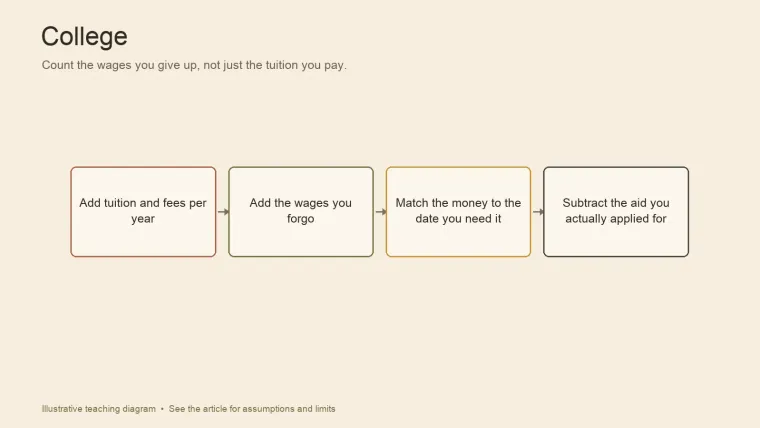
The explicit cost of college is the bill: tuition and fees, plus books, housing and food beyond what you would have spent anyway. The opportunity cost is the three or four years of wages you would have earned, plus what the money itself could have done while you were in school. Different quantities, constantly confused.
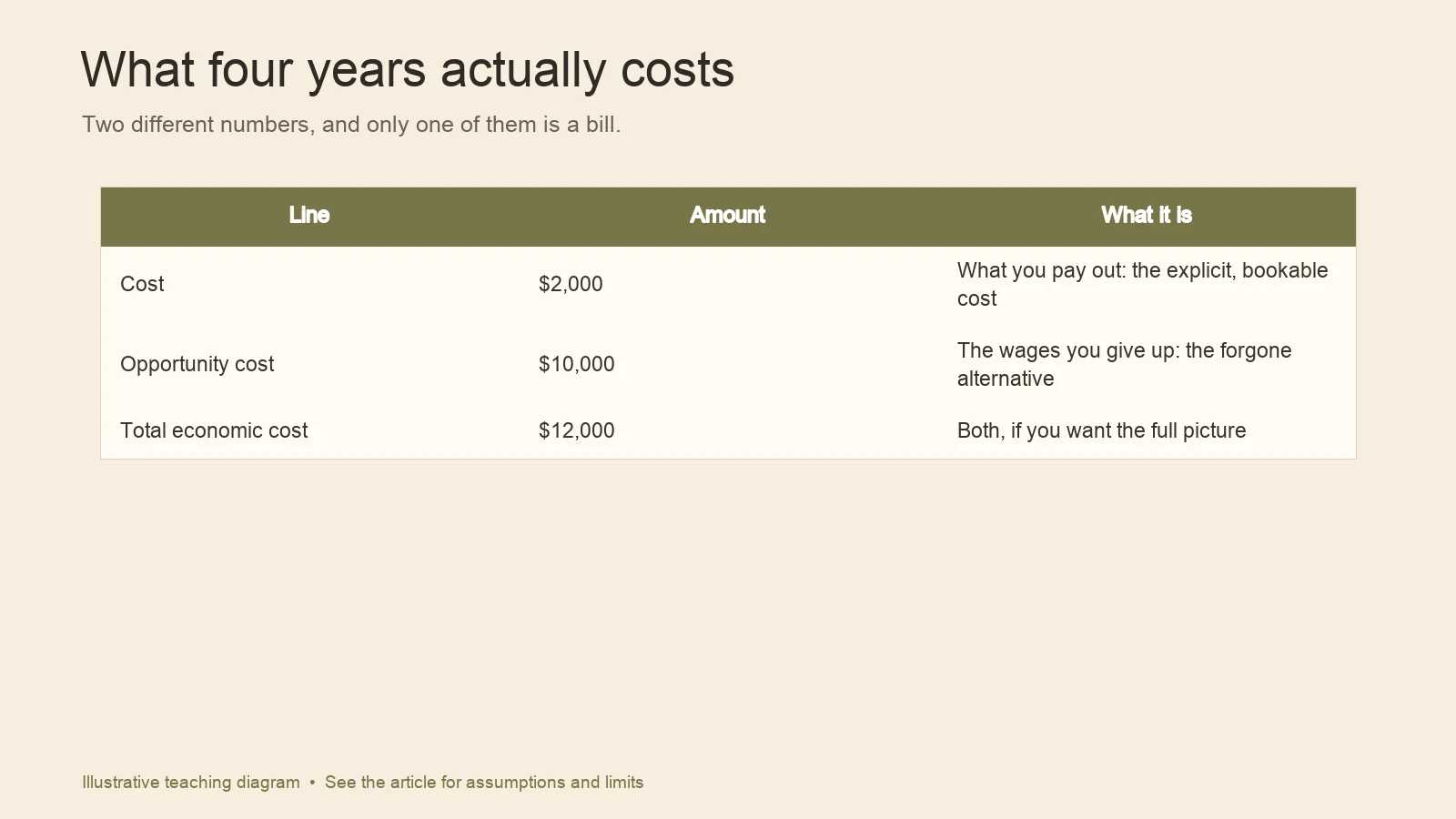
A classroom example makes it clean. Bob studies A-levels at $1,000 a year for two years, and has an alternative job paying $5,000 a year. Is the opportunity cost $12,000 or $10,000? Three numbers:
| Amount | What it is | |
|---|---|---|
| Cost | $2,000 | What you pay out: the explicit, bookable cost |
| Opportunity cost | $10,000 | The wages you give up: the forgone alternative |
| Total economic cost | $12,000 | Both, if you want the full picture |
An accountant reports $2,000. An economist reports $12,000 as the total cost, and $10,000 as the opportunity cost. Never add the loan to the forgone wages and call the sum “the opportunity cost”: the tuition is the cost, the wages are the opportunity cost, and the total is the total.
If you are explaining this to a teenager, the definition alone will not land. What works is three numbers on one page with your own numbers substituted: you will pay this much a year, you will not earn this much a month for four years, and here is what that money would have become.
Borrowing to invest is a bet, not a free arbitrage
Back to the 20-year-old. The plan is appealing: take federal subsidized loans at a low rate, leave the $75,000 in index funds earning more than the loan costs, and collect the difference. If the investments returned 8% while the loan cost 4%, you would clear 4% on the difference for two years.
What makes it look like arbitrage is that one side is knowable and the other is not. The loan rate is fixed and the interest accrues on a schedule you can write down. The investment return is an expectation, carrying all of the variability. Over two years, broad markets can be up 10% or down 10%, and if you need the money the moment you graduate, a 10% decline turns a spread into a shortfall.
Run the comparison the honest way and three corrections appear:
- Subtract the fees. A fund’s expense ratio, plus any origination or repayment cost in the loan terms, come off the investment return before you compare it with the loan rate.
- Check whether you can exit the loan cheaply. If the plan depends on clearing the balance at graduation, confirm there is no prepayment penalty and no interest accrued on the payoff quote.
- Price the downside. A plan that only works when the market cooperates is not a spread. It is a bet with a loan attached.
And the number that decides it: the spread you are quoting is an expected number, and expected numbers are not what arrive. If the market returns less than the loan costs, you paid interest on money that was sitting in cash and the spread was negative. Over a two-year window, that is not rare.
The question that settles it: when do you need the money?
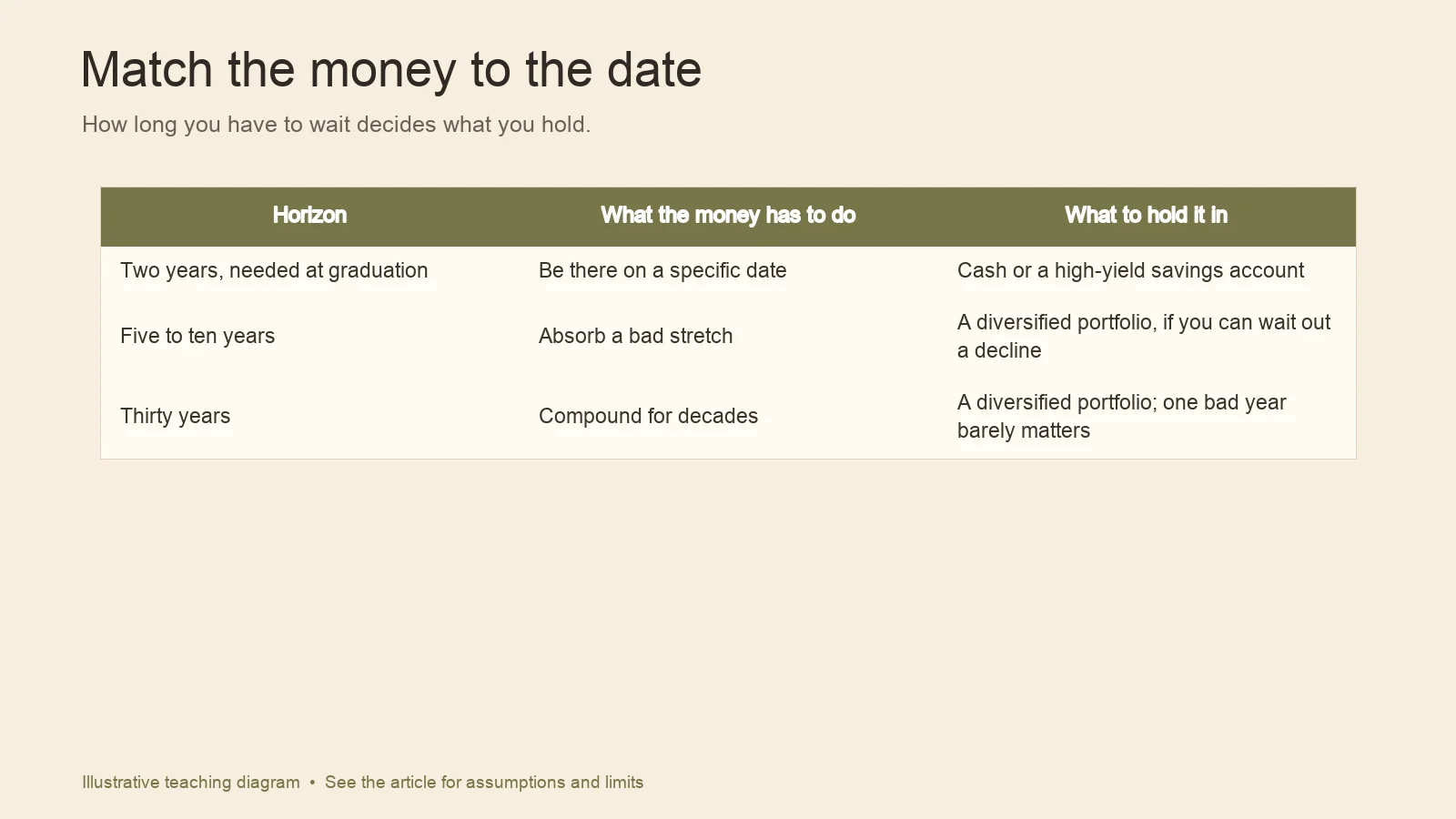
Before you run any numbers, answer one question: when does this money have to be there? Not “how much might it earn” — when is it needed.
| Horizon | What the money has to do | What to hold it in |
|---|---|---|
| Two years, needed at graduation | Be there on a specific date | Cash or a high-yield savings account |
| Five to ten years | Absorb a bad stretch | A diversified portfolio, if you can wait out a decline |
| Thirty years | Compound for decades | A diversified portfolio, and one bad year barely matters |
The third column carries the counterweight that resolves the argument. If you have the cash to pay for school, you have plenty of time to invest after school. Borrowing to hold a market position for two years, when the money could sit in cash today and be invested for forty years afterwards, buys two extra years of compounding and charges you the risk of the two years in between. That is a poor trade, and it is why the soundest answer is to pay out of pocket and start investing after graduation. If you want the cash left intact anyway, keep it somewhere safe rather than in the market — two years is too short for a market position to reliably come out ahead, so park it where it cannot lose 10%.
Aid and tax credits most people never apply for
Before you sign up for the full price, do the boring research. Very few people do it, and the money is sitting there.
Grants. Completing the FAFSA is the first step. Grants are money you do not repay.
Scholarships. Ask the college, not just the financial aid office. Community colleges often hold small scholarships nobody applies for because nobody asks. A few hundred dollars from several adds up to a semester.
Tax credits. The American Opportunity Tax Credit offsets part of the tuition and fees you pay for eligible education, and it has rules you need to check before you count on it.
The order matters. Do this research before deciding how to finance the rest: a student who finds grant money and borrows the remainder is in a different position from one who borrowed the full price and treats aid as a windfall later.
The 0% promo card trap
There is a route through tuition that sounds reckless and mostly is not. A nanny earning $750 a week with $8,000 saved planned to put a $2,700 community college bill on a 0% interest credit card with 2% cash back for ten months.
That plan is workable. Ten months at 0% with a balance she can pay down is manageable, and 2% back is a real return rather than a fee. The mistake is assuming the danger is the credit card. The danger is the promotion.
| The plan as it looks | The trap | |
|---|---|---|
| Interest | 0% for ten months | A remaining balance converts to a standard rate near 25% |
| Reward | 2% cash back | On a $2,700 balance that is about $54, against roughly $56 a month of interest at 25% |
| Skill required | Pay the balance down each month | Know the exact date the promotion ends |
The trap is arithmetic, not hypothetical. If $2,700 is still on the card when the promotion ends, the standard rate of roughly 25% applies, and the interest on the remaining balance runs about $56 a month — slightly more than the 2% cash back the card paid you. The advantage flips sign.
Two habits prevent it. Write the promotion end date in your calendar the day you open the account and treat it as a bill. And know the balance you need to clear before that date, because “I will pay it off then” is how people end up paying 25% by accident.
Choosing a major: the optimism bias
The bet you are making when you pick a major is not which major pays the most. It is whether you overestimate your own future income.
The evidence is uncomfortable in a specific way. Prospective students can rank majors from most- to least-well-paid with reasonable accuracy. What they get wrong is the personal part: they carry an optimism bias about personally making median or higher pay in the field they picked. The bias is strongest for students from lower-income backgrounds, whose estimates are less accurate because they know fewer people in those fields.
So the ranking is not the problem. The projection of your own place inside the distribution is.
The same optimism shows up in the stories people tell about the arts. One graduate described choosing an arts degree with the hope of being one of the small few who made it big, and the honest version of that field is a wide spread: at the low end, essentially destitute and earning less than minimum wage from your craft; at the high end, a millionaire. The bet is on your position in that distribution.
Two things follow. First, the median is the median: plan for the typical outcome. Second, prestige, name and income path are three dimensions you can trade separately, not one bundle. Take the cheapest route to the income path you want, take the famous name and accept a weaker income path, or take the expensive credential on the promise of a network — three decisions, each with its own price, instead of one decision about a school.
If your family is weighing study abroad against staying and working at home, keep two lines apart: what the risk and return are, and what the family expects. An expectation is not evidence. And some of the value of these years is not financial at all — it is the people you meet — so a decision that ignores that is incomplete, not rigorous.
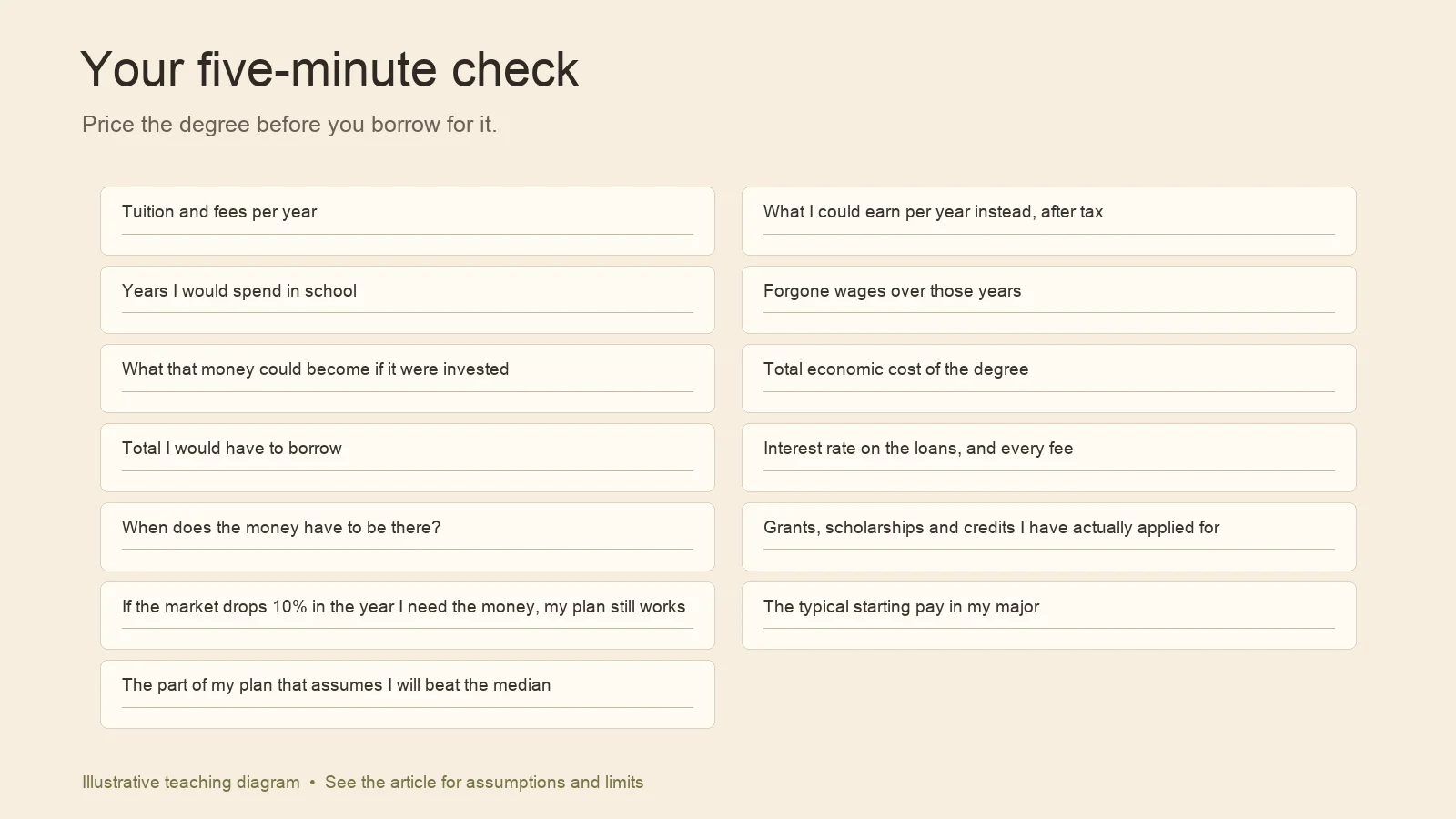
Your 5-minute college check
Tuition and fees per year: ___
What I could earn per year instead, after tax: ___
Years I would spend in school: ___
Forgone wages over those years: ___
What that money could become if it were invested: ___
Total economic cost of the degree: ___
Total I would have to borrow: ___
Interest rate on the loans, and every fee: ___%
When does the money have to be there? ___
Grants, scholarships and credits I have actually applied for: ___
If the market drops 10% in the year I need the money, my plan still works: yes / no
The typical starting pay in my major: ___
The part of my plan that assumes I will beat the median: ___
Line eleven is the one people skip and the one that changes decisions. If the answer is no, the plan needs a safe place to sit rather than a market position, far easier to fix now than after graduation. Line thirteen is the honest one: write down which part of your plan assumes you will beat the median. If you cannot name it, you are not planning, you are hoping.
College is the largest opportunity cost most people ever take on, and it stays invisible because the bill is the visible part. The framework underneath is in the opportunity cost guide, and the arithmetic for forgone wages is in how to calculate opportunity cost. If you are partway through a program and wondering whether to finish, the sunk cost fallacy guide explains why the money already spent should not decide it. To turn one idea like this into a daily action, Daily Read is built for that.