A household with more than $400,000, much of it in stock units that vest twice a year, sits down to ask whether now is a sane time to redo the kitchen — and discovers they have no real read on their own money. They have never built a monthly view of where everything stands, and they are not even sure which of their accounts matters for a remodel.
Most renovation decisions are not financially wrong. They are judged by the wrong standard. A remodel usually gets argued about as an investment that ought to “pay off”, which turns a decision about daily life into a gamble you are not allowed to lose. Change the standard and the same project becomes an ordinary, answerable question.
The house you live in is consumption, not an investment
The house you live in is where you live. It does not pay you, it wears out, and no renovation changes that. A home is not an investment; it is a place to live. The honest way to weigh a remodel is to compare its cost against your expected enjoyment of it.
That is not an escape from thinking about money. It changes what you compare against. The question stops being “will this pay back?” and becomes “are the goals I have already committed to funded first — retirement above all — and is the space I live in worth spending surplus money on?”
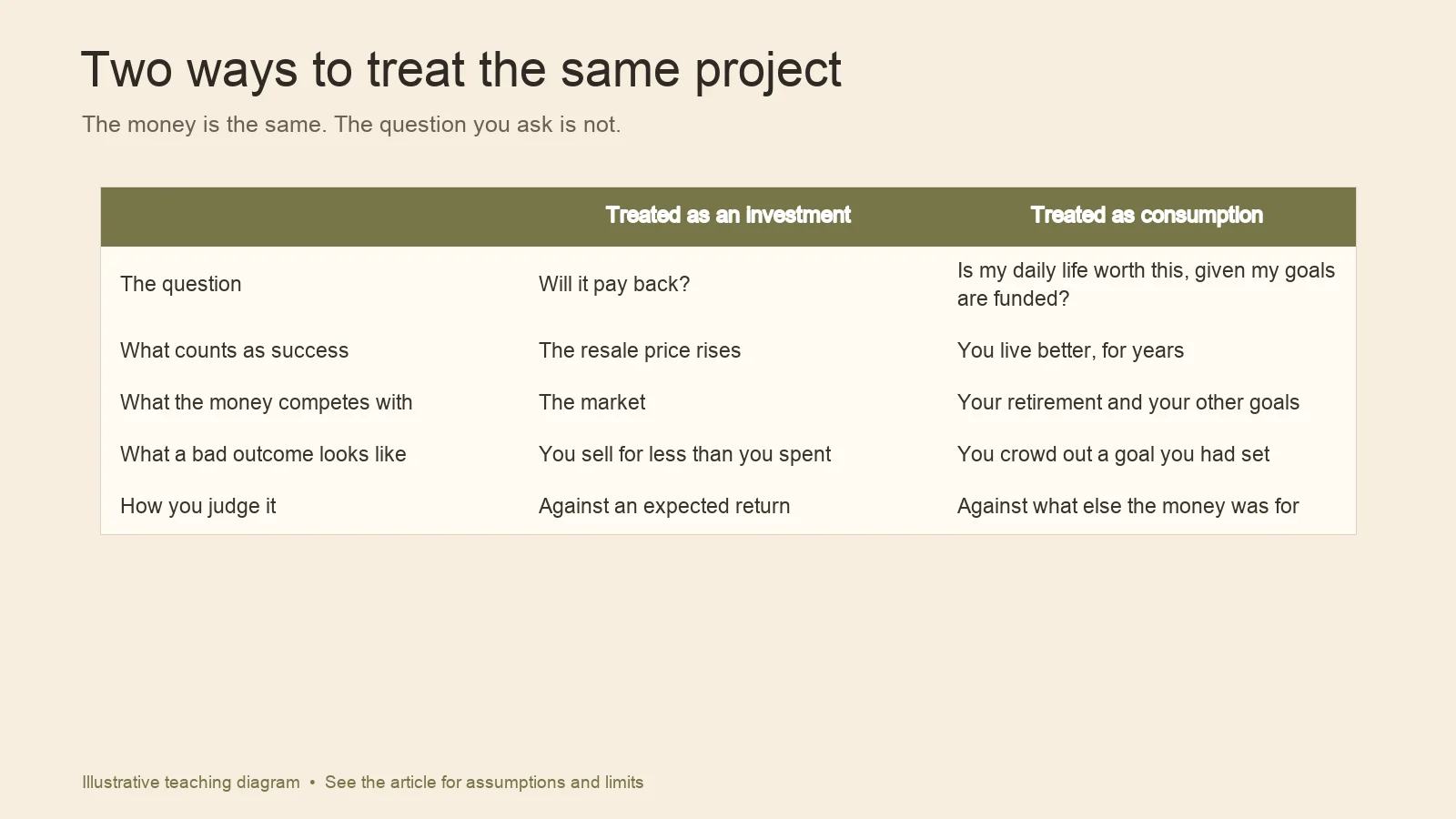
| Treated as an investment | Treated as consumption | |
|---|---|---|
| The question | Will it pay back? | Is my daily life worth this, given my goals are funded? |
| What counts as success | The resale price rises | You live better, for years |
| What the money competes with | The market | Your retirement, your emergency fund, your other goals |
| What a bad outcome looks like | You sell for less than you spent | You overspend and crowd out a goal you had set |
| How you judge it | Against an expected return | Against what else the money was for |
Two things fall out of that table. First, a remodel has no yield, so pricing it against the market compares two different kinds of money. Second, the answer stops being scary. If you have been arguing with yourself over whether $150,000 of remodeling “beats” the market, you have been using a yardstick that does not measure the thing you are buying. Ask instead what that money was going to do, and the tension usually drains out of the question.
Split the money: value-adding and pure consumption
Not all renovation dollars are the same kind of dollars, and mixing them in one line is why people cannot decide. Split the budget in two.
Value-adding is work a future buyer would pay for: added usable space, an extra bedroom or bathroom, a layout that opens up the main floor, a kitchen that fixes a real defect. Roughly, it increases what the house is worth to the next owner.
Pure consumption is work that changes how the house feels to you and returns nothing at resale: new finishes, a nicer tub, a better range, paint you like, a deck you will sit on every summer.
Both are valid, and neither is a financial mistake on its own. The trouble only starts when they sit in one line item, because then the decision has no question you can answer.
Consider a family of four with a $400,000 house who have already spent $50,000 on it and are weighing $200,000 more from a brokerage account, knowing the house would sell for only $500,000 to $550,000 after the work. Their question was whether putting more into a house than the house could be worth is a red flag. Three separate answers, and none of them is a simple yes or no:
- Split the $200,000. How much of it buys something a buyer pays for, and how much only buys a better life for you?
- Is the $200,000 a bet on the resale price, or consumption with a price tag?
- Does that money have a more important job than making a house you already live in nicer?
Renovate this house, or buy the house that fits
Here is the comparison most people are missing. A renovation should be compared against another house, not against an investment return. The real question is usually not “fix this house or keep the money?” but “fix this house or buy the house that already fits?”
A Bay Area surgeon owned a $600,000 house now worth $1.4 million and faced a $300,000 quote for a kitchen, wall removal and new windows. The quote solved one of five separate complaints about the house. The alternative was selling and buying a $2.5 million to $3 million house outright, with cash.
Notice what had gone wrong. The renovation was being measured against a five-problem wish list it could never satisfy, and against a market return, when the actual decision was between buying a house she wanted and fixing a house she did not.
| Your answer to this | What it means |
|---|---|
| ”I would happily live in this house once it is finished” | You are buying consumption, you have priced it, and the project stands on its own |
| ”It fixes one thing, and I would still want to move” | You are patching a house you want to leave; compare it against the house you would buy |
| ”It adds value a buyer would pay for” | Judge it on the value-adding column above, and still fund your goals first |
The first question is the most useful one. If you would happily live there, the number stops being an investment return and becomes a price for something you will actually use.
Every dollar you add to this house crowds out one more alternative, and the crowding gets worse as you go: the further you push a project in one direction, the more each additional dollar costs in what you give up elsewhere. That is the law of increasing opportunity cost showing up in a remodel.
The cheaper fix for the same complaint
If the project solves the complaint you are actually complaining about, do not skip the cheaper version of the same fix.
A 39-year-old remote worker in San Diego, earning $12,500 a month with about $1 million in retirement accounts and $250,000 in a brokerage account, was weighing $50,000 to $70,000 or more of floor plan changes, a kitchen and attic flooring to get a dedicated home office, knowing the return might be less than half of that. The stated complaints were clutter and no office.
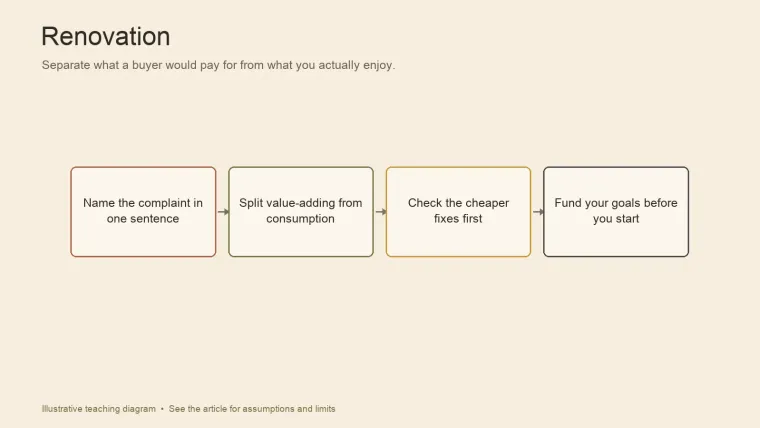
A renovation does not fix a clutter problem. Much of that complaint can be addressed for around $2,000 — organizers, a purge, and furniture you already own repurposed. That does not mean skip the project. It means write the complaint in one sentence first, then list the three cheapest ways to answer it, then price the project against the cheapest one that actually works. If the $2,000 version solves it, the $70,000 version is a different decision and deserves its own yes or no.
Only liquid money, and no financing
Two rules about where the money comes from, and both are non-negotiable.
Only liquid accounts. Checking and savings are what you spend from. A retirement account is not a source for a remodel — are you planning to early withdraw to pay for a sink? You do not liquidate investments to buy things. A brokerage account holding savings is a step better, but the rule holds.
No financing. Do not borrow for a remodel. You will pay interest on it, and you will still be making that payment long after the room stops being exciting. Paying in cash lets you skip the whole cash flow mess and keeps the decision where it belongs, with money you actually have.
Start with a monthly net worth view. It costs nothing, it is the only way to tell whether $70,000 is a small fraction of what you have or a large one, and it makes this decision answerable instead of anxious. But keep the two habits apart: the net worth view tells you where you stand, and only the liquid pot tells you what you can spend.
Property tax can change the answer
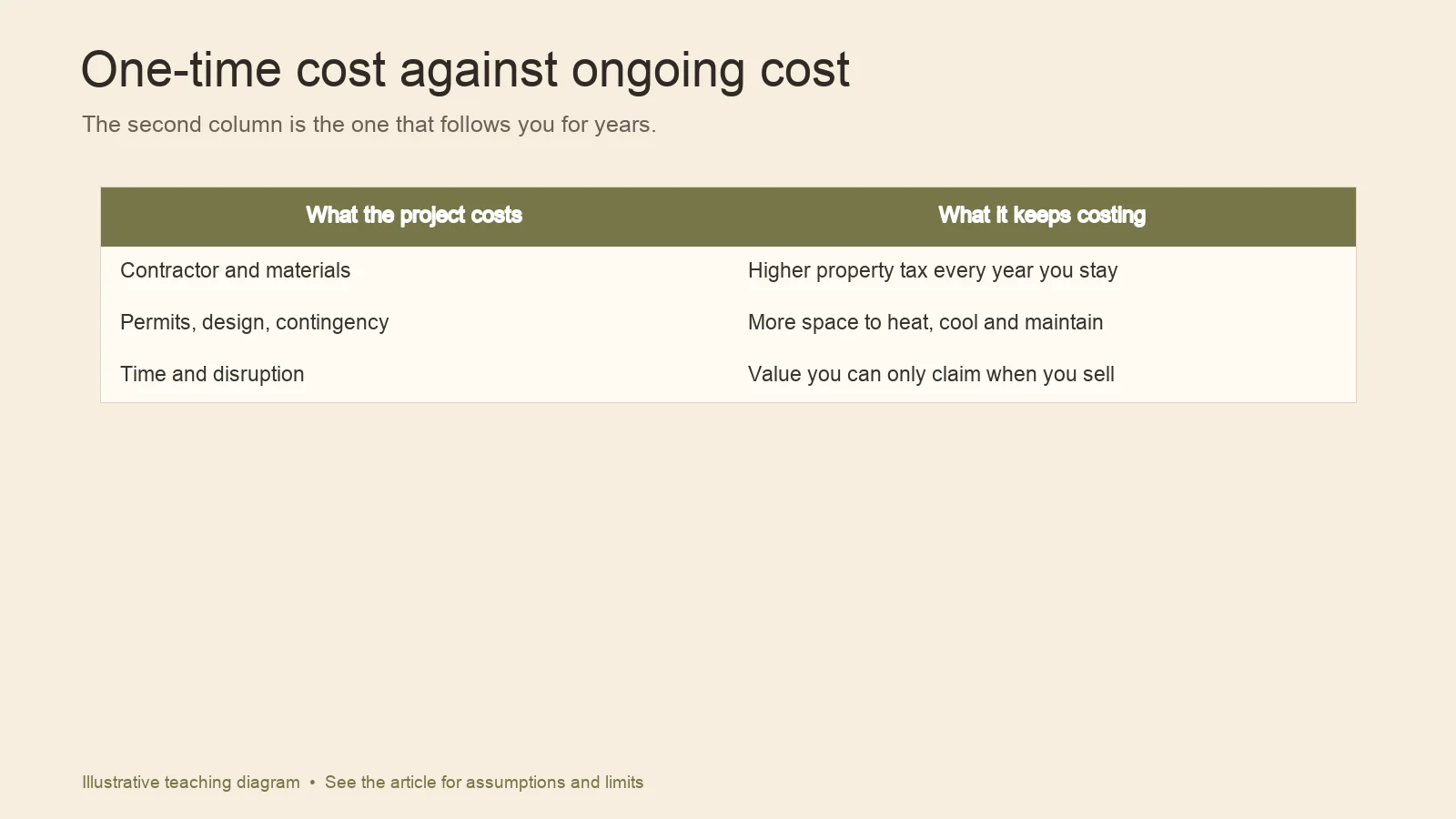
One more line belongs in the budget. Added square footage or major upgrades can trigger a reassessment of the home’s value, depending on the state, and that raises your property tax bill permanently. It is the cost of the project that keeps going after the contractor leaves.
| What the project costs | What it keeps costing |
|---|---|
| Contractor and materials | Higher property tax every year you stay |
| Permits, design, contingency | More space to heat, cool and maintain |
| Time and disruption | Value you can only claim when you sell |
If the work adds space, put the tax line into the total before you compare. A project that adds a bedroom and raises your tax bill is a bigger commitment than the invoice suggests. Check whether your state reassesses on added square footage or major upgrades before you sign, not after.
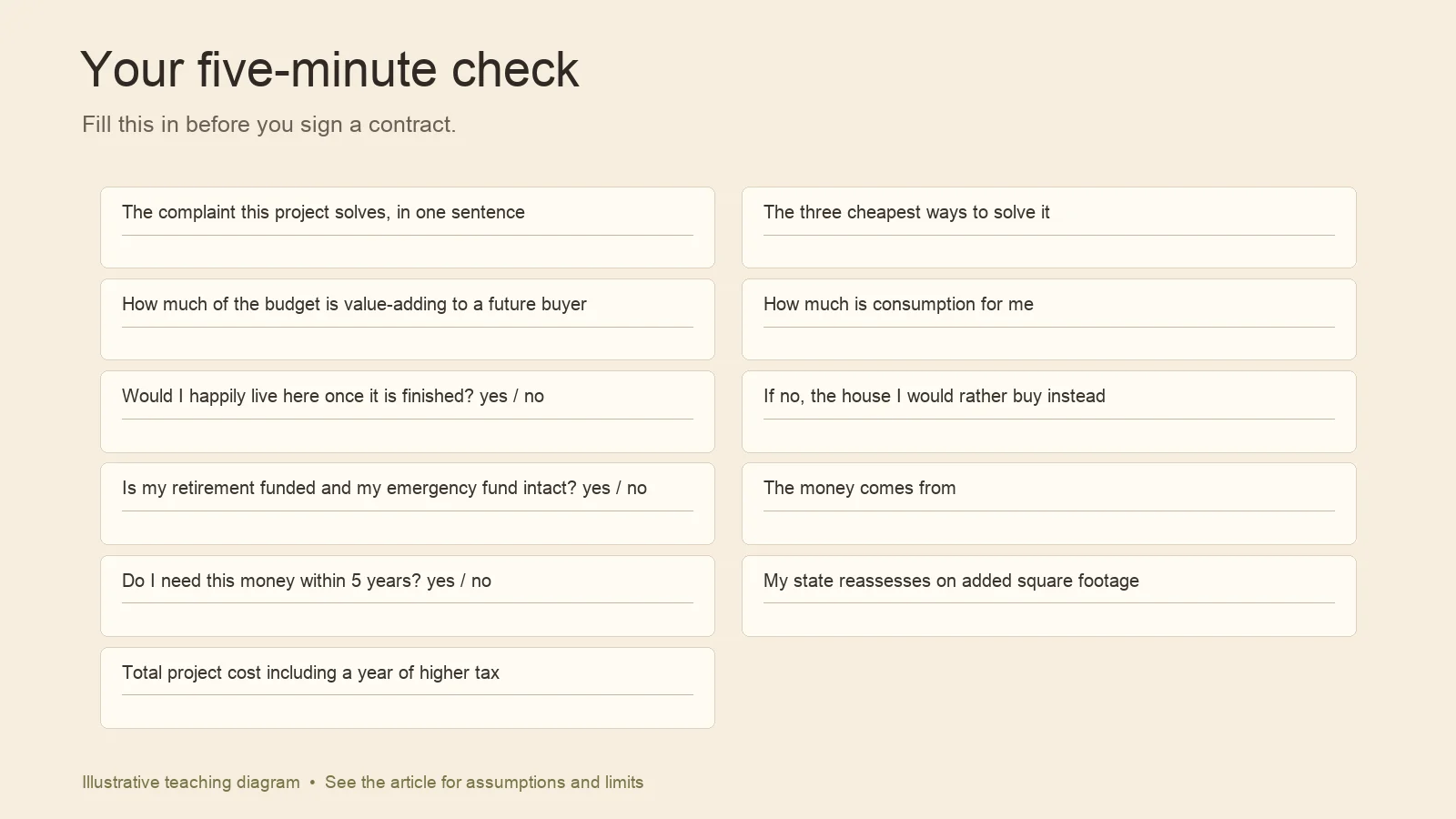
Your 5-minute renovation check
The complaint this project solves, in one sentence: ___
The three cheapest ways to solve it: 1) ___ 2) ___ 3) ___
How much of the budget is value-adding to a future buyer: ___%
How much is consumption for me: ___%
Would I happily live here once it is finished? yes / no
If no, the house I would rather buy instead: ___
Is my retirement funded and my emergency fund intact? yes / no
The money comes from: ___ (liquid accounts only)
Do I need this money within 5 years? yes / no
My state reassesses on added square footage: yes / no
Total project cost including a year of higher tax: ___
Line five settles the most cases. If the answer is yes, this is a priced consumption decision and the rest of the card is about affordability. If the answer is no, you are not doing a renovation — you are deciding whether to move, and you should price it that way.
Line seven is the guardrail. If retirement is not funded, the answer is no no matter how good the project is, because the project is competing with the goal that matters more.
Renovating is a spending decision about the place you live, and the honest way to run it is the opportunity cost guide applied to what the money was going to do. The arithmetic behind a project this size is in how to calculate opportunity cost. And if the project is really an argument for buying a different house, the trade-off vs opportunity cost guide separates the compromise from the thing you give up. To turn one idea like this into a small daily action, Daily Read is built for exactly that.