
On April 16, 1953, six weeks after Stalin’s death, President Eisenhower told the American Society of Newspaper Editors exactly what a weapon costs. “The cost of one modern heavy bomber is this: a modern brick school in more than 30 cities. It is two electric power plants, each serving a town of 60,000 population. It is two fine, fully equipped hospitals.”
Trade off vs opportunity cost comes down to two questions. A trade-off is the compromise between competing uses of a limited resource, such as money, time, or attention. Opportunity cost is the value of the best alternative you actually give up when you choose. Naming the trade-off describes the choice; naming the opportunity cost prices it.
Eisenhower named the opportunity cost and kept the trade-off
The “Chance for Peace” speech is often quoted as a critique of military spending. Read closely, it is a lesson in this distinction.
The trade-off was security against everything else a country could build. Eisenhower stated it in one line: “Every gun that is made, every warship launched, every rocket fired signifies, in the final sense, a theft from those who hunger and are not fed.”
The opportunity cost was specific. One bomber equaled schools in more than 30 cities, or two power plants, or two hospitals, or some 50 miles of concrete highway. A single destroyer equaled “new homes that could have housed more than 8,000 people.”
Notice the word “or.” Each item is a separate alternative for the same money. The bomber’s opportunity cost is the one you would actually have chosen, not schools plus power plants plus hospitals.
Naming the cost did not mean refusing to pay it. In the same speech, Eisenhower said the free nations “must, at any cost, remain armed, strong, and ready for the risk of war.” He made the price visible and still accepted the trade-off. That combination is the point of the distinction.
He also refused to reduce everything to dollars: “This world in arms is not spending money alone. It is spending the sweat of its laborers, the genius of its scientists, the hopes of its children.”
The difference in one table
| Question | Trade-off | Opportunity cost |
|---|---|---|
| What does it describe? | The compromise between competing options or objectives | The value of the next best option forgone |
| What must you identify? | What improves and what you sacrifice | Which rejected option you would otherwise choose |
| Does it need a dollar amount? | No | No; the alternative can have value in time, experience, output, or other terms |
| Can there be several things you sacrifice? | Yes, a compromise can involve several dimensions | Do not add alternatives that could not jointly be chosen |
| Eisenhower’s bomber | Security in exchange for civilian building | The schools, plants, or hospitals you would actually have built |
OpenStax defines opportunity cost in terms of the next best alternative. In casual speech, people use “trade-off” for the sacrificed benefit too. You do not need to police that. State the resource, the alternatives, and the value clearly enough that someone else can follow the choice.
The same distinction on a Saturday

You can describe the compromise before you know which forgone option matters most.
National budgets and personal calendars follow the same logic. In this fictional example, three uses compete for one Saturday afternoon, and you cannot combine them.
| Option | What it offers | What is uncertain |
|---|---|---|
| Course | Practice using a tool you want to learn | Whether the practice will be useful later |
| Extra shift | $120 after the extra travel and other relevant costs | Whether a comparable shift will be available another day |
| Visit | An afternoon with a friend who is leaving town | Whether you can meet before they leave |
Suppose you choose the course and would otherwise take the shift. Your opportunity cost is the $120 net income forgone. The trade-off is learning in exchange for that earning opportunity.
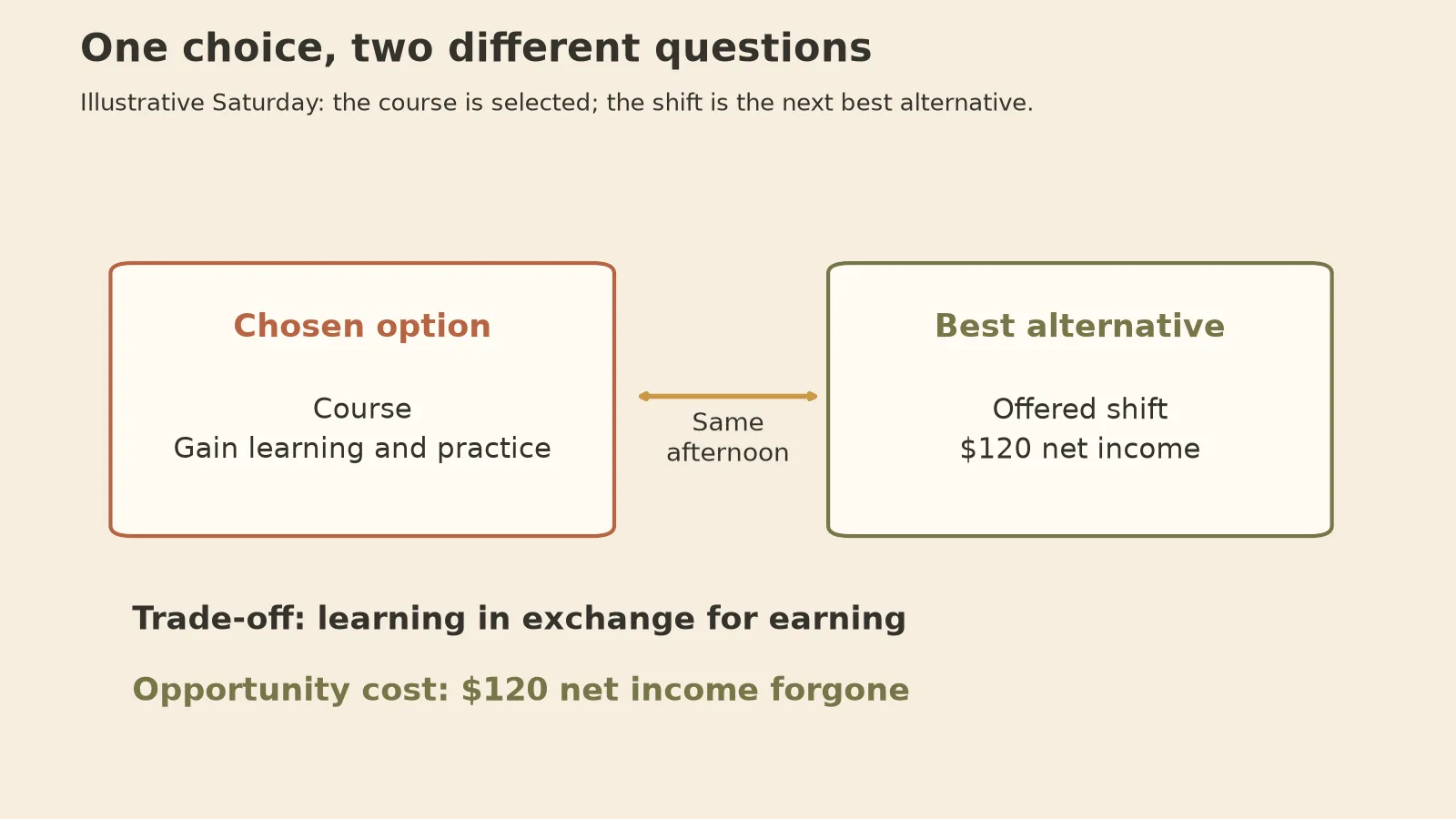
The best alternative depends on the same resource constraint and the decision maker’s priorities.
Now change your preference. If the visit would be your next choice, the opportunity cost is the afternoon with your friend. Calling it $120 because money is easier to write down would be misleading. The dollars here are invented and are not a price for friendship. The useful part is the counterfactual: what would you actually do with the resource if your chosen option disappeared?
That question also screens out fake alternatives. If the shift was never offered, it cannot be what you gave up.
Use the distinction in five lines
- My limited resource is ___, over ___.
- I am choosing ___ because ___.
- If that option were unavailable, I would choose ___.
- The trade-off is ___; the opportunity cost is ___.
- I would reconsider if ___ changed.

Write the alternative before assigning a value to it.
If line three is hard, you have not found the alternative yet. Go back to the options instead of inventing a number. If line four mixes dollars, hours, and experiences, keep each label. For a choice with several criteria, the decision-making frameworks guide adds structure, and second-order thinking traces what the choice changes later.
Where the distinction goes wrong
“There are trade-offs” ends the conversation. It names a compromise and prices nothing. Compare: “Adding these two features removes four days of testing; our next best plan keeps the testing and postpones the features.” The second sentence gives a team something to decide. Eisenhower did the same with bombers and schools.
Every rejected option gets added up. A list of alternatives is a menu. If three mutually exclusive uses compete for one afternoon, choosing one does not forgo both others. If a combination really is possible, treat it as its own option.
A return gap is called the whole cost. If A yields 80 units and your next best option B yields 100, the value forgone is B’s 100. The 20-unit difference answers a different question. The opportunity cost formula guide separates the two.
A past payment is counted again. A nonrefundable course fee does not change between today’s options. A refund or resale option would. See sunk cost fallacy vs opportunity cost.
Hard-to-price value is treated as zero. Not knowing how to price a visit or rest does not make it worthless. Describe it, and leave the comparison in several dimensions if no honest conversion exists.
Frequently asked questions
What is the difference between opportunity cost and trade-off?
A trade-off describes the compromise between competing options or goals. Opportunity cost identifies the value of the next best alternative you give up. They describe related parts of the same choice.
What is an example of a trade-off?
Eisenhower’s 1953 speech frames one: military strength in exchange for schools, hospitals, and homes. On a personal scale, using a Saturday for a course leaves less time for paid work or a visit.
What is an example of opportunity cost?
Eisenhower put one bomber at schools in more than 30 cities, two power plants, or two hospitals. Each is a possible opportunity cost; the true one is whichever you would have built instead.
Can you give an example of both together?
A team postpones two features to protect testing time. The trade-off is narrower scope in exchange for more testing. The opportunity cost is the value of the best plan it rejected, including the features that plan would have delivered.
Your 5-minute trade-off check
Resource and period:
Choice:
If this disappeared, I would:
Trade-off (what improves / what I sacrifice):
Opportunity cost (one alternative, in its own units):
I'd reconsider if:
Do this before you commit the afternoon. A short, distraction-free block from Slow Down is enough to fill the card and notice whether line three changes your mind. For the core concept, see opportunity cost.