On January 2, 1971, cigarette commercials disappeared from American television and radio. You might expect the tobacco companies to have suffered. Instead, industry ad spending fell 25% that year, sales held steady, and stock returns for the major firms hit abnormal highs. The law did for them what they could not do for themselves: it took away a dominant strategy.
A dominant strategy is a choice that gives a player a better payoff than every alternative, no matter what the other players do. If it is better against every opponent action, it is strictly dominant. If it is never worse and better at least once, it is weakly dominant.
The cigarette ad war was a prisoner’s dilemma
Economist Shi Qi’s study of the 1971 broadcast ban, later published in the RAND Journal of Economics, starts from a simple observation: cigarette advertising mostly moved smokers between brands. Total sales barely changed when the ads stopped.
Look at it from one firm’s seat. If rivals advertise and you stop, you lose smokers to them. If rivals stop and you keep going, you win smokers from them. Advertising is better either way, so it is a dominant strategy. Every firm reasons the same way, every firm pays for ads, and the share gains largely cancel out. Qi puts it plainly: the ban helped the industry out of a prisoner’s dilemma.
There was a second payoff. Since 1967, the FCC’s Fairness Doctrine had required stations that ran cigarette ads to give free time to anti-smoking messages. Those messages received about $75 million in airtime by 1970, and consumption dropped. According to a public-health history of anti-smoking campaigns, the industry itself approached Congress with a proposal to remove cigarette ads from broadcast, and the free anti-smoking spots went with them.
The same structure in a bare matrix
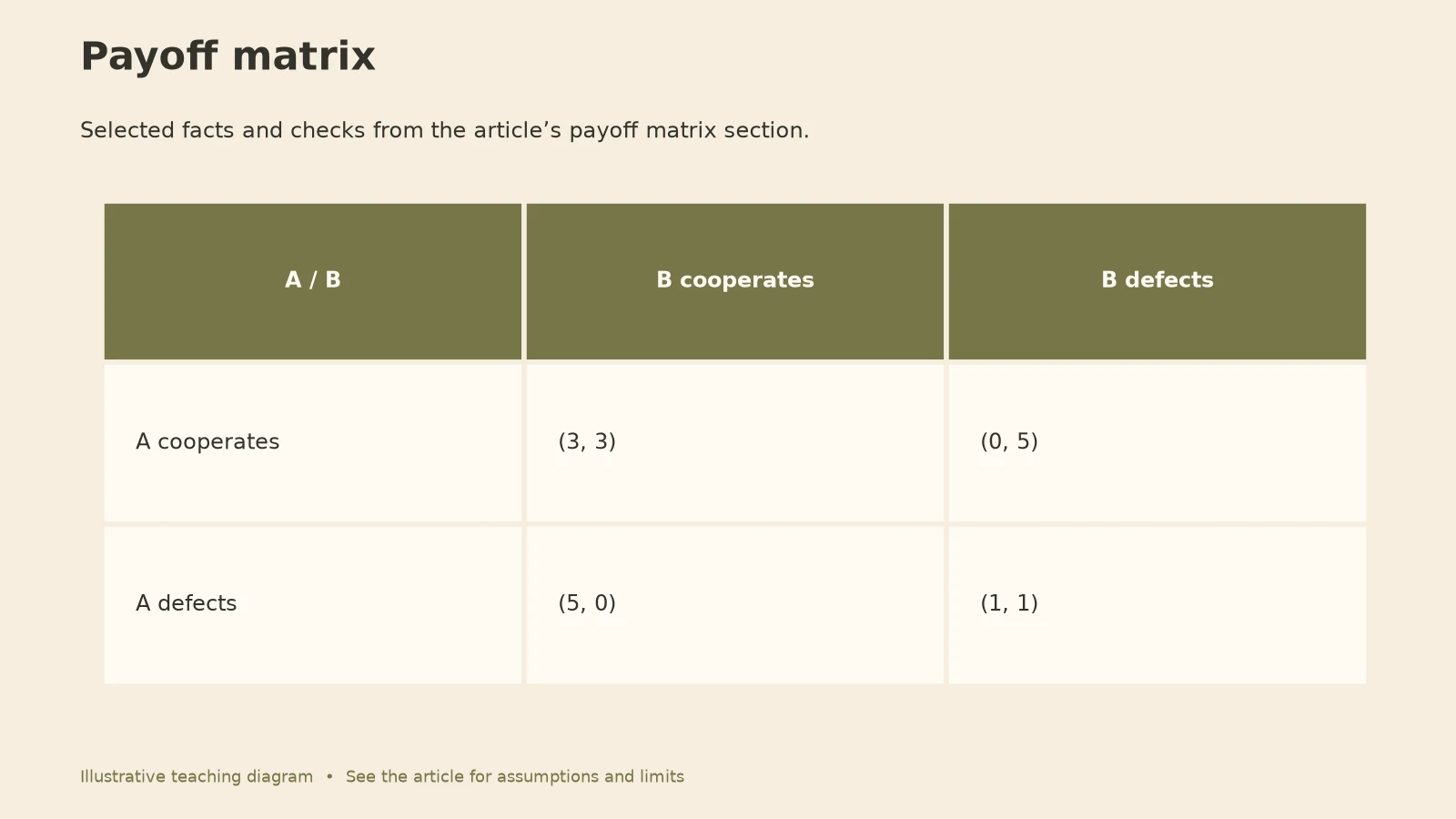
Here are the incentives with abstract labels. Read “defect” as “keep advertising” and “cooperate” as “cut back.” The row player is A, the column player is B, and each cell lists (A’s payoff, B’s payoff). The numbers are constructed to show the structure, not measured from the tobacco market.
| A / B | B cooperates | B defects |
|---|---|---|
| A cooperates | (3, 3) | (0, 5) |
| A defects | (5, 0) | (1, 1) |
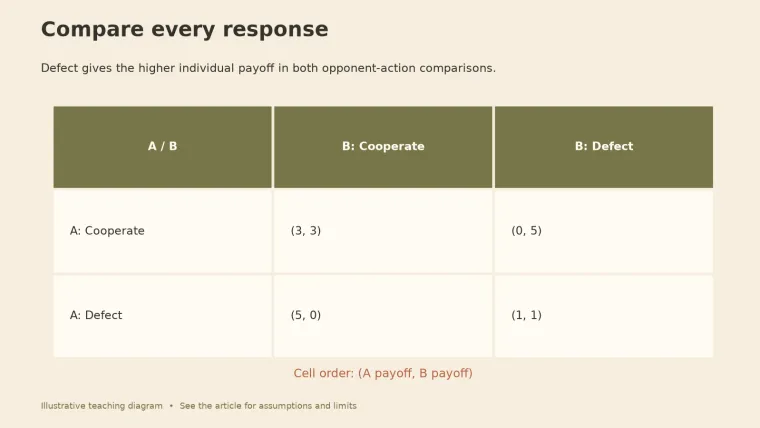
For A, read the first number. Against B’s cooperation, defect gives 5 rather than 3. Against B’s defection, defect gives 1 rather than 0. Defect wins in both columns.
For B, read the second number. The comparisons mirror A’s: defect wins in both rows.
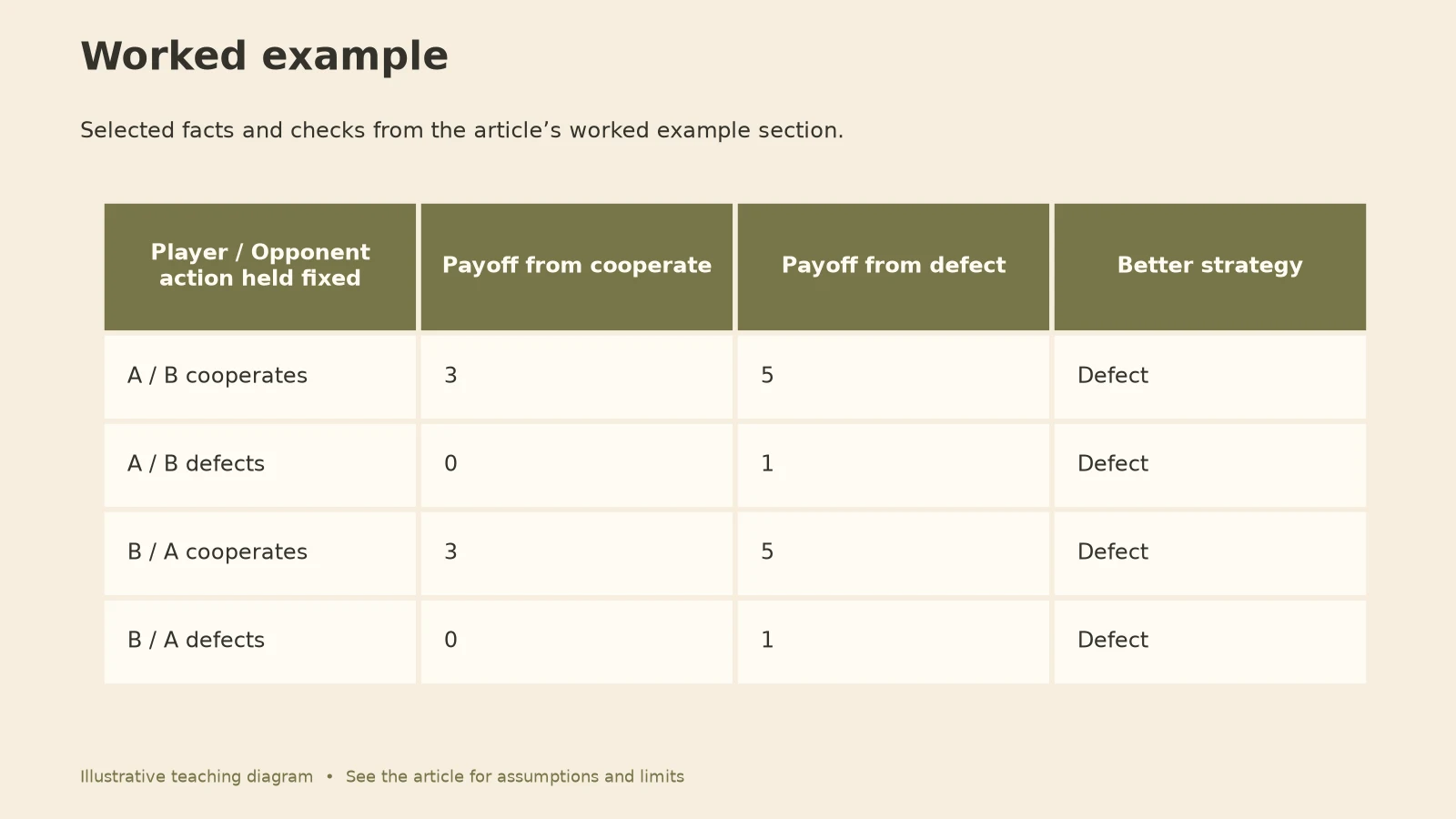
Laying the comparisons out one by one keeps you honest:
| Player | Opponent action held fixed | Payoff from cooperate | Payoff from defect | Better strategy |
|---|---|---|---|---|
| A | B cooperates | 3 | 5 | Defect |
| A | B defects | 0 | 1 | Defect |
| B | A cooperates | 3 | 5 | Defect |
| B | A defects | 0 | 1 | Defect |
Both players land on (1, 1) when (3, 3) was available. Each made the individually better move in every comparison, and both ended up worse off.
A handshake fails where a rule succeeds
Suppose the tobacco firms had simply promised one another to cut back. The matrix shows the problem. Whatever the others do, each firm does better by breaking the promise, so a voluntary truce is fragile from the start.
The 1971 law worked because it removed the option for everyone at once. Nobody had to trust a rival, and nobody could gain by cheating on broadcast. When a dominant strategy produces a bad shared outcome, the durable fixes usually change the game itself: the available actions, the payoffs, or how often the players meet.
A dominant strategy is a much stronger claim than equilibrium
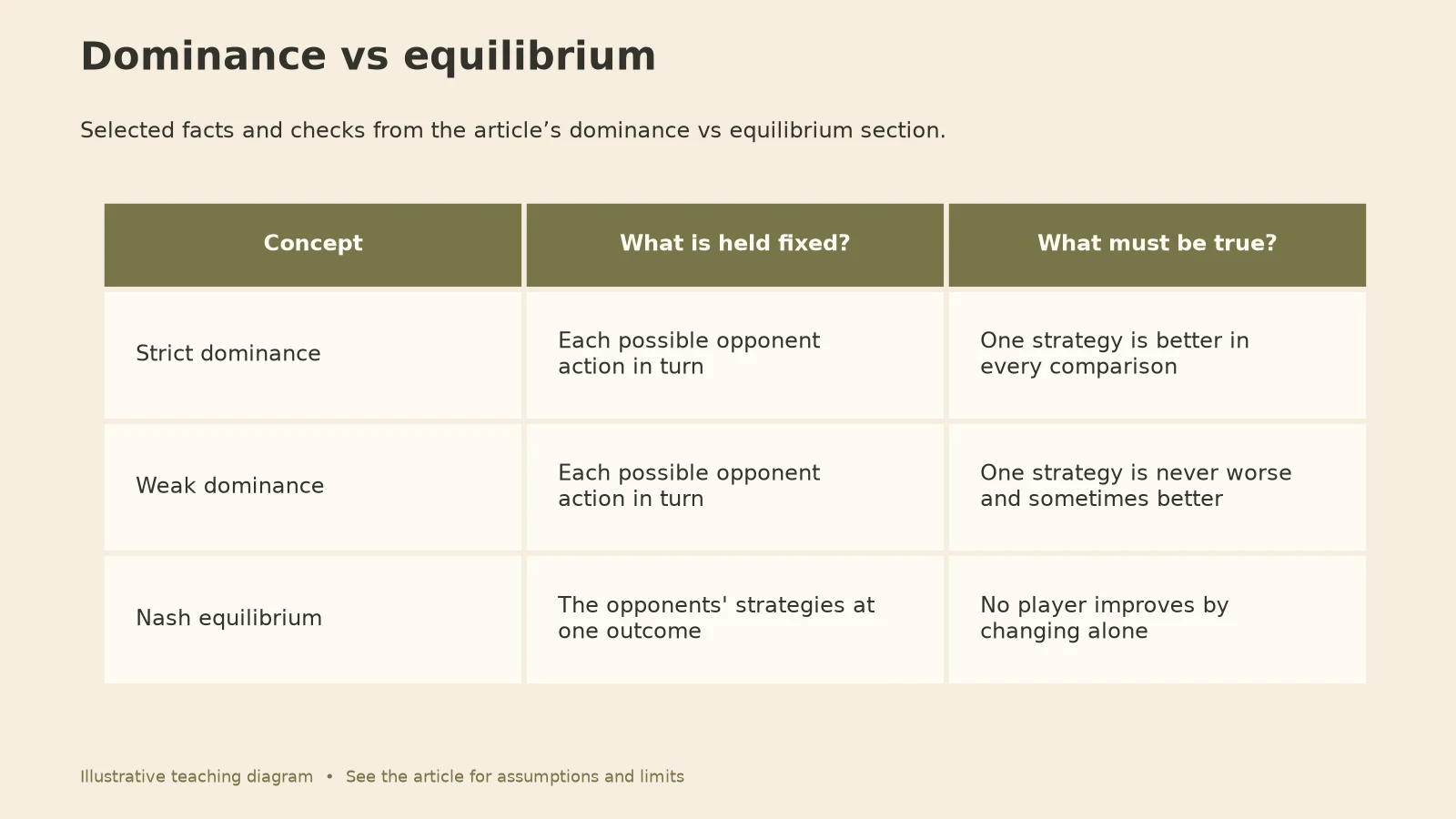
| Concept | What is held fixed? | What must be true? |
|---|---|---|
| Strict dominance | Each possible opponent action in turn | One strategy is better in every comparison |
| Weak dominance | Each possible opponent action in turn | One strategy is never worse and sometimes better |
| Nash equilibrium | The opponents’ strategies at one outcome | No player improves by changing alone |
When every player has a strictly dominant strategy, playing them gives a Nash equilibrium. The reverse fails. In a coordination game, where both players want to match (X with X, or Y with Y), neither has a dominant strategy, yet both matching outcomes are equilibria. The Nash equilibrium walkthrough shows how to mark those best responses.
Open Yale Courses’ lecture on dominance covers reasoning from the other player’s seat. For core vocabulary, see game theory basics, and for the classic structures, game theory games.
When the dominant strategy comes back
Banning one move rarely ends the race. Qi found that industry ad spending stayed low for three to four years, then recovered. By 1980 it was 80% higher than before the ban. The incentive to outspend rivals never went away; it moved to the channels the law left open.
Repetition can change the answer. The matrix above is a one-shot game. When the same players meet again and again, cooperation can pay, as Axelrod’s tournaments showed.
One big number proves nothing. A strategy with an attractive payoff in one cell is dominant only if it wins in every comparison. Ties everywhere mean no strict dominance at all.
Questions
Can a game have no dominant strategy?
Yes. In many games, the best move depends on what others do. Coordination games are the simplest example.
Is a dominant strategy always the socially best choice?
No. The cigarette ad war and the matrix above both show individually dominant choices leaving everyone worse off.
How is a dominant strategy different from a best response?
A best response is best against one specific opponent action. A dominant strategy is best against all of them.
Your 5-minute dominance check
Pick a situation where you keep spending effort because others do: bidding, discounting, replying fastest, working late.
My options: A or B
Their options: 1 or 2
My payoff for A vs B if they choose 1:
My payoff for A vs B if they choose 2:
Does one option win both times?
If everyone picks it, are we worse off than (B, B)?
What rule, deadline, or shared limit would remove the race?
If one option wins both rows and the shared result is still poor, look for a way to change the rules before you try harder. For one short idea like this each day, try Daily Read.