A penalty kick gives the goalkeeper almost no time to react. The ball reaches the goal line in about 0.3 seconds, so kicker and keeper effectively pick a side at the same moment. That makes it one of the cleanest real-world tests of Nash equilibrium ever run, and the players passed it.
A Nash equilibrium is a set of strategies, one for each player, where nobody can get a better payoff by changing only their own choice while the others keep theirs. It is a condition of mutual best responses. It does not mean the outcome is fair, jointly best, or unique.
Penalty kicks are matching pennies played for real
Economist Ignacio Palacios-Huerta collected 1,417 penalty kicks from professional matches in Spain, Italy, England, and elsewhere between 1995 and 2000, and published the analysis as “Professionals Play Minimax” in 2003.
The keeper wants to match the kicker’s side; the kicker wants a mismatch. In his data, a goal was scored almost every time they chose different sides and a little over 60% of the time when they chose the same one.
Kickers also have a stronger side, which the paper calls the natural side. So why not aim there every time? Because the keeper would notice and dive there every time, and a keeper who always dived one way would be beaten by any kicker who noticed that. In every cell, someone gains by switching alone. The only stable answer is for both players to mix.
The data matched the prediction almost to the decimal
In a mixed equilibrium, each player mixes in the proportions that leave the opponent indifferent. If kickers scored more on one side, keepers should lean toward it until the advantage disappears.
| Share choosing the non-natural side | Nash prediction | Observed |
|---|---|---|
| Goalkeepers | 41.99% | 42.31% |
| Kickers | 38.54% | 39.98% |
The indifference showed up in outcomes too. Kickers scored 81.1% of the time on their non-natural side and 82.7% on their natural side. Among the 42 players with at least 30 kicks each, the equal-success test failed for three at the 5% level, about what chance alone would produce.
The second prediction is subtler: a good randomizer’s next choice should not depend on the last one. Lab studies had found that people trying to act randomly switch too often. These players showed no dependence on their own previous kicks, their opponents’ kicks, or past outcomes.
One caution. Penalty kicks are unusually friendly to the theory: two players, two main options, an instant result, and years of practice. The fit says more about this setting than about equilibrium everywhere.
Best responses are the whole test
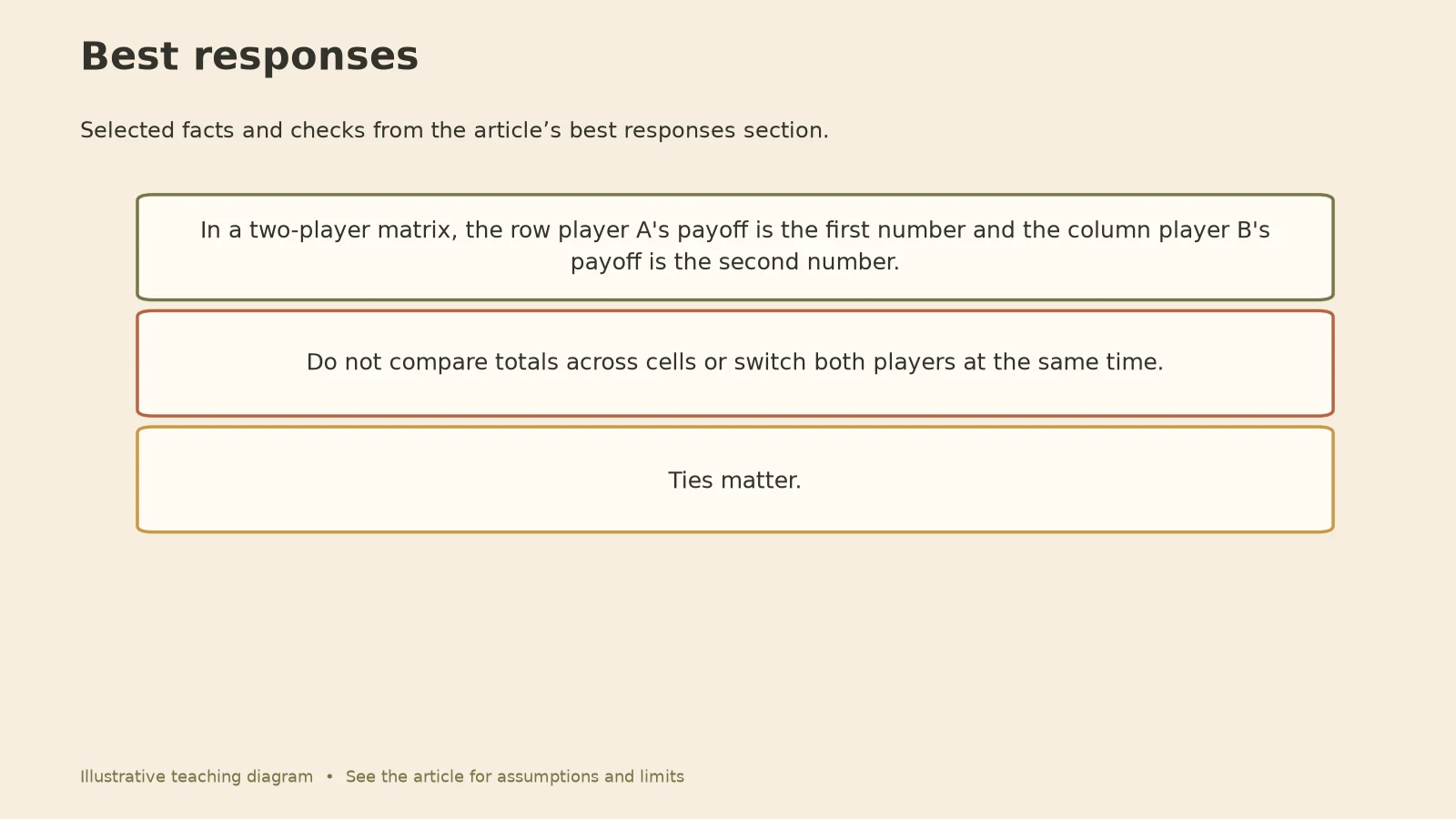
In a two-player matrix, the row player A’s payoff is the first number and the column player B’s payoff is the second number. To find A’s best response, hold B’s choice fixed and compare down that column. For B, hold A’s row fixed and compare across it.
Do not compare totals across cells or switch both players at the same time. The question is always whether one player gains by moving alone. Open Yale Courses’ lecture on best responses builds this step by step.
Ties matter. If two actions give the same top payoff, both are best responses.
Some games have two equilibria, and some have none in pure strategies
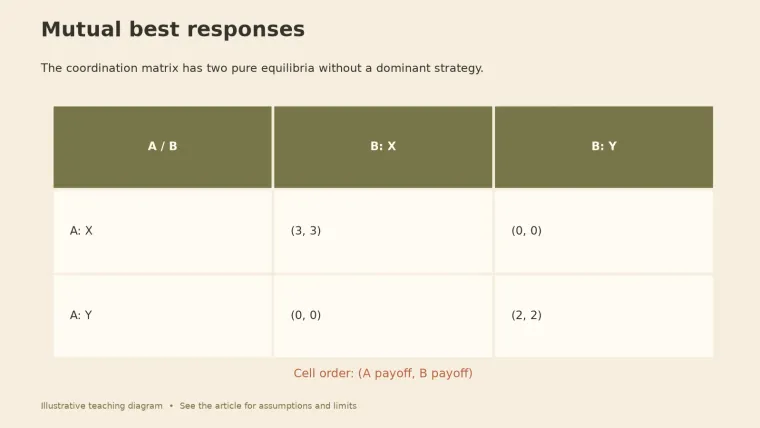
Two fictional players choose X or Y. Matching pays; mismatching pays nothing. Each cell is (A’s payoff, B’s payoff).
| A / B | B chooses X | B chooses Y |
|---|---|---|
| A chooses X | (3, 3) | (0, 0) |
| A chooses Y | (0, 0) | (2, 2) |
If B chooses X, A prefers X; if B chooses Y, A prefers Y. B’s comparisons mirror A’s. So (X, X) and (Y, Y) are both equilibria: at either one, switching alone drops the switcher to 0. (X, X) pays more, but which one players land on depends on convention, communication, and history the matrix leaves out.
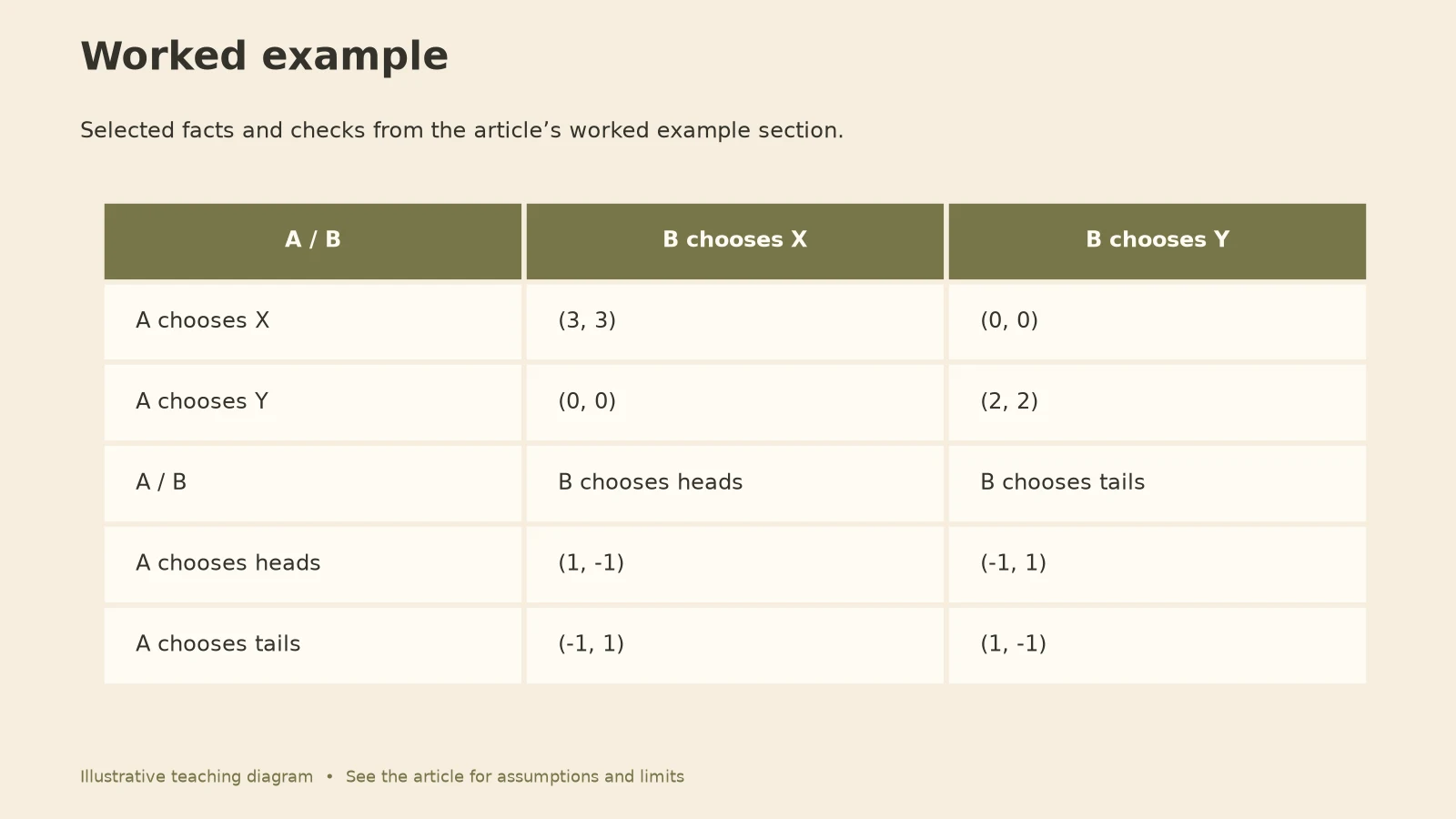
Now strip the penalty kick to its skeleton. In matching pennies, A wins 1 when the coins match and loses 1 when they differ; B gets the opposite.
| A / B | B chooses heads | B chooses tails |
|---|---|---|
| A chooses heads | (1, -1) | (-1, 1) |
| A chooses tails | (-1, 1) | (1, -1) |
Every cell gives someone a reason to switch, so there is no pure-strategy equilibrium. With these symmetric payoffs, the mixed equilibrium is a 50/50 split for each player. Lopsided penalty payoffs moved that mix to roughly 60/40.
A dominant strategy is a much stronger claim
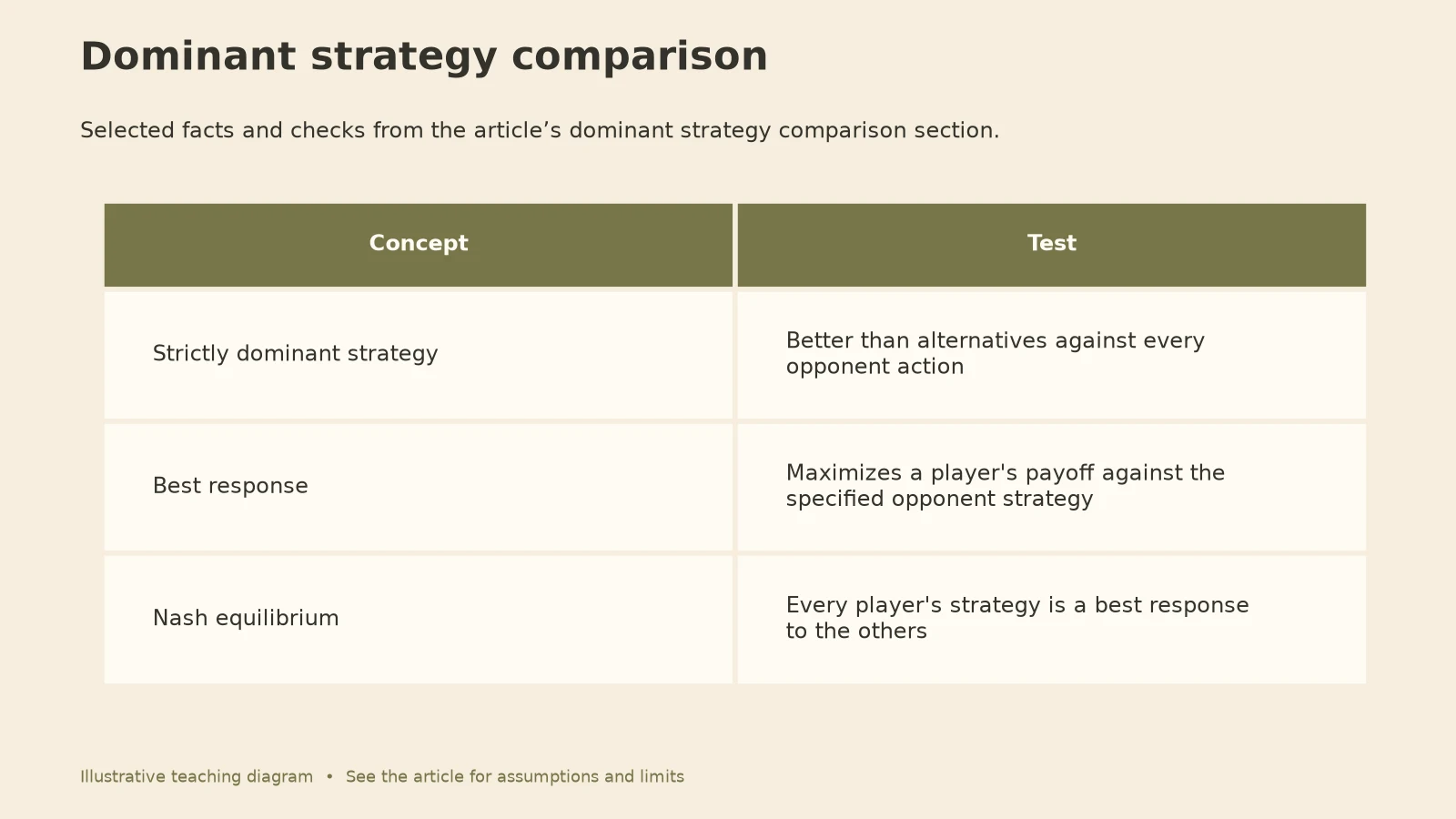
| Concept | Test |
|---|---|
| Strictly dominant strategy | Better than alternatives against every opponent action |
| Best response | Maximizes a player’s payoff against the specified opponent strategy |
| Nash equilibrium | Every player’s strategy is a best response to the others |
The coordination matrix has no dominant strategy, yet it has two equilibria. Penalty kicks have none either, which is exactly why mixing pays there.
The dominant strategy walkthrough covers that stronger condition, game theory basics covers players and payoff notation, and game theory games compares the classic structures. The Nobel committee’s 1994 announcement explains why Nash’s idea became central to the field.
Where equilibrium thinking leads you astray
An equilibrium can be bad for everyone. In the prisoner’s dilemma, mutual defection is the equilibrium even though mutual cooperation pays both more. Stable and good are different properties.
Several equilibria leave the prediction open. A model can show what is stable without saying what will happen.
Most people are not penalty specialists. The paper notes that lab tests of mixed strategies have often come out negative, partly because subjects meet unfamiliar games with little time to learn.
The matrix may be the wrong game. Talking, repetition, reputation, and missing options can all change the answer.
Questions
Can a game have more than one Nash equilibrium?
Yes. The coordination matrix has two. Explaining which one people reach takes extra information.
Does no pure equilibrium mean no equilibrium at all?
No. Mixed strategies can still form one, as matching pennies and penalty kicks show.
Is a Nash equilibrium the same as an agreement?
No. Players can be in equilibrium without talking or liking the result. It only means nobody gains by changing alone.
Your 5-minute equilibrium check
Pick one situation where your result depends on someone else’s choice, such as a negotiation or a meeting time.
Players: who chooses?
Options: two or three each
Payoffs: (mine, theirs) for every cell
My best response to each of their options:
Their best response to each of mine:
Cells where both marks meet:
If none: what mix keeps me unpredictable?
What the matrix leaves out:
If no cell gets both marks, predictability is your weak spot. If two do, ask which one you can steer toward. A Slow Down focus timer keeps the exercise to five minutes.