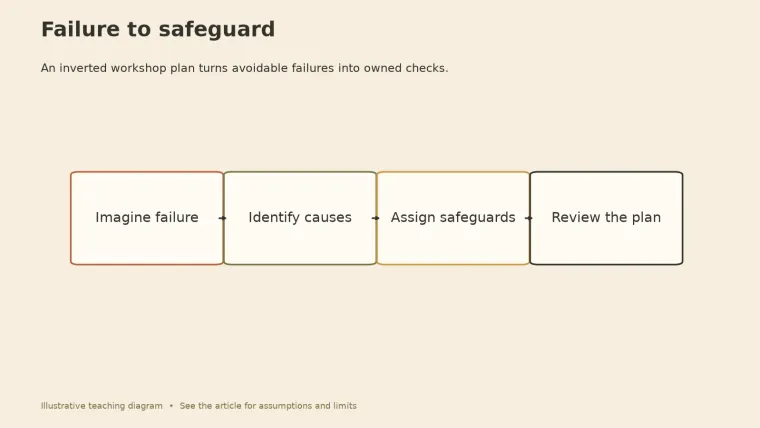
On June 13, 1986, Charlie Munger gave the commencement speech at the Harvard School in Los Angeles. He did not tell the graduates how to be happy. Borrowing a trick from an earlier speech by Johnny Carson, he told them how to guarantee a miserable life. His first prescription: “be unreliable.” Then he explained why the backward version was the useful one.
The inversion mental model solves a problem backward. Instead of asking only how to succeed, you ask what would guarantee failure, then prevent or avoid those conditions. It adds a failure-focused check to a forward plan. Munger credited the mathematician Carl Jacobi, who kept repeating one phrase: “Invert, always invert.”
A commencement speech delivered backward
In the transcript of the 1986 speech, Munger recalls that Carson “couldn’t tell the graduating class how to be happy, but he could tell them from personal experience how to guarantee misery.” Carson’s list: ingesting chemicals to alter mood or perception, envy, and resentment. Munger added his own, starting with unreliability: “Do not faithfully do what you have engaged to do.”
He closed with a story about a rustic who said, “I wish I knew where I was going to die, and then I’d never go there.” People smile at it, Munger said, and ignore its basic wisdom. His summary of the method: Carson approached “the study of how to create X by turning the question backward, that is, by studying how to create non-X.”
Why does this work? “How do I have a good life?” invites vague answers. “What would reliably make my life worse?” produces a concrete list you can check yourself against. The same shift works on ordinary plans:
| Forward question | Inverted question | What the inversion surfaces |
|---|---|---|
| How do I have a good life? | What would guarantee misery? | Unreliability, envy, resentment |
| How do we run a useful workshop? | What would make it a waste of time? | No decision to make, a missing approver, no follow-up |
| How do we launch on time? | What would make us late? | Unowned dependencies, a late approval |
| How do I keep exercising? | What would make me quit? | No set time, an all-or-nothing plan |
Why imagining failure finds more than imagining success
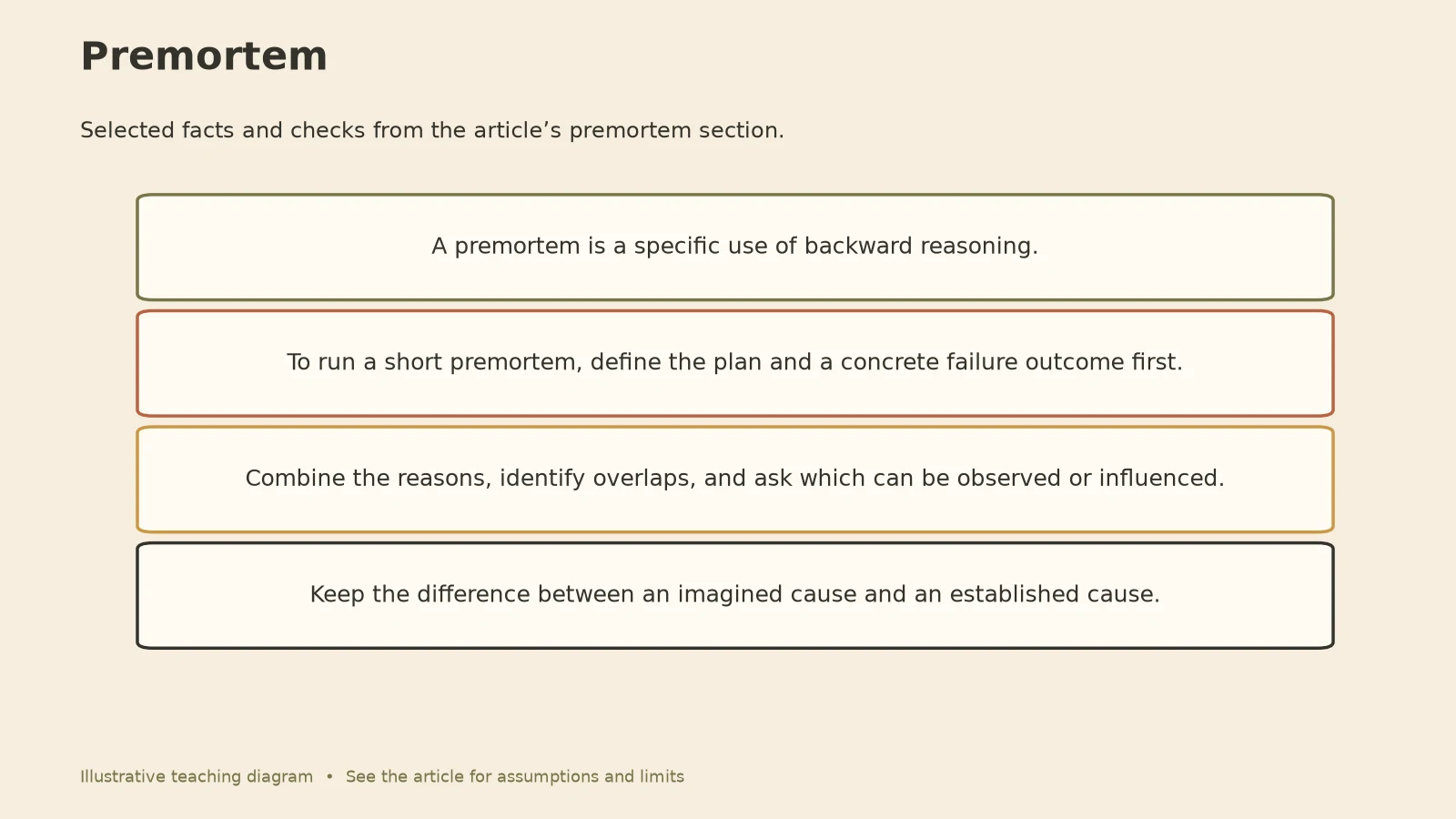
A premortem is a specific use of backward reasoning. You assume the project has already failed and list the reasons. In Gary Klein’s 2007 HBR article, he cites 1989 research by Deborah Mitchell, Jay Russo, and Nancy Pennington: imagining that an event has already happened “increases the ability to correctly identify reasons for future outcomes by 30%.”
To run a short premortem, define the plan and a concrete failure outcome first. Then have people write reasons on their own before anyone speaks, so the first confident voice does not set the list.
Combine the reasons, identify overlaps, and ask which can be observed or influenced. Each surviving reason should lead to evidence gathering, a safeguard, a contingency, or an explicit decision to accept the risk.
Keep the difference between an imagined cause and an established cause. “A vendor might miss the delivery” is a possibility. A record of repeated late deliveries is evidence. Neither gives you a probability without more work. For collecting independent views in a group, see group decision-making.
Inverting a workshop
Take a team that wants one agreed change to the handoff between sales and delivery, with an owner and a review date. Invert it: the meeting ends with nothing usable. What caused that?
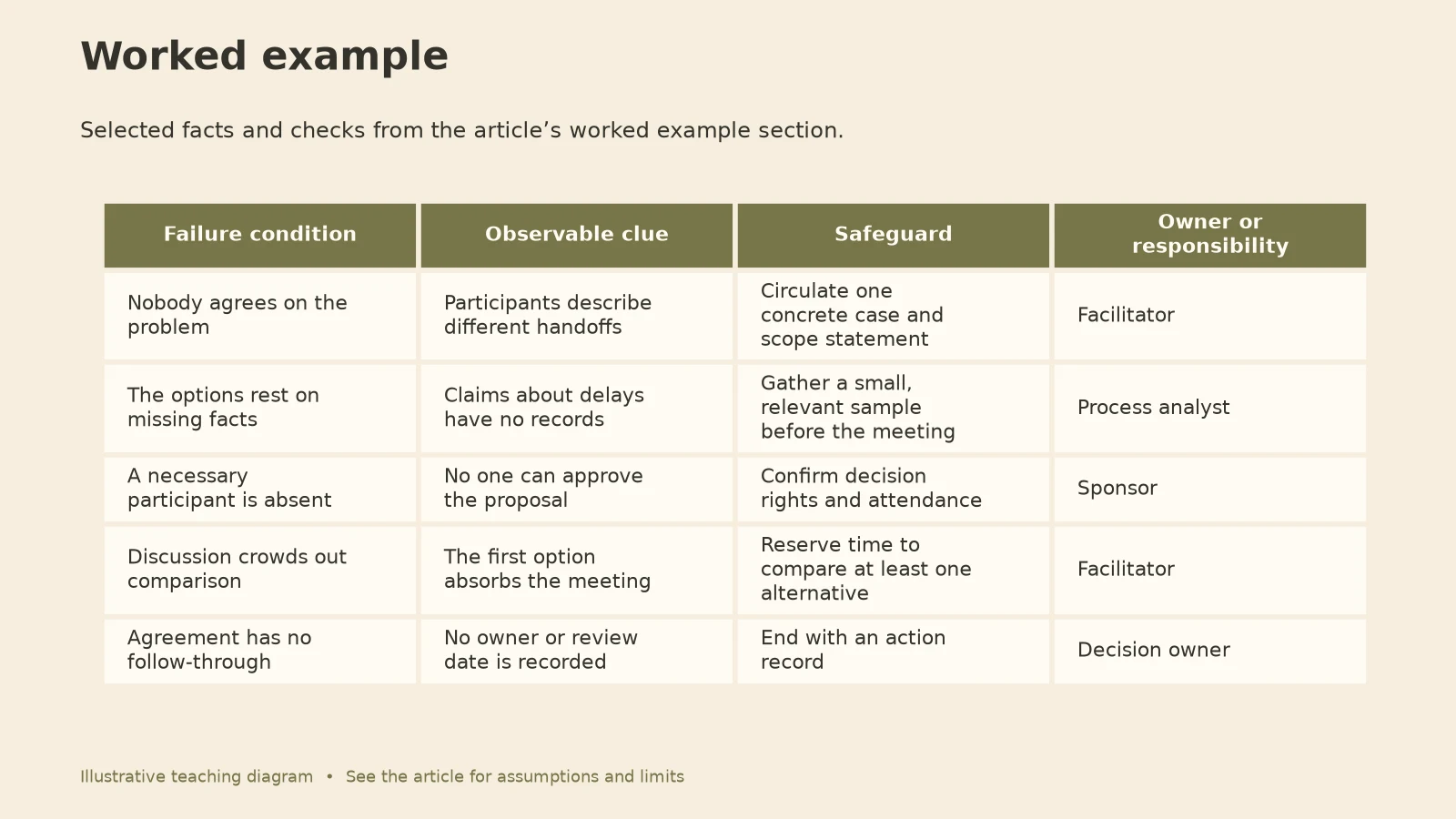
| Failure condition | Observable clue | Safeguard | Owner or responsibility |
|---|---|---|---|
| Nobody agrees on the problem | Participants describe different handoffs | Circulate one concrete case and scope statement | Facilitator |
| The options rest on missing facts | Claims about delays have no records | Gather a small, relevant sample before the meeting | Process analyst |
| A necessary participant is absent | No one can approve the proposal | Confirm decision rights and attendance | Sponsor |
| Discussion crowds out comparison | The first option absorbs the meeting | Reserve time to compare at least one alternative | Facilitator |
| Agreement has no follow-through | No owner or review date is recorded | End with an action record | Decision owner |
Every safeguard costs something. Extra participants take time, and gathering data can delay the meeting. Match the effort to what is at stake: a short checklist for a small reversible choice, more preparation for a big commitment.
How to use inversion
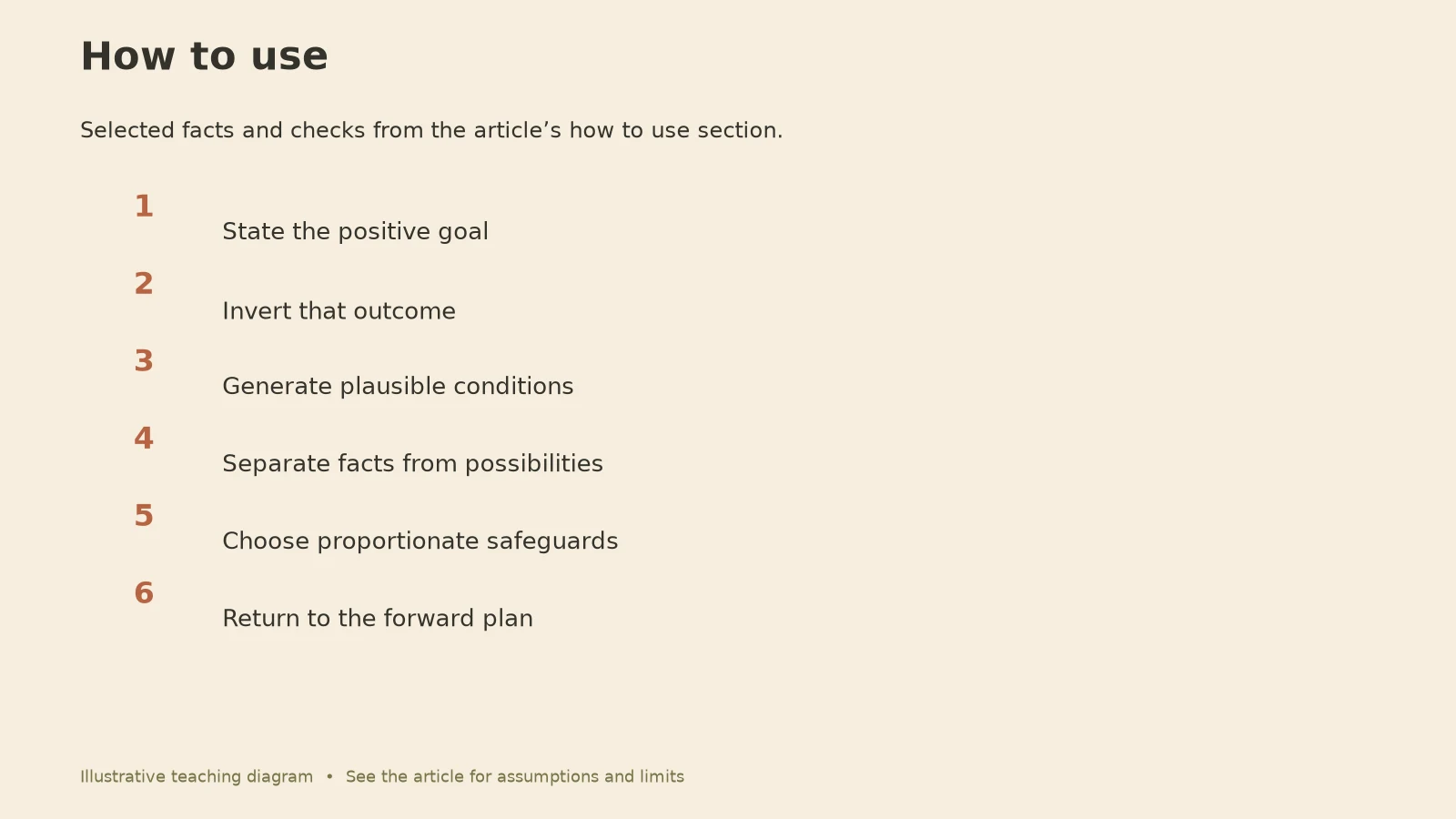
- State the positive goal. Include what success looks like and by when.
- Invert that outcome. Describe failure concretely, not as “things go badly.”
- Generate plausible conditions. Consider missing information, conflicting incentives, dependencies, capacity, and follow-through.
- Separate facts from possibilities. Note the source of any claim about an existing weakness.
- Choose proportionate safeguards. Give each an owner and a check you can observe.
- Return to the forward plan. Decide how to pursue the goal with the safeguards in place.
Step 6 is the one people skip. Munger’s speech was a guide to a good life, delivered as its opposite. The inversion serves the forward goal. To check what your safeguards might cause in turn, use second-order thinking.
When inversion backfires
It turns into pessimism. A long list of disasters with no actions attached produces anxiety. Narrow the scope until each failure leads to something you can do.
It becomes a veto. Every project has weaknesses. A plan can have real risks and still be worth doing.
It chases unpredictable catastrophes. “Something unforeseeable could happen” is true and gives you nothing to act on. Look for conditions you can check before you commit.
One avoided failure creates another. Collecting every fact can delay a decision past the point where it matters. For choosing among the options that survive, see decision-making frameworks.
Questions
Is inversion just thinking negatively?
No. It asks a targeted question about failure and turns the answers into action. It should end with a clearer plan.
Is inversion the same as a premortem?
A premortem is one structured version, usually for a team project. Inversion can also be a quick personal check, a hunt for a counterexample, or a way to find constraints before you design a solution, as in first principles thinking.
Can inversion guarantee success?
No. It catches some avoidable problems. Unknown conditions, wrong assumptions, and changes outside your control remain. Write down what you checked and what is still uncertain.
Your 5-minute inversion
Goal (what success looks like, by when):
It's [date] and this failed completely. Why?
1.
2.
3.
Which of these can I observe or influence now?
One safeguard, with an owner:
Back to the plan: what changes?
Try it on a habit you keep dropping. Ask what would guarantee you skip it, then build the safeguards into your plan in Sweat.