
In October 1993, Michael Jordan retired from the NBA after three straight championships. The following spring he was a 31-year-old outfielder for the Birmingham Barons, a Double-A minor-league team, and he had not played competitive baseball since high school. He finished the 1994 season hitting .202 with 114 strikeouts. He also stole 30 bases.
Your circle of competence is the set of tasks and judgments you understand well enough to handle on a defensible basis. Its boundary matters more than its size. Competence belongs to a specific task in a specific setting, so one person can be deep inside the circle in one job and outside it in the next.
The best basketball player alive, hitting .202
Baseball-Reference’s minor-league record shows what transferred and what did not:
| Measure, 1994 Birmingham Barons | Result | What it suggests |
|---|---|---|
| Games played | 127 | He stayed with it for a full season |
| Batting average | .202 | Hitting professional pitching is a separate skill |
| Strikeouts | 114 | Pitch recognition was still developing |
| Home runs | 3 | Strength did not turn into power at the plate |
| Stolen bases | 30 | Speed and athleticism carried over |
MLB.com’s look back notes that .202 “means different things to different people.” To some it proved he was in over his head. Others point out that he had not played since high school and was facing Double-A pitching.
Both readings support the same point. Jordan’s competence did not disappear in 1994. It was attached to basketball, a task with its own patterns, feedback, and years of practice. Speed came with him. The ability to hit a curveball did not. In March 1995 he returned to the NBA and won three more titles.
Where the idea comes from
The model is closely associated with Warren Buffett and Charlie Munger. In his 1996 shareholder letter, Buffett writes that an investor needs to evaluate selected businesses, not every company, and must know the boundaries of the area they understand.
Applying it outside investing is an adaptation. A circle is a metaphor, not a measured area or a fixed trait. Its shape changes with the task, the setting, and the cost of being wrong. “I am good at design” is too broad to check. “I can build a responsive landing page in our existing component system and check it against these requirements” can be examined.
Competence, familiarity, and confidence
| Signal | What it tells you | What it does not establish |
|---|---|---|
| You recognize the terminology | You have encountered the subject | You can make a reliable judgment about it |
| You can explain the process | You understand at least part of the method | You can execute it under real constraints |
| You have relevant completed work | You have performance evidence | The evidence transfers to every new setting |
| You can identify common failures and check results | You have useful task-level understanding | You can handle every rare or high-stakes case |
| You feel certain | You experience confidence | Your answer is accurate |
In their paper on intuitive expertise, Daniel Kahneman and Gary Klein point to two conditions for trustworthy intuition: an environment regular enough to learn, and enough practice with feedback to learn it. They also warn that feeling sure is not a reliable sign of being right. Jordan had years of that feedback in basketball and a few months of it in baseball.
Same website, three different circles

Competence belongs to a specific task; a related job title does not automatically extend it.
The same split shows up in ordinary work. A designer who has built several reviewed landing pages in one component library gets three requests about the same website:
| Task | Relevant evidence | Boundary | Sensible next step |
|---|---|---|---|
| Build a familiar landing page | Completed and reviewed work in the same component system | New requirements can still introduce unfamiliar behavior | Work independently with the usual review |
| Run a new research method | Reading and some supervised practice | Limited experience choosing participants and interpreting results | Design a small study with an experienced reviewer |
| Repair production data | No relevant completed work | Errors could affect live records | Delegate the repair and learn in a separate practice environment |
The designer can still help with all three: build the page, prepare research materials, and describe the database symptoms to whoever fixes it.
How to find your boundary
- What exact task am I claiming to handle? Include the outcome, setting, and constraints.
- What relevant evidence supports that claim? Completed work, observed results, or review.
- Which failures can I recognize? If you cannot tell when the result is wrong, independent action may be beyond you for now.
- Where does my evidence stop applying? A new tool, audience, scale, or deadline can change the task.
- What happens if I am wrong? A reversible practice run and a change to live records deserve different safeguards.
- Who can review what I cannot yet judge? The reviewer needs relevant expertise; seniority alone is not enough.
A capability ledger you can fill in
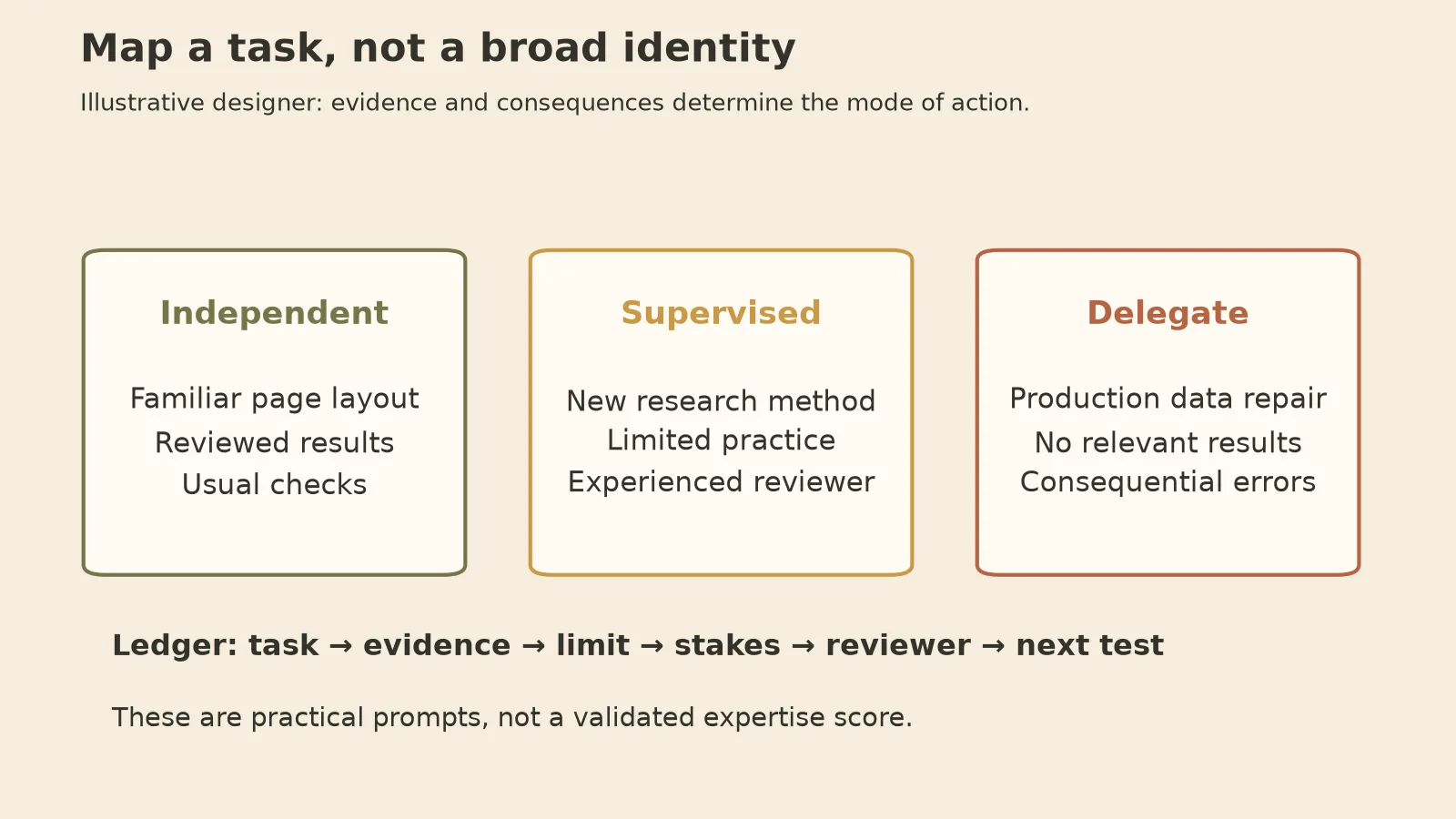
The boundary becomes useful when you can state what you would handle differently.
| Field | Your note |
|---|---|
| Task and setting | What outcome will I produce, and where? |
| Evidence of competence | Which relevant result has been checked? |
| Known limit | What unfamiliar condition could invalidate that evidence? |
| Stakes and reversibility | What can go wrong, and can it be undone? |
| Mode of action | Independent work, supervised practice, or delegation |
| Reviewer or check | Who or what can detect errors I may miss? |
| Next learning test | Which nearby task would produce useful feedback? |
Treat it as a working tool rather than a scientific score. A good completed row often sounds modest: “I can edit this page layout, but I need review for the new keyboard interaction because I have not built or tested one before.”
How to expand your circle

Expansion requires relevant practice and a check that can reveal mistakes.
Jordan did not start in the major leagues. He played a full season at a level where every at-bat produced feedback and a strikeout cost nothing permanent. That is the pattern: pick an adjacent task whose results you can check, in a setting where mistakes are affordable.
Write down beforehand what success looks like and how you will check it. Do the task, get feedback, and record what you missed. Note the help you had, too: a task finished with unlimited time and a mentor beside you is good practice, but not yet proof you can do it alone.
Sometimes the better move is to find a reliable collaborator instead of learning everything yourself. That choice has an opportunity cost either way.
When the circle of competence backfires
It becomes a reason never to learn. Working inside your circle and practicing beyond it can coexist. The difference is the setting and the risk.
Reputation stands in for evidence. Fame in one field makes people persuasive in another. Ask for relevant performance, not a résumé. The cognitive-biases guide covers why the halo is so convincing.
The circle is drawn around subjects instead of decisions. You can know a lot about a field and still lack a basis for one particular prediction.
The boundary is treated as permanent. Skills go stale, tools change, and new practice can move the line. Revisit it when conditions change.
Frequently asked questions
What is a circle of competence?
A mental model for identifying the tasks and judgments you understand well enough to handle on a defensible basis. Knowing where it ends tells you when to act, ask for review, or delegate.
Can you give me some examples of competence?
Producing a checked layout in a familiar design system, reconciling a routine set of records, or troubleshooting a known equipment fault. Each needs evidence and a boundary. Familiarity with the wider subject is not enough.
What is the mental model of the circle of competence?
Work from what you can justify, recognize where that knowledge ends, and build new ability through practice with feedback. For more models like it, see mental models; for a simple practice log, see how to improve critical thinking.
Your 5-minute boundary check
A task I'm about to take on:
My evidence I can do it (results, not feelings):
Where that evidence stops applying:
If I'm wrong, what breaks? Can it be undone?
Mode: alone / with review / hand off
Who can check what I can't:
One nearby task I could practice with feedback:
Run it in a quiet five minutes in Slow Down before you say yes to the next request outside your usual work.