In 1956, loading a cargo ship by hand took about a week of labor, plus another week to unload, at roughly $5.83 a ton. On April 26 that year, a trucking owner named Malcom McLean sent 58 aluminum truck bodies from Newark to Houston on an old tanker, the Ideal-X. His team put the loading cost at 15.8 cents a ton.
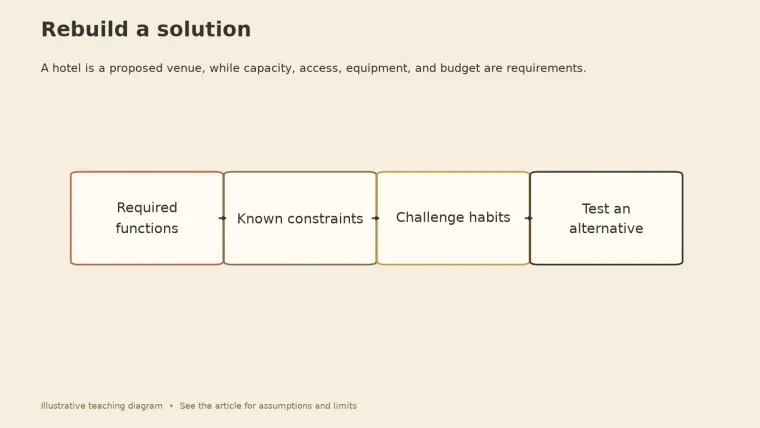
First principles thinking means breaking a problem down to the facts and requirements that must hold, then rebuilding a solution from those rather than from habit. It separates what a job actually needs from the form the job usually takes. McLean asked what moving freight required, and the answer left out most of the dock.
The box: shipping rebuilt from its requirements
According to the Richmond Fed’s history of containerization, cargo then arrived in bags, barrels, and crates, each handled by gangs of longshoremen. McLean was an outsider to shipping. “A ship to him might as well have been a truck on water.” His first plan was to carry whole truck trailers on ships. He soon realized that wheels, beds, and axles would waste space, while the trailer bodies alone could be stacked.
The core idea was to handle cargo twice and only twice: once at the shipper, once at the destination, with the box never opened in between. That cut labor, damage, and theft, which also lowered insurance.
| Convention in 1956 | Requirement underneath | McLean’s rebuild |
|---|---|---|
| Goods loaded piece by piece in bags, barrels, crates | Goods must arrive intact | Seal them in a box at the shipper |
| Trailers travel on wheels | Only the cargo needs to cross the water | Lift the box off its chassis and stack it |
| Cargo handled at every dock | Each handling adds cost, damage, and theft | Handle it twice: origin and destination |
| Ships built for loose cargo | Port time and deck space cost money | Convert ships to carry stacked boxes |
The cost numbers came from McLean’s own experts, as reported by historian Marc Levinson in The Box. They describe loading cost, not the full cost of building a container system.
Habits look like facts until someone asks what they’re for
Break-bulk loading was not stupid. It reflected the ships, ports, and labor that existed. Few people would have called piece-by-piece handling a rule. It was simply how loading worked, which is what makes a habit hard to see.
The first-principles move was a question about function: what does a shipper need? Goods moved from one place to another, intact and cheaply. Everything else was a means, open to replacement.
The rebuild was also slow and expensive. Containers were only 8 percent of freight at the Port of New York in 1962, and McLean’s company, Sea-Land, lost $8 million from 1957 through 1960. A sound first principle still needed cranes, ports, standards, and customers. That gap is why the method ends with a test.
The same audit on a small decision
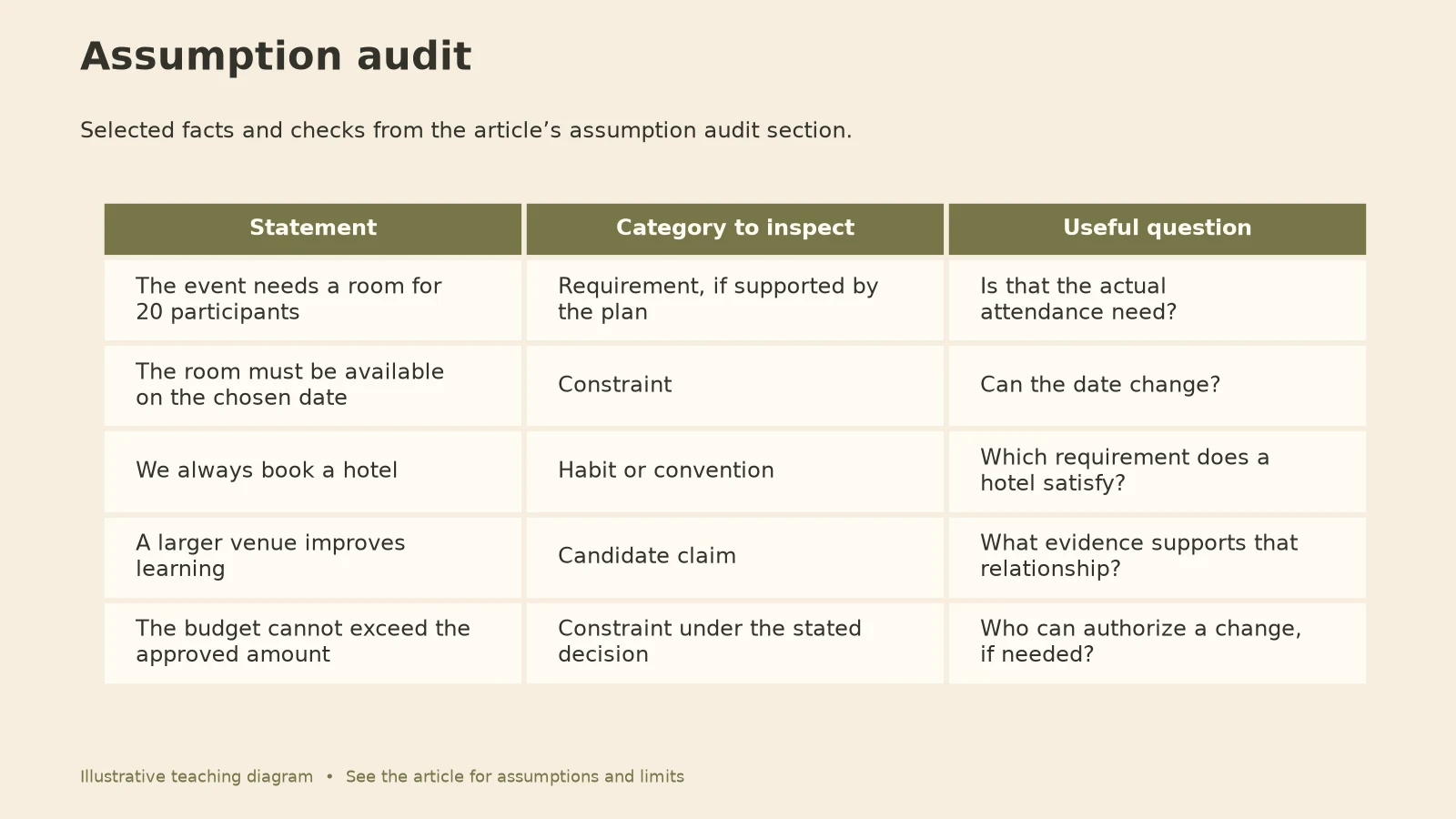
The method scales down. Say a team plans a half-day workshop for 20 people and assumes it needs a hotel. Sorting each statement by type shows where the habit is:
| Statement | Category to inspect | Useful question |
|---|---|---|
| The event needs a room for 20 participants | Requirement, if supported by the plan | Is that the actual attendance need? |
| The room must be available on the chosen date | Constraint | Can the date change? |
| We always book a hotel | Habit or convention | Which requirement does a hotel satisfy? |
| A larger venue improves learning | Candidate claim | What evidence supports that relationship? |
| The budget cannot exceed the approved amount | Constraint under the stated decision | Who can authorize a change, if needed? |
Break the need into functions, such as space, seating, access, a display, low noise, and availability, and “hotel” becomes one option among several. Calling a statement a habit does not make it wrong. It means the statement has to justify itself.
How to rebuild from first principles
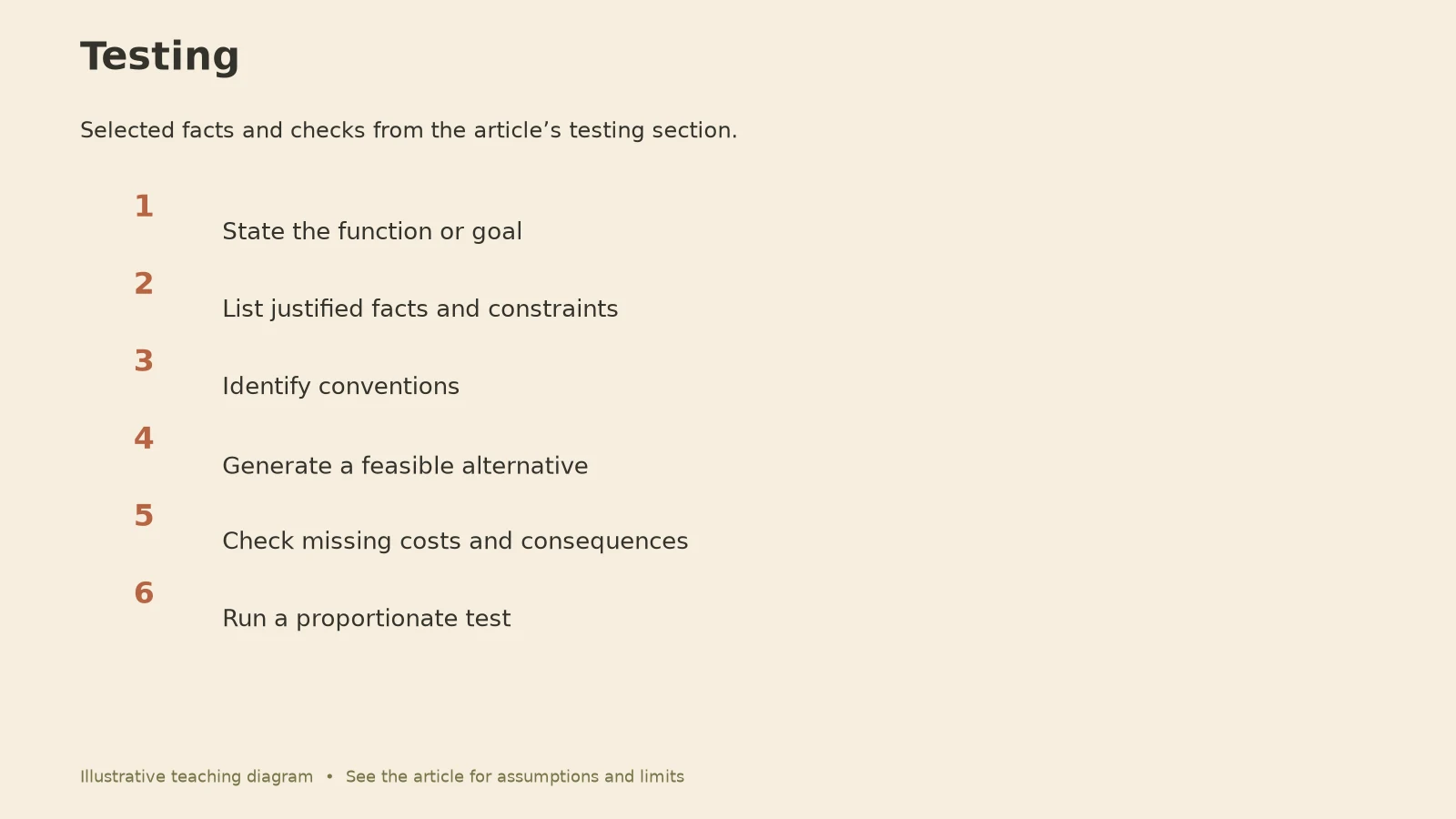
- State the function or goal. What must the arrangement enable? For McLean: goods delivered intact, cheaply.
- List justified facts and constraints. Record the evidence and whether each constraint can change.
- Identify conventions. Ask which requirement each one serves. The wheels served the road; at sea they only took up space.
- Generate a feasible alternative. Build around the required functions instead of the familiar form.
- Check missing costs and consequences. Include setup, coordination, equipment, and the people whose work changes.
- Run a proportionate test. The Ideal-X was one converted tanker on one route, not a new fleet.
If the test fails, revise the premises. A failure often exposes a requirement you missed. The inversion mental model is a quick way to look for one before you start.
When first principles thinking backfires
A belief gets promoted to a principle. “Customers only care about price” sounds foundational and may be untested. The Foundation for Critical Thinking stresses examining evidence and assumptions; apply that to your premises first. The critical-thinking guide has a checklist.
Hard-won conventions get thrown out. A standard practice may encode lessons about safety, failure, or coordination. Ask why it exists before replacing it.
The system gets ignored. A better idea still needs the people, equipment, and rules around it. Containers took years to spread.
The story gets simplified. Retellings of famous innovations drop the losses and the prior work. Keep the costs in your own version.
Questions
Is first-principles thinking the same as ignoring experience?
No. Experience supplies evidence. The method asks which parts of it are justified and which are conventions the current goal does not need. The idea itself is old: Stanford’s account of Aristotle’s logic discusses foundational premises and what follows from them.
Must the basic premises be absolutely certain?
Practical decisions rarely reach that standard. Record your confidence, separate constraints from assumptions, and test the parts that would change the action.
What is the most common mistake?
Calling a preferred belief a first principle and building on it without checking. The premises need scrutiny first.
Your 5-minute rebuild
What I'm trying to achieve (function, not form):
How it's usually done:
Which parts are required? Which are habit?
For each habit: what requirement does it serve?
One alternative built only from the requirements:
Hidden costs or people affected:
Smallest test I can run this week:
Take one routine you follow at work and run it through Daily Read as today’s five-minute exercise. For comparing the alternatives it produces, see decision-making frameworks and opportunity cost.